
Ash Runners
Episode 5 | 52m 54sVideo has Closed Captions
Learn how animals on New-Britain have learned to live with the Earth’s moods.
On the volcanic island of New-Britain off the coast of Papua New Guinea, a handful of animals have learned to live with the Earth’s moods. When ash from a volcanic eruption invades their habitat, the choice is simple: leave or stay and adapt. In truth, it’s not that easy, since volcanoes and their actions are unpredictable and each creature responds in its own way.
Problems playing video? | Closed Captioning Feedback
Problems playing video? | Closed Captioning Feedback
Ash Runners
Episode 5 | 52m 54sVideo has Closed Captions
On the volcanic island of New-Britain off the coast of Papua New Guinea, a handful of animals have learned to live with the Earth’s moods. When ash from a volcanic eruption invades their habitat, the choice is simple: leave or stay and adapt. In truth, it’s not that easy, since volcanoes and their actions are unpredictable and each creature responds in its own way.
Problems playing video? | Closed Captioning Feedback
Where to Watch Life on Fire
Life on Fire is available to stream on pbs.org and the PBS app.
Buy Now
Providing Support for PBS.org
Learn Moreabout PBS online sponsorshipOn a remote island of Papua New Guinea, volcanic eruptions have become part of everyday life.
What do animals do when ash invades their habitat?
Coming up, we discover how different species have learnt to cope with such extreme conditions.
PEOPLE OF THE VOLCANOES (narrator) Burning ash snuffs out life.
Little stirs so close to an erupting volcano.
The surviving animals have a choice.
Stay and fight or flee the wrath.
Yet amazingly some creatures are actually attracted to the disaster zone.
Soon there's a new cast of characters running the gauntlet of the ash.
ASH RUNNERS (narrator) This giant butterfly lives in a land of active volcanoes.
Every time one blows, it's forced to abandon its forest home and head off into the unknown.
The volcano which destroyed its birthplace lies in Papua New Guinea, on an island known as New Britain.
Here the harbor town of Rabaul nestles inside a vast caldera, a large gaping central mouth, with several smaller volcanoes around its edge.
When a volcano is dormant, dense tropical forest thrives on the richly fertilized beds of ash.
And fruit bats make themselves at home, resting upside down, unperturbed by the strange noises, as if they've heard it all before.
(rumbling) It was towards the end of the last century that this caldera first began to give clear warning signs.
For years Rabaul's dragon grumbled and hissed, suggesting that the pressure in the chamber was building up and the volcano about to explode.
Acidic gases began to burn the trees, as they are here at Karkar, another volcano within the same chain.
Tremors shook the ground daily.
And incredibly the land near Rabaul harbor rose over three feet.
Despite all these signs of the monster within, some people were reluctant to leave.
Then early one morning in 1994, it finally exploded.
Luckily most people got away just in time.
But this was only the start of its longest eruption in living memory.
For still today Rabaul's dragon does not sleep.
It might nap for a few months, but then it blows again, raining ash down on the few stoic inhabitants still determined to live in the shadow of the volcano.
Each time the wind blows burning ash to a new area of forest, the story repeats itself as the residents are forced to choose: either flee or face the consequences.
Like the people before them, these fruit bats seem reluctant to leave.
But at night it's easier to see why local people named this crater Tavurvur, the Hornets' Nest.
Stinging ash coats the fruit like a dusting of pepper and the hungry bats have little choice but to eat it.
They'll be lucky to get away with just a serious stomach ache.
For the reluctant bats, this is one scare too many and like so many before them, they leave in a mass exodus.
Come morning, the Hornets' Nest is extremely angry.
Clouds of fresh ash absorb water and fall as thick, choking, black rain.
It coats the plants in a cement-like layer, which the sun's rays will never penetrate.
No sunlight.
No chance to grow.
When water mixes with sulfur, it turns into burning sulfuric acid.
Yet another poison in the volcano's deadly cocktail.
In this inhospitable landscape, four extraordinary creatures fight to bring young into this strange new world.
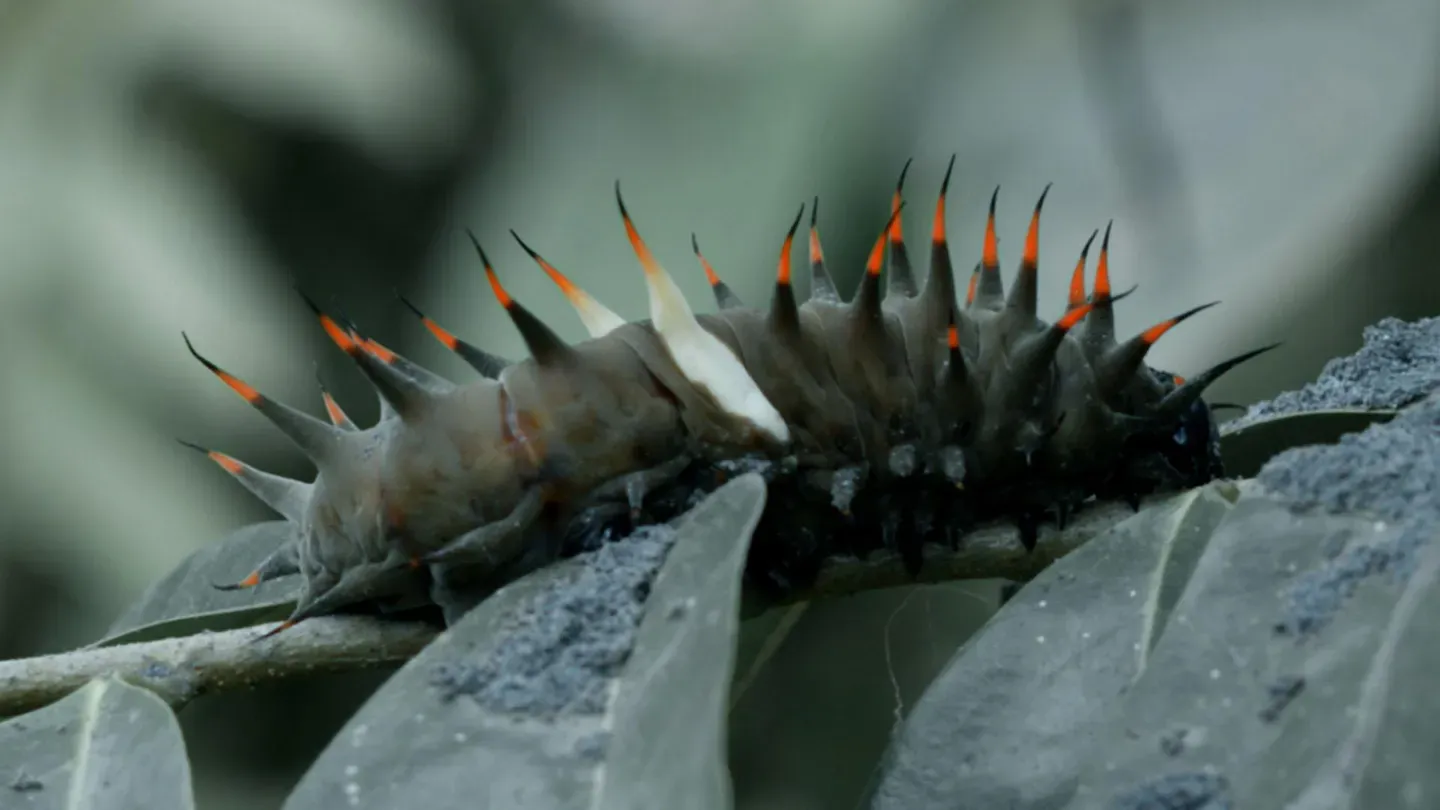
The plant it feeds on may be dying but this birdwing caterpillar is going to keep on munching while it can.
Protected by its shell, the hermit crab survived and now it must take advantage of the new opportunities.
Casualties are easier to spot on the scorched earth and the Brahminy kite moves in.
As it scours the devastation for fresh pickings, it flies dangerously close to the volatile Hornets' Nest.
And in one of the stranger twists of natural selection, somewhere on these islands is a creature which actually uses volcanoes to give life.
For this strange, prehistoric-like bird, the megapode, the roar of the volcano is like a call to commune with the ashes.
It's searching for the perfect nursery for its young.
For these unusual birds actually use the heat from the ash to provide a natural incubator for their eggs.
They have to be choosy for the temperature needs to stay around body heat.
They check it, not with their large feet for which they're named megapode, but with a gland in their throat.
Competition is frantic.
Any bird which waited for the bombardment to subside risks finding the best spots taken.
In the danger zone, giant eggs are laid quickly in burrows deep in the warm ash.
And if digging, even with oversize feet, seems too much like hard work, there's another strategy.
Try removing the sitting tenant.
That's bad luck.
This hen needs to get a move on, and not just because of the lava bombs.
Warm ash fields are scarce.
Over the next days and weeks more and more hens will flock to this natural hearth.
Surprisingly, less than a mile away, it's just another day and a family of spinner dolphins is playing.
Bathed by fresh ocean currents and buffered from shock waves, they're protected from the destructive force.
But on land nothing can be taken for granted.
A shift in the wind whips the light ash into dust devils... ..or drifts and dunes, which smother more plants.
Against the odds, at least one birdwing caterpillar has survived and now at last it can stop eating.
It's ready to use its natural armor against the dragon and begins to weave with silk.
It builds a chrysalis, which when dry, will protect it from extreme heat.
Sheltered from Tavurvur's rage, slowly, over several days, the ungainly caterpillar transforms into a beautiful birdwing butterfly.
From her yellow wings, she's a female.
Right now she's at her most vulnerable.
She needs another day free from ash and rain while her wings harden and her complex eyes learn to focus.
A birdwing can see many more frames per second than we can, as if moving objects are in slow motion.
And every detail so much sharper.
Ants move in to clean up the remains of the chrysalis.
Having no eyelids, butterflies clean their eyes with their legs.
Some hapless ants land in even more trouble.
The hidden gravedigger survives each eruption undercover, then gets to work quickly, building pitfall traps to catch the unwary.
The aptly named antlion makes good use of the ash.
The firmer soil allows it to dig steeper, more slippery traps.
One unusually lucky escape.
A day has passed since the birdwing emerged and the volatile Hornets' Nest is furious again.
A butterfly needs sunlight to see and plants to feed on.
But as the ash clouds rise high into the sky, they blot out the sun, masking the high-frequency ultraviolet light which butterflies use to see colors.
She has less than two months to find a mate and start a new generation, yet still she's struggling to focus.
She can't even see her favorite food flowers, despite her super-sight.
She's effectively blind.
The birdwing should escape while she's still young.
Disorientated and hungry, she heads upwards, seeking the ultraviolet light.
But although her wings are as large as a blackbird's, they lack bone structure and are not as strong.
The delicate birdwing is at the mercy of the prevailing winds.
She can only fly with the wind or against it.
To escape the plume of ash and to reach the light on the other side, she must fly directly towards the Hornets' nest.
All around the bay, the windblown ash continues to wreak havoc.
The local opportunists are ready to take advantage of the chaos.
Hermit crabs patrol the shoreline, using their antennae to find the free offerings thrown up by land or sea.
This female needs to feast well.
For in the next phase of the moon, when the tide is at its lowest, and has pulled right back from the mangrove swamps, it will be time to lay her eggs.
She must leave the relative sanctuary of the shoreline and cross the dangerous open landscape to reach low tide.
She heads for the coral reef, which has formed over cooled volcanic rock, to give her offspring some shelter.
But the reef is crowded with open mouths as clownfish and sea anemones wait to greet her.
She lays over a thousand eggs and as soon they meet salt water, tiny larvae hatch.
Having given them the best chance, she can't help them now.
They're swept away to a life of adventure or death.
And if only ten larvae survive, transform into baby crabs and colonize new islands somewhere in the Pacific Ocean, it won't have been a bad night's work for one mother.
Back at Tavurvur, despite the desolation, the Brahminy kite must also breed.
The male rides the superheated thermals searching for a tree that is still standing with a good all-round view.
This dying fountain tree seems a strange choice.
Surely even for a scavenger, it's far too close to an active volcano for comfort.
(bird calls) The female arrives to check his judgment.
If she doesn't like his choice, she will simply move out.
She appears to have accepted his odd choice of territory.
(squawks) Just one other problem.
A party of singing starlings also fancies the fountain tree.
Starlings will always mob birds of prey, especially if they can gang up on them.
They're protecting their nests, but they're also notorious thieves.
The kite sees them off.
But starlings like to have the last word.
(squawks) With the starlings a constant pest, one kite will need to stay on watch, while the other builds the nest.
They may have won the tree from the pesky starlings, but with volcanic dust blowing directly towards them it could prove a fragile victory.
(squawks) While the kites seem drawn towards the Hornets' Nest, at least one birdwing has made it to the other side of the plume... ..in a bid to escape.
At the mercy of the winds, birdwings can travel more than 100 miles a day, as they seek new forest and islands in an extraordinary odyssey across open sea.
She can only see by daylight.
Before night falls, she must find somewhere safe to land.
By making such incredible journeys, these birdwings have colonized the entire coast of Papua New Guinea, and south as far as Australia.
But the wind is taking this traveler to the tiny island of Manam.
Lying in the path of the trade winds, Manam gathers wanderers from all over the world, including birds of prey, like this osprey.
Luckily, ospreys only eat fish.
With dusk approaching, the birdwing must rest.
Fertilized by ancient ash beds, rich, lush forest covers Manam's slopes.
To her it must seem like butterfly paradise.
By comparison, the land around Rabaul seems like the outer reaches of hell.
Sometimes the volcano is deceptively quiet, as cooled magma plugs the crater.
But pressure builds up again, ready to burst.
In a serious bad mood, Tavurvur can chuck out several tons of ash daily.
This is tough enough for the locals to contend with, but with so much debris flung into the stratosphere, it also influences the weather.
(thunder) A tropical downpour offers some relief, as it washes away encrusted ash.
Heavy rain erodes the light ash soil, opening up new channels to the sea, allowing strange ocean predators to sneak deep inland, close to unsuspecting victims.
Giant mottled eels, up to six feet long.
And ravenous.
If they can get up enough speed underwater, the momentum will carry their open jaws right to the crab.
This hermit sidles out of reach.
Living under regular attack from the volcano, it's got far bigger dangers to contend with.
The megapodes brave the apocalypse to return and lay a second or third egg.
To them the ashen hearth is like hallowed ground.
Even the trees offer little shelter, for some of the bombs raining down are bigger than a truck.
Few other birds take crazy risks like these.
They've learned the hard way to run for their lives.
But sometimes, even for these war-weary birds, the stress is too much.
And they abandon their eggs before they have a chance to bury them.
And, as usual in nature, someone is always ready to take advantage.
She doesn't try to defend her egg against the Pacific monitor lizard.
But if she's not careful, she could become the meal.
(squawks) There's little they could do for their eggs anyway, because, tasting scent particles with his forked tongue, the lizard finds its prey by smell.
Once it has locked on to a scent, it is relentless.
The hens may seem like hopeless parents, but in fact they never defend their eggs.
They take all their risks upfront, dodging bombs, and put all their investment in the egg itself.
That's why these eggs are so huge.
They're made up of 70 percent yolk, over twice as much yolk as a domestic hen's egg, designed to give the chick a good start.
For unlike other birds, megapodes never even sit on their eggs, let alone defend them.
When each egg is laid, the hens will return to the forest to feed up, never seeing their own eggs again.
They rely totally on hot gases from these cauldrons to keep the ashes warm, trusting to fate that their eggs won't become hard-boiled.
When the river levels fall, the volcanic toxins become concentrated, and the water turns lethal, poisoning those who can't escape.
And every time the monster spits, its weapons rain down on more casualties.
With eyes that can register high-speed movement and have a large field of view, a kite can home in on the tiniest corpse, while at the same time dodging flying missiles.
Hundreds of miles across the ocean, life seems much calmer on Manam.
And the birdwings make the most of their short adult life.
The emerald wings belong to a male.
But it's his seductive scent, not his flashy wings, that should make him irresistible to a female.
But first he must charm her, flying close to waft his potent scent all around her.
This female is playing hard to get.
She just wants to be left in peace.
She's already mated and is searching for a safe place to lay her eggs.
Of all the plants in this tropical forest, the female selects only one, the Aristolochia vine.
Its name means "best for childbirth".
Blessed by tropical rain rather than ash, the birdwing caterpillar absorbs poisonous toxins from the vine as it feeds and secretes them onto its spines.
In theory, the poison will deter predators, including one of the largest pigeons in the world.
Crowned pigeons normally eat fruit, so it may not have tasted caterpillar before.
Unfortunately, its beak is vicious, but as the poison begins to work, it's unlikely to try caterpillar again.
Back at Rabaul, the Hornets' Nest looks surprisingly benign.
It changes mood constantly.
When the crater hisses white smoke, it indicates that the pressure inside the chamber has fallen, for this is sea water, evaporating and escaping through the cracks.
The change won't make any difference to the dolphins, but it might just signal that the fiercest eruptions are in the past.
It seems a good day for the first megapode chicks to emerge from their burrows.
Unique amongst birds, they're on their own.
With their mothers long gone, they have to fend entirely for themselves.
But fortified by that huge yolk, they're born to run from flying bombs.
But with no parents to protect them, they're like sitting ducks for the kites.
With so much fresh food on offer, the kites have chosen their nest site well.
This pair seems perfectly suited to life amid the chaos.
Able to switch from scavenging on tiny casualties to hunting down live young, kites are one of the most adaptable birds of prey.
After more than 16 years of eruptions, as the kites hunt down the megapode chicks, the community here has reached a kind of normality, if life can ever be normal around such a moody volcano.
The megapode hens which abandon their eggs to the care of the volcano must also be doing something right, because several thousand birds now come here to lay their eggs each year.
One day, probably sooner than later, the Hornets' Nest will quieten down and the cast of animals will change again.
When it sleeps, its ashes will no longer help feed the kite family.
Some people are slowly returning, and soon tropical forest will cloak the crater slopes, as it already does on the opposite side of the bay.
As one volcano grows tired, another awakes.
In a land of volcanoes, even paradise is ephemeral.
The volcano on Manam has now blown.
Once again a wanderer must head into the wind.
(explosion) Subtitles by Silverway Media
Episode 5 Preview | Ash Runners
Preview: Ep5 | 30s | Learn how animals on New-Britain have learned to live with the Earth’s moods. (30s)
Providing Support for PBS.org
Learn Moreabout PBS online sponsorship New Episode
- Science and Nature

Explore scientific discoveries on television's most acclaimed science documentary series.











Support for PBS provided by: