
Icelandic Volcanoes
Episode 1 | 52m 58sVideo has Closed Captions
Learn which Icelandic volcano may awaken next and what the consequences could be.
The 2010 eruption of Iceland's Eyjafjallajokull volcano provoked economic chaos, paralyzing air traffic for days. This eruption, however, was mild. Much more powerful volcanoes in Iceland are ready to wake up. Through spectacular aerial footage of this country, which is an accumulation of lava and ash, a maze of craters and faults, the episode tries to discern which volcano will awaken next.
Problems playing video? | Closed Captioning Feedback
Problems playing video? | Closed Captioning Feedback
Icelandic Volcanoes
Episode 1 | 52m 58sVideo has Closed Captions
The 2010 eruption of Iceland's Eyjafjallajokull volcano provoked economic chaos, paralyzing air traffic for days. This eruption, however, was mild. Much more powerful volcanoes in Iceland are ready to wake up. Through spectacular aerial footage of this country, which is an accumulation of lava and ash, a maze of craters and faults, the episode tries to discern which volcano will awaken next.
Problems playing video? | Closed Captioning Feedback
Where to Watch Life on Fire
Life on Fire is available to stream on pbs.org and the PBS app.
Buy Now
Providing Support for PBS.org
Learn Moreabout PBS online sponsorshipHow can one small eruption bring the whole of Europe to a standstill?
In 2010, a relatively minor eruption in Iceland caused economic chaos when volcanic ash grounded all aircraft.
Coming up, we find out which major volcano could be next to blow.
Life on Fire is made po PEOPLE OF THE VOLCANOES (narrator) Iceland was created by volcanoes.
Mountains of hot magma rose from the depths of the earth, rivers of molten lava poured down their slopes, solidifying into a jumble of rocks.
Ash rained down creating these fertile plains.
Earthquakes helped twist and crumple the landscape.
Some of the lava fields or high plateaus are so vast, it's easy to forget the volcano that made them.
Other volcanoes lie hidden under vast sheets of ice.
They have become the stuff of myth and legend.
But in geological terms Iceland is very young.
It's still being built.
It's only when an eruption has consequences across the world that the rest of us learn something Icelanders know well.
These volcanoes haven't finished yet.
ICELANDIC VOLCANOES: WHO IS NEXT?
(narrator) On 14th April, 2010, Eyjafjallajokull erupted with an explosion that made Iceland the focus of a media storm.
The ash cloud produced by the volcano spread over the Atlantic Ocean and Europe, cutting off one of the world's busiest airspaces.
Almost every European airport closed and airlines lost more than a billion dollars.
The six-day standstill was disastrous for the economy.
(baby crying) (narrator) Worldwide, the tourist industry lost even more money, and countless small farmers and fishermen struggled to make ends meet, as fish from Uganda, flowers from Kenya and vegetables from Zambia were left to rot.
Sports events and business meetings were cancelled.
Meanwhile around the volcano, the skies were dark and ash fell like rain covering the fields and roads.
(speaks Icelandic) (translator) We may have to stop farming and move somewhere else.
Leave the place where I grew up, my memories.
Nobody really knows what lies in store.
(narrator) A few months later the eruption ended, leaving the last few wisps of water vapor and a thick blanket of ash covering the ice around the crater.
While the rest of the world forgets, now the disruption is over, Icelandic volcanologists are not fooled.
They know there are several larger volcanoes lying in wait.
Eruptions are of course quite dangerous and some of them are really very damaging both to human life, to human health and to structures.
In Eyjafjallajokull we had a relatively small eruption, but in some other volcanoes here in Iceland we expect larger eruptions than that, so we should never forget that.
(narrator) It had an impossible name, but by Icelandic standards it was a small eruption.
The big question is not whether another volcano will bring chaos and disruption to the world, but which one and when.
Iceland's active volcanoes lie along the Mid-Atlantic Ridge.
A long jagged rift in the earth's crust between two great continental plates.
The rift almost divides Iceland in half.
To the east lies Europe and Asia.
To the west, the Americas.
As the plates drift apart, the cracks widen and lava from deep in the earth escapes.
With one of the highest densities of active volcanoes in the world, Iceland is a magnet for volcanologists.
For decades, scientists have had this turbulent land under continual surveillance.
And Iceland has become a giant laboratory.
The huge fallout from Eyjafjallajokull has increased the pressure on the scientists to provide answers.
Pall Einarsson has spent the last 40 years studying earthquakes and volcanoes.
He trained most of Iceland's geologists and is still trying to understand how this volatile land was created and how it could change.
(Pall) One of the problems of doing volcanology in Iceland is that we don't only have one active volcano or two active volcanoes.
We have about 30 active volcanoes all along the rift.
Some volcanoes we don't really know very much about, because many of them are really very complicated beasts and it takes really a lot of measurements to understand what they are doing, and how they do things.
Some volcanoes are simple and easy to understand.
One thing that we know about our volcanoes is that they're all different.
They're all different from each other.
We can rarely apply our ideas about one volcano to the next volcano.
So we have to measure them all.
It's as simple as that.
So we have to spread out our observations.
We have to make observations all around the country and that requires a lot of work.
(narrator) Science has come a long way since Jules Verne's professor tried to journey to the center of the earth through an Icelandic volcano.
But the challenge is still to work out what is going on deep below from the few signs on the surface.
(Pall) Most of our volcanoes are doing nothing.
They're just sitting there, recuperating after the last eruption or something.
But most of them are very quiet and not doing anything.
Some of them are preparing for the next eruption, but they are all possible candidates for the next eruption.
(narrator) While any one of the 30 or more active volcanoes could erupt, there are four extremely dangerous candidates.
Legend has it that Hekla is the gate to hell.
She keeps her secrets well hidden, and then erupts suddenly and dramatically every ten years or so.
Askja is a beautiful but deadly giant.
Sleeping quietly, high in the mountains, few people knew she existed until she exploded with shocking consequences over a century ago.
Hiding under the ice, Katla is the most fickle.
She has demonstrated her power more than 20 times since people first came to Iceland and now she's overdue.
And finally, at the summit of this icy land, Grimsvotn is so remote that it was left in peace for the trolls and dwarves until scientists came calling.
(helicopter starts up) Bjorn Oddsson specializes in volcanoes which erupt under the ice.
Grimsvotn lies under Europe's largest glacier.
The relentless wind and bitter cold make it difficult to work up here.
But scientists can at least take advantage of the long summer daylight hours to get to know the volcano better.
Not easy, when it's hidden under a vast featureless ice field, which in some places is 2,000 feet deep.
The ice is so thick that eruptions can take place beneath it without anyone but the scientists being aware.
These cliffs are the walls of the crater poking through the ice, the only visible part of the volcano.
Below this jumble of ice and rocks lies not only the rift in the earth's crust but the hotspot or upwelling of molten rock which helped create Iceland.
At this point the hot magma from deep within the earth pushes directly upwards towards the thin crust or ice at the surface.
Bjorn and his companion are literally standing on top of a giant ice-covered cauldron.
(Bjorn) We are in the Grimsvotn caldera, in the center of Grimsvotn caldera, which is based on top of the hotspot, the underlying hotspot of Iceland.
And the hotspot is coming from the mantle.
It's magma from the mantle which is rising straight up, up to the crust of the ground and causing high volcanism at this area.
It's like in Hawaii and the Azores islands, a magma plume rising from the mantle.
We can talk about double activity because it's between two continents of the mid-Atlantic Ocean.
So we have magma coming up while the continents are spreading and also due to the hotspot.
And that might be the one reason for Grimsvotn being the most active volcano of Iceland, having 70 confirmed eruptions since settlement in 874.
This is a high-heat geothermal area, and under the ice we have spots of geothermal, causing the ice to melt and so we see the cauldron on the surface of the glaciers.
And the more heat we have, the deeper the cauldron is.
So we monitor every year.
We monitor these cauldrons by GPS measurements and radar to see if they are growing deeper or not.
(narrator) The rising magma melts the ice from below forming huge lakes of water under the glacier.
The ice sits on top, like a cap or a bottle top, holding in the water.
When the volcano is ready to erupt, the rising heat causes even more water to melt and sometimes the force of water shifts the cap suddenly, leading to dangerous flooding.
(Bjorn) Because it's in the center of the caldera, it's difficult to reach the outer world, so we have to come here twice a year and download the data from the station.
Now measurements are showing that the pressure, the underlying pressure in the magma chamber, is close to what we had at the last eruption, so we could expect it anytime.
The last eruptions?
In 1983, it was under the cliff over there.
The year 2000 we had an eruption under the cliff more to the right, and in 2004 in the corner over there.
And the eruption sites have been moving more to the west for the last eruptions.
So I would expect the next eruption to happen to the north-western corner of the caldera.
But like I say, when you find a rule in nature, it changes.
(narrator) So Grimsvotn is as unpredictable as the next volcano.
But these fresh carpets of ash and deep, overflowing cauldrons signify to many volcanologists that this remote giant could be the next to blow.
As well as flooding, because Iceland's volcanoes lie under sheets of ice, they are particularly dangerous to aircraft.
When hot lava hits the solid, cold sheet of ice, the lava smashes into thousands of tiny shards, which are carried with the plume of water vapor high into the air.
The dagger-like shards, smaller than grains of sand, may travel with the wind into the path of aircraft.
But ironically, because Grimsvotn erupts frequently, it is less powerful than other volcanoes.
Every time it erupts, some pressure and water is released, causing disruptive local flooding rather than a cataclysmic explosion.
So this colossus sitting over Iceland's hotspot is not its most dangerous volcano.
Far more menacing are those sleeping beauties which give even less away.
High in the central plateau of Iceland, scientists also move in on Askja once the snows have melted.
Over the centuries, Askja has emptied its magma chamber several times.
Now it sits in the center of a vast lava field, a desert-like jumble of boulders and rubble of its own creation.
Askja has been dormant for the last 50 years, but now it too is showing signs of stirring.
(Pall) We have here something that imitates a magma chamber of a volcano to demonstrate how a volcanic eruption may occur.
We have here a fluid, in this case water.
It could be magma.
And it has gas dissolved in it and that's a critical part of this, because then the gas may get out of the fluid and start an eruption.
So we just give it a little shake.
You can try this at home.
So here we have the mixture of gas and fluid and then suddenly when the pressure drops...
So, this is an erupting magma chamber.
(narrator) And after the chamber empties, it slowly fills up again.
Askja's chamber last emptied in 1961 when a huge crack opened, allowing a spectacular flow of lava to escape.
But in 1875, an even more powerful eruption came out of nowhere, creating curtains of ash and pumice stones which poisoned the land and killed livestock, forcing many Icelanders to flee the country.
Hazel Rymer is an English volcanologist who returns to Askja every summer.
She's trying to work out where the magma is in its cycle to gain some clues as to when it will erupt again.
(Hazel) These are gravity meters.
They measure very tiny changes in the acceleration of gravity.
The force of gravity depends on the distance to the center of the earth.
These instruments are so sensitive, if I made a measurement here or down here where the ground is a little bit lower, just a centimeter less, I can measure the difference.
That's how sensitive this is.
Here I would be a bit closer to the center of the earth, so gravity is stronger, a little bit higher.
So, what we're finding there is how gravity varies across the volcano and what I'm interested in is how it varies through time.
So I do this every year.
I make several measurements at each of these points and I see how it changes.
(narrator) The ground here is a bit like the burnt crust of a soufflé.
It rises, but once out of the oven, once the eruption is over, it deflates and cracks as it cools.
The volcano has been deflating quite rapidly since the 1961 eruption at about six centimeters a year in the center.
But that rate of deflation is slowing down.
It's now only two or three centimeters' per year deflation.
So... it may be that the rate of deflation is very rapid, but it slows down prior to coming back up again.
It may well be that this big deflation that we're seeing of the volcano is a long-term elastic response to the huge amount of lava that came out in 1961.
All of this came out and so the volcano will take some time to relax from that eruption.
It may be that that's what this long-term deflation was all about and the slowing-down that we see now is a combination...
Partly that it's a long time since this eruption and so it would stop sinking anyway, and perhaps partly because we have a new intrusion of new magma at some depth.
What we think is going on, as I say, is that magma is beginning to accumulate beneath Askja again.
(narrator) So under this burnt crust, Askja's enormous magma chamber may be filling up again ready for its next eruption.
The crucial question is, what kind of eruption?
Erik Sturkell is a Swedish geologist whose work complements Hazel's.
By studying the changes in the height of the earth's surface, he's trying to work out whether Askja's next eruption will be a lava flow, like that of '61, or a more terrifying explosive eruption, as occurred 150 years ago.
(speaks Swedish) First we had rain to trouble us.
Now the sun gives a lot of reflections.
So you can never be that pleased.
It's hard, but I think I prefer to suffer in the sun than in the rain.
So this is a lava flow that came in '61.
After about five years, it had stopped contracting and it was cooling down.
And right here it's rather thin.
(man speaks Swedish) And we are leveling to see if there are any changes in the magma chamber.
We can... As we have a line from the center and outwards, so you can see if it is going up or going down.
And the magma chamber, if the magma comes in, it behaves as a balloon.
It expands, lifts up and goes out to the side.
This volcano will be active again.
(narrator) Because the chamber is only just starting to fill, it's too early for Erik to be certain which kind of eruption it'll be.
But he knows the damage this volcano can do.
Well, the same magnitude as 1875, that's bad.
What happened in 1875, this eruption took place here in the spring.
And in Stockholm and Helsingfors, they could see a fine-grain gray ash, People were walking with black coats, they got some gray dust on it.
And they had no idea what caused that.
Something was coming down but they had no explanation.
It took three weeks until the first ship arrived from Iceland and there was news that another eruption had taken place here.
So that kind of eruption, that will disrupt air traffic, will destroy farms, and so on.
That is a major eruption, a major explosive eruption.
(narrator) The eruption of 1875 came out of the blue.
The magma chamber emptied so suddenly that the ground collapsed and dropped over 600 feet, creating this giant new lake.
The first scientists who came searching for the volcano which caused so much damage disappeared without trace.
Perhaps they were lured too close to one of the many beautiful lakes.
Carbon dioxide, rising off the surface, can cause people to pass out and drown.
These rocks paint pictures of the past.
They wait like pieces of a puzzle to be picked over and solved by geologists.
But the more important question is when will Askja erupt again?
The best guess is it may take another 20 or 50 years to erupt but no one is certain.
The trouble is a volcano has no respect for human timescales.
(Hazel) A volcano lives for tens of thousands of years or longer.
A lot of things happen in that period of time.
To understand how a volcano works, you need to make measurements for as long as possible.
A human lifetime is nothing to the lifespan of a volcano.
And so we are here for a few decades and we have some snapshot picture of what is happening for this small period in the history of the volcano.
We really have no idea about the large, long-term evolution of the volcano.
But we're getting some idea now that...
I've been doing these measurements for 25 years.
Icelandic colleagues have been here much longer than that.
But this volcano was here a long, long, long time before that.
(narrator) And since Eyjafjallajokull erupted, it's not only those on the ground who need answers.
(Pall) A very important aspect of warnings of eruptions is the danger to overflying aircraft.
It's a bit of a worry that some of the busiest air routes across the Atlantic go straight above the Icelandic volcanoes.
We have been talking about this for a long time, but finally now Eyjafjallajokull has demonstrated that this is a real threat and has to be taken seriously.
(narrator) Even when the sky looks crystal clear, because volcanic shards are as tiny as dust, they can get sucked inside jet engines, where they could melt, clump together and block the airflow.
It's in the 50 years since Askja last exploded that aircraft traffic has grown so fast.
Now, every second, a commercial plane takes off somewhere in the world.
Every day, 80,000 flights carry passengers across the skies.
While Askja may give us 20 or more years to prepare, Hekla lies directly under the international flyways and is ready to erupt much sooner.
(Pall) Working in the area of Hekla, you can see, almost every 10 minutes there is a big passenger plane crossing right across the summit of Hekla.
And Hekla is ready for an eruption.
There was a very close incident in 1980.
A plane flew right above the summit of Hekla just half a minute before the eruption broke out.
So in that eruption, a plane was almost shot down by the volcano.
I seriously think that the pilot of that plane still doesn't know about this because pilots usually look forward, they don't look back.
The plume cut the trail of his plane just behind the plane.
I observed this myself in the field working around Hekla.
(narrator) In Icelandic, hekla means hooded cloak, a reference to the cloud that often casts its shadow over the mountain.
As soon as the snow melts, scientists move in to monitor the third of the four high-risk volcanoes expected to erupt in the near future.
To many Icelanders, all volcanoes are female.
Sometimes called the angry sister, Hekla, like Askja, is unpredictable, capable of belching out clouds of ash into the sky or spewing rivers of hot lava down her slopes.
Hekla is ready to erupt again.
But the big problem is that her magma chamber is too deep even for modern instruments to reach and so she gives little warning.
In some ways Hekla really is the gateway to the center of the earth and she still hides her mysteries even from scientists.
Hekla is a fascinating volcano for geologists like Bjorn because she erupts so often.
More lava has been thrown out by Hekla than by almost any other volcano in the world.
(Bjorn) We have Hekla, and all around us are lava fields from different eruptions.
Last century, it erupted in 1947, '70, '81, '91 and the year 2000.
You can see the difference in the moss on the lava which shows us the different ages of the lava field.
The most black one is the latest one from the year 2000.
The rule is that it has erupted every ten years.
And it's ten years since it erupted last time, so we are expecting Hekla to erupt in the close future.
The magma chamber lies very deep, at over 50 kilometers depth, so there are practically no earthquakes giving us information that it's going to erupt.
So the longest time we have in rehearsal is like 30 minutes before it goes off.
This is the entrance to hell.
The Danish king was always sending people out to Iceland to write reports on Icelanders and how they lived and usually in these reports, creatures lived in Hekla and there was a big lake around it spewing fire all year round.
So people were really afraid of Hekla.
(narrator) There's another saying about Hekla.
The longer she goes between eruptions, the angrier she is.
This correlates with the science.
The higher the buildup of pressure without any release, the more serious the explosion.
So paradoxically for the locals, it may be better if a volcano like Hekla erupts sooner rather than later.
And for those who fly, the good news is that since the crisis caused by Eyjafjallajokull more centers have been set up to warn of ash clouds and avoid another total paralysis of air traffic.
(air-traffic controller) X-ray, runway seven... (narrator) For Iceland, Eyjafjallajokull was a relatively small eruption.
A larger explosion, longer and more powerful, could cost the world more than a few million dollars.
All around them, Icelanders find reminders of just how catastrophic eruptions can be.
Icelanders grow up with the story of Laki and the scars it left on their history and landscape.
Even though these giant lava boulders solidified over 200 years ago.
Rivers of lava continued to flow for weeks covering an area half the size of Greater London.
The ground opened up and gave birth to a chain of 130 craters, stretching across the heart of the island.
These craters belched for eight months and clouds of poisonous gas and ash drifted across the countryside, suffocating most of Iceland's sheep, cattle and horses.
The long, slow famine which followed killed over 20 percent of Iceland's people.
A gaping rift over 30 kilometers long appeared.
It must have seemed as though the island was splitting in two, revealing its molten heart.
Long before the invention of the airplane, the aftermath was felt across continents.
The deadly cocktail of gases and ash was carried way up into the atmosphere and across to mainland Europe and beyond.
The extra energy created havoc with the weather patterns and acid fog spread slowly over Norway to Germany, then France and Britain, eventually, indirectly, killing over a million people.
Ash blocked the light and heat energy from the sun.
The skies stayed dark and for several years the seasons were disrupted.
In France, unusually cold summers were followed by freezing winters.
Violent storms and hail destroyed the crops.
The year was 1789.
The French Revolution is sometimes blamed on Laki.
(guillotine falls) (head thuds on wooden platform) To put this in context, no one died as a direct result of Eyjafjallajokull, though local people are still dealing with the fallout.
Despite the trouble she caused, despite the dramatic pictures and the massive media coverage, this is the kind of eruption Icelanders face every few years or so.
And although for a short time local farmers had to live under clouds of ash, like their ancestors before them, they're learning that volcanoes are bountiful as well as destructive, that they give as well as take.
A few months on, and the volcano is dormant again.
The landscape around it has been completely transformed.
(man speaks Icelandic) (translator) My great-grandfather saw Katla erupt in 1918 and my grandfather saw the eruption of Hekla in 1947.
He had just taken over the farm, like me today.
This is my first year.
And I'm dealing with the problem of ash.
(man continues in Icelandic) When the eruption started we had to abandon the house.
We returned the next day and everything was black and covered with ash.
(speaks Icelandic) It was a shock to see the land totally black, after one night.
We started thinking about the future, about the months and years ahead.
But we decided to take it one day at a time, and not to make any big decisions and to wait and see if it was going to stop.
And one day after six weeks, it stopped.
So we waited to see if the grass would grow.
And the grass managed to grow through the ash.
We've already cut the pasture twice and soon we'll cut it a third time.
(man continues in Icelandic) The eruption happened at the best possible moment, just before the crop started to grow.
In fact, the timing was perfect.
We think the ash had an insulating effect and kept the ground warm so the crop grew quicker.
And we didn't need to use as much fertilizer.
In the long term I think it's good that ash is mixed with the soil and future harvests should be better.
(man continues in Icelandic) Now everyone is worrying about Katla.
If Katla erupts, everything could turn black again.
But today I'm not afraid of Katla.
I've seen an eruption in my garden, seven kilometers from my bed.
So, no, I'm not afraid of Katla.
(narrator) One brave farmer may not be too worried about Katla, but for most people she is the big one.
Known as Hekla's angry big sister, she too lies hidden beneath the ice.
But she's much larger than Eyjafjallajokull.
Her magma chamber is deeper, her glacier even thicker, and her past far more terrifying.
These petrified rivers of ash are witness to the violence of her previous eruptions.
Eyjafjallajokull is her nearest neighbor.
Katla is likely to blow with the same kind of explosive eruption, the kind that sends ash clouds high into the skies.
In the Meteorological Office in Reykjavik, Emmanuel Pagneux also specializes in volcanoes which erupt under ice.
(Emmanuel speaks French) (translator) The last eruption of Katla was in 1918 and the plume of ash rose up 12 miles in altitude.
Maybe 20.
We're not sure because at the time, we didn't have the instruments that we have nowadays.
But this type of eruption can have an impact on the climate because the ash cloud can go into the stratosphere, which wasn't the case with Eyjafjallajokull.
So airborne particles could circulate for several years in the high atmosphere, interfering with solar rays and perhaps causing temporary cooling of the climate.
(narrator) Scientists working on Katla have found nothing to suggest that she will erupt imminently.
Once again it could be days, months or even years.
But unlike Askja, Katla's magma chamber is fully loaded, so she's primed and ready.
Luckily she's likely to give more warning than Hekla.
Not a lot, but perhaps a few days.
The warning is critical, because while ash which explodes into the atmosphere could disrupt flights and commerce, Katla directly threatens the people who live at the foot of the glacier.
For thousands of years, water from the melting ice has carried ash and volcanic rock into the valleys.
It is these glacial rivers, loaded with volcanic matter, that over time have helped build and change the landscape, making Iceland what it is today.
But during eruptions, these rivers can become tidal waves, swamping and destroying everything and everyone in their path.
(Emmanuel speaks French) (translator) Each time there's an eruption under the ice, a large amount of ice melts and causes huge waves of floodwater, made up of a mixture of water, mud and ice.
During the eruption of Eyjafjallajokull, even though there was a good deal of floodwater, it was nothing compared with what we are likely to have if Katla erupts.
This is a much more dangerous volcano.
The floodwater generated by Katla, according to our calculations, could have a height of between 20 to 30 feet, and near the glacier it could be hundreds of feet.
It's something that we're very aware of in Iceland.
We know that this region is particularly exposed to the risks of volcanoes, direct and indirect.
But it's not enough to make people leave their farms.
They've always lived there, from generation to generation.
They're farmers, people who are very attached to their land.
(horses neigh) (man speaks Icelandic) (translator) I live here, but I don't think about it too much.
I know that the volcano is there and of course I look at it from time to time.
I know Katla is there.
That doesn't stop me going where I want, when I want, and living without thinking about it.
Katla is in her place and she will wake up when she's ready.
It's terrible to think about the vegetation we've planted on the sandy desert.
Imagine all that turning black again.
It would be really tough.
I know this land really well.
Imagine the destruction that will be caused by the floods on this green landscape.
It's just not a good thing.
But it's probably less dangerous to live here near Katla than in the streets of Reykjavik.
(Pall) We live in a volcanic country.
We have to learn to live with our volcanoes.
There is no other option.
So we have to study them, we have to know what they are up to.
We'd better do that.
I mean...
They are here and we are here.
We are going to make the most of it.
There are benefits.
We get hot water from the ground as a result of the volcanism, which is really like our oil.
This is an energy source that we utilize quite heavily.
We should also not forget that if there were no volcanoes, there would be no Iceland.
Iceland is made of volcanoes.
But in Iceland geology is visible to everybody.
You can see things happening before your eyes.
You have earthquakes once in a while to wake you up and shake you up a little bit.
Volcanoes are erupting here every two, three, four years or so.
And they arouse tremendous interest with the people.
So people really regard this as the most popular entertainment they can think of.
So if there is a small eruption, people go there in big numbers to observe and be impressed.
It's a very impressive thing to experience, to see an eruption.
(narrator) So while scientists do all they can to warn the rest of the world, ordinary Icelanders do the only thing they can.
They respect their volcanoes, but they refuse to let them rule their lives.
They live in a land made of volcanoes, spectacular volcanoes, among the best in the world.
They might as well celebrate them.
(man) There's an interesting story.
Where did you fin Subtitles by Silverway Media
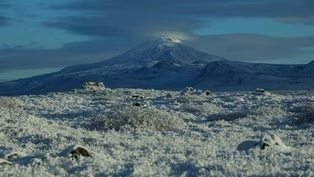
Episode 1 Preview | Icelandic Volcanoes
Preview: Ep1 | 30s | Learn which Icelandic volcano may awaken next and what the consequences could be. (30s)
Providing Support for PBS.org
Learn Moreabout PBS online sponsorship New Episode
- Science and Nature

Explore scientific discoveries on television's most acclaimed science documentary series.





 New Season



 New Season

Support for PBS provided by: