
Phoenix Temple
Episode 4 | 52m 55sVideo has Closed Captions
Witness nature’s struggles to conquer ash and lava before a volcano's next eruption.
Around the Masaya Volcano in Nicaragua, life has struggled for thousands of years to re-emerge from the ashes. Underground, vampire and other bat species have colonized the miles of tunnels created by hot flowing magma. In the crater, parakeets and vultures have made nests on cliffs exposed to toxic gases. On the flanks of this still active mountain, the vegetation has been burnt away by lava.
Problems playing video? | Closed Captioning Feedback
Problems playing video? | Closed Captioning Feedback
Phoenix Temple
Episode 4 | 52m 55sVideo has Closed Captions
Around the Masaya Volcano in Nicaragua, life has struggled for thousands of years to re-emerge from the ashes. Underground, vampire and other bat species have colonized the miles of tunnels created by hot flowing magma. In the crater, parakeets and vultures have made nests on cliffs exposed to toxic gases. On the flanks of this still active mountain, the vegetation has been burnt away by lava.
Problems playing video? | Closed Captioning Feedback
How to Watch Life on Fire
Life on Fire is available to stream on pbs.org and the free PBS App, available on iPhone, Apple TV, Android TV, Android smartphones, Amazon Fire TV, Amazon Fire Tablet, Roku, Samsung Smart TV, and Vizio.
Buy Now
Providing Support for PBS.org
Learn Moreabout PBS online sponsorshipFor thousands of years, each eruption of the Masaya volcano in Nicaragua has extinguished all surrounding life forms.
But in the crater that was once filled by a giant lava lake, birds have now made their nests although they are exposed to toxic gases.
Vegetation has also struggled to re-emerge from the ashes.
The long-barren stretches have been recolonized over the years by a flourishing forest.
Find out next how plants and animals win their fleeting victory over ash and lava.
(narrator) Nicaragua, in the middle of the long string of volcanoes which make up Central America, is home to Masaya, a huge volcano that has been active for over 30,000 years.
During its long life, it has caused some of the largest eruptions in history.
The surrounding landscape has been created from lava, ash and gas, while at the center lies a desolate, empty land.
But like everywhere else on earth, the natural world has learned to adapt and take advantage of this temporary terrain.
Nature has lived with volcanoes since the dawn of time, since the earth first came to life.
Each time the Masaya volcano destroys everything around it, life returns, re-emerging from the ash at its feet.
(narrator) Five centuries ago, the Spanish discovered the Central American isthmus and the Masaya volcano.
The first witnesses talked of an enormous mouth of fire that burned endlessly and rose so high during the night that it touched the sky.
At the time, a huge lake of lava bubbled in the crater.
Faced with such power, man was terrorized by this monster which he was unable to tame.
The indigenous people sacrificed women and children in the fiery lake to appease their gods.
They called it Popogatepe, the Burning Mountain.
The first missionaries erected a cross at the edge of the crater to contain the evil.
They saw the lake of lava as the gateway to hell.
Masaya had become the mouth of a devil whose entrails spewed out in long burning tongues.
Nothing could survive this fire.
Neither man nor any living thing.
500 years later, the cross remains but the lava has retreated to the depths of the crater.
Every day, the volcano releases tons of toxic gas filled with carbon dioxide and sulfur.
It is preparing for the next big eruption, its first in over 200 years.
Over the last two centuries, the crater has become a stifling, burning pit where nothing seems able to survive.
The imprint that the lava lake has left has similarities with the largest volcanoes on Mars.
Continuous lava flows down the flanks of the volcano have scarred the landscape and the thick crust is only now beginning to be colonized by vegetation.
Harsh, hostile and discouraging.
But nature has never been one to retreat from a challenge.
Anything is possible as long as there is water.
But the water filters away through the rock's pores and disappears underground.
In order to survive here, you must be able to trap this essential element.
Carried by the wind, lichen spores are the first to latch on to the now-cold lava bubbles.
These pioneers hold the water and attack the rocks.
Each particle torn from the lava lodges in cavities and cracks creating the first earth... ..for the first seeds.
Moss and ferns enrich this primary soil and hold the water a little longer, healing the ground and laying the foundations for the first trees.
Finally, the first leaves protect the stone from the harsh sun.
Each tree shelters a shaded garden and the seeds that were hidden in the soil reveal themselves and take shape.
The dead leaves that fall to the ground become a rich humus that nourishes the seedlings.
The gardens feed themselves and reproduce.
It takes 200 years of struggle on the black lava for the plants to create these isolated islands of fertility.
And if the volcano gives them enough time before the next eruption, these islands of greenery will join up to form a forest, the birthplace for other forms of life.
The new residents of the forest are needed to pollinate flowers and disseminate seeds.
Each living thing is interdependent and each tries to multiply, invade and dominate the black crust on which they were born.
The trees grow strong and become giants.
The living world triumphs over the dead matter of the volcano.
Re-emerging from the ash, the forest becomes a jungle and the volcano lies forgotten below.
But under the jungle, Masaya conceals a secret in the darkness.
With the weight of time, the solid crust has broken, creating an entrance to this hidden world with its own gatekeeper.
To avoid danger, a more obscure path must be followed.
The roots of the giant fig trees have found a direct approach.
Inside the volcano lies another universe... ..sheltering an element that's vital for the regeneration of the forest.
Rivers of lava have created a network of tunnels deep inside the mountain.
The melted walls and basalt stalactites bear witness to the heat which once reigned here.
Hot, viscous lava once flowed in this network of veins and arteries that runs below the forest.
But now the miles of tunnels are cold and damp.
The basalt seeps moisture for several days after the rain has stopped.
The giant tree roots probe ever deeper in search of water, infiltrating the volcano's hidden habitat.
Bats have made their home in the volcano's labyrinth.
They feed on the fruit and pollen they find in the forest just above their heads.
But they must wait for nightfall to leave their refuge.
Every day before dusk, the bats are driven by hunger from the depths of the tunnels and gather together in the largest cave.
They come from all over, hyperactive and overexcited.
They groom, scratch, wash and prepare themselves for their grand exit.
They gather together so they will be less vulnerable as they enter the outside world.
The dark heart of the volcano harbors an astonishing maelstrom of life.
Thousands of bats orbit at full speed in total darkness without ever touching, circling in the same direction, just inside the entrance, immersed in the sound of their sonar.
They must wait for total darkness outside before one bat makes the first move and the others follow.
(bat squeaks) The gatekeeper takes only one bat every three or four days.
Tens of thousands are spared and disperse throughout the forest.
They devour fruit and scatter their seeds.
Their tongues probe deep into the plants' blossoms and pollinate the night flowers.
In the pitch darkness, this army of bats helps to ensure the future regeneration of the forest.
Over the last thousand years, tropical forest has established itself on some of the oldest lava flows.
Thanks to the initial pioneers, the hostile black rock is now host to a rich diversity of living creatures.
The forest has taken advantage of Masaya's slumber to creep up its slopes.
But some scars remain, reminding us of the danger of living at the foot of this giant.
One day, all this will be destroyed again.
To the west of Masaya, under the prevailing winds, the land is asphyxiated by the volcano's toxic gases.
Contrary to appearances, Masaya is not really dormant, just drowsy.
Though the lava is no longer visible, it hasn't gone but bubbles just under the surface of the Santiago crater.
No forest, no plants, no lichen can survive here.
And yet some life is waiting to emerge from the ashes of Masaya.
The black sand, heated by the sun, is an ideal incubator for the green iguana.
After three weeks the eggs hatch and the young must fend for themselves in this lunar landscape.
They need to look for a way out of the crater in order to find food and shelter in the volcano's forest.
In the meantime, at least they are not completely alone.
(birds squawk) Nobody knows how these Pacific parakeets survive in the swirling noxious gases.
But parakeets are cautious birds and they use the location to their advantage.
They have chosen a place where no predators can threaten them.
The lake of lava has created deep wells surrounded by vertical cliffs.
Each year during the wet season they come here to reproduce, digging tunnels in the soft dirt of the crater's walls.
Perhaps the parakeet is the phoenix of legend.
Reports from 400 years ago make reference to the parakeets, implying that the birds have survived several eruptions despite the destruction of their nests.
And yet they come back and today there are more than 2,000 squawking birds spread around Masaya's craters.
(birds squawk) Though their home is inaccessible and protected from predators, the parakeets take considerable precautions when leaving it.
Their gaudy color is in sharp contrast to the rocks surrounding them.
Once in flight, they are exposed.
So every morning when the sun rises, the birds assemble at the bottom of the crater and circle their way to the top.
Like the bats, there is safety in numbers.
At the summit, the flocks leave the crater, skimming the ground.
The color of their feathers makes more sense here.
The volcano provides the parakeets with both food and lodging.
They spend the day feeding in the surrounding forest.
The crater is plunged into stony silence surveyed by gloomy sentries.
Black vultures.
Capable of surviving extremely hostile conditions, black vultures also nest in the volcano's crater.
These monogamous birds need only a flat ledge to raise their chick.
It's an unlikely home for an unlikely family.
Some seem to have found the perfect spot in the tunnel entrances in the cliff.
Only their droppings betray their presence.
The black vulture was already a symbol of death at the time of the Mayans.
For more than 10,000 years it has soared over the volcanoes of Central America.
They take advantage of the warm winds and thermals that carry them effortlessly above the volcano, without flapping a wing or making a sound.
The vultures use the highest tree on the volcano as a resting place and watchtower.
As well as useful air currents, the volcano offers the scavengers a commanding view of the surrounding landscape.
They're able to survey their domain and patrol for easy food sources.
These birds have a poor sense of smell, so they rely on their eyesight to locate their quarry.
They spend the day gliding on the thermals around their tree, waiting for an opportunity.
(distant squawking) Each day follows the same pattern and twilight sees the return of the squawking parakeets.
They have their own resting place, an isolated tree stunted by the volcano's gases.
Before returning to their nests, they take a break, a romantic pause to strengthen the bonds between the couples and the colony.
(birds squawk) The noise of the parakeets turns to silence as the sun goes down and the night creatures arrive.
At sunset, swarms of flying insects are attracted by the warmth of the crater.
They attract an army of nocturnal hunters who emerge from the long tunnels of lava just above the toxic mouth of the volcano.
Squadrons of insect bats take to the skies.
They have just a few hours to hunt down their only meal of the day.
The warm rocks provide a backdrop to the bats' flamboyant acrobatics as they race to eat.
Ignoring the gas and chasing seemingly invisible prey, the bats scatter in the steam for a night of gluttony.
As day breaks, the day shift returns.
(birds squawk) For tens of thousands of years the volcano has controlled the surrounding landscape.
All the creatures on Masaya's foothills are living on borrowed time.
One day they will be wiped out once more and have to begin again from scratch.
On Masaya the legend of the phoenix has become reality with life rising from its ramparts in between eruptions.
Nature gathers strength from the ashes and the coffin becomes a cradle.
But all the plants and animals that populate the volcano have had to adapt to a more recent arrival.
Since the days of sacrifices in the lake of lava and despite the warnings of the Spanish missionaries, a town has sprung up at the foot of Masaya.
This settlement has taken the name of the volcano.
Its 200,000 inhabitants live packed together in not the largest but the most densely populated town in Nicaragua.
Far from being the gateway to hell, Masaya is now a fertile land where humans prosper.
The oldest lava flows, furthest from the volcano, have been transformed into a rich soil full of minerals.
Over the years the forest has disappeared, replaced by fields and pastures encircling the volcano.
But the creatures who have inhabited Masaya since the dawn of time still manage to take their share.
A new equilibrium has been established.
(birds squawk) In the fields of sorghum, there are no heavy losses.
The parakeets take their share of what was once their forest and the farmers extend their fields over the foot of Masaya.
But the conflicts between cultivated and wild land are not always easily resolved.
The indigenous Indians recognized that volcanic land was rich and fertile, but the colonists brought a new form of exploitation.
Livestock farming is taking over the area surrounding the volcano and replacing the forest.
The cattle provide food for the inhabitants of the town and the volcano.
The warm blood flowing in these cows has enabled one species to multiply, a species which has found a perfect home in the volcano's caves and can now be found throughout the whole of Latin America.
(bats squeak) Vampire bats live separately from the other bat species.
They use cracks, crevices and the collapsed roofs of lava tunnels to hide from the sun.
These gargoyles lurk in the shadows, haunting our imaginations.
Thirsty for blood, these dangling, crawling Draculas must wait for nightfall to find their food, their razor-sharp teeth ready for their next victim.
The cattle provide a stationary banquet which the bats are sure to find every night in the same place.
And the volcano's vampires are well trained in taking the warm blood of these large mammals with no risk to themselves.
Each evening the bats wait for the cows to lie down.
Each evening the same wound is reopened.
Their canine teeth are so sharp that the bite should be completely painless.
(cow moos) The bats' saliva contains draculin, a powerful anticoagulant which allows the blood to flow freely.
They tap their nectar directly from the source.
But the bats never seem to be sated and can drink for nearly an hour.
Any excess is excreted in their urine.
They're able to separate the water from the blood while they're drinking, allowing them to digest a concentrated amount of red blood cells.
By the end of its meal the bat is so heavy that it must wait before it can take to the air and return to the colony.
This nightly blood-letting is not sufficient to weaken the cows.
But the bats can transmit diseases that are problematic.
Rabies can paralyze and kill whole herds of cattle.
But without the cows and their masters there would be a lot fewer black vultures living on the Masaya volcano.
Vultures are known for their ability to adapt to human encroachment.
They know where to find food in urban areas.
The inhabitants of the volcano live by the rhythm of the sun and each morning before dawn, vultures from the volcano head to the city to clean up mankind's leftovers.
(dog barks) Masaya's black vultures have adapted perfectly to man's relatively recent presence.
Some families even live permanently on the town's dump.
Attracted by the rubbish on offer, the black vultures abandon the volcano.
(thunder rumbles) (rain falls) Masaya's next big eruption could destroy and cleanse everything.
The nests, the cliffs, the forest, even the town.
Nature would have to begin its work again from scratch.
Today, the volcano's threat of a massive new eruption can be read in the gases that it is emitting.
Storms bring swirling winds, carrying the steam further into the forest.
As the water droplets pass through the gas they become loaded with sulfur and chlorine.
The rain gnaws and burns everything it touches.
Leaves crumple and fall one by one.
The branches break on the dry trees and the reddened grass will soon return to a desert of ash.
Volcanoes both destroy and create.
Each new eruption demolishes the existing structure and replaces it with virgin land.
New possibilities for new pioneers.
The eternal cycle will soon begin again, obliterating nature's work.
And if Masaya does not erupt, it could be its neighbor or another nearby since the whole of Central America is made up of volcanoes.
But whatever happens, the phoenix is sure to rise from the ashes once more.
Subtitles by Silverway Media
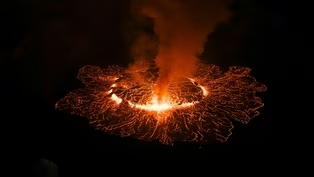
Episode 4 Preview | Phoenix Temple
Preview: Ep4 | 30s | Witness nature’s struggles to conquer ash and lava before a volcano's next eruption. (30s)
Providing Support for PBS.org
Learn Moreabout PBS online sponsorship
- Science and Nature

Explore scientific discoveries on television's most acclaimed science documentary series.

- Science and Nature

"Our New World" reveals Nature's astonishing adaptation abilities and how humans can help it thrive.










Support for PBS provided by: