Prairie Sportsman
Life on Lac qui Parle
Season 13 Episode 7 | 27m 46sVideo has Closed Captions
The historic Milan Beach Resort and river otter revival in the Minnesota River Valley
Host Bret Amundson visits the historic Milan Beach Resort, angles for crappies on Lac qui Parle Lake and learns how river otters were returned to the Minnesota River Valley.
Problems playing video? | Closed Captioning Feedback
Problems playing video? | Closed Captioning Feedback
Prairie Sportsman is a local public television program presented by Pioneer PBS
Production sponsorship is provided by funding from the Environment and Natural Resources Trust Fund and Shalom Hill Farm. Additional funding provided by Big Stone County, Yellow Medicine County, Lac qui...
Support provided by:


Prairie Sportsman
Life on Lac qui Parle
Season 13 Episode 7 | 27m 46sVideo has Closed Captions
Host Bret Amundson visits the historic Milan Beach Resort, angles for crappies on Lac qui Parle Lake and learns how river otters were returned to the Minnesota River Valley.
Problems playing video? | Closed Captioning Feedback
How to Watch Prairie Sportsman
Prairie Sportsman is available to stream on pbs.org and the free PBS App, available on iPhone, Apple TV, Android TV, Android smartphones, Amazon Fire TV, Amazon Fire Tablet, Roku, Samsung Smart TV, and Vizio.
Buy Now
Prairie Sportsman Premium Gifts
To order, email yourtv@pioneer.org or call 1-800-726-3178.Providing Support for PBS.org
Learn Moreabout PBS online sponsorship- It's kinda the hub of this part of the lake, this area right here, that it's the center of the lake.
You got the bridge there, which is a landmark.
How is it ebbed and flowed over the years?
I guess as far as traffic coming.
- At that point, you find it looked in the tub and saw all the minnows.
They move like they don't have a joint in their whole body.
(cheerful music) - Funding for this program was provided by the Minnesota Environment and Natural Resources Trust Fund.
SafeBasements of Minnesota.
Your basement waterproofing and foundation repair specialist since 1990.
Peace of mind is a safe basement.
Live Wide Open.
The more people know about West Central Minnesota, the more reasons they have to live here.
More at livewideopen.com.
Western Minnesota Prairie Waters.
Where peace, relaxation, and opportunities await.
(lighthearted guitar music) - If you've ever sat down and had a burger in this cafe, then you've probably spent some time at Lac Qui Parle Lake.
For years, hunters and anglers have traveled from all over the state to enjoy the outdoor recreational opportunities that the Minnesota River Valley has to offer.
For nearly one years, the Milan Beach Resort has entertained both the locals and the visitors to the area, with hot meals, campsites, and more.
(lighthearted guitar music) - Well, I was born here.
So since the late sixties I've been here.
My grandfather started it in 1928, and it moved from him to my mother and then onto me.
- Jeff Randall and his wife Stephanie, took over the resort in 2013, after Jeff's mother Jane, passed away.
- I spent a lot of time here, because Jane and I were in the same as in high school.
And I remember coming down here in the summer, and I'd help her cook in the back, you know, it was no big thing.
Her mother was a peach, just the most sweetest person I've ever met, probably.
- It has always been my happy place.
I grew up, my mom used to work for the Randall family in Appleton.
We grew up camping out here, always been a really happy place for me.
- While the scenic location was a draw for a lot of visitors, the smell of baked goods often floated through the campground, creating memories for those who spent time as a child there.
- One of my favorites is Mildred.
She would always sneak me in the back door and when she was baking cookies, if we were camping out here, and so I'd come and bake cookies with her and she was just an amazing lady, really good baker.
- Mildred was Jeff's grandmother, who worked long days in the kitchen.
Do you have a favorite cookie from Mildred?
(Jeff laughing) - Yes.
I remember it being five or six years old, and I was standing on a step stool at the stove making donuts with her.
She made homemade buttermilk donuts.
- Mm.
- And I still make them once in a while.
- Oh.
Really?
Using her recipe.
- Using her recipe, which was her mother's recipe, which- - Those weren't in the restaurant today?
- They were.
- Oh, they were.
- Oh yeah, the whole cookbook was there.
- I mean the donuts.
- Oh no.
- Oh.
- No.
No.
I don't.
- I'm coming back for the donuts.
- I'll make you something.
- All right.
- When Jeff and Stephanie took over, the resort had a lot of miles on it and was in new eat a repair.
- Yeah.
You know, there was a lot of things to fix up, bring up to code, bring up to date, redo.
A lot of money went into this.
Not just us, I mean, there was volunteers, and friends, and family, and people that still put a lot of time in.
And they want us to be a success.
- When we took over, that was one of our main goals was to expand to the full hookup side.
That was just what people wanted.
You know, they don't wanna deal with the honey pot, and hauling water and all that.
The whole of the campground was basically, the 16 original sites, and then they had just some random campers up to the north end, pulled in here, there, and everywhere.
There was no, basically, beyond the outhouse up there, there was nothing, it was just trees and a few campers.
So it used to be just plug in and go.
We put meters on all of the spots.
We added 24 full hookup spots.
We've done a lot of landscaping and tree cleanup, and all those things that got neglected towards the end, and just an overall rehab of things.
- Those campsite are a valuable commodity, and don't open often, with some sites hosting the same family for a long time.
- Longer than we've been alive.
So 50, 50 years, apparently they like it here.
You know, it's been through a lot of changes.
- Taking over and running a place that has such an emotional bond for you and your family, isn't always easy.
- Sometimes, it feels like it's an immense pressure.
You know, good.
But it's like, are we doing it justice?
Are we upholding what they would have wanted?
Or is this where they saw it?
You know, are we living up to that?
- Do you think you are?
- I like to think so.
- You sure.
- Yeah.
I'd like to think so.
I don't know.
I don't know how they fit all the stuff in that they used to do.
You know, it's, you hear the stories of all the things, you know, Hoezy trapped minnows.
And he ran a track line up to the twin bridges, and how did you get all that in, in a day?
I don't think they slept.
- Well.
The campground and cafe have been popular with the locals.
The resort used to have more options for fun.
- Somewhere, he had a dance hall here in a skating rink, and then the resort just happened piece-by-piece, I do believe.
Camping the cafe, boat rentals, cabins, and whatever else they could find to do along the lake.
- It's kind of the hub of this part of the lake, this area right here, that it's the center of the lake.
You got the bridge there, which is a landmark.
How is it ebbed and flowed over the years, I guess, as far as traffic coming?
But I'd assume that probably in the eighties there, when goose hunting was seventies and eighties, maybe that was, it was probably pretty wild back then.
Yeah, you got that right.
There were people all over the place.
But if we go a step back further back to the forties and fifties, thirties, forties, and fifties, there were a lot more farm families in the area.
Instead of seeing one farm in a mile section, back then there were maybe two or three individual little farms, farming and making living.
So you had all these kids, all these families, not a lot of money, and the closest place to go on the day off, or if it's hot is down by the water.
- But what makes a region, a destination for hunters and anglers, almost closed the business.
- He started the restaurant thinking that lake was going to be with cabins, and in the sixties, the state come into DNR started the wildlife refuge here, and eminent domain all the property on along the lake.
So we, and maybe two other families have land close to the lake.
- For reasons unknown to Jeff, the resort was allowed to stay.
So they focused on the wildlife.
- So, you know, we're the only resort on the lake.
We're really the only place on the lake shore, that the public can can go, besides the state park, besides the picnic area, boat landing.
- During the height of the goose hunting craze around Lac Qui Parle, the lake would hold around 150,000 Canada geese, and the area was crawling with camouflage.
And those people would boost the local economy.
- And along with that came the people in the fall that wanted to hunt.
And it was a lot of metro people, a lot of people outside the area that would come in to do this.
The state had state blinds along the lake, that you could rent, 118 of 'em and they were all full.
And every farmer had their field rented out for the goose season.
Yeah.
Everybody thrived.
Everybody was making money.
It was a fun time to be here.
- And those people were coming in and eating at your restaurant, staying at your resort.
- Yeah.
Staying at the resort.
We had cabins back then, of course, the cafe, the campground, we had a gas pump back then.
So it benefited everybody.
And even though you could only shoot one goose here back then, it was a draw like, I've never seen as far as people.
- I remember going in and clearing tables for them during goose hunting season, and it was just crazy.
It was a crazy time.
- And goose hunting around here can still be good, it's not like it once was.
What happened with the business as the hunting started to decline?
- Oh, it declined.
It's hard.
I mean, there's not a lot of extra money.
There's days, or months, or weeks, that you cross your fingers and hope that you make it.
Because that was a huge part of the income back then.
- Another landmark that can be tied to the resort was the famous Milan Bridge.
- You know, a lot of people had it that had a really intense connection to that bridge.
So they come in and tell stories of jumping off the bridge, or just fishing off the rocks and the amazing fish they would catch.
- Despite the popularity of that bridge its age was showing.
And it became the focus of a necessary infrastructure improvement.
- In the last two years, the bridge project, where they put in a new concrete bridge, that road was closed for two years, two and a half years.
And so that was almost nothing when they had the pandemic, which I had to close, which takes away even more.
The last five years it's been tight, but we still make it.
You know, we still get up and do what we have to do and we'll do it until I don't want to anymore.
- It's that kind of perseverance that has kept the resort going.
And a favorite breakfast and lunch spot for locals.
Fishing has become more popular in recent years, and the lake has even hosted a few tournaments.
- It was the Paul Larson Memorial tournament.
A friend of mine passed away a few years ago, and they started a tournament in his name, the proceeds go to the local high school scholarship programs, I do believe.
Yeah, my son, Austin, who is 15 now, he is my tournament partner in the summer.
And he got the biggest fish of the day.
He got the only fish of the day, and he won the tournament.
I'm just there to drive the boat and net the fish.
- It was 29 and 3/4 inch walleye.
Didn't catch a single fish all day.
It was a storm at the beginning of the day, and then thinking about quitting, but we decided to make one more last troll through the to back where we started, then we would leave.
- It was really foggy when we started, and there was no wind.
Mid-morning a very intense storm came through, a lot of wind, a lot of rain.
- It was getting pretty bad though.
We had to reel up our lines for probably 15 minutes or so.
- The tournament was at the end of August.
It was a slow bite that day.
There were only five fish turned in, outta 75 boats for the whole tournament.
You know, we both were getting bored.
We were not catching anything.
It was kind of hot.
We talked about quitting.
- Almost thought about giving up.
And all of a sudden you look back and rods doubled over.
And next thing you know, you're reeling a 29 half inch walleye.
- Won every category of the tournament, seven plaques.
And I don't know how much money we got 9,000.
I mean, it was just an incredible day, and I couldn't have been more proud to have my son catch it right in front of me on that day.
- With the resort being a family business.
Is he gonna be running the resort someday?
- Oh gosh, I hope not.
I hope he decides to do whatever he wants to do that's gonna make him happy.
And if it at this, then I support it.
- There's a lot of challenges in owning a resort, particularly one that's been in the family for a long time.
But at the end of the day, if you get to spend time with family doing things you love, you'll find ways to make it work.
- Oh no.
Oh no.
(man laughing) - He's got one.
- The Milan Beach Resort offers hot meals and cold sundrops, and can give you a glimpse into the storied past of hunting and fishing at Lac Qui Parle Lake.
(geese quacking) (lighthearted guitar music) Carol Henderson, the Minnesota DNR's first non-game wildlife supervisor, is chiefly responsible for bringing back native species, that have vanished from our state.
Like Trumpeter Swans, Paragon Falcons, and Bluebirds.
Human intervention, reeked havoc on many of our creatures, including otters in the Minnesota River Valley.
(bouncy piano music) - Otter was distributed pretty much statewide originally, when in settlement times.
And obviously, the habitat was better in Northern Minnesota, with more wetlands, more beaver ponds, and lakes, rivers.
But they also were present out on the prairie, along the smaller rivers.
Well, the Minnesota river and all the tributaries.
During the 18 hundreds, there was incredible pressure for trapping, and virtually no regulations or restrictions, for seasons, or bag limits.
And even a modest amount of trapping pressure apparently, caused the local population of otters, to become extirpated, by the mid to late 18 hundreds in Southwestern, Minnesota.
- Carol first noticed, that otters were missing from the Minnesota river in the mid 1970s, when he was assistant manager of the Lac Qui Parle Wildlife Refuge.
- And I met local conservationists like Ben Toma, at the Wilmer Sportsman's club.
Then they were an inspiration because they had initiated lots of conservation projects.
One of their themes was "Let's Put Something Back", and I thought, wow, that's a really nice conservation message for anybody.
And as I got more involved with my work at Lac Qui Parle, you know, I realized what animals were present, and which ones apparently were missing, that the Otter was missing.
And then when I was selected to join the DNR, as the non-game wildlife program supervisor in 1977, that changed my whole perspective in terms of the potential for making a difference in bringing back wildlife species that we may have lost, or that species that had been greatly decimated in the past.
- Carol's new duties at the DNR St. Paul headquarters included tracking furbearer species like, Otters, Bobcats, and Martins, and then reporting to the federal government on the number of pelts sold by Minnesota trappers.
- And that's when I learned about a wonderful PhD dissertation from the university of Minnesota, by Evadene Burris Swanson about "The Use and Conservation of Minnesota Game from 1850 to 1900.
And it gave a history of what happened to the Bison, to the Elk, to the Caribou, to the Beaver, to the Otter.
Even it had information about the disappearance of passenger pigeons from Minnesota.
From that dissertation, I've obtained records, fur buyers from Southwest Minnesota, who had actually been buying otters from local trappers, during the middle to later 1860s and seventies.
So I knew they were originally from that region.
And that's where I thought maybe what we should do, is try a restoration project for otters, as one of our first efforts.
Because I was on a statewide budget of no more than 25 or $30,000 per year, including my salary.
I didn't have much money to work with.
So if I wanted to do something, I had to do a low budget approach.
So I came up with a strategy of how to get some otters, using my knowledge of who the otter trappers were in Northern Minnesota, because they had to report to me every year.
So I sent a note out to the successful otter trappers, and just introduced myself and said, I have a background in and trapping.
I grew up trapping as a farm boy in Iowa, and I was familiar with what needed to be done and what, in terms of what kinds of traps could be used.
And we ended up suggesting a small coil spring mink trap, which wouldn't necessarily hurt their feet when they got caught.
We got 11 people approved to get permits, to catch otters for us.
And so they were gonna get $150 a piece.
I still needed the money to pay for that.
So the Wilmer Sportsman's club offered $600 to cover four otters.
And then I had friends in St. Paul Ottoman Society who were interested in this.
So they offered $600.
And then I went to the Minnesota Archery Association, and they had donated $600.
So now I had $1,800 to bring back 11 or 12 otters that following year.
(lighthearted guitar music) - In November of 1980, a conservation officer who knew of the Otter restoration project, called Carol about an Otter in the officer's custody.
- There was a family that lived up on the Northwest angle, who had had a young Otter stay around their fishing camp all summer.
They called him crazy, because he would jump in the boat, running around, and try to find minnows or fish that were lying around in the boat, then jump out.
And he just totally lost his fear of people.
When fall came, the owners of the resort were worried that the Otter was gonna get in trouble and get taken as a pelt.
And so they tried to smuggle the Otter through customs.
Well, they got caught and they confiscated this Otter.
So they called me wanted to know if I could use the Otter.
I said, sure.
I'll take the Otter.
We'll release him out at Lac Qui Parle.
I got the Otter.
And then I had to figure out how do you babysit an Otter overnight before I could get out to Lac Qui Parle?
So I went down to the local Vados bait shop here in the twin cities, and got an ice cream bucket full of lots of minnows.
So I thought, well, what should I do?
Well, how about if I just fill the bathtub, put the minnows in and just see if he's hungry?
Well, I took him out of the cage, took him into the bathroom, shut the door.
He went running around, and around, checking out everything, just incredibly curious.
He was looking for doors.
He pushed open the door to the towel closet, and I had to shut that.
And then he tried to, he pushed open the door for the close shoot.
So he could dive to the basement, but I had to slam that shut.
Well, then he tried to push up the lid on the toilet, and that was the point where I had to shut that down.
So anyway, at that point, he finally looked in the tub and saw all the minnows and he just floop.
They move like they don't have a joint in their whole body.
They're just fluid in their movement, just so graceful, incredible.
And so aware of their surroundings.
Well, he was just inhaling one minnow after the other, until there was only one left.
- The next day, Carol took Oscar to Lac Qui Parle.
- Let him there off by the water.
He runs out in the water, he's there about, not hardly 30 seconds.
And he comes back up to my feet with a bull head in his mouth, and proceeds to crunch down the bull head.
I think they're so successful in their foraging for fish, that they don't have to spend a whole lot of time hunting for fish.
So they have a lot of, what you might call play time.
(upbeat music) - Oscar was the first Otter released in the Minnesota River Valley.
Over the next two years, 22 more otters were released to Lac Qui Parle in the Big Stone National Wildlife Refuge.
- And we didn't need to release very many, because otters have a unique reproductive strategy called delayed implantation.
They have their pups in the Spring, and then within a month or so they immediately re-mate, and get pregnant.
But the eggs do not develop until the following Spring.
So, you could say that a female Otter is either always pregnant or about to get pregnant.
By having that kind of a bias toward catching the pregnant females.
We knew that we weren't just releasing 22 otters.
We were releasing a whole lot of otters through the following year, with the pups that the females would be having.
In other states, they were putting radio transmitters inside the otters, and tracking their movements afterwards.
Well, I didn't have money for that.
I just trusted the otters to be smart enough to figure out how to make up on the Minnesota River, at Lac Qui Parle.
The thing that was amazing about otters is that they're very doglike in their intelligence.
They learn quickly, they're they're wonderful, brilliant animals.
Of course, we didn't have radio telemetry to use for finding where the otters went, but we had subsequent sightings of people seeing otters playing out on the ice at Lac Qui Parle lake or on the Minnesota River.
Someone who was spearing Northern's on Lac Qui Parle lake, and he was just bent over his hole in the ice, waiting for Northern to come by.
And an Otter just exploded out of the open water, and looked at him a little bit.
And then we it back down again and shocked, both him and the Otter, I think.
People who still work out there have done Otter surveys, and found that the otters have basically moved up and down the river all the way down to Mankato, and up and down the various tributaries of the Minnesota.
So that they're back where they once were over a hundred years ago.
With two years of effort, and with the money I raised the first year, and then we scratched up enough money for about $1,300.
The next year out of the non-game program from checkoff donations.
For under $4,000, we did the entire reintroduction project to bring back otters in Southwest Minnesota.
The most important thing about restoring some of these lost species is that, they may have been missing from our scene, from our state, for over a hundred years.
We don't know what we're missing?
We don't know what role those animals are playing in the ecological chain of things?
in terms of the balance of nature or how they fill a role as a predator or pray species, and how they can just energize our lives and inspire us to do more good things for nature?
(lighthearted guitar music) (upbeat saloon music) - True or false, Zebra muscles are invasive, but they do contribute to water clarity, which is good for our lakes?
False.
Zebra muscles filter tiny food particles out of the water, which reduces food for larval fish and other animals.
The increased water clarity can promote aquatic plant growth as light penetrates to lower levels, and changes the predator prey dynamics.
We can stop aquatic hitchhikers from investing more lakes and streams by cleaning up everything we pull out of the water.
It's a simple drill; Clean in, clean out.
Before leaving a water access, clean your boat and water equipment, remove and dispose of all plants and aquatic species in the trash.
Drain water from your boat, ballast tanks, motor live well, and bait container.
Remove drain plugs and keep drain plugs out while transporting equipment.
Dispose of unwanted bait in the trash.
To keep live bait, drain the water and refill the bait container with bottled or tap water.
And if you have been in invested waters, also spray your boat with high pressure water, rinse with very hot water dry for at least five days.
Stop the spread of AIS.
Funding for this segment was provided by the Aquatic Invasive Species Task Forces of Wright, Meeker, Yellow Medicine, Lac Qui Parle and Big Stone counties.
(cheerful music) Funding for this program was provided by the Minnesota Environment and Natural Resources Trust Fund.
SafeBasements of Minnesota, your basement waterproofing and foundation repair specialist since 1990.
Peace of mind is a safe basement.
Live Wide Open.
The more people know about West Central Minnesota, the more reasons they have to live here.
More at livewideopen.com.
Western Minnesota Prairie waters, where peace, relaxation, and opportunities await.
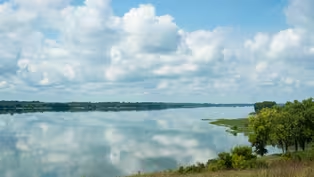
Preview: S13 Ep7 | 30s | The historic Milan Beach Resort and river otter revival in the Minnesota River Valley (30s)
Video has Closed Captions
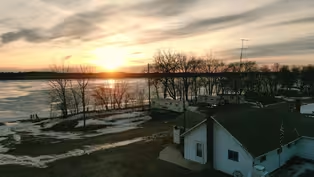
Clip: S13 Ep7 | 12m 57s | History of the Milan Beach Resort, owned by the Randall family for nearly 100 years. (12m 57s)
Video has Closed Captions
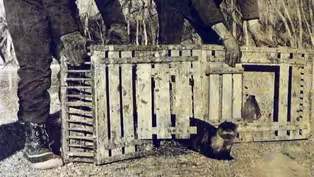
Clip: S13 Ep7 | 11m 41s | River otter restoration in the Minnesota River Valley. (11m 41s)
Providing Support for PBS.org
Learn Moreabout PBS online sponsorship
- Science and Nature

Explore scientific discoveries on television's most acclaimed science documentary series.

- Science and Nature

Capturing the splendor of the natural world, from the African plains to the Antarctic ice.











Support for PBS provided by:
Prairie Sportsman is a local public television program presented by Pioneer PBS
Production sponsorship is provided by funding from the Environment and Natural Resources Trust Fund and Shalom Hill Farm. Additional funding provided by Big Stone County, Yellow Medicine County, Lac qui...