
Lifestyle Gardening: Edible Choices for Small Spaces
Special | 27m 48sVideo has Closed Captions
Learn about choices for a small gardening space, houseplants and more.
This week we learn about small vegetables that can be grown in small spaces, houseplant care, landscape material selection, peach tree considerations, beneficial insects, and mushrooms in the yard.
Problems playing video? | Closed Captioning Feedback
Problems playing video? | Closed Captioning Feedback
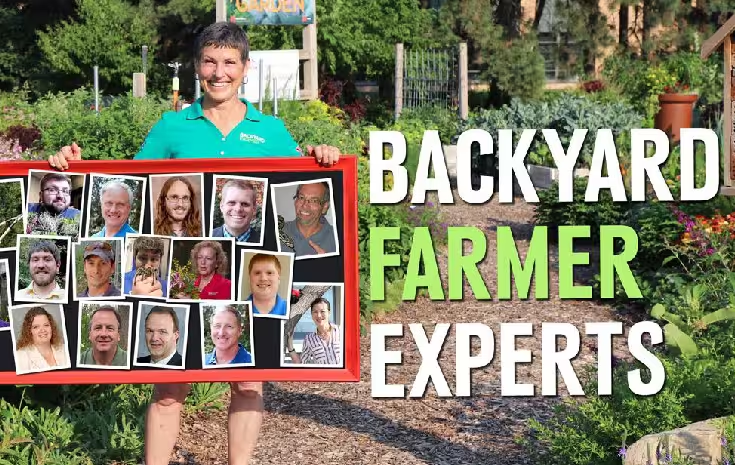
Backyard Farmer is a local public television program presented by Nebraska Public Media
Support provided by:

Lifestyle Gardening: Edible Choices for Small Spaces
Special | 27m 48sVideo has Closed Captions
This week we learn about small vegetables that can be grown in small spaces, houseplant care, landscape material selection, peach tree considerations, beneficial insects, and mushrooms in the yard.
Problems playing video? | Closed Captioning Feedback
How to Watch Backyard Farmer
Backyard Farmer is available to stream on pbs.org and the free PBS App, available on iPhone, Apple TV, Android TV, Android smartphones, Amazon Fire TV, Amazon Fire Tablet, Roku, Samsung Smart TV, and Vizio.
Join the conversation!
Looking for more information about events, advice and resources to help you grow? Follow us on Facebook to find exclusive content and updates about our upcoming season!- [Narrator] "Lifestyle Gardening" is a production pf IANR Media and Nebraska Extension.
(upbeat instrumental music) - Hello and welcome.
to another episode of "Lifestyle Gardening."
I'm Kim Todd and today we'll be talking about a few of the edible choices for your small spaces, but also focus on landscape materials for your home.
For our first feature today, we're going to return to the subject of houseplants.
Last time, extension assistant Scott Evans showed us some great selections for plants.
Today, he's going to give us some tips on how you can keep those plants alive and vigorous inside your home.
Here's Scott, to tell us more.
(upbeat instrumental music) - In a previous episode, we talked about houseplant selection and today we're going to talk about house plant care.
We mentioned about light.
One of the things about light, if a plant starts stretching, if that new growth looks spindly or weak, the plant is telling you that it needs more light.
So you might need to find a new window for it to go into or talk to your garden center professional about grow lights that might best fit your need.
One of the things that we often get the most questions about is watering.
We tend to love our plants to death and we give the plant too much water, or just not enough.
People like to ask how much water?
We should always water until it comes out of the bottom of the pot.
Let it accumulate in a tray or a saucer, wait about 10, 15 minutes, see if any of that water is taken back up.
If it's not, get an old turkey baster and what you're going to do is just siphon that excess water out, and then just put it back into the plant or a watering can, but we don't want the plant to sit in water.
If it is sitting in water, it acts like a wet sock or shoe and it could rot out the root system of the plant.
The second most popular question we get is about fertilizer or plant food.
So let's clear a myth.
Plants make their own food, fertilizers help them do it.
So think of a fertilizer as a plant nutrition.
And when you go to your favorite garden center, you're going to be bombarded with more fertilizer options than you are at the grocery store trying to buy cereal.
So work with that garden center professional and you just want a good basic fertilizer that has nitrogen, phosphorus, and potassium.
There are a lot of options on the market, so just read those instructions and follow them.
It's always better to err on the side of less than more when it comes to fertilizers, because we can do more damage than good.
And we never want to fertilize a plant if it's stressed or if it's not actively growing.
So during the winter months, like right now, we're not going to be fertilizing because plants are kind of in a dormancy and not actively growing.
One of the other things that I want to talk about are a couple common problems that we see with house plants.
One of them is brown tips on the edges of the leaves.
And a lot of times, this will indicate that there's been too much mineral deposits on the root system or the lack of humidity.
One of the ways that we can solve humidity is by making pebble trays.
This is when you take a saucer, a pipe hand, or something that you're not using, and fill it full of gravel or aquarium rock.
And you're going to put some water in it and that the plant's going to sit right on top of it but it's not in the water itself.
If you have a lot of plants, you can take an old seed starting tree and some grow crates and put it on top of it, so where you can fill the bottom of this tray with water and set the plants on top of it.
What that's going to do is create a microclimate.
So as that water is evaporating, it's going to raise the humidity around the plant.
And the second thing that can happen, or talking about brown tips on the plant, is that it could be from that mineral deposit from those fertilizers.
So what we want to do is stick that plant, if you're able to, either in the shower or the sink, and allow water to run through it.
The shower is kind of the best way because you can help wash off the dust on the plant.
You can help wash off any insects that you might not see.
And then it will also allow that water to run through the container, to allow the minerals to be washed off.
One another thing that we want to be, make mention of is our containers.
A lot of our really nice decorative containers don't have any holes on the bottom.
So what you want to do is just place the plant in here, in another pot so that we can take it out when you're watering and stick it back in.
If you run into an insect problem, you can always stop by your local extension office and we can identify the insect for you.
But if you have to use an insecticide, we want to make sure that's listed to be used indoors and onto the plants that you intend to spray it.
Insecticidal soap is the most common one out there and it helps take care of our soft-bodied insects, such as mealybugs, aphids, white flies, those types of insects.
So this will be a great way to help manage any type of pest.
Hopefully, you can take some of these tips and incorporate 'em into your house plant care.
So for both you and your plants are happy.
- These tips will certainly help you keep those plants thriving for the life of the plant.
But do remember, a lot of these issues are caused by the common problem of over-watering.
Make sure you know those plants, give them what they need, don't give them too much.
Let's move on to our landscape lesson.
Today, we're going to give you some tips on choosing good landscape and hardscape materials.
Although the old saying, "You get what you pay for," is true, you'll also need to plan everything out ahead of time in order to get the right materials for your design.
Let's take a few minutes to discuss landscape materials.
(upbeat instrumental music) One of the hard things to do if you are kind of a newbie into this venture, is to pick the right materials for those hardscape projects.
You can start with the internet, of course, there are great pictures, there are excellent websites from companies and suppliers, but as we probably all know from buying clothing or something for the grill, or toys or anything else over the internet, you don't necessarily get what that picture looks like.
And that is particularly true if you're talking about rocks and blocks.
So this one tiny little rock in my hand weighs maybe three quarters of a pound or a pound, and it's a certain color.
And of course, depending on how good the photography is, you can go ahead and take a look at what is online in the pictures, but you certainly can't pick it up in your hand.
And it's really hard for people to then make that math leap into tons.
Oftentimes, hardscape materials are sold by the ton.
And then to know how many tons of this particular rock you would need to cover a certain amount of area is also tricky.
So the other thing to look at, or to think about as you're choosing those materials, is how much area do you have to cover?
How strong are you?
Can you lift all of these boulders, especially if they're big ones yourself?
Are you going to have to bring in materials?
Where are those materials going to be stacked?
Do you need to get them delivered?
Will they fit in the back of your pickup or preferably your friend's pickup?
What are you going to do about it if you have an overage or an underage?
And that also can be an issue.
Many of the supply companies will not take back materials that are kind of in overrun for obvious reasons.
What are they going to do with a partial pallet or three or four hands full of rocks?
And of course, if you run out and you just happen to have chosen a material that is very difficult to come by, you're not going to be able to match it.
So a great piece of advice is go online, take a look, start doing that exploration to begin with, go ahead and use those calculators that so many companies have to figure out the conversions from square feet or square yards, to cubic feet, to cubic yards, to tons, understand that oftentimes, those have a little bit of an overrun in them, which is obviously a better idea, like I said, than running out.
And then if at all possible, take a little bit of a jaunt in a journey in your vehicle, drive by, take a look at whether the color and the size matches what you really had in mind.
And that's true from everything for boulders to pavers, to wall materials, even fountains, pond supplies, and lighting.
Laying out a good design and planning ahead will help you save time and money when it comes to those materials.
It's really much better to get out a tape measure and take some good notes before you purchase anything.
For today's interview, we're going to stick with this topic of landscape materials.
We talked to Brent Van Winkle from Outdoor Solutions about how their business is surviving the pandemic, and how good quality landscape materials can benefit your outdoor living space.
(upbeat instrumental music) One of the most interesting things that happened in 2020 was people had to stay home and when they were staying home, they took a look at their landscape and figured out that maybe they should make some improvements.
So I'm going to be talking today to Brent Van Winkle at Outdoor Solutions about just exactly what did people do and what did they buy, and how did they get it installed during 2020?
So Brett, what did people actually come in and want to purchase this year during the entire close down of the pandemic?
- Well, what we've seen this year is a large rise in homeowners coming in.
We always get a lot of homeowners and it's a fair mix of contractors coming in, too, but this year they kind of flipped.
There's a lot more homeowners that came in, a lot more do it yourselfers, and they were all fairly new at it.
Most of the projects were just your basics, you know, putting in mulch, rock, there were some people that tried to tackle some bigger retaining walls, patios, things like that on their own, but for the most part, again, it's just a lot of homeowners, do it yourselfers, coming in their first time and doing some just the typical small projects that they would usually hire out.
- Did you see any particular changes in terms of your own business and how did you have to accommodate maybe what was a lot more people in certain situations?
- Well, when we first started out with COVID, we didn't really know what to expect.
We thought our sales would go down.
It actually was the exact opposite.
Our sales spiked very heavily to the point where we actually couldn't keep up with our homeowners.
There was so many of them coming in on a, especially when when things shut down for a few weeks there, they were coming in so, so quickly on our weekdays, which are, you know, typically contractor driven days that we couldn't get our day to day things done, such as reordering materials, pulling products for sole jobs, things like that.
So we actually had to cut our hours back, our store hours, even though we were still here after hours getting our day-to-day activities done.
We also cut down use of our trailers, that's pretty, our trailer rentals is a real big deal for our homeowners, but we just couldn't handle the workload of sparing a guy to be continuously hooking up them trailers all day, so we had to cut that down for a while, too.
- Is it really important based on what happened last year for people to plan ahead or do you think, oh gosh, it's a great Saturday, let me go off and buy something and then install it is going to work this year?
- Do we think it's going to be as extreme of a year?
I don't think so.
I don't think anyone does.
I think that we have talked to some of the larger companies out there.
Some of the places we get large supplies from, you know, our pavers, retaining wall block, things like that.
And they, you know, probably have analysts on board that are, they're forecasting their futures.
So we are going to see what we think is a trend that's going to go upwards.
It's not going to drop off, but as far as how busy it was this year, I think we're going to see that trend go down a little bit, just because, you know, hopefully this vaccine will be out soon, and if it already hasn't came out, and what we'll see, I think, is going to be people that are gonna focus from the backyards in their homes, back to traveling and getting out and just kind of enjoying their regular life.
So the one thing I will tell people is we didn't have too big of an issue, but I know nationally, there was a lot of supply shortage.
We've seen rock quarries that were shut down this year that we couldn't get stuff from at all, because a lot of the work visas were shut down and they rely on that labor out in their quarries.
We've seen, you know, low numbers of, you know, some of the concrete products, things like that, where we've had a few issues with that, but we stockpile pretty heavily here, so it hasn't been as big of an issue as it had been at other places.
I still recommend to people to plan properly.
It's fine if you're going to come in and grab some rock and mulch and things like that, but if you're doing a bigger project, it's always a good plan even without us being that busy to plan ahead.
- So the long and the short of it is if you have a project in mind for 2021, the cold, dark, dreary days of winter is a really good time to start thinking about that.
The pandemic has caused havoc in our society, for sure.
And we really do appreciate the monumental effort it's taken to keep pushing forward, especially in the gardening world.
It's time now to answer a few questions with our backyard farmer panelists.
Might be a good idea to grab that pen and paper and take some notes in case you'll need some of these answers during the upcoming growing season.
- So we get the question all the time, why is my peach tree not producing?
Or why is my peach tree failing?
Why is it dying?
And that's because a lot of the fruit trees like that, the peaches and some of the relatives don't do well in our extreme cold temperatures here in Nebraska.
Now the tree might look okay, but whenever we're looking at the timing of flowering, or the the formation of the buds, we actually can lose production at that point.
Sometimes the tree is okay, health wise, but it just never produces.
And that usually happens because of the death of the flower buds during the winter.
Fruit trees typically form their flower buds in the late fall and overwinter them on the tree.
And so whenever we get those extreme cold temperatures, what happens is that those buds can die if it gets cold enough, or if they're starting to open up and flower, and we get a cold snap, they can die and you can lose your entire harvest that way.
And I've heard people say that they've had peach trees for years and decades and have never gotten a harvest.
Sometimes, the tree can look damaged, as well, from the winter.
What happens is a lot of the peach trees have a thinner bark than some of the other fruit trees.
And whenever we have fluctuations in temperature in the winter, we get a lot of expansion and contraction, and the bark actually splits on those and we get a lot of damage.
So you might see that splitting and you see like some sap running out and we call that gummosis, like it gets really gumming.
And that can be a point of entry for lots of diseases and insects.
So that's one of the reasons that we actually tell people that peaches and some other relatives aren't the best idea for Nebraska because they just don't perform very well here.
You want to look for another fruit, a similar fruit, and you want to check, really check, that hardiness to make sure that we have hardiness for those fruit trees that are zone five, usually, or if you can find even lower, that would be better because some of our winter temperatures can get low enough to do damage beyond those zones.
- So many insects that we see in the landscape look very different from immature to adult.
So we can hardly recognize them, but we do see them, and we get pictures of these immature insects.
And when we say, "No, that's a Lady Beetle, or that's a Lacewing," it's almost mind blowing 'cause it does not look like that.
So I'm going to talk about some of these insects and what they look like as immatures, and then what they look like as adults.
Because these immatures that I'm going to talk about are very beneficial in our landscape.
So they may look a little scary and unrecognizable, but we really want them there.
So the reason why these insects look different is because these are insects that go through complete metamorphosis.
And what that means is that they go through four life stages, egg, larvae, pupa, and adult.
So when that pupil stage, that's when they go through their transformation and they will come out as an adult with different mouth parts sometimes, they will live in a different habitat, and different form and function.
So the first one I'm going to talk about are called Syrphid Flies.
Syrphid Flies we know as hover flies, as adults they kind of look like bee mimics, but they are pollinators.
But as larvae, they look like these green floppy worms that are normally close to aphids and they are predators.
So they will take care of the aphids that are feeding on your plants.
Another immature insect that we're usually taken aback when we see them, are called Lacewing Larvae They look like tiny, but fierce alligator like creatures because they've got these mandibles that stick out and they feed on aphids and other soft body plant insects, as well as they will eat some pest eggs, like stink bug eggs.
As adults, they fly, they will often come to porch lights.
We've got green Lacewings and brown Lacewings and they've got very intricate wing venation.
And that's how we can recognize them as entomologists, but they look very different, but they're very good organisms.
People actually buy them for bio-control in greenhouses.
And the last one, our Lady Beetles.
We all know what lady bugs look like.
They are dome shaped, they're often orange or red, and have or do not have black spots.
But as larvae, they also look like tiny alligators.
They're often like a dark brown or black, and sometimes they'll have yellow or orange or red markings on them.
They are voracious eaters of aphids and other small sap-sucking insects.
So even though we may not recognize them, they are still good.
Look them up and keep them in your garden.
- So unknown mushrooms in the yard are one of the most common questions that we get here at Backyard Farmer.
What's growing and is it toxic?
So the first thing that we always recommend is let's start off with just getting a couple of pictures of that mushroom so we can try to identify it from the pictures.
When taking pictures of mushrooms, it's important to take a few different pictures.
We want to make sure that we're getting the picture from the top down.
And so we can see what the cap is looking like, any coloration on the cap.
We also want to try to get a picture from the side, if possible, as well, so we can see some of that stem and the underside of the cap is very important to see it also.
On the underside of the cap, this helps us determine whether it is a Guild Mushroom, whether it has pores or things like that.
Now, the final thing that we need to do when sending in a picture of mushrooms, or really a picture of anything, is to include some sort of scale in that image.
So whether it's a quarter, whether it's a pen or something like that, just to make sure that we have a decent idea what size, what the size of that mushroom is that we may be dealing with.
Now, if we're unable to identify it based on the picture alone, which does happen sometimes, then we may actually ask for a sample to be submitted into the diagnostic clinic.
When submitting a mushroom for diagnoses, it's a great way to one, a great way to preserve that mushroom is to pull it out of the ground and keep as much of that base intact, and then just put it into a paper bag and put it in your refrigerator until you're able to send that sample to the diagnostic clinic, or if you are in Lincoln, you can even drop it by.
- Stay tuned to upcoming "Lifestyle Gardening" programs for answers to your common questions.
For our last feature today, we're going to help you find something to eat.
You can either go to the grocery store or find an open restaurant, or you can grow it yourself.
Some of you might not have enough room for a full vegetable garden, so we thought we'd offer a few tips for growing your own food in small spaces.
One of the subjects we really want to focus on this year is the edible landscape.
And I know a lot of people dip their toes into that edible water last year.
I want to talk today about small spaces, small places, and small vegetables.
And part of the reason for that is a lot of people are going to be gardening or wanting to garden in containers, in very small plots, on a patio, on a deck, and something like a giant pumpkin can really overwhelm that space.
So fortunately, in the gardening world, the breeders, the plant breeders have come up with a lot of small vegetables, whether it is small peppers or smaller tomatoes, small cauliflowers, small cucumbers, plants that actually are going to give you that same taste, the nutritional pop, in a smaller package.
One of the advantages of using those small vegetables, certainly besides the space saver, is that you also do not have to space them as far apart.
So even though you might get peppers this big instead of peppers this big, you're not spacing them 24 inches apart, so you have room for a little bit more diversity in your small space garden.
So let's look today a little bit at some of the words that you should seek out whether you are growing your own vegetables from seed, or looking for those great plants that have already been started by somebody else in the garden center.
And you're going to see words like tiny, and dwarf, and bush, and mini, and toy, and baby associated with the actual variety or cultivar of the vegetable.
That's a good start in the vegetable world or in the gardening world, but one little tiny piece of caution.
And this is sort of a fun one.
We grew this particular vegetable in our backyard farmer garden last year.
It's called a Mouse Melon.
Last time I checked, a mouse is a really tiny creature.
And the Mouse Melon is a little tiny melon but the vine itself is not a little tiny vine.
It's a crawler, it's a sprawler, it's a very tall thing.
So we're not going to talk today specifically about vertical gardening as one of the ways for you to garden in small space.
That's for another time and another place.
But I want to show you a handful of the kinds of cultivars and varieties that are available.
As an example, there is a tomato called Glacier.
It is a bush tomato.
With tomatoes in particular, if you want one that's going to thrive in a small space, you want to look for a determinant tomato.
So determinant means it's going to stop growing, produce its fruit, as opposed to going up and up and up into that tower.
I already mentioned the word bush.
Bush beans have been on the market for a long time.
Bush cucumbers, bush zucchini.
There is a small zucchini that is available that's a little tiny thing about like this.
And then we look also at words like baby.
So in the lettuce world, you'll see mesclun as a mix, you'll see greens as a mix.
You see these tiny little ones.
And of course you can also, with some of those leafy greens, you can harvest them small.
There is a difference between harvesting vegetables small, carrots, radishes, zucchini, squash, and starting out with something that is actually already going to grow in a smaller package.
So you want to be a little careful about that, as well.
And then you want to also think in terms of do you want to take advantage of cascading sorts of vegetables, like some of the tomatoes?
So take a look first at those words that are attempting to tell you a little bit more about the size of the vegetable you're going to grow.
Toy choy, of course, is a bok choy that is tiny.
So the word toy tells you that that's going to be a little bit smaller than the great big bok choy.
So of course, a lot of people also want a garden with herbs and herbs come in a small package to begin with.
You do have to be aware of and careful of the differences in watering requirements and soil, dry soil, but you can certainly keep them small and you can dwarf them by a smaller container.
So take a look at those seed packets.
Of course, as always in the vegetable world, or in the edible world, don't plant it if you don't want to eat it, and make sure that if you really do want those small ones, you pick the right plant.
There are plenty of options for you to grow fruits and vegetables, even if you think you don't have enough room, and even if you do have enough space, you can always use these tips to grow more.
That's going to do it for today's program.
Thank you so much for joining us.
On our next program, we'll be taking a look at how gardening and plants can actually help you recover from illness or a stay in the hospital.
So good afternoon, good gardening.
Thanks for watching.
We'll see you all next time on "Lifestyle Gardening."
(upbeat instrumental music)


- Home and How To

Hit the road in a classic car for a tour through Great Britain with two antiques experts.













Support for PBS provided by:
Backyard Farmer is a local public television program presented by Nebraska Public Media