
Lifestyle Gardening: Garden Trends & Woody Ornamentals
Special | 28mVideo has Closed Captions
The final Lifestyle Gardening episode will feature garden trends, woody ornamentals & more
On the season finale of Lifestyle Gardening we’ll see some new woody ornamentals, hear about garden trends for the upcoming season, discuss the landscape renovation process and see some winter issues that might need attention as soon as the weather warms up.
Problems playing video? | Closed Captioning Feedback
Problems playing video? | Closed Captioning Feedback
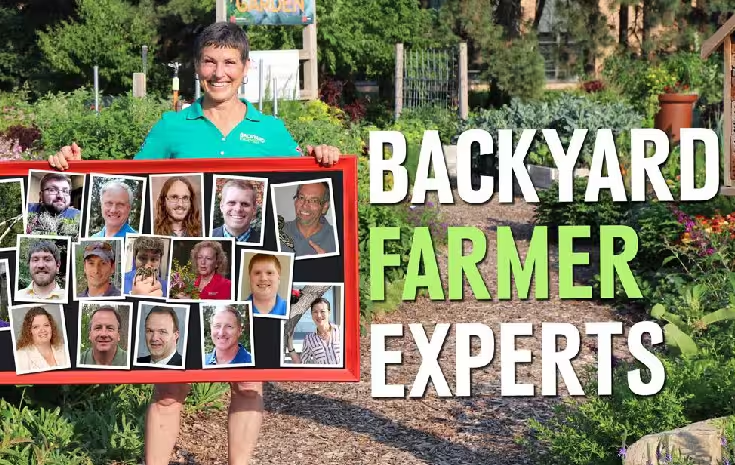
Backyard Farmer is a local public television program presented by Nebraska Public Media
Support provided by:

Lifestyle Gardening: Garden Trends & Woody Ornamentals
Special | 28mVideo has Closed Captions
On the season finale of Lifestyle Gardening we’ll see some new woody ornamentals, hear about garden trends for the upcoming season, discuss the landscape renovation process and see some winter issues that might need attention as soon as the weather warms up.
Problems playing video? | Closed Captioning Feedback
How to Watch Backyard Farmer
Backyard Farmer is available to stream on pbs.org and the free PBS App, available on iPhone, Apple TV, Android TV, Android smartphones, Amazon Fire TV, Amazon Fire Tablet, Roku, Samsung Smart TV, and Vizio.
Join the conversation!
Looking for more information about events, advice and resources to help you grow? Follow us on Facebook to find exclusive content and updates about our upcoming season!- Lifestyle gardening is a production of IANR media and Nebraska extension.
(upbeat music) - Hello, and welcome to the final episode of Lifestyle Gardening for this season.
I'm Kim Todd.
Today, we're going to be looking at garden trends for this season.
Winter issues, you'll need to look into where the weather warms up, and we'll hear about how a landscape design company takes a client from start to finish, on a renovation project.
But for our first feature, we're going to hear from Randy Wolf, from Campbell's nursery about you Woody plants, for you to try this season.
(upbeat music) - If you're interested in planting a flowering shrub or two in your landscape this season.
I want to talk to you today about some of the new varieties that have become available the last few years.
Most of these are improved varieties of selections that we've had in the past but we should perform better for you.
First one I wanna talk about is the Seven Sons shrub, which is a large shrub, however, the new variety here called "Temple of Bloom" is a more compact grower.
Six, seven, eight feet is a good size for it.
Likes full sun.
Interesting plant in that it will bloom in the summer.
This one actually blooms me a little bit earlier than the species.
And after the white flowers have dropped off, you've got these bracts, or a portion of the flower that's left on the plant, cherry red, makes a great show.
The other cool thing about this plant is eventually these stems will get big and strong looking and they have a white peeling bark, so you've got that interest as well.
So, another one that, well a years ago when I went to school, we called this "Carolina all spice".
This is a Calycanthus, or a sweet shrub.
It has a unusual flower.
It got the kind of a burgundy look, very fragrant, and people argue over the fragrance.
Some say, it smells more like pineapple, others say strawberry, some even say juicy fruit gum.
So this is about a six footer would tolerate a little bit of shade and still flower nicely for you.
A very unusual flower color.
This next one is an Aronia or choke Berry, and one of my favorite geniuses or shrub families.
Aronia's choke berries are native to the Eastern part of the United States.
Nice shrub for sun and we'll handle quite a bit of shade.
They are multifaceted in that they'll have glossy green foliage, as you see here.
They produce white flowers, we've got some buds coming on here in the fall.
They get a nice fall color or lots of reds, oranges, that sort of thing.
This is a new variety, stays very small two foot by two foot.
So it'll fit in almost anywhere, and give you a good shrub.
This is a sister plant to it, and both of these came out of the university of Connecticut.
So they're very hardy.
This is a one called "Ground Hog".
I'm showing you a older dormant plant of it.
It grows more sideways, three feet wide and only a 14 or 18 inches tall would make a great ground cover.
I tell people use this where you normally would maybe use a Gro-Low sumac, but it's too wet.
This'll handle the wet soil.
Gro-low sumac won't give you as many or more good attributes than, than sumac will.
This next one here, you go back in this industry, as long as I have, there was a lot of private shrub, or privet hedges planted back in the day.
This is one called "Straight Talk".
It comes out of a Northern source, so it's very hardy.
It tends to grow vertical.
You can see that in, in his branching habit.
So it makes a very good untrimmed hedge.
You don't have to trim this one, If you don't want to, you get a semi formal or informal look, you can flip it a little bit here and there if you need to, but a great privacy hedge fairly fast growing a low maintenance type of hedge plants (indistinct) A lot of people come in, and they they'll ask for a Limelight Hydrangea by name, and Limelight has been a mainstay for the last 10, 12 years.
It's a great plant.
Now we've come out with a another one that's even better yet.
We call it Limelight Prime.
Limelight Prime Hydrangea is a all the same toughness of limelight.
It's got the big white snowball clusters of flowers in the summertime, in the hottest part of the year.
This one just happens to be more compact.
So instead of that eight, nine foot shrub you've got one that's more like a five foot shrub.
Comes out with a green flower cluster turns pure, pure white eventually goes back to green.
Zone three hardy, so a winner it'll laugh at our winters every year so.
This next one is a, a new plant comes out of Canada.
Again, extremely hardy.
This is called "Iceberg Alley Willow".
It's a Willow that has a lot of pubescent, not only on the foliage, but also on the, the branching, five foot by five foot.
Willow's like all willows, this one will handle moist soil.
So you've got that spot where it's too wet to grow a lot of things.
This one will grow there.
You've got an, a kind of an unusual background color with that that few essence there for other plants to be grown in front of it, extremely hardy, very few problems with it.
So that's a good grouping of new plants for the shrub garden.
And if you need know more about them, get ahold of your local professional nursery.
- Thanks, Randy.
We do hope we'll get a chance to try some of those wonderful new plants in and around our homes this spring.
For our landscape lesson this week, we're going to focus on garden trends.
Part of being a good gardener is trying new things, new colors, and not being afraid of creating something beautiful around your home.
Let's take a few minutes to see what's trending out there.
(upbeat music) It's always fun to talk about the garden trends when they come out.
And of course, they're a little bit all over the board depending on which source you choose for your trends.
There are many, many consistencies, however, and just imagine this, pretty much on everybody's top of the chart is gardening is the number one tread for 2021.
However you describe it and define it.
That includes in a lot of sources, edible landscapes, gardening with children, gardening and containers, using mixed landscapes that do include those edibles in those containers, small spaces, tiny spaces, gardening with a purpose.
And that's a big one.
So if we back all the way up and think about that if your purpose is to create something that your family can enjoy in your own backyard that might translate into a backyard oasis.
That might be the retreat in the backyard.
We're seeing also a lot of trend information about kind of stepping away a little bit from landscapes that are extremely formal and tidy and neat into a more casual landscape, which really does encourage a greater interaction between the participants or the users.
So that also includes of course, attracting all of that wildlife, the pollinators, the birds, the pests, even if you don't like the pest, the wildlife and letting your children engage in that, learn from it, enjoy it and relax.
So many landscape trends this year are also comforting, and calming to be able to say, gosh this is the place where I'm going to retreat, enjoy life at a little bit of a slower pace.
So that also translates into lower input.
And of course the word sustainability ties right into that as well, which would mean as always, let's talk about low impact, low input, high impact, conserve water.
Think a little bit about night pollution from light, if you're going to use that light, make it low.
Think about native plant material if it's appropriate, and it's not always appropriate.
Those adapted plants do have their place as long as they are not invasive.
And we can keep our eyes on them.
We like to talk also about the color of the year and it's pretty interesting this year.
It is yellow and gray.
So if you think about it, what does yellow do for a very gray day, brightens everybody's mood makes everybody smile.
You can include everything from an edible landscape plant like Cornelian Cherry Dogwood, to great annuals, to tropicals.
Because tropicals are also still a great trend as our houseplants.
And of course, one of the best ways that you can actually follow a garden trend, create that wonderful lush experience that also includes planting those trees for shade, for outdoor canopy for the purpose of using those spaces the way you really want to.
So take a look at your own spaces, think about what you want to do, or did do last year that either did or did not work in your garden space.
Follow those trends, if you wish.
Include those great colors, go monochromatic if you'd rather, include edibles in containers in your garden space, in buying those trees and shrubs, engage your children, your grandparents go outside, and play.
Being creative and trying new plants and selections can really enhance your outdoor living space.
It's also fun.
Take a few moments to consider what you can try and where you can try it.
For this week's interview.
We're going to hear from a few employees of King Horn Gardens in Omaha about the process of doing a landscape renovation project.
If you've grown tired of your backyard you're going to want to hear what it takes to create something new here's Cory Brabeck, and Anne Houser from Kinghorn gardens to tell us more.
(upbeat music) One of the really fun topics we're going to talk about today is the design process, but more importantly taking design from start to actual installation on a renovation landscape.
And I know a lot of people are really interested in that.
So it's fun to be able to talk to Cory Brabeck and Anne Houser from Kinghorn gardens, about just exactly how that process works.
So Corey and Anne, welcome to Lifestyle Gardening.
- Hey Kim, it's great to be here.
- Hey Kim, great to be here as well.
- So let's start with a couple of questions that are pretty essential, and that would be, how do you start building that good relationship with a client, that does leave you guys to co-create the right design, for those clients?
- I think a relationship With a client starts with the client themselves, getting to know the client, getting to know their past history, maybe where they grew up, maybe what their childhood was like.
And then you can kind of relate that into the current existing home, or landscape that they're in, whether that be a new home whether that be an older construction type home, or maybe the home where they lived previous.
- I agree Corey, I think that's a great thing is to figure out the history of our clients.
And I also think it's really important to do a good job for every project that we do, because that way we get referrals.
And so they see us down the street and they know that we did an, a wonderful job for their neighbor and they want us to be able to do the same thing for them.
- What's really fun is when you get a client where you have done work for, some of their family or maybe even their parents, and those types of referrals are really exciting.
And that also helps us to get to know the client a lot faster.
And also just, maybe it lets us in on that picture of what their childhood was like.
- And it is really different.
And within families themselves too, like, you know we have multiple generations of clients, in our organization, and sometimes with the parents want is completely different from what the kids want.
So it's, you know, you really need to get to know the people that you're meeting with, and the garden that they want and what they really think is going to make them happy.
- Okay So Anne and Corey, do you start with what the client wants, or do you start with what they actually have?
Is there really a right way to do that?
Does it make any difference, and how do you help them articulate what they want and what they need, and whether those are actually the same thing?
- I think it's interesting for people because sometimes what they want is different from what they have.
And, you know sometimes we can make those changes, and sometimes we can't.
So you really need to listen to the client.
You really need to get to know what they're saying to you, and really truly embrace what they're going for, so that you can understand what the end result is for them.
That's really gonna kind of make this a successful experience for them in their garden.
- And a lot of times we we're meeting with a client, it may be a landscape, or a situation that they're inheriting, or that they just purchased, may also be brand new.
It may be a new construction.
And so you're kind of walking into it with two different point of view, I would, per se, you know sometimes we have to work with what they have and maybe they want us to work with what they have.
And other times it's just a clean slate.
So a lot of it depends on that.
There's two different ways to look at that.
- So let's take a walk through the park or in this case, your process from that initial meeting with those clients, to sitting around their beautiful fire pit with friends and family after you finished your work with their landscape project.
- After that initial meeting, we do come back, and we work on the designs for the clients.
We sometimes float conceptual ideas back to them, sometimes we send them pictures to try to make sure that that's, you know, we're headed in the right direction.
That's really important for us to try to do to really listen and get them going in the right direction with our first design.
Once we have the design completed, we present the design to the client, with pictures of every plant that we have on the site, and even inspiration photos to show them what we think, and what we're, what we're reaching for in terms of the end result for their garden.
And then with that presentation we typically show them our proposal for the work to be done.
And once they sign off on that work, our is our design gets turned over to the installation crews, and they get it on the schedule.
And once the schedule comes up for this client to have their project worked on, then we get out there with a crew who works hard and is really dedicated to the craft of what we do, and the real and the design intent that comes with each individual design.
So we, the designers work with those install crews on site and they do a wonderful job.
They take care of the property, they clean up, they do an amazing job.
And then once it's over, we do a walkthrough with the client and then we toast the garden.
You know, sometimes it's a little bit of a celebration when we get those gardens done.
- And spoke quite a bit about the design intent of the garden and the actual design.
And what's really important is meeting with the client after the installation, and years down the road to discuss how the garden is performing.
And if it's performing in the ways that they would like.
And it's also, it's up to us to make sure that as we garden and help them take care of that initial space, that we follow the design intent the original intent that the designer instilled as far as the dream goes.
So that's very important.
A lot of times we see landscapes, or gardens installed, and or created, and the design intent is often lost.
So it's very important that we follow that original dream and keep that in place.
- [Kim] So I'm guessing in all the years you've worked with landscapes and with clients, you've probably run across situations where either the existing site, or the situation itself and what the client wants are such a terrible match that you really can't figure out a way to resolve that.
What are you do then in terms of your design process to help get that back on track?
- I think in that situation, it's very important to be aware of other people out there in this industry that can help you.
It's really good to have good relationships with people in the industry because you know, we're not all experts at what we do.
There are many times we need to ask for help.
There are certainly things we are very, very good at with our also times when we need to call and ask for assistance, or maybe just other ideas.
- And I think to, you know, there are times when a client has a goal and a big dream that they want to fulfill in their garden.
And sometimes maybe the plant material isn't quite the right fit for what their site in their environment, if other garden allows for, but there's oftentimes plants that can be substituted in to those places so that they can have a similar effect without necessarily being a duplicate of what they have torn out of a magazine or shown us in their pinterest boards.
- And maybe one final question in this short segment.
And that would be, is there a typical timeline for a start to finish project for working with the client on that renovation project from start to finish?
- Its a really good question.
'cause I don't think there's anything typical, about we do what we do in a day(chuckles) You know, every project is unique and different.
Some projects we start when the homeowner buys a property, sometimes we'll even start before they buy it by the property.
And they ask us for help to direct them as to which property might be better.
Sometimes it involves construction.
Sometimes it's just remodeling, sometimes you know sometimes we just have this, just this renovation in a garden.
So really there is a whole spectrum of what typical is for a garden design group like ours.
So it's really hard to give a true answer to that that question because there is nothing typical about what we do every day.
- Thanks Corey and Anne for actually doing the interview with us on this really great and timely subject.
And of course we are really looking forward, to carrying the whole project through the season on backyard farmer.
Once again, we want you to focus on creativity, and it doesn't have to come in the form of a complete renovation, maybe just an installation here or there.
Just a few changes like that can really transform your living space.
And talking to professionals like these folks can really help you in the process.
It's time now to answer a few of those common questions.
Our backyard farmer faculty panelists are here to give you some answers to some of the more popular questions we get.
So let's take a few minutes for questions and answers.
(upbeat music) - Well there are quite a few things that can cause internal needle discoloration on our evergreens, but when we're dealing with our spruces especially if we're seeing this discoloration starting from the bottom of the tree, and working its way up, and out, there's a good chance we're dealing with one of our needle cast diseases.
Now in spruce trees, we have two different needle cast diseases that we really worry about.
Stigmina needle cast, and Rhiosphaera needle cast.
Both of these diseases have very similar symptoms where in the spring, or late fall or spring or early summer we'll start to see some of these internal needles turn bronze and then maybe eventually even a purple.
And if you look at these needles closely you may even see some black specks that are poking out of those needles.
Those black specks are actually our fungal fruiting bodies for both Rhiosphaera and Stigmina.
Now, even though we have two different needle cast diseases of spruce, control for them is fairly, is fairly similar.
And so one of the first things we want to do is to try to maintain, try to manage airflow through the canopy.
Anything that we can do to increase air flow that will decrease our needle wetness period.
And when we have the quicker, those needles are able to dry out, the less effective the fungi will be able, the less effective the fungi will be at causing infection.
Additionally, we can put some mulch around the bottom of the tree.
Mulching around the tree, not only will help the tree maintain good moisture availability, but it will also prevent any of that those fungal pathogens that have dropped in previous years on other needles that will prevent that inoculum from splashing up, and hitting the new needles on the spruce tree.
As far as control for this one as well, even though we're not seeing symptoms typically until later in the summer, later in the spring early summer, control is really early in the spring, right when those needles are beginning to expand.
So typically we're thinking about two fungicide applications.
The first application when those needles are about half expanded, and then we want to come back three to four weeks later, and hit it with another fungicide application, to really protect the current year's needles.
We may have to repeat this fungicide application for for at least two years in order to get good control, but between the fungicides, and some of those cultural controls your spruce trees really should start doing better.
- Our regular backyard farmer's show starts this week.
So don't forget, you can submit your questions via email and we love to get your pictures as well.
For our final feature, we're going to check out some plants that may already be popping out of the ground.
And some that might need some special attention after a cold winter.
(upbeat music) Now that winter is finally loosening its grip.
It's time to take a look at what exactly made it through the winter in good shape, and what might need a little bit of help.
We were a little concerned about a lot of plant parts above the snow line, and whether the flower buds would freeze off, or open inconsistently, or of course not turn into fruit.
Still remains to be seen on a lot of plants.
This viburnum, as an example is showing right now like it's going to break bud without even thinking about what happened in winter.
On the other hand, our New Jersey tea is showing a lot of winter die backs.
So we'll wait and see what happened with that, when before we actually prude off that dead foliage.
The roses, including those hardy shrub roses, really took a hit, and we're finding even on the best of the best of the yellows, that's been there forever.
Yellow submarine, yellow submarine has just a literalist tiniest piece of green.
A lot of our herbaceous perennials are coming out of the ground.
Maybe a little bit inconsistently, because what we are seeing is perhaps instead of being a full lush crown of the plant, maybe we have a handful of shoots around the outer edges.
And again, it's going to depend an awful lot on what part of the state you were in.
If you had good snow cover to help with that insulation especially when we had those abrupt temperature drops.
The other interesting thing about their herbaceous perennials is to see what was underneath the ground from last year.
This is penstemon, which had some leaf spot issues.
And of course, since these are essentially an evergreen, or or a broadleaf, evergreen, they hold their foliage.
We're seeing still the remains of those rust diseases or those leaf spots.
So take a look at those before you figure out what exactly you need to do with your plants.
And of course, before you start doing all the cutting and removing.
we're seeing a lot of broadleaf evergreens like boxwood that are showing winter desiccation or damage on the South, or the Southwest side.
There's is wind.
There's is winter.
There's is cold.
Again, be aware that you really probably shouldn't prune that out right now, just take a wait and see.
We're also seeing that on evergreens, like Arborvitae with the whole side really being pretty winter burned or winter damaged.
So we wait and see on those as well.
Before you get out the pruning shears.
One of our huge concerns always when we have an unusual winter is the flower buds of plants that bloom very early, and on previous year's wood or old wood.
Peaches, cherries, apples, forsythia, lots and lots of plants like that.
And whether these buds are completely damaged or in are going to drop, again it's a wait and see remains to be seen.
Hopefully they're protected enough depending on the location where we won't see a lot of winter injury on those.
If we do, it's a matter of you're either not going to get the fruit, or if you've got too much twig die back, which can also happen.
You're going to have to be doing additional pruning on those plants.
One final thought or a note on plants that were planted either late in the fall, or they really didn't get a chance to get established, even if they were planted earlier.
Take a good hard look at those plants.
Hopefully they were covered with snow, but you may find yourself in a situation where especially some of the smaller ones, might need to be replaced.
As we go into the spring of the year, be careful about taking all of that debris away from the crown too early.
You don't want them to have to force their leaves up through a lot of it, but you also want that there for a little bit of protection.
If we get one of those late freezes which of course can happen in Nebraska.
This is really a great reason to go outside and inspect that landscape and those planting beds for any damage, pruning needs, or to be able to give some attention to something that might be responding strangely, to the warm and wet, and winter weather we've had.
Spring is right here, right now.
Soon, it will be time for planting.
And that is all the time we have for today's program.
We're also ending another season of Lifestyle gardening.
We do hope you'll join us for backyard farmer coming to you on Thursdays, on any Tea.
Thanks so much for watching.
Good gardening, good growing.
And we'll see you all again next winter for Lifestyle gardening.
(upbeat music)


- Home and How To

Hit the road in a classic car for a tour through Great Britain with two antiques experts.












Support for PBS provided by:
Backyard Farmer is a local public television program presented by Nebraska Public Media