
Lifestyle Gardening: Ornamental Grass and Outdoor Lighting
Special | 28mVideo has Closed Captions
Topics include ornamental grass selections, outdoor lighting and more.
This week on Lifestyle Gardening we’ll take a look at ornamental grass selections, outdoor lighting, nutrition and gardening and an edible landscape.
Problems playing video? | Closed Captioning Feedback
Problems playing video? | Closed Captioning Feedback
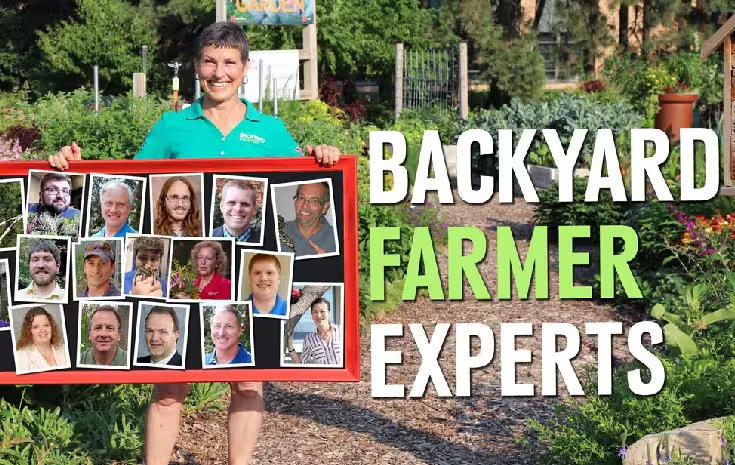
Backyard Farmer is a local public television program presented by Nebraska Public Media
Support provided by:

Lifestyle Gardening: Ornamental Grass and Outdoor Lighting
Special | 28mVideo has Closed Captions
This week on Lifestyle Gardening we’ll take a look at ornamental grass selections, outdoor lighting, nutrition and gardening and an edible landscape.
Problems playing video? | Closed Captioning Feedback
How to Watch Backyard Farmer
Backyard Farmer is available to stream on pbs.org and the free PBS App, available on iPhone, Apple TV, Android TV, Android smartphones, Amazon Fire TV, Amazon Fire Tablet, Roku, Samsung Smart TV, and Vizio.
Join the conversation!
Looking for more information about events, advice and resources to help you grow? Follow us on Facebook to find exclusive content and updates about our upcoming season!- [Narrator] Lifestyle Gardening is a production of IANR media and Nebraska Extension.
(upbeat music) - Thanks for joining us for another fun show on Lifestyle Gardening.
I'm Kim Todd and today we're going to be looking at the nutritional value of growing your own food, more edible landscapes and outdoor lighting.
Let's get today's program started with a few selections of ornamental grasses.
We went to Bluebird nursery in Clarkson to see what's available and hopefully give you some good ideas for you to try in your landscape.
(upbeat music) - We carry out long, large range of grasses because we have to have people that want it for native and we have to have people that want to for dry areas, dry shade, living under Oaks, you know, we get all these questions all the time.
And so we try to make sure that we have a wide range of grasses for everybody.
I know some of our best sellers are like Blonde Ambition grass, and that's a Bouteloua and then Sporobolus Herterolepis.
Those are some of our top sellers.
The Carexes are really coming on now because people want a lawn alternative.
And so Carex Appalachia is one of them that's really good for that.
We'll take some dry shade, Carex rosea is a newer one that's out on the market, that's really nice clump former takes excellent dry shade will grow just about any place, it just can't take the intense heat sun, but once it's establish and as a clump grower Carex, the other Carexes like blue zinger and stuff, they're not as hardy here, but they got the blue foliage to them and stuff.
But those are all good.
And so right now we're having people want more of like I said at lawn alternative because they're tired of I think, fertilizing and watering.
And so people are looking for that.
And people are always looking for something to grow underneath trees, you know, everybody wants to put their trees in.
And so they want stuff to be underneath that tree area and stuff.
Some of the plants we have here, none of these are the Carex or anything like that.
But another things that are real popular is the Panicums.
Yeah, they're kind of taken place of the Miscanthus because Miscanthus like does so all over the place.
And part of the areas of the country, the Miscanthuses are just very invasive, so people are looking for alternatives for that.
So Panicum Dallas Blues is an old old fashioned one, was one of the first blue forms on the market.
And it gets seven foot tall, you know, so if it's a little too tall, then we have some other varieties, they're a little bit shorter, heavy metal is a shorter one, Northwind which is a very nice upright one is a very nice one, that's a shorter one too.
And so we try to have a wild diversity of those two.
And then you have this is Ruby Ribbon, Panic Ruby Ribbon because everybody wants that red foliage in the fall or late summer.
So here's another one called Ruby Ribbons that came it was a cross between heavy metal and another variety and so that gives us your nice red color for the fall and stuff.
Old fashion Panicum Trailblazer, which is the plain old native that's out in the fields and stuff like that.
So, but we tried to carry like I said a wide range of different grasses.
This is Schyzachyriums like the standing ovation, the blues, those have been coming on, which is the lead on the blaze little blue stem area.
Those grasses all range anywhere from two foot to 48 inches depending on your moisture content.
And one thing to remember with native grasses, the drier you keep them, the more upright they will be.
If you overwater, over fertilizer they all have a tendency to open up and flop and you really do not want to have that open up and floppiness and so if you want to get the real good appeal of those grasses, try to keep them on the drier side because you'll get more coloration, more upright and you won't have the floppiness all the time.
So we talked about a few of the grasses here, I know there's a lot more out there that people need and stuff.
But once you get these grasses and get them into your garden and get them established, you're gonna be completely happy with them, you're gonna have a full color with a lot of them.
So we have summer color, you're gonna have winter interest if you leave them which I like to leave a lot of the grasses during the winter, because your native bees, things like that grow in them.
And so it's a habitat for everything.
And I do not cut any of that stuff till spring.
And so a lot of people, you know, you need to keep it like a long season interest.
And you will have that.
- These grasses make perfect plants for special accents around your home, or in sweeps and masses on berms.
They provide structure and beauty, especially in the fall and the winter.
Maybe you have some spaces that could benefit from one of these great grassy selections.
What does your home look like after that sun goes down?
Well, most of us have a porch light, perhaps a lamp or two inside the house.
But the placement of just a few lights outside can make a dramatic difference about how that home looks in the neighborhood.
That's what we're going to focus on for today's landscape lesson.
(upbeat music) This is the time of year when it's really a good idea to go outside and take a look at whether you want to use any landscape lighting.
There's a big difference between the type of lighting that you need an electrician for, and the kind that you can do yourself.
So we're really talking low voltage lighting, 12 volt, a lot of it, you can actually install yourself and you have many, many options.
First off, though, let's consider what you want that lighting to do.
Do you want to apply trees?
If so we do not place those lights right at the base of the tree.
You're not trying to light the trunk.
Everybody knows what the trunk looks like.
You want to light that canopy.
Are you talking about doing a wash of lighting on your home?
Do you wanna do path lighting?
Do you want to set off a specimen, all sorts of possibilities with landscape lighting, what you'll need to look for then is exactly the kind of fixture that you need.
And we have the opportunity to get little tiny button lights, all sorts of ones that are on a small riser, different styles, different canopies, different patterns of light as well.
The great thing about the new landscape lighting, the new 12 volt lighting really is that you do have options.
And yes, you can go cheap or inexpensive and get little tiny ones or ones that are plastic.
If you're really committed to this go for bronze or aluminum, bronze is a better material and it lasts longer and the price is not significantly higher.
You're going to need a transformer, you're going to need to be able to get that current which is what the transformer does from your house outlet or wherever you're plugging in, down to that 12 volt.
And you're not going to daisy chain it which means link like this.
The ideal is to go to a hub, and then go out almost like a wagon wheel to where your little landscape lights are.
The other beautiful thing about landscape lighting now is it's almost exclusively LED lighting.
So it's inexpensive, the bulbs last a very, very long time, the quality of the light, especially if you think in terms of the Kelvin, which is the color somewhere between 3000 and 5000 Kelvin, that's going to look really really natural, the light is also not hot, so you're probably not going to set your house on fire, especially if you do everything right.
And then of course, you could go ahead and choose little solar landscape lights, little tiny solar pad on top of them, they do work pretty well.
The downside of course is if you're in a location where they get shaded or it's a cloudy day, or they get kicked or tipped, they're really not going to perform for you the way you want them to.
So take a look at dusk or in the dark.
Figure out what you want to light, be really deliberate about it and then go ahead and do a little bit of exploration to be able to make that landscape look absolutely beautiful in the evening hours.
This is a creative change that can really make a difference in the way your home looks in the neighborhood.
With solar powered lights that store energy during the day, you can really make your house or your landscape stand out in the evening.
Switching gears to our interview, we come upon a topic that we haven't really talked about much on our program.
Today we're going to talk to extension nutrition educator, Natalie Sehi about your garden and what it provides for your body.
(enchanting music) So it's my pleasure to be talking to Natalie Sehi today about the connection between nutrition and gardening.
We've focused a lot on how to grow things but we haven't really focused on why.
And this is coming from a generation that really did love those Cheetos and Tostitos and some of those foods that, you know, the nutritional value is maybe a little less.
So, Natalie, talk about your experiences with and what you do and your passion about nutrition and growing your own food.
- Yeah, so thanks for having me.
First of all, I think the great thing about growing your own food is it gives you the opportunity to expose your family, whether that's younger kids or older kids to food, because we all know, it's not really nutritious, unless they actually consume it.
So gardening gives you that opportunity to kind of take it from the beginning, through the end with consumption.
- I love that not nutritious if you don't eat it, so that pepper plant can sit or that perfect tomato, and there it sits.
And then the squirrel gets really, really good nutrition.
So why are people especially families doing gardening?
Or what sort of persuasive speaking do you use or fun things you've done with your own family?
- Yeah, so I have four kids, teenagers, as well as a younger one who's nine and kind of their whole life, they've enjoyed the garden that we have in our own backyard.
And we talk about that with families that we educate within our different programs.
But you know, I think you mentioned at one point kind of the planted pick it, prepare it, and I think that applies to letting them even pick things out at the store that they want to grow.
So those plants that they want to grow in their garden and then also, once it's in the garden, picking it and giving them the opportunity to try it and sometimes, you know, just seeing that plant grow, whether you know, it's the from the flower all the way to the fruit or the vegetable really helps them be excited, you know, to try it or at least, you know, touch it.
And sometimes that helps kids, you know, really want to give it a shot.
- So making that connection between they get to pick it out to start with, and then grow it and work with it, how much of that then do you see translating from children into their parents or into their peers?
Does, you know I look at some of the peer pressure of Oh, you've got to wear these shoes or, you know, follow this person, does the same thing happened with nutrition and food?
And do they make that connection?
Or is that just one in there that those of you who really do know, the nutritional value can say, Oh, the red pepper versus the green pepper, that kind of thing?
- Yeah, I think peer pressure has a lot to do with the kids like it.
I think a lot of times we see those kids that are a little more self confident being the ones like yes, you know, I really wanna try it.
And then there's those that are a little more hesitant, and it takes a little bit more prompting, you know, we talk about using your five senses.
So really allowing those kids to explore it.
So taste it, maybe comes last because they're smelling it, touching it, really looking at it first.
And then there are times where we even encourage kids like don't yuck my yum.
So yeah, so we're like, you know, thumbs up, thumbs down, maybe thumbs in the middle.
But again, that peer pressure does come into play and if some kids are maybe on the yuck side, may influences their peers.
And so we do try to play on the young side so that those kids are willing to take at least a bite and it might take, you know, 10 times or more for kids and even us as adults.
I know there were things that I didn't like as a kid and grew to like as I got older, so.
- That's a great way to think about it and I'm sure kids have fun with that as well.
So, do you see particular successes?
Is it colorful?
Is it small?
You know, the ones really that you would encourage especially starting out younger or new gardeners to try for the nutritional value.
What comes to mind with that?
- I think smaller is easier for kids, they're maybe not intimidated by a large tomato.
So if you look at something like a cherry tomato or the little mini peppers are great, I know I grew those in our garden for the first time and they tasted just like what you buy at the store.
They're nice and sweet and they're little you can prepare them or just pull them out of the refrigerator or straight out of the garden with a little rinse of water and eat them but I know my kids always say mini tastes better.
You know it's kind of that bite size.
But on the flip side, you know something big like a pumpkin can get kids really excited to so seeing that grow from something really tiny to you know, who knows.
There's the giant ones that can really get kids excited, especially if they like sit beside it and see it grow.
Can just create that excitement and then realize they can eat it, whether that's the pumpkin itself, or maybe the seeds.
Oftentimes kids are excited about that too.
- So food safety of course and food insecurity are things that we also talk about a great deal.
Do you and this is a generalization or a general question, do you consider food that is grown in your own space safer?
- That's a great question and I think there's a lot of education that can be tied in to that too just in terms of, you know, making sure the soil or the potting area that you use, is I'll say clean, but it is dirt.
But just keeping in mind, are there pests?
Are there animals, are there sorts of things that come into that?
But you know, we really emphasize, whenever you pick something from the garden, make sure you rinse it under cool running water before consuming it.
- Which of course is hard to do if you really wanna just pop it from there into your mouth - Yeah, I know.
Yes, and we, you know, have been known to do that little cherry tomato, or like I said, those mini peppers are easy to pop one in your mouth when you're picking, so.
- Exactly.
- But ideally, yes-- - So you're involved heavily with SNAP, talk a little bit about SNAPP and your programming and the way you do educate.
- Yes, so part of the funding that I have for my position is through the Supplemental Nutrition Assistance Program.
It's the education arm, so SNAP-Ed, which focuses on providing nutrition education and food resource management skills to families with limited resources.
And then we also do work, like the gardening projects that we do that help with improving food access in communities.
- And I would think as we move forward into whatever 2021 is going to look like that that will become even more important.
And I'm assuming that a part of what you saw last year was the need for a lot of that kind of education.
Is that true?
- Yeah, that is true.
We saw a lot of families that were maybe a little concerned about their food access, and where were they gonna get some of that fresh produce that they'd been accustomed to?
You know, we were limiting trips to the grocery store and those sorts of things.
And so, we did partner with folks from horticulture, Terry James, specifically on helping to get some plants into the hands of families that could use them or into our gardening projects across the state that helped improve food access.
But we did see a lot of families growing their own plants, which is exciting.
Just because it's a new thing, and I'm continuing that education into 2021.
So that hopefully they can do it for another year, or more - That's awesome.
So again, we love to talk about this kind of thing, both on Lifestyle Gardening and on Backyard Farmer, Natalie, thanks for coming in.
I'm sure we will have you on again, come the real gardening season, starting in April.
- All right, thank you.
- Gardening really does provide you with a lot of health benefits.
Getting outside and doing your chores is good exercise.
Eating what you grow is good for your health.
Right now it's time to answer a few questions with our Backyard Farmer panelists.
Let's take a few minutes to hear some answers to your common questions.
(upbeat music) - The Japanese beetles are in your yard because they emerged and they flew into your yard.
They may have been there last year and so that's why they're back again.
But it's likely that you have some plants in your yard that they really like, they love roses, they love fruit trees, they love linden and birch trees, and they also like grape and 300 other varieties.
So there's a lot for them to eat.
They start eating flowers, the petals and the leaves and they can really defoliate some of those plants and they make it look pretty bad.
So I can understand why people wanna treat for them.
However, there are some treatments that are better than others and more effective.
A lot of people wanna treat for grubs and they wanna treat their yard.
However, trading for grubs will only take care of the immature stage of the Japanese beetle.
And it may help if you have damage to your turf and white grub feeding.
However, treating your turf if you do not have a turf or white grub problem is not gonna help with the adult beetles feeding on those plants that you wanna protect.
So what you wanna do when they emerge in June, which is when they start coming out of the soil because that's where they've spent the winter and spring.
When they come out of the soil, they'll start feeding right away and mating.
What you wanna do is handpick those off your plants, especially the ones that you can reach your most valueable ornamentals and that way, you'll reduce the eating and reduce that aggregation, when they will all kind of hang out on the same plant and feed.
Another thing you can do if you've had issues in the past, especially with your roses, you can do a systemic treatment.
But this means you have to think ahead of the June time period.
So that when you do that drench, and most people are doing that for their shrub roses, you wanna do that around Mother's Day so that the plant has time to take up the insecticide up into the roots.
And that would protect some of the plants.
However, that is not labeled for applications on linden trees.
So that is going to be something that you cannot treat for.
So think ahead, if you have had some beetles in the past, you can think about not planting those certain flowers or moving them further away to the outskirts of your yard, and away from your most valuable ornamental.
(upbeat music) - Why are my Bradford pears turning orange?
Why are my apple trees turning orange?
Very, very common questions that we were getting in the Diagnostic Clinic in 2019.
And really previous years as well.
And we've talked a lot about this, but these are some of our Gymnosporangium rusts.
And so, rust that move from one of our Rosacea plants, so pears, apples, etc.
And I'm having alternate host as on one of our junipers, or cedar trees, Cedar Apple rust is one of the very common ones.
But we do have some other rusts that occur as well.
Unfortunately, once we start to see those leaves turning orange kind of middle to late fall, it's too late to do any sort of control options.
So if you were in this situation last year, recommended in 2021, that you think about this as we're, in the early in the spring, because that's our treatment window.
And so the only time that we can actually treat for some of our rusts on Apple and pear trees is in the spring right when those buds are beginning to open.
And that's the time we want to apply some sort of fungicide.
Fungicides that can control our rust diseases are those that include chlorothalonil, or copper as well.
- Stay tuned to Lifestyle Gardening for more answers to your common questions.
As we wind down today's program, we've heard about the benefits of growing your own food.
Most think of a vegetable garden when we talk about that.
But you can grow plenty of other plants that provide something to eat using shrubs.
Here are a few tips of woody shrubs that you can snack on.
(upbeat music) One of the great things about a landscape is you can do really whatever you want to with it.
And there's so much interest in the edible landscape that we thought we'd focus a little bit on the woody plant material that you can use in place of plants that don't allow you something to eat.
Of course, vegetables are not woody plants.
So we're not going there today.
And we might talk just a little bit about plants like asparagus and horseradish, because those are perennial in the landscape.
But more importantly, think about trees and shrubs that are going to give you the structure, the form, the shade, attract wildlife, if you want that wildlife to graze on your landscape, give you all of the elements that we really talk about when we talk about designing a landscape.
So you could start if you're not allergic to the tree nuts, we have Hardy Pecans, we have Northern selections, they are an absolutely spectacular landscape tree, tall solid they need very, very little care once established, especially if you get the right varieties or cultivars.
The shrubs give you another opportunity.
And many, many shrubs offer us with multiple sorts of ways to use them as food.
Let's start with hazelnut or Hazel.
We have American hazelnut which is native.
It's a suckering shrub.
The hazelnuts are small, they're very edible.
They're not the hazelnuts that we buy in the grocery store that is European or a hybrid selection.
But they are quite tasty again if you can get them before the squirrels do.
More importantly, it is really a lovely shrub.
And it's a pretty tough shrub, it'll form a little colony.
The seeds themselves are in this funky looking sort of fringed bracketed little, it's called an in volume curse.
So here they sit, and then we do get some good fall color.
As importantly right now in very very early spring.
They are starting to do their flowering and the male flowers are this beautiful dangling fringe that is yellow.
So, in the breeze you see this great dangling fringe of cat can, of course the early pollinators absolutely love it.
We have another little sort of tall shrubs, small trees, suckering thicket former, which is papaw.
Again a native.
To me this gives a fabulous tropical appearance in the landscape because the leaves are sort of this spatula, litter egg shape.
The flowers hang down, they're a really odd color and there's a reason for that because they attract a certain pollinating fly and they look a little bit like dead meat.
Pawpaw itself is an acquired taste, but they are certainly something that is edible.
One of my absolute favorite, large shrubs small tree for edible landscape, and for the landscape itself is Cornelian cherry.
This is a dog wood.
It's not your everyday old red twig dog wood though.
It has with age, beautiful bark that sort of exfoliates and shreds and looks a little like camouflage.
It will also form a beautiful rounded form, maybe 15 feet up 15 feet across, over time.
It flowers extremely early, but not so early and it's so tough.
Those flowers really rarely if ever freeze off and they're yellow.
So this is a time of year when yellow in the landscape on a shrub is absolutely lovely.
Followed by something that is as red as my shirt that you can eat, the Cornelian cherries are edible.
There is also a vertical form of that for smaller spaces.
You can purchase cultivars of that when also that give you either bigger fruit, different flavors, and you'll notice I have not talked much about blueberries.
For really a good reason.
They're a little tricky in the landscape because they're, of their need for acid soil.
A great shrub if you are willing to do the work.
I think most importantly with woody plant materials that you want for edibility, think in terms of replacing some other plant in your landscape with a specific requirement or a specific need with something that provides you with an edible object off the plants.
We hope these ideas will help you be a little creative around your home.
You can pick shrubs for beauty and structure and why not also try something that will provide you with something to eat.
That's all the time we have for today's program.
For our final show this season, we'll be hearing about garden trends for the upcoming season and we'll take a look at some new plants at the garden center.
So good afternoon, good gardening.
Thanks for watching.
We'll see you all next time on Lifestyle Gardening.
(upbeat music)


- Home and How To

Hit the road in a classic car for a tour through Great Britain with two antiques experts.












Support for PBS provided by:
Backyard Farmer is a local public television program presented by Nebraska Public Media