
Liquid Metal, Ancient Mountains | Sophie’s ELECTRIC Road Trip Part 6
Special | 31m 26sVideo has Closed Captions
In her drive from New York to Tennessee, Sophie spots ancient mountains in Shenandoah.
Having just driven an electric car from California to Massachusetts, science-comedian Sophie is taking a completely new route back West: as she drives from New York all the way to Tennessee in this leg of the trip, she finds puppets in Baltimore, the Social Justice School in DC, ancient mountains in Shenandoah, and surgical robots in Nashville.
Problems playing video? | Closed Captioning Feedback
Problems playing video? | Closed Captioning Feedback
Major support for NATURE is provided by The Arnhold Family in memory of Henry and Clarisse Arnhold, Sue and Edgar Wachenheim III, Sarah and Sandra Lyu in memory of Seung...
Liquid Metal, Ancient Mountains | Sophie’s ELECTRIC Road Trip Part 6
Special | 31m 26sVideo has Closed Captions
Having just driven an electric car from California to Massachusetts, science-comedian Sophie is taking a completely new route back West: as she drives from New York all the way to Tennessee in this leg of the trip, she finds puppets in Baltimore, the Social Justice School in DC, ancient mountains in Shenandoah, and surgical robots in Nashville.
Problems playing video? | Closed Captioning Feedback
Where to Watch Nature
Nature is available to stream on pbs.org and the PBS app.
Buy Now
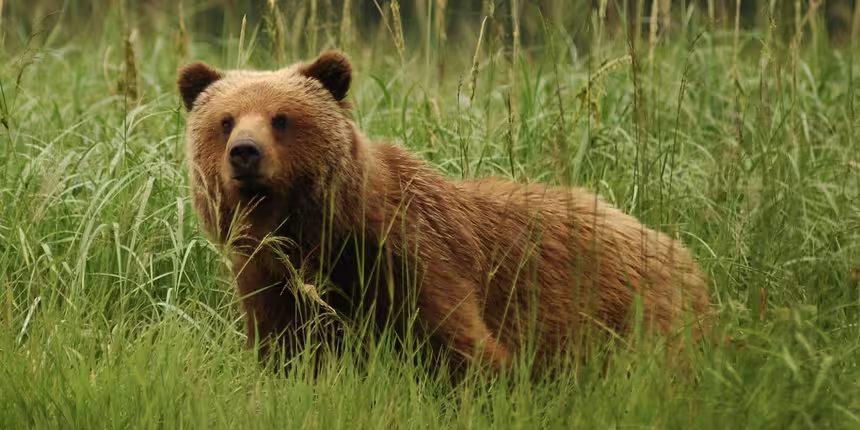
Explore More Ways to Watch
Bring the beauty and wonders of wildlife and natural history into your home with classic NATURE episodes.Providing Support for PBS.org
Learn Moreabout PBS online sponsorshipMore from This Collection
Scientist-comedian Sophie Shrand drives an electric car from Los Angeles to Boston and back on a coast-to-coast, roundtrip journey across the USA. Across 7,000 miles and 25 states, Sophie scopes out spectacular sights, explores the science of sustainable travel, and meets people across the working to build a brighter tomorrow.
![The Grand [Canyon] Finale | Sophie's ELECTRIC Road Trip Part 8](https://image.pbs.org/video-assets/bXtXc12-asset-mezzanine-16x9-fDqsQHK.jpg?format=avif&resize=316x177)
The Grand [Canyon] Finale | Sophie's ELECTRIC Road Trip Part 8
Video has Closed Captions
Sophie finishes her coast-to-coast-to-coast trip, completing her biggest science experiment yet. (25m 22s)
Otherworldly Wonders | Sophie’s ELECTRIC Road Trip Part 7
Video has Closed Captions
Arkansas to Arizona is full of extremes, literally! (28m 33s)
Dinos, Tortoises, Rats and... Garlic: Massachusetts| Sophie’s ELECTRIC Road Trip Part 5
Video has Closed Captions
A museum, a university, and a festival remind Sophie that home is where the science is. (24m 35s)
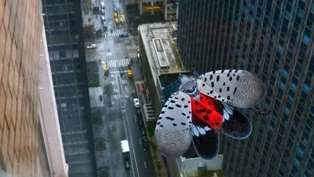
Fast and Curious: Midwest Bikes and NYC Bugs | Sophie's ELECTRIC Road Trip Part 4
Video has Closed Captions
Sophie investigates electric racing motorcycles and stomps invasive bugs as she makes it halfway! (25m 53s)
The Detour is Worth It | Sophie’s ELECTRIC Road Trip Part 3
Video has Closed Captions
Sophie and team face the challenges of 12,000-ft elevation and a bullet run through middle America. (28m 21s)
Horsepower vs Horse Power | Sophie’s ELECTRIC Road Trip Part 2
Video has Closed Captions
From Moab to Arches, Sophie examines the (literal) science of horsepower. (26m 40s)
Lake Mead Mysteries | Sophie's ELECTRIC Road Trip Part 1
Video has Closed Captions
Sophie Shrand and crew pack the car, charge the batteries, focus the cameras, and hit the road. (24m 16s)
Providing Support for PBS.org
Learn Moreabout PBS online sponsorship- [Sophie] There are times where we want metal to be solid.
- [Emily] Mhm.
- When do you want metal to be liquid?
Wow!
Hi, I'm Sophie.
(upbeat music) I drove an electric car on a coast to coast round trip journey across the USA.
I set out to answer two questions.
Can it be done?
And can it be fun?
What I found was (energetic music) so much more.
It's "Sophie's Great American Electric Road Trip."
(birds chirping) (pensive music) - [Brendan] Got a bit of a tricky situation here, Soph, on our charging.
- Okay, what is it?
- [Brendan] It's been very tricky to find level threes.
There's a level two, which we might be able to add some miles on, but not a ton, which means we'd have to drive another half an hour to a level three after breakfast.
- Are we gonna need to skip things so that we can charge in time to get to Baltimore by six o'clock?
- So I feel like we had a pretty good system down, driving, filming, and we take a few days to just like chill.
And now, I feel discombobulated.
- Now, we have to go back.
(pensive music) - [Brendan] We're taking a different route.
We're gonna see different places and different people.
- In this next leg of the trip, we're driving from the Catskills, New York, all the way to Nashville, Tennessee.
Luckily, I have friends everywhere, and we're gonna meet them along the way.
First up is Baltimore to meet my friend and fellow kids show host, Danny Joe, of "Danny Joe's Tree House."
I'm excited to see Danny.
You've never actually met in person.
It's all been over the internet.
An internet friend in real life.
Ooh, this is really pretty.
(pensive music) - [Brendan] This looks familiar.
- We were here before in the rain on the way to Boston.
- [Virtual Voice Assistant] One of our charging crew experts will be on the line to assist you shortly.
- So far, today, this has not been fun.
(phone on-hold music) Like, we're on a road trip, and we're spending all day just trying to find a place to charge.
The app won't let me put in my credit card information.
- [Call Center Representative] Oh, not a problem, ma'am.
...escalate the ticket for the inconvenience.
- It is incredibly hot out here.
Ouch!
Oh my gosh.
October, everybody.
- [Brendan] Wait, wait, wait, hold on.
Just stand there.
- And call me a genius.
(guests chattering) I'm just feeling like all my energy just totally went away.
- [Brendan] It's hard to maintain for two months.
- It's the start of the return journey, and there's a lot more.
We have another month of this.
(guests chattering) I want to have fun, and I feel very heavy right now.
Yeah.
And we have to go, because we have to find a charger.
(lighthearted music) Oh, frick.
- What?
- No, that was a good oh, frick.
Maybe this day is saved.
(bouncy pop music) - Good donut.
All right, seven things that could go right from here on out.
- Why does that question bother me so much?
(Brendan chuckling) (upbeat pop music) It's charging.
(upbeat pop music) (Sophie groaning) Where even are we?
(upbeat pop music) Parking spot right up front.
Let's go be with a friend.
(Sophie sighing) - [Danny] Sophie!
- Danny!
- You made it!
- Hi!
- Hi!
Oh, I'm so glad you're here.
- You're a real person!
- You're a real person.
- [Sophie] Thank you.
- [Danny] Come on in.
This is Felix.
- [Sophie] Hi, Felix!
Hi!
- [Danny] I want to hear everything.
Come, have a seat.
So what's going on?
How's it been?
- Ugh, you know, today was a day where nothing catastrophic happened.
- Mhm.
- But everything seemed to go wrong.
All of it combined was just like really overwhelming, and I felt like, "I don't know what I'm doing."
- You said the word overwhelming.
We talk about that a lot.
Okay, pick a hand.
Not that one.
Pick the other one.
(Sophie laughing) We're gonna take a time in, right?
Not a time out, just time in.
We're gonna blow up our balloon three times.
- [Sophie] Okay.
(balloon stretching) (sentimental music) - So don't tie it up.
- Mhm.
- Just give it a little twist.
(balloon squeaking) You give it a squeeze and let all the hot feelings go into the balloon, and this little balloon's gonna turn into a hot air balloon.
(sentimental music) And you're gonna go right through the ceiling and up through the clouds, and you're gonna get what us grownups call some perspective.
And you're gonna look down at everything that's been going on, and you do not have to fix it.
So just think about it.
Just be with it.
When you're ready, because you're the boss of you, you can come back down three times.
Ready?
One, (air hissing) two, (air hissing) (balloon farting) yeah.
And three.
(Danny and Sophie laughing) (balloons farting) So let it go.
(Sophie laughing) Let it go!
- Aw!
That is so helpful.
I think I lose perspective a lot.
Like, I get very zoomed in.
- It's not just you.
I mean, it's everybody, I think.
Take a time in every once in a while, you know?
We used to fight against timeouts.
They don't really work.
They make everybody feel terrible.
So we used to say, just change one little word to time in, and it changes everything.
- Yeah.
- I came up with that on a day that I was feeling very, very overwhelmed.
And I think play is a really good way to work through stuff like that.
In fact, would you like to play?
- [Sophie] Yes, please.
- [Danny] Let's go to the tree house.
Come on, Felix, let's go!
(playful music) - Pixie, I need some transportation, like a carriage with a thousand horses, you see.
- Oh, if only there was a fellow woman of science.
- Did I hear you asking for a woman of science?
- I've never seen an electric vehicle.
Have you?
(playful music) - Oh, yeah.
- I've been driving one across the country, actually.
- It sounds awful.
(Sophie laughing) That sounds awful.
From what I understand, there's no place to charge, it's exhausting.
- It hasn't been perfect.
It hasn't been easy every day, but generally, it's actually been really fun.
- This is a passing trend.
- Ooh.
- Right?
Am I correct?
- Weeelll- - Am I pushing your buttons?
(Sophie laughing) (playful music) - We could think of a trend as something that is passing, or we could see it as something that is headed in a certain direction.
- Can I please ride in your electric vehicle?
- Yes, Absolutely.
- Shotgun, shotgun?
- [Danny] These are puppets.
If they were real children, they'd be sitting in the back with seat belts on.
- This is true.
- Have you ever tried to put a seatbelt on with puppets?
- Do you need some help?
- Yeah.
- Safety first!
- Safety first.
- Punch it.
- [Sophie] Punch it!
(cheerful bouncy music) - Mm!
- Yay.
That was great.
- Hug the camera guy.
(Sophie chuckling) - Yeah!
- [Danny] He's not just the camera guy!
He has a name!
- [Brendan] I'm like a camera guy.
(crickets chirping) - I feel so much better.
- [Brendan] Yeah?
- Yeah.
Sometimes, the cure to a bad mood is a good friend.
- [Brendan] What'd you get there?
- Ice cream.
Vegan ice cream that I'm gonna eat for breakfast.
(upbeat bouncy music) I am really looking forward to meeting the students at the Social Justice School.
Myron and I were fellow Fellows at Camelback Ventures a while ago.
So we've been friends for a long time, and he's been building this school.
Hey, check it out!
- Hey, how's it going?
- Hey, hi!
- It's good to see you.
I know it's been too long.
- What is the Social Justice School, and why did you make it?
- Yeah, the Social Justice School is a middle school here in Washington D.C., serving students fifth to eighth grade.
And our mission is to catalyze an integrated community of scholar activists who are designers of a more just world.
We believe that schools should be rooted in love, learning, and liberation.
(upbeat bouncy music) If we could turn this middle school brain, this obsession with fairness, instead of it being inward to outward, then, we can create the conditions for young people to be so empathetic, to love each other so hard, or they want to do something in order to change the world.
- [Sophie] How do you see social justice in the climate solution space?
- Well, we can teach our young people that, you know, systems were designed, and we always say that they can be redesigned as well.
- [Sophie] I've been following Myron's work with the Social Justice School for years, so I had to stop by and talk with some of the students.
They've been learning about the impact of plastic pollution on the environment and on humans.
- Plastic pollution is like a big problem, the way that we use plastic or how we have single use plastic.
- [Student] Right.
- [Student] Yeah.
- Looks like I've found some co-teachers, and class is in session.
Plastic is a type of polymer, (bouncy music) long chains of atoms strung together.
Nature is full of polymers like DNA, proteins, and plant cell walls.
(bubble popping) Plastic is made mostly from fossil fuels, like natural gas and crude oil.
Plastic is everywhere.
Point to something right now- - [Student] Like, everybody- - that has plastic in it.
- [Student] One, two- - [Student] Everything.
- [Student] This.
(student chuckling) This.
- Yeah.
- Probably like- - All of it.
- a thousand things in this building.
- [Sophie] Plastic isn't just grocery bags (bubble popping) and water bottles.
It's in fabrics, building materials, car tires, most things we use every day.
Plastic is used so much, because it's lightweight, versatile, and it really lasts.
But that's part of the problem.
- Because plastic cannot break down, like completely, it just spreads into little pieces, like little hard pieces that it just can't break down.
And then, marine life eats that plastic, and that plastic will end up in us after we eat marine life.
- [Sophie] Lots of plastic never goes away entirely.
It just breaks down into smaller pieces, less than five millimeters, called microplastics.
Microplastics get into the water, soil, and even the air.
And then, into living organisms.
Microplastics have been found in food, like salt and honey, in animals in the ocean, and on land, in plants, and in humans.
So what are we gonna do about it?
- And what commitments are you guys making- - [Student] Oh.
- to plastic?
- I know one commitment that I'm making is just to keep spreading the knowledge.
- Trying to recycle as much, (energetic music) like correctly recycle, because some people really don't get it.
- Be the person who shows other people how to do it.
- Come together as a community, do like trash cleanup.
- [Sophie] Whose job is it to create this change?
- I think the government mostly, they have the power.
(students enthusiastically speaking) Right.
- They have the power.
- They have the power.
- Right.
- We don't have all of that power.
- Right, we're just kids.
- Right.
- If we use our voices- - Yeah.
- maybe like everybody would hear us out and like try to like come together and stuff.
- I'm gonna miss bubble wrap, but if it's for our kids' kids kids' kids, our kids' kids kids' kids.
(children chattering) - Right.
- Oh.
- Do we still get to see the car?
- Yeah, you want to see the car?
- Yeah.
- [Students] Yes.
- Okay, let's go.
- Our young people, through using design thinking, are able to really think about how to solve complex problems.
And so, it gives us a lot of hope because the reality is that they will be the ones who will make change in the world, and they're already starting to do it right now here in D.C.
(cheerful music) - What a great school.
Here's a fun fact that Myron told me, Ms.
Woods is teaching English language arts.
I thought she was the science teacher, because we were talking about this very in-depth science topic.
So they're thinking across disciplines, across subjects as they're learning literacy and reading a text that has to do with climate change, and then, weaving in the science topics.
What a brilliant way of teaching.
Yay!
All right, onto the next.
Today is a day.
Oh, just bonked myself in the head.
(bouncy bluesy music) Off to get a free fast charge.
- [Neighbor] Is it charging pretty quickly and working well for you guys?
- Yeah, yeah, we're at 218.
(Sophie gasping) Hold on one sec.
Have you heard about these?
- [Participant] Not-uh.
- Spotted lanternflies are super invasive, and New York City has a huge problem with them.
So sad they've come this far south.
(lighthearted music) - [Park Attendant] And there you go.
- Thank you very much.
- Thank you.
- [Park Attendant] Have a good night.
- Awesome, thanks, you too.
Annual National Parks Pass.
Probably should have done that before we left on the trip.
(lighthearted music) (crickets chirping) (Sophie exhales) (lighthearted music) (Sophie dusting off hands) (bag crinkling) - [Brendan] The natural sounds of Shenandoah Valley.
(Sophie laughing) - You crunching.... - [Sophie] I know.
- [Brendan] ...a chip bag.
(more crinkling) (rain drops pattering) [Brendan] Morning.
- Morning.
Welcome to my cooking show, where I try things for the first time and you get to be part of it.
(lighthearted music) I'm trying the hot plate.
I tested this back at home.
So satisfying.
Yay, it worked!
(lighthearted music) (lighthearted music continued) (guests chattering) Wow.
Yeah.
So they know, like, natural plants to stop erosion, right?
That's such an important way to acknowledge that nature knows what it's doing.
And yet, at the same time, they've displaced thousands of people who already lived here and did use nature in harmony.
And it's really important that there's acknowledgement of that in a National Parks Visitor Center.
Core samples, layers of soil or ice.
Basically, an entire history or a timeline of that area.
It helps us determine the climatic changes, because you're able to look thousands of years in the past.
(brush crunching) How cool that this big meadow exists on the top of a mountain range.
Meadows, like deserts, also surprisingly robust, delicate ecosystems.
Full of life!
Including one very cold human.
(Sophie groaning) No, more wind!
Oh, wow.
Look at that.
(Sophie chuckling) (lighthearted music) Camping to me always feels like a step back in time, but this place feels like ancient.
These mountains are a billion years old, so they have seen so much.
A friend of ours who's from around here has told us stories about the woods, and the trees, and the mountains, how old they are and how magical they are.
She said, "Say thank you to the trees."
I've been thinking about, the last couple days, because they've been emotionally difficult for me.
As much as we've been twisting and turning on the roads of the mountain, I've had these twists and turns of my mood.
- [Brendan] Why do you think this particular part of the journey would affect you in that way?
- This place has so much history.
There is a lot of darkness to this place.
In the making of the park, thousands of people were displaced.
And before that, there was war here.
And before that, there was war also here.
And before that, there were Indigenous people whose lives were changed forever when Europeans came over.
I'm a scientist, I know.
But it does feel like there are ghosts here.
Mountains aside, I also just put a lot of pressure on myself.
This project is all the new things.
There's very little about it that is familiar, and that was part of the challenge.
But so much of this is unknown, and that's getting to me.
What do you think?
- [Brendan] You're never gonna get rid of all frustrations.
You're never gonna get rid of bad days, surprises, or changes in plan.
And you're never gonna be able to get away from making mistakes.
What it comes down to is just being kind to yourself, because then, you can move through it.
You can work it out.
(Sophie sighing) [Brendan] I think we should say thank you to the trees.
- Yeah.
Thank you, trees!
(bluesy music) (critters chirping) - [Brendan] What is an hour to the mountain?
(critters chirping) - Oh, gosh!
(Sophie chuckling) And what is a second to a hat?
(Sophie laughing) - And what is a hat... - To a mountain?
- To a mountain?
(Brendan and Sophie laughing) - And what- - Is a mountain... - [Brendan And Sophie] To a hat?
(Sophie laughing) - I just listened to some Appalachian folk music, and the song about leaving the mountains to go work in tall buildings.
(sentimental music) Ugh, man.
One song.
(cheerful music) Ooh!
Is that the Natural Bridge?
- Yep, natural concrete.
- I'm gonna be saying that for the next 15 miles.
(cheerful music) This looks right.
These are really neat.
Is that the Natural Bridge?
Oh, that is cool.
Oh, wow.
Wow!
Natural Bridge might look a little bit familiar, because it is an arch, just like the arches we saw in Arches National Park.
But instead of sandstone, this is limestone.
And instead of being 150 million years old, this little baby is just under a million years old.
It's a few hundred thousand.
It's like nothing.
Nothing!
But it's not nothing, because it's really amazing.
(Sophie chuckling) (cheerful music) Imagine what it must have been like to be the first human to come across this.
There are so many natural wonders like this that are truly wondrous, you know?
Wondrous and beautiful!
And magical!
(Sophie chuckling) (Sophie sighing) I'm ready to sit in a car again for a few hours.
(lighthearted music) What a transition, huh?
Now, we're just back with like regular life.
Cute.
Cute.
Cute.
Cute!
(car lock chirp) Goodnight!
(various animal calls) Tired of the noise of the city?
Try the noise (Sophie laughing) of the country.
(upbeat country music) A TARDIS in the middle of a tiny town in Virginia.
There's a lot of science to be found here in Tennessee and a whole lot of history and culture.
(upbeat country music) Look at that!
What the heck is that?
- [Brendan] It's an upside down building.
- [Sophie] Yeah.
(upbeat country music) How funny, it doesn't take much, does it?
I feel like I'm part of the club again.
- [Brendan] Instead of being put off to the side in a dark corner of a parking lot?
- Yeah!
All right, Knoxville.
The timing of the charge, again, works with when I have to pee.
(Sophie sneezing) (Sophie chuckling) My brother lives in Nashville.
We're gonna go meet Jas.
We're gonna meet people who are building tools to help make surgery even less invasive.
Perhaps not directly climate science related on the surface, but as far as solutions to create a more sustainable future?
(upbeat country music) Nice!
Yay, yay, yay.
Gonna see Jas, my brother.
(Sophie grunting) (Jason laughing) - [Jason] Oh my God, I just had a huge steak and cheese sub.
- [Sophie] We're wearing matching outfits!
- Oh my God, we match!
(Sophie laughing) We match!
- Yay!
That's so weird!
(Sophie and Jason laughing) Is Liz home?
- Not yet, she's going to be done with lab around seven.
So we got a few things we could do until then.
Okay.
(accordion chiming) - I can do that.
- Um... (accordion chiming) - You want to see my goose?
- [Sophie] Yeah.
- [Jason] Isn't it great?
It's a goose!
- Willie, the loudest cat in all the land.
(Willie purring) (Willie meowing) (accordion chiming) - [Jason] All right, folks.
- Let's go.
(energetic EDM music) - [Sophie] Vanderbilt day!
- Welcome to the VISE space.
So this is where we've got all the medical engineering going on here.
- There are scientists here, I can smell it.
(laughing) Let's find them.
The PhD students at the Vanderbilt Institute for Surgery and Engineering work in surgical robotics, inventing cutting-edge devices, solving real world surgical problems.
- [Jason] Abbie is our ultrasound expert.
- [Sophie] Ooh!
- [Jason] And our lab manager.
- We are standing in the mock OR, and the mock OR is designed to give our students an idea of what a real OR would look like.
Not all of them have a chance to go in and observe a real surgery, so we design this space to give them that context.
Here we have a clinical ultrasound machine.
- The way that the sound is traveling through these different tissues is what's giving you the information.
Just like an echo against a mountain or in a big empty room.
That is your carotid artery, but the colors indicate the direction and the magnitude of the flow.
So right now, we are seeing that mostly blue, so we're seeing blood going away from the transducer.
With this type of ultrasound machine, we can image really fast blood flow at really shallow depths.
What we would love to be able to do is image really slow blood flow at really deep depths.
- [Sophie] Ooh!
- So that would help us identify tumors and track their growth.
We want to help people, that's the whole point of this entire space that I get to manage.
So besides doing just my research, I get to help all of these other people that you're gonna meet today do their research.
(cheerful music) - Look at your palm.
- Yeah.
The hummingbird is gonna come to your palm.
- [Sophie] Yeah!
- Using the HoloLens for us is like our way to see what happens in the operating room, how an expert would behave whenever they're performing a specific procedure, and compare that to what a trainee or a novice surgeon.
It will validate those differences, and after that, maybe propose a different educational tool.
(cheerful music) - We're trying to understand how like different parts of your brain are communicating with each other and if like anything in your DNA is in charge of that.
The software is supposed to help neuroscientists understand the genetic data better and the geneticist to understand the neuroimaging better.
- You also are the president- - Yeah.
- of women at Vise.
- These like amazing women at different stages of their career, and everyone has like very similar struggles.
- I really wish I could be part of it, but I didn't go here.
- We'll accept you, you're a Shrand.
- Thank you, Jason Shrand!
(Nhung laughing) (cheerful music) - This is something called a concentric tube robot.
This is an endoscope.
And instead of these big traditional robots where you see you have rigid links and arms, we actually use very small tubes.
And this is actually made out of a special alloy made of nickel titanium called Nitinol.
So it's very bendy.
[Jason] Allows you to access parts of the body that you could never access before.
You can go through sinuses and go into the inner ear, through the cochlea.
It's about a millimeter in size.
- [Sophie] Yeah.
- [Jason] Like the very tool tip there.
- [Sophie] Yeah.
- [Jason] And it's about the same diameter as the needle they use to give you a shot at the doctor.
And so, what we're gonna do next is we're gonna put an electrocautery fiber in there.
It's gonna fit inside of a fraction of a millimeter.
For certain surgical procedures, they could put a little hole in you, stick in one of these, and they slap a bandaid on you.
- [Sophie] Amazing.
- [Jason] And send you home.
And your recovery time is zero.
- Where am I?
Am I in?
- You're past it.
- I'm past it.
(cheerful music) Beep.
Still, I'm just gonna come and unhook it- - There you go.
- Hook it from the bottom.
- We wanted the robot to feel like a tool for the surgeon.
Right?
So the surgeon is the one directly operating it like a regular surgery.
- [Sophie] Right.
- [Jesse] Just a little cooler.
- I specifically work with lung surgeons.
Your lungs are divided into like basically four parts, left and right, top and bottom.
And some of those parts are harder to work on than others.
This is a special type of metal called Field's metal.
It melts at a really low temperature.
We could probably put this in the body one day, right?
We wouldn't want to be too hot for that.
- There are times where we want metal to be solid, like our rings and our mugs.
- Mhm.
- When do you want a metal to be liquid?
- So this would be a tool that could help surgeons get to where they need to go in that liquid state, where we can make all these complex shapes, then, solidify part of it (pensive music) and leave part of it liquid, so they could like operate on the body there.
This metal core here- - [Sophie] Wow!
- [Emily] is rigid.
So I'm gonna melt one of these down, so that we can move it.
- Should we turn it on?
- [Emily] I think we should turn it on.
- Yeah, we should turn it on.
- [Emily] They're going to take a few minutes to melt, right?
And this one is liquidy and kind of ready for you to feel it.
- [Sophie] I could see it.
- [Emily] A lot of the times in soft robots, we want to create this S-curve, and you're kind of doing that intuitively, right?
You're saying I can bend these in different directions.
- [Sophie] It actually looks kind of like a finger joint.
- [Emily] We take a lot of inspiration from those things, like an octopus arm or an elephant trunk.
We also talk about serpentine or serpent robots, snake-like robots.
- [Sophie] Mhm.
- And then, the idea is that if we control this shape and we would be pulling on this with motors and tendons, we can actually re-rigidify it in the same state.
This is also liquid metal.
This is gallium.
It's what we call biocompatible.
- As soon as you said biocompatible, I was like, that means it's safe to touch.
Can I touch it?
- It does.
It means you can totally play with it.
So I'm actually gonna pour some of this in your hand right here.
- [Sophie] Awesome.
- And so, you can see, you can actually like roll this around.
- [Sophie] Oh, it's colder!
- [Emily] It is.
- [Sophie] Let's see if I can get it in here.
Look at that.
(pensive music) - [Emily] But you can see this, right?
This is all the way solid.
These are also all the way solid.
I can pick these pieces up.
- [Sophie] Mhm.
- [Emily] These are solidifying, so they're going through that heat transfer, and then, you have this stuff on your hand that's like still liquid.
And we're utilizing all of these properties to create variable stiffness robots, and that's what my research is.
- This is awesome, okay.
- [Emily] Neat!
- Will you show me where to wash my hands?
- [Emily] I will.
- Even though I want to have this on forever, because it's really cool.
And it's okay for this to go into the waterway?
- [Emily] Mhm.
It'll actually all dissolve.
- That's cool.
(faucet trickling) In your world, what drives you forward?
(pensive music) - My grandmother had lung cancer, and she actually ended up passing away from the same complication that I'm working on solving now.
My grandma on my mom's side was an artist, and she wrote books and cookbooks, and she was an interior designer, and she was like always looking for ways to create new things.
And I got that and have applied it to science.
- It's so cool to think about how much innovation is happening every single day.
- Cool.
- And now, I live here forever.
- I think you should live here forever.
- Yeah.
(upbeat music) - Emily makes these as a byproduct of her experiments.
- Oh.
- And she just, and she knows I love them.
I don't think I've ever had this many of them on me at once.
- Well, you're in for a treat.
(Jason and Sophie laughing) (upbeat music) (Willie meowing) We have three days in a row of really long drives.
- [Jason] How long is your limit?
- [Sophie] This.
- Really?
- I mean, yeah.
- Bye!
- Bye.
- Have fun in, um, where are you going?
Arkansas.
- Arkansas.
- Can we do one more group hug, because I messed up on the first one?
I went like this, and then, had to do that.
- Okay, yeah.
- Oh, I didn't even notice.
-Okay, ready?
- [Liz] What are we doing now?
- Are we hugging each other's arm pits?
- [Sophie] Yeah!
- [Jason] Yeah we're hugging each others arm pits.
- Yeah!
(everyone laughing) - [Liz] Bye, Brendan!
- [Brendan] Bye!
Group hug.
- [Jason] Happy trails.
- [Brendan] Yep.
- [Liz] Happy trails!
- [Brendan] I'm just gonna get the shot of Sophie driving away for the documentary.
- Okay.
- Bye!
(Sophie chuckling) - [Jason And Liz] Bye!
- [Sophie] Love you!
(birds chirping) - [Liz] You're back!
- [Jason] Hi!
(Brendan laughing) - Hey.
(bird calling) - [Brendan] Hey.
- Hey.
Hey.
- [Brendan] Hey.
- Need a ride?
- [Brendan] Yeah.
(bird calling) - Okay, come on in.
(Brendan chuckling) (Brendan exclaiming) Were we silly enough?
- Do you want to go back and be sillier?
- Always.
(upbeat bluesy music) I have a ghost story.
I had a dream last night about fairies.
(brooding music) The next campsite over, there was a conference happening.
And I thought, "Oh, that's cool."
And they had invited me over.
But when I was getting closer, they got further away.
And I started to think, "Hmm, could fairies coordinate a whole conference just to fool me?"
(suspenseful music) That seems like a lot of work.
That's my brain's version of a ghost story.
- [Brendan] Did the fairies have a continental breakfast?
- I never found out, because I decided not to follow.
And maybe that's why I, you know, I'm still here.
Oh, gosh.
Oh gosh!
Ooh!
Thank you, trees.
Thank you, trees.
(suspenseful music) Support for this program was provided in part by VELA.
VELA connects families and founders in the Indie Education Movement, where families take charge of their children's education.
Learn more in the VELA app or at vela.org.
(Sophie snapping) Cool jacket!
 New Episode
- Science and Nature

Explore scientific discoveries on television's most acclaimed science documentary series.











Support for PBS provided by:
Major support for NATURE is provided by The Arnhold Family in memory of Henry and Clarisse Arnhold, Sue and Edgar Wachenheim III, Sarah and Sandra Lyu in memory of Seung...