Call The Doctor
Living with Back Injuries
Season 34 Episode 11 | 25m 27sVideo has Closed Captions
Even minor back issues can mean not living life to the fullest.
Back problems can come from a number of sources, but even minor back issues can mean not living life to the fullest.
Problems playing video? | Closed Captioning Feedback
Problems playing video? | Closed Captioning Feedback
Call The Doctor is a local public television program presented by WVIA
Call The Doctor
Living with Back Injuries
Season 34 Episode 11 | 25m 27sVideo has Closed Captions
Back problems can come from a number of sources, but even minor back issues can mean not living life to the fullest.
Problems playing video? | Closed Captioning Feedback
How to Watch Call The Doctor
Call The Doctor is available to stream on pbs.org and the free PBS App, available on iPhone, Apple TV, Android TV, Android smartphones, Amazon Fire TV, Amazon Fire Tablet, Roku, Samsung Smart TV, and Vizio.
Providing Support for PBS.org
Learn Moreabout PBS online sponsorship(upbeat music) - [Male narrator] The region's premier medical information program," Call the Doctor."
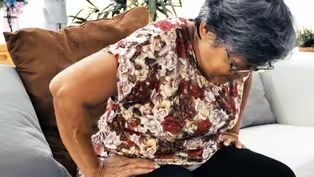
- [Female narrator] Back pain can come from a number of sources.
From injuries, to playing sports to working around the house, falls, even some medical issues.
Back pain can be mild, but according to the Mayo Clinic, it's one of the most common reasons people go to the doctor or miss work, and it's a leading cause of disability worldwide.
We've assembled a panel of experts to discuss how to avoid certain types of back strain, and if you deal with it already, how you can manage better.
Living with back injuries now on "Call the Doctor."
- Hello, and welcome to this episode of "Call the Doctor."
I'm Julie Sidoni.
I'm the news director here at WVIA and I will be the moderator for the show this season.
This episode, as you just heard, will focus on back issues, injuries, and other types of problems with your back, which can really affect your everyday life.
We've assembled a panel of experts who know all about back trouble.
Hopefully we can learn from them, maybe learn how to best manage back pain, which so many people deal with.
So first we'll open as we do with every show, just to welcome you all here.
And I'd love to give you a little time to introduce yourself, tell people who you are, where they can find you, et cetera.
- Sure.
Thanks.
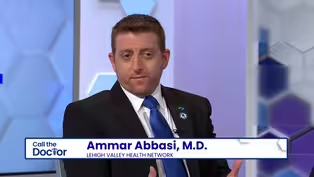
Dr. Ammar Abbasi, it's a pleasure to be here.
I'm a board certified physiatrist with Lehigh Valley.
I'm the clinical regional lead for the Lehigh Valley Orthopedic Institute at Hazleton.
And I can be found currently at the Health and Wellness Center at, in Hazleton.
And I treat all kinds of conservative musculoskeletal or muscle bone nerve joint type pain, neck and backs.
- Welcome.
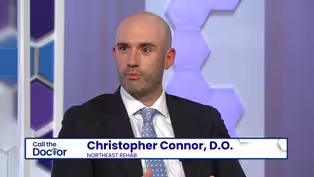
- I'm Dr. Christopher Connor.
I originally grew up just a little north of here.
After completing my training, came back currently with Northeastern Rehabilitation Associates for the last six years.
I see patients in Wilkes-Barre, Scralton and in Carbondale.
My practice primarily focuses on management of non-operative musculoskeletal spine complaints.
Spend half my time seeing patients in the clinic and then the other half performing minimally invasive spine procedures.
- We'll talk a little bit more about those in a few minutes and you doctor.
- Thanks, Julie.
My name is Ed DelSole I'm an orthopedic surgeon.
I'm a local guy, I'm an Abington Heights graduate, University of Scranton graduate.
As I said, I'm trained in orthopedic surgery.
I'm fellowship trained and board certified to take care of surgical conditions of the spine.
I am at Geisinger orthopedics in sports medicine in Scranton.
- So I say this every single time, but it's always true that there's so much information here that we will never get through in 25 minutes, but I'm hoping we can at least give people a little bit of an overview of the topic.
And I wanna start with basically all the many ways you can hurt your back.
If someone...
I'm looking right at you here.
So we'll start here.
If someone comes to you and says, my back hurts, where do you go from there?
It seems as though there could be a lot of possible answers.
- Sure.
There's a lot of structures in the back that can cause pain.
So that, I mean, the first thing you wanna look at is ask them their age, you know, see how old they are and see what they've been doing.
Was it something activity related?
Is it, is, does the pain shoot down the leg?
Is it something more that's been ongoing for long periods of time?
So depending on how long it's been going on or how it manifests, if there's numbness, tingling, or weakness, you treat all of these types of things differently.
And so you can have a disc issue in the back, a bone issue, a nerve issue, joint issues coming outta the spine.
So a lot of different ways.
And of course don't forget, muscle related issues and myofascial issues.
So there's a lot of different ways you can hurt your back.
So it all starts with that history and physical examination, seeing the doctor and us doing our assessment.
- This really...
I mean, you're kind of like detectives, it seems there's a whole lot of different directions you could go with a complaint.
- Oh, absolutely.
- You'd mentioned earlier.
I mean, we were talking a bit earlier about the comprehensive approach to treating back issues.
I think that was you Dr. DelSole, what did you mean by that?
- Well, I really loved treating the spine patient because it's sort of, everyone is kind of a unique puzzle.
You're trying to fit all the pieces together to try to understand what's generating the symptoms.
And what's the best way to treat that.
And as a surgeon, I'll be the first to tell my patients, not everybody needs an operation.
In fact, most people, the vast majority of people who have a back condition will never need to have an operation.
And so how do we treat that problem in sort of a team based approach between physical therapists, physiatrist, primary care physicians?
That's sort of the comprehensive care of the patient because many things that are not musculoskeletal can cause back pain, gallstones, kidney stones, all these things can create back symptoms.
And I think keeping sort of a team around you to manage your spine condition probably makes the most sense.
- So you talked about different ways that you ask a patient, is it shooting down your leg, et cetera?
What... Could you walk us through maybe what a patient would, the questions that they might ask you or something that you might ask them to try to ascertain where to go next?
Dr. Connor?
- I think that the biggest in kind of my first step is okay, obviously the location of the pain, what brought it on, oftentimes to go back to your first question, can be insidious.
I mean, there's many times where they just kind of start noticing pain that they hadn't noticed before.
Some of the things I like to know, and I find very helpful is, well, what kind of things make the pain worse?
What kind of things make the pain better?
Those oftentimes in my opinion, kind of give us clues as to maybe what's causing some of this pain that might be persistent for a while.
- So step one, are there times when someone can figure out exercises or other things that they might do at home, is there some back pain that can be treated just at home if someone wanted to do that?
- Yeah and majority of back pain, especially kind of new onset back pain, which is obviously very common.
It usually resolves within four to six weeks.
So many times these patients haven't seen a physician, they might have seen their trusted physical therapist or a chiropractor, or just with the age of digital media exercises online, there is a lot of resources out there for patients, whether through the American Academy of Orthopedic Surgeons or just even on YouTube and different platforms where there's a lot of different websites available.
- So you would suggest some movement then as some way at least initially if you figured out that it wasn't an acute issue.
- I always tell my patients movement is medicine.
So as long as they're able to move and they don't have any worrisome findings such as, acute weakness in a leg or other issues, which we can get into, yeah movement is typically a good thing.
- From... Go ahead you wanted to say something?
- Yeah so I think...
So I agree with you.
I think when we talk about doing things at home, just have to be aware of how the pain came on.
So if we're, if we were moving a couch and we started having back pain and we see that it's resolving as the time goes on, in a short period of time or a fairly reasonable period of time, as we do some stretches or things at home, then that's great.
If we're having back pain, that's kind of creeping up on us and it's kind of gradually increasing in intensity over time.
That's something that might need to be evaluated.
And so staying home may not be the right, answer at that time.
So different things that, as a person, as a patient really look at kind of how this came on, if it makes sense that, hey, this is just a simple back strain or a muscle problem.
I did something silly or yesterday I had an extra level of activity.
Sure, absolutely.
Treat this at home.
But just be aware that there's other things that can kind of really be more serious so that we have to be aware of like Dr.DelSole talked about.
- And when should people seek treatment?
I mean, I know that there's probably more than one answer to that question, but when do you suggest people pick up the phone and call their doctor if they're really having trouble?
- My opinion is if you have pain that's been going on for longer than six weeks is progressively getting worse and is associated with any sort of concerning neurologic problem, right?
That would be weakness.
That would be progressive numbness.
That could be challenges going to the bathroom that are sort of sudden and unexpected.
Weight loss that you've noticed being progressive over the course of several months or weeks.
Fevers, chills associated with the very focused area of pain in your back.
Those could be signs of a really concerning issue.
And so in those scenarios, I would definitely recommend calling your doctor.
- So we went over some, at home remedies and obviously there's physical therapy, but before we get to surgery, there has to be a number of different interventions.
Could you talk a little bit about what those might be?
I'll give that to the two of you.
Sure.
- When we look at conservative management, conservative care, we talked about doing kind of stretches at home, exercises at home.
So depending on what this is, again if it was some, it was an issue lifting a couch or something that you feel is something, related to a muscle issue, then you can do stretches and exercises and probably be okay.
Some stretches and exercises actually can cause more problems depending on what your issue is.
So if you're having pain going down the leg and you're doing exercises that are more with bending forward, that can actually aggravate certain types of issues where you'd wanna actually lean back.
Sometimes you can have arthritis in the back and that can, exercise where you're leaning back and actually be aggravated by those types of exercises.
So we have to be kind of careful with those types of things.
In the past, we used to talk a lot about ice.
This is probably debatable, but I in general prefer heat, and low backs at this time.
And of course there's always over the counter Tylenol and ibuprofen, but when you get evaluated, if the pain has lasted, six weeks or so then certain things like chiropractic treatment or massage, maybe your first way in you may, a lot of people seek chiropractic treatment for first back pain.
And that's not necessarily the wrong thing to do.
As long as your chiropractor is... You feel confident that your chiropractor's doing appropriate an assessment and asking you about your symptoms and doing a proper examination.
- [Julie] Okay.
- So that's one of the remedies.
- Yeah to expand on that.
So almost a kind of a stepwise approach.
So we have the physical medicine based approach with PT, chiro, home exercise program, therapeutic massage, acupuncture, which is, becoming more popular and more mainstream as well for these issues.
And then if symptoms do persist beyond that, that's where sometimes we will try to work a little bit harder at figuring out the true cause of the back pain to really kind of find that pain generator we call it, which then sometimes we might have to target with either a diagnostic or therapeutic injection or a intervention around the spine.
- You say injection.
And I think I automatically think of a steroid, but there has to be many other types of injections.
- There are.
And that's the tough part sometimes.
If patients come in and say, well, I had a cortisone shot in the back, it didn't work.
There are... And sometimes they don't, but there are a lot of different types of injections and procedures.
And as we were talking earlier, I would say at least half of what we do are more diagnostic in nature.
So really trying to find the pain generator, because there may be a procedure that doesn't involve cortisone that can be done for more therapeutic, longer term relief.
Or sometimes it can be helpful for a surgeon as well if we did put lidocaine on this nerve or this area, and it did temporarily relieve pain.
And this might help with some of their assessment, going into potential surgery if the conservative options don't work.
- Is it that you will try to avoid surgery if you can, or is it more that some cases just require it and some cases don't?
- I think both are true.
I think if you are coming in with a pure pain syndrome, it'll be nice to avoid an operation because plenty of times, as we said, the symptoms will subside.
There are scenarios where surgery is the ideal treatment.
Those are scenarios where you're having neurologic issues.
Those are scenarios where you have an infection that's best treated with an operation, scenarios, where you have a deformity, something like a scoliosis, scenarios where you may have a new diagnosis of a cancer that goes to the spine.
Those are scenarios where surgery would certainly be something on the table as a major part of the discussion.
Although in many cases, still not necessarily a requirement, it's a case to case situation.
- And I imagine there are many different kinds of surgeries as well.
It's probably way more than we can handle here, but can you detail a few of the ones that you most commonly perform?
- Absolutely.
I tell my patients this all the time, there are basically three, basically three kinds of spine procedures.
One is called decompression.
The idea being there is something putting pressure on a nerve in your spinal canal, we need to take the pressure off the nerve.
And that's a great way in many cases to relieve pain, that's in the extremities, the legs, the arms.
It can also relieve some back pain.
There's a second kind of operation, which is called a fusion.
A fusion is basically taking two bones in your neck or your back and trying to get them to heel to one another.
- [Julie] Okay.
- The reason to do that would be if there's abnormal motion between those bones or if there's a deformity, like we said, a scoliosis that would be a reason to consider a fusion.
There's a third kind of operation, which has become popular over the last 10, 15 years, which is a motion preservation procedure.
And there are many different kinds of this, but I would say the most common would be called a disc replacement.
That's still sort of an up and coming procedure, and we're still doing a lot of research to try to figure out who's the best candidate for this kind of a procedure, but the outcomes so far are positive.
- What kind of follow up then is required?
Will people need to have a second surgery down the line, or will they then go back to say, there's someone who will handle the physical therapy or what's the, what happens after surgery?
- Sure.
And I think it depends on the patient and what the overall pathology or problem in the spine is.
Classically we do talk about something that we name it adjacent segment problem.
So if you have had a spine fusion, the likelihood of you needing to have another spine surgery in your lifetime, because the level above or the level below starts to wear out is probably around 30%, depending on how old you are at the time that you have that operation.
And so, yeah, it is definitely a consideration.
We think that motion sparing procedures may decrease that risk, but we're still working through that.
- If I could just add-- - Of course.
- Kind of circle back where, when talking about more pain syndromes with patients and okay, should I see a surgeon yet or not?
I try to always tell my patients when dealing with back issues, the timeline is a lot different than what you might be used to with like a shoulder elbow or knee injury, right?
We're kind of used to maybe three months, might be feeling better by six to eight week, but by three months, you're kind of back to normal.
Spine is not like that.
And spine does take much longer.
So if you can be patient and with some of these other kind of conservative options that we talked about, the goal sometimes is just to kind of get you through that period of time, whether it's more like six or 12 or 18 months where then kind of the body can heal itself to an extent, or some of that pain just doesn't become as big of a limiting factor.
And I guess function is a big thing too.
And so obviously the neurologic issues obviously surgery, but patients when they're trying to kind of decide, should I go for surgery function?
Right?
That's what it comes down to for me is, can you live like this?
Is it interfering with quality life and function?
- Yeah, that's the question we ask the same thing as people say, hey, when do I need surgery?
If the examination is fairly normal from a neurologic standpoint, like we were talking about, we're not looking at any big cancers or things that need immediate surgery.
What we as doctors call red flag symptoms.
So when you can't live like this any longer.
But for us, I think, patients that have surgery and don't have surgery, may stick with providers like myself and Dr. Connor for the conservative management and mitigating symptoms sometimes even lifelong because back conditions don't generally, may not go away.
So you may end up with management.
So this may look like I feel good.
I did some activity.
My sciatica is aggravated, right?
My..
I have pain down my leg.
It improves with stretches, exercises, maybe some anti-inflammatory medication or ibuprofen leave, maybe an injection from the doctor.
And then this cycle kind of goes up and down over the next couple of years.
And so that is management.
So then you get better as a patient knowing what works and what doesn't work.
I shouldn't be lifting that.
I'm not helping people move any longer.
I may not be able to run or do the specific type of activity.
And we're here to kind of help, A, find, make sure that this is the same issue and not a new issue, 'cause you can always have new problems.
And the second thing is we're here to help give you tools in your toolbox to help manage your pain, whether it be stretches, home exercises, chiropractic, massage, acupuncture, medications, and there's different types of devices and units that can be used at home and then pain management injection.
So these are all different options within that comprehensive plan of care that we talk about.
And then finally, we need to make sure that you're not at the point where things have degraded to the point where you absolutely need an operation.
So that's kind of why some back patients end up being kind of our lifelong patients.
- You both brought up timeline and I'm wondering, I do know people who had injuries in high school who as grown adults are still dealing.
Why does back pain... Why is it so pervasive?
Why for some people does it just never get better?
- Wait, I don't think we understand.
I don't...
I think that the most, the least understood patient is probably the most common patient, which is the chronic patient with pure back pain who's had it for a very long time with a great deal of arthritis throughout the back.
We don't have a great understanding as to why.
And the evidence for that is that you can look at their pictures, the x-rays, the MRI, and you can see problems.
If you do operations to fuse the spine and try to fix the problems 50 to 60% of them have no relief in their pain.
And what does that say?
That says that we really don't understand what we're operating on or that the operation in that kind of patient doesn't really work very well.
So we have a fair understanding of cancers and infections and sciatica pains.
The, chronic back pain symptom with arthritis is probably the least understood and is probably the most complicated issue.
- The other thing that is complicated that I wanna touch on is something I didn't even think about until the three of you showed up today for the panel, which was the connection with the psychological.
If someone has back pain and has been dealing with that for a very long time, how does that factor into, how do you treat them?
You can all chip in if you like on this one.
- It's exhausting.
I mean, so, you know, as a personal, I mean I have back pain with bulging disc and sciatic.
I ended up missing work yesterday actually because of it.
So it actually flared up.
So here we are talking about this and here I am, but I'm here and I've had back pain since high school, but it is exhausting.
And the management is exhausting because it does take you doing, watching your weight, continuing with your stretches at home exercises, maybe having regular visits to the chiropractor, taking...
Sometimes taking medication.
So it's and a lot of times these patients will go from specialists to specialists, looking for something new or miraculous to make things better when it's really going back to these core principles of living a healthy lifestyle, doing your stretches or home exercises and kind of being okay with having some pain, maybe in that two to four zone and understanding that if I do something, that I shouldn't do posture body mechanics wise, that I may jump up to that six, seven, eight, nine level.
- Interesting.
- Yeah.
And healthy lifestyle choices like you touched on is a huge thing that probably we don't spend enough time talking with patients about, Like in chronic back pain to diabetes, it's a chronic condition.
Patients have to take an active role in their management and it's not something that is gonna go away oftentimes, right?
But you can successfully manage it and managing it means you can still kind of live a meaningful and active life speaking on depression or different mood issues that are associated with it.
We do rely a lot on some of our psychological colleagues and pain psychologists are a very useful resource to have.
- How much of that do you see Dr. DelSole.
- It's very common.
Chronic pain is an emotional experience too, right?
I mean, I think it is the kind of thing that can really take a very sort of even keeled person and just make them feel crazy because they can't seem to understand and wrap their mind around why they're in so much pain all the time.
We know from some of the literature that's been written, there's a great association between depression and chronic pain.
And it's probably this sort of cycle where you're in pain and you feel bad about it because you can't do the things that you'd like to do in your life, whether that be working or holding your child, right?
These things sort of snowball.
And they create this cycle that's difficult to break.
But all these things are, pain included, are just perceptions and responses to some kind of a stimulus that the brain has.
But it's a very interesting dynamic between your emotional and physical response to pain.
- It seems like a natural connection, but one, I hadn't really seriously considered.
- It's common.
I think most patients that I see who are in a lot of pain are also not just having the worst pain that they've ever had, but they're sort of in their worst emotional state that they've been.
And hopefully we try really hard to get them out of that.
- The actual definition of pain has the emotional component right in it.
It does.
- [Julie] Really?
- Yeah.
- I was gonna ask you actually, the, one of the last things we have time for here is if you have a message, what's one thing that you will hope people take from this or something that they might, you would hope that the public can pick up about this.
Is there a misconception that you'd like to speak to?
- I think the most important thing on my end is to realize that, being diligent in the stretches, the home exercises.
And what we define in PT may be the difference between, and, a healthy lifestyle with respect to weight and sleep.
Maybe the difference between managing pain appropriately and not ending up on an operating table versus pushing the envelope to an operation.
- Yeah I tell my patients, you have to be your best own advocate.
So if something doesn't seem right with you, you could always seek another opinion, but like we just touched on, it really does come down to management of a chronic issue for a majority of people and it can be done successfully.
It will take a team.
And at times it's gonna be easier and tougher.
- [Julie] Hard days too.
Yeah.
- Yeah.
- I agree with everything that was said.
I think that surgery can be a fantastic solution for patients with the correct problem.
Sometimes it's literally like flipping a light switch, they wake up and they feel normal again.
And that's a tremendously, exciting thing for patients to go through and it's been, and it's great for me to be able to help people get that and achieve that.
But for many patients, there's really no silver bullet.
And just like Chris said, there is really this concept that I think people need to grasp.
And that it's a chronic thing.
It's like having a heart condition.
You know, if you can treat a heart attack, you fix the blood flow, everything is good, but you still have a living beating heart and new things can happen.
And, it may be a lifelong commitment to managing and advocating for yourself.
That is what's needed the most.
- Well, thanks to all of you.
I know there's not enough time for all of the questions we would have, but I appreciate your expertise and you're being here today and that's gonna do it for this episode of, "Call the Doctor."
For all of us here at WVIA, have a great night.
We'll see you next time.
(upbeat music)

Living with Back Injuries - Preview
Preview: S34 Ep11 | 30s | Watch Wednesday, May 11th at 7pm on WVIA TV (30s)
Providing Support for PBS.org
Learn Moreabout PBS online sponsorship
- Science and Nature

Explore scientific discoveries on television's most acclaimed science documentary series.

- Science and Nature

Capturing the splendor of the natural world, from the African plains to the Antarctic ice.












Support for PBS provided by:
Call The Doctor is a local public television program presented by WVIA