ARTEFFECTS
Local Feature: Episode 1104
Clip: Season 11 | 6m 54sVideo has Closed Captions
Featuring Jill Altmann, a textile artist from Reno, Nevada, who creates one-of-a-kind pieces.
In this segment, we meet Jill Altmann of Reno, a textile artist who creates one-of-a-kind pieces using handcrafted dyes and techniques.
Problems playing video? | Closed Captioning Feedback
Problems playing video? | Closed Captioning Feedback
ARTEFFECTS is a local public television program presented by PBS Reno
ARTEFFECTS
Local Feature: Episode 1104
Clip: Season 11 | 6m 54sVideo has Closed Captions
In this segment, we meet Jill Altmann of Reno, a textile artist who creates one-of-a-kind pieces using handcrafted dyes and techniques.
Problems playing video? | Closed Captioning Feedback
How to Watch ARTEFFECTS
ARTEFFECTS is available to stream on pbs.org and the free PBS App, available on iPhone, Apple TV, Android TV, Android smartphones, Amazon Fire TV, Amazon Fire Tablet, Roku, Samsung Smart TV, and Vizio.
Providing Support for PBS.org
Learn Moreabout PBS online sponsorship- Hello, I'm Beth Macmillan and welcome to "ARTEFFECTS."
In our featured segment, we meet Jill Altmann of Reno.
Using her own dyes, created from flowers and vegetables from her garden, Altmann combines weaving and knitting techniques and textures that result in beautiful, one of a kind pieces.
Let's head to Altmann's studio in South Reno where she brings her inspiration and creativity to fruition.
(upbeat music) - I'm Jill Altmann and I live in rural South Reno.
I have an amazing view of Mount Rose to Peavine.
I find inspiration where I live.
I'm a textile artist.
I weave on a loom.
(loom bangs) And I use a knitting machine.
I use the same yarns on the knitting machine that I do on the loom.
We have an acre of grapes where we make wine from our vineyard.
They're getting there.
And we have a garden where I grow edibles and flowers that I use for dyeing my yarns that I use in my work.
(upbeat music) I hand make everything that comes out of the studio.
I buy my yarns from suppliers that get yarns from all over the world.
I mostly work with cotton and linen, and then I work with wool, wool alpaca blends, and things that have nice texture and nice hand.
I take the human body that is a form of sculpture and I drape art on it.
My fabrics are my artwork.
I shape my textiles, my fabric into clothing that people wear.
(upbeat music) The uniqueness of my work is a compilation from a lot of my travels and seeing what other cultures have done, and specifically, I have to say what is worn in Japan has greatly influenced me, because they're based on shapes that were cut from cloth, that there was zero waste.
They had manipulated the cloth in the technique called shibori, so they were folding, clamping, stitching, pleating, and then putting it in the dye baths.
And when they brought it out, that was the design.
This dye pot is indigo.
It's all done with natural materials, which I have outside.
So it's indigo, it's calcium hydroxide, and it's fructose, so it feeds on fruit sugar.
So to keep it really active, you use banana peels.
(upbeat music) You have a lot of control, but then you lose it when you put it in the dye bath, because the dye bath seeps, and then there are different colors that happen.
And you never know until you take it out of the dye pot what you're gonna have.
I think it's very, very important that individuals educate themselves, that they see a lot of art shows, they see the techniques being used, and they use the inspiration that other artists have used in their work in their way, and that's what I try to do.
I keep binders of inspiration ideas or museum pamphlets or other artists' work.
I use buttons that are handmade primarily.
I use silversmiths buttons from Genoa.
I had him make pre-Euro coins into buttons for me that I used on my work.
I like to have artisans work on my work, the way the Navajo used coins and the buffalo head nickels as their closures and as their artwork and on their jewelry.
I wanna connect myself with past cultures and past artisans and people.
And it's important that not only I learn from that, but newer people who are coming into the craft feel that connection with the past going forward in making their own work.
I often get a question, "How long did it take you to make this?"
It has taken my whole life to create these one of a kind pieces.
The best moment of all is when it's cut, sewn, I try it on, or the customer comes in, picks it up, and they stand at my front door and they go, "Yeah, you got it."
That to me is the ultimate compliment and affirmation.
- [Narrator] Funding for "ARTEFFECTS" is made possible by Sandy Raffealli with Bill Pearce Motors, Heidemarie Rochlin, in memory of Sue McDowell, the Carol Franc Buck Foundation, and by the annual contributions of PBS Reno members.
(upbeat music)
 New
NewVideo has Closed Captions
Clip: S11 | 7m 24s | Discover the Western Lights Illuminated Art Festival in downtown Reno. (7m 24s)
 Now Playing
Video has Closed Captions
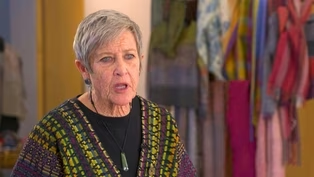
Clip: S11 | 6m 54s | Featuring Jill Altmann, a textile artist from Reno, Nevada, who creates one-of-a-kind pieces. (6m 54s)

Video has Closed Captions
Clip: S11 | 12m 7s | See Nevadans decorate the 2025 U.S. Capitol Christmas Tree with 10,000+ handmade ornaments. (12m 7s)
Video has Closed Captions
Clip: S11 | 9m 41s | The new Charles and Stacie Mathewson Education + Research Center at the Nevada Museum of Art. (9m 41s)
Providing Support for PBS.org
Learn Moreabout PBS online sponsorship















Support for PBS provided by:
ARTEFFECTS is a local public television program presented by PBS Reno