OPT Documentaries
Lost and Found on Route 66
Special | 54m 44sVideo has Closed Captions
Discover what’s been lost—and found—on Route 66.
A century after the creation of Route 66, the Mother Road still finds new ways to surprise explorers and provide stories to those who exit the interstate and follow the road less traveled. Whether it's forgotten places given a new spotlight, or the stories of brave new ventures, Route 66 has found a way to thrive in a new millennium.
Problems playing video? | Closed Captioning Feedback
Problems playing video? | Closed Captioning Feedback
OPT Documentaries is a local public television program presented by OPT
OPT Documentaries
Lost and Found on Route 66
Special | 54m 44sVideo has Closed Captions
A century after the creation of Route 66, the Mother Road still finds new ways to surprise explorers and provide stories to those who exit the interstate and follow the road less traveled. Whether it's forgotten places given a new spotlight, or the stories of brave new ventures, Route 66 has found a way to thrive in a new millennium.
Problems playing video? | Closed Captioning Feedback
Where to Watch OPT Documentaries
OPT Documentaries is available to stream on pbs.org and the PBS app.
MAN 1: This program was made possible by the generous support of.
WOMAN 1: Liberty, working to create a more sustainable future in the communities they serve by providing clean, renewable energy and strengthening the grid.
Information at libertyenergyandwater.com.
WOMAN 2: Great Southern Bank is committed to improving the places we call home by sharing resources, getting involved, and volunteering.
Learn more at greatsouthernbank.com.
MAN 1: OPT member Jan Baumgartner, supporting lifelong learning and storytelling in the Ozarks in loving memory of her husband, Gary Baumgartner.
MAN 2: Citizens Memorial Hospital, dedicated to meeting rural health care needs throughout eight counties in Southwest Missouri.
Information at citizensmemorial.com.
SUSAN CROCE KELLY: My personal connection goes back to when I was a very small girl.
There was an old blacktop road near us.
My mother told me, I was about five, I think, and my mother would say, this is the most famous road in the world.
And I remember thinking, this?
You know.
But of course, my mother was right, as mothers always are.
And she told stories about Route 66.
She talked about going down to the highway and seeing movie stars drive past.
The whole business of the highway, of the world coming to her.
JEREMY MORRIS: What is Route 66?
I guess the technical answer is that it's a 2,500 mile stretch of road through eight states from Chicago, Illinois to Santa Monica Pier.
But I think the real answer is that it's a two lane delivery system to interesting people.
DAVID ESLICK: Everybody in the world knows about Route 66.
And it's funny, 65 highway runs from the coast to the border, and 71 runs that same way.
You don't hear much about them, but everybody knows about Route 66.
RENEE CHARLES: You get to see everything.
You get to see the openness of America, the people.
It's a dream.
It's the American dream.
SUSAN CROCE KELLY: The idea of getting in a car and traveling wherever you want to was just amazing, because travel had been so difficult.
JEREMY MORRIS: I think originally, especially for people of the Ozarks, it was freedom to go somewhere else.
Most people at that time didn't travel very far from their home, even in their own lifetime.
It's the route.
There's nothing like it, period, that takes you that far and has that much interest, and that there were so many people that made their living along the way.
In a hamburger shop, a gas station, a garage, motel, what have you, that was their livelihood, period, along the way.
And they built it from the ground up.
KATHLEEN SEALE: I think Route 66, more than a lot of stories across the US and Missouri, is a diverse story.
It's female owners.
It's Black travelers.
It's immigrant communities that you can see how they all interacted and were a part of the Missouri story and how they built these communities up.
JASON PATRICK: I think it's a slice of Americana.
You know, the American dream.
It's this last bastion of the best of America, of yesteryear.
And people just, they just want to be a part of it.
They want to touch it.
They want to taste and feel it and smell it.
JOHN SELLARS: It's beautiful.
It's just beautiful.
It shows you what a wild and beautiful and diverse land we live in.
[bright music] JEREMY MORRIS: Route 66 through the Ozarks, I call it a primal road.
It's much older than the 1926 pavement.
So prior to 1926, it was the old wire road, which is where the telegraph followed during the Civil War.
Prior to that, it was the Springfield to St.
Louis road.
Prior to that, it was an Osage walking trail.
That's not the first travelers of the road, though.
The original travelers on this road were herding animals.
There are bones of mastodons and herding animals that forged that path.
So we call it Route 66, but it's a primal road that was forged by mastodons.
CORA SCOTT: The development of Route 66 is what you would call a sea change in American culture.
So before that ability to travel all the way across the country, it was very difficult for especially the average American family to see states or cities outside of their home base.
So it allowed for commerce and development to happen all along that route.
So several things were invented as a result of Route 66.
Certainly the drive-through, which we had the first drive-through in America in Springfield.
JOHN SELLARS: I knew Red.
Red and Julia were two of the finest people you ever want to meet.
And Red, he was a go getter.
He was a fascinating man.
But his restaurant, it was an experience.
It was a place to go.
And he was as entertaining as any human on Earth.
He had a drive up window, which was built into the side of his house there.
He was very passionate about giving very quick service.
KATHLEEN SEALE: Red's is a true icon here in Springfield, due in large part to the sign.
So it was called Red's Hamburg.
It was supposed to be hamburger.
But when he gets the sign, he realizes that it's too close to the power line and has to cut off letters at the end.
And such is born Red's Hamburg.
CORA SCOTT: A lot of what we know of the American road trip culture came from Route 66.
KATHLEEN SEALE: Cars are becoming a little bit less of a luxury and more of a natural item for a family to own.
And I think Route 66 really plays into that and fed off of that a little bit.
And this is where you see a rise in new architecture, of being more modern and more unique and interesting, and again, feeding into the car culture.
So you have the drive-ins.
You have drive-in theaters, you have more drive-in restaurants, just making it easy to pull in and get back on the road.
JOHN SELLARS: So many of the little motels, I mean, people would be worn out from driving some little old car on a rough road for hours on end, and they needed a place to stay and rest.
And the little motels that we have hundreds of still left in this area, a lot of them built out of natural stone.
Beautiful places that are finally being restored a little now.
We have some wonderful local people here that are working to restore a couple of them, that are taking them back to the way they looked back in the day.
My name is Phyllis Ferguson, and I own and operate the Rockwood Motor Court with my husband, Tim Phillips.
The Rockwood is on old Route 66.
It's been in operation since 1929.
This year, the centennial year of Route 66, makes us 97 years old and the oldest court or motel that's still in operation on Route 66 from Chicago to LA today.
The Rockwood started as a tourist camp, as most of the old courts and motels did, and it was for people who were traveling the East West corridor from Chicago to Santa Monica.
A very important time in our country.
With the Rockwood opening in 1929, saw people who were traveling, a lot of them out of desperation because of the hard times of the Depression, which had hit in October of '29.
It was built in 1929 by Deverne Ruckman, and there's some controversy about whether Deverne is a woman or a man, but it seems that Deverne is a woman.
So for 1929, a woman opening a motor court that the family home was here.
My husband and I live in it today.
There was a Shell filling station and then the six cottages behind the family home.
For us, it's been just a very interesting time to not only renovate and restore the motor court so that folks today can come and have that authentic experience, but also for us to get to meet the people who travel Route 66.
Around 1948, it got a facelift, and that was this giraffe style masonry.
So it's Ozark sandstone, and it's put up on the side of a building stuck up there.
And then they put the mortar in and they take this extruded mortar and they make lines all around the rocks.
So when you step back from it and you look at it, it looks like the spots on a giraffe.
The reason I think the Rockwood has survived is it started out in a pretty rough time, and that is that we had the Great Depression within months of it opening, and then it went through World War II, which actually, I believe, was a boon to many of these small businesses that we had travel related to the military coming through here, especially with Fort Leonard Wood.
When times were good then, after World War II and people were traveling and had some money through the '60s.
For Tim and I, when we started restoring the Rockwood in 2019 and opened on December 31 of that year, we had no idea that two months and seven days later, COVID would raise its head.
And we were a little apprehensive, not sure what would happen.
But as it turned out, COVID put people back on the roads.
And those vacations they were taking internationally, they had to figure out how to make a road trip and stay at home.
So we got extremely busy during that time.
So I think it's just some grit and determination that's kept these old places open like this.
DAVID ESLICK: Word of mouth is what fills those up.
People stay there and then they put it on Facebook that they've been there and they love it.
And Tim and Phyllis are great.
And so they end up filling up that motel.
PHYLLIS FERGUSON: We were inducted into the Historic Hotels of America, and it's something we're really proud of.
It's a small group of historic hotels or lodgings in the country.
We have managed somehow to exist for 97 years, almost 100 years on Route 66.
That's a pretty big deal.
I mean, not just for Rockwood, but for the other places, the old places that it's not always been easy, but somehow, some way, people managed to keep them operating.
For African-American travelers along the road, especially in the early years, it could be incredibly difficult in a lot of states.
They weren't allowed to stop and stay for the night at most hotels or motor courts along the way.
There were a lot of restaurants where they couldn't stop and get food, even service stations where they couldn't stop for gas.
JOHN SELLARS: African-Americans traveled the road very tentatively.
There were a lot of places at that time that were dangerous for them.
And so something called the Green Book came out.
And Mr.
Green, who was a postman on the East Coast, began to develop a book that people would send in information to him about places to go and places not to go.
And he listed all those in the Green Book, and it made it safer for them to travel, because they knew exactly where they could stay and other places to avoid.
We had a couple of places that were in the Green Book.
Graham's Barbecue was one of them.
KATHLEEN SEALE: Graham's Rib Station was a Black owned restaurant here in Springfield that was one of the very few places where Black travelers could actually stop and sit down and eat.
And it was very successful for many, many years.
So it wasn't just local families that were visiting Graham's, but a lot of people who were traveling along the road, passing through Springfield, or might have stopped here for the night that were able to go there.
JOHN SELLARS: Graham's Barbecue was the first barbecue place in Springfield.
Wonderful food.
And they totally had no thought of what your ethnicity was.
They served and catered to anybody and everybody.
Always just a great place to go and get barbecue.
Alberta's Hotel was a place for them to stay.
They also had a restaurant there.
She had also a campground outside the city where they could park out there and camp.
Alberta's just one of those self-made legends, not just of Route 66, but of Springfield, of the era.
She was a woman who owned and operated a successful business during a time period when a lot of women didn't.
And on top of that, she was a woman of color who was doing this.
So she had a very successful hotel here in town that was the place for Black travelers to stop.
So Springfield's growing at this time.
They're bringing in a lot of well-known entertainers, celebrities.
But if they were Black, they were not allowed to stay at any of the white hotels in town.
They weren't allowed to frequent a lot of the establishments.
So for the most part, they stayed at Alberta's.
And she had a rumpus room where people could go for entertainment and dances.
She ran a tight ship and keeping it clean.
But you had people like the Harlem Globetrotters who were stopping and staying at this individually family run and owned operation.
ELIZABETH LOGAN CALVIN: Keep in mind, because we were right on Route 66, all of the musicians that were traveling, and let me say, African-American musicians traveling from East to West or West to East, they were coming through Springfield.
And if you're driving or in a bus or in a car, you know you've got to stop somewhere.
So one of the places where you stopped was in Springfield and at Alberta's Hotel or at Graham's.
Graham's Motel.
If you were going to stay somewhere, that's where you stayed.
IRV LOGAN: So Alberta bought the house next door, and she opened up her first-- what did she call it?
The Snack Shack.
The Snack Shack.
IRV LOGAN: And so kids would come there and spend their money, and she wanted to make sure everybody was safe.
KATHLEEN SEALE: Alberta went a step further of it wasn't just a haven, last resort, had to go to it.
She made it into something that was welcoming, that people legitimately wanted to go, even if it was just local people going to hang out at the rumpus room, if it was travelers, if it was some of these celebrities passing through.
It was a destination for them.
ELIZABETH LOGAN CALVIN: She was a woman ahead of her time.
She really was.
And to think about what she was able to accomplish, she was amazing.
Route 66 is like this umbrella for creativity.
It doesn't matter what you're into, but it allows you to experiment with it and show it to others.
So people show up here all the time, and the first question they ask is, what is Red Oak II?
And I tell them, well, it's an ongoing art project.
It's a historical preservation village.
It's a Route 66 attraction, it's a Jefferson Highway attraction, and it's also our yards.
This is 100% private neighborhood.
Lowell Davis was a local artist, sculptor, painter.
In the 1980s, he created these farm figurines that were sold in about every gift shop in the country.
And so he bought the farm next door.
He moved back home from Texas.
And he thought, well, I've got this cornfield here.
What am I going to do with this?
So he started moving buildings from his hometown of Red Oak I, which had become kind of a ghost town about 30 minutes East of here on Route 66, and started moving buildings one by one and created a town.
It's basically a 3D painting you can walk through.
This is what I love about Lowell.
He said, you know what?
I'm just going to make my own city.
And that's what he did.
And we live in it now.
Oh, he was a character.
He would smoke his corncob pipe and he had an ascot, and he always had a little hat on, and he kind of shuffled around and sat on his porch every night greeting people from all over the world.
We get about 60 or 70 countries every year in our yards just wandering through here, and he would meet them all.
He'd tell some stories.
At least half of them were true, I'd say.
And he was an interesting character.
And he's buried right here at Red Oak II.
You can come see his grave.
But this is his legacy.
And so we're continuing his legacy, you know.
Yeah, he's eccentric.
And all the folks that live here are a little eccentric.
But we really care about what he did, and we want to preserve it.
All the buildings have some kind of a tie to the area, whether it be to an old schoolhouse, whether it be a jail, a blacksmith shop, general store.
It's all kind of a theme.
We progressively moved around the facility and bought different buildings at different times.
JEREMY MORRIS: We have about 50 or 60 structures total, and most of them are pretty historically important.
So right across the street, we have the 1841 Jasper County Courthouse, also known as the George Hornback Cabin, which was the first courthouse in Jasper County.
You see a lot of architecture and a lot of buildings that would have just fallen in and fallen apart, and local ghost towns or just local fields where they laid.
A lot of them have historical significance.
So we want to preserve those.
Also, you get an idea of what an 1890s to 1930s kind of pre-World War II town would look like.
To me, saving these buildings to say, OK, you have something to talk about, something real, versus just building a brand new building and there's no history, you know.
And again, preservation is just extremely important, because when it's gone, it's gone.
KATHLEEN SEALE: It's really this strange, interesting walk through the past, because there's all decades and time.
It may be the only snapshot history for the entirety of Route 66 history of it runs through all the decades.
I think it really speaks to the Route 66 spirit of ingenuity and imagination and building on what you have.
JEREMY MORRIS: People ask, do you have HOA's?
Do you have-- it's like, no, we have peer pressure.
You can do whatever you want here.
We're off grid.
We're outside city limits.
If you want to put a giant totem pole or a bottle wall, you can do whatever you want.
If we don't like it, we'll tell you.
We're a community.
This is our child care center.
And since I guess I'm the new Sheriff, I don't have the key to that.
So sorry.
Don't lock your kids in there.
OK, so this is the Elmira school.
Dates to 1884.
We try to keep everything in good shape, roofs, everything like that, just to preserve everything.
JEREMY MORRIS: At Red Oak II, our favorite color is rust.
We call this a hillbilly limousine.
So the general store, this was the Walmart Supercenter of Red Oak I. And I'll take you inside.
This wasn't just a store where everybody shopped.
This was the social center of the community also.
But as you see, here's a little picture of Lowell right here doing what he loved best, painting.
So Lowell Davis learned art here.
This is where he kind of became an artist, and he actually lived in the back.
His father was the proprietor here, and the family lived in the back.
This is why the town exists right here.
These little figurines.
These figurines were in every gift shop in the country in the 1980s.
And Lowell said, what am I going to do with this money?
I think I'll just make a large version of the miniatures.
Once you're here, people feel something here.
There's a little bit of magic at Red Oak that you may not find in a typical neighborhood.
And people show up and their first question is, what is this?
What is this place?
There's something in the air at Red Oak.
We have 9 or 10 full time citizens here.
I would say that everybody that lives here is a preservationist.
There's nothing convenient about living at Red Oak II.
We all are very much deeply engaged in preserving these buildings and the history, and most importantly, the stories of the people who lived here.
I came to visit Lowell Davis, who was the artist who created Red Oak II in July of 2004.
And I never thought I'd be moving here.
The only regret I had was that I didn't move earlier.
Lowell Davis himself was very appealing.
I had collected his art, so he was inspiring.
As his town was, I think, his ultimate work of art, this place that we're in right now, Red Oak II.
It's kind of peaceful, but yet you have a lot of visitors coming through.
In the summer, we get all kinds of people from Europe doing Route 66.
And it's just great to sit on the porch and talk to them, which is what Lowell would do.
JEREMY MORRIS: In most communities, you don't have people from Italy or Spain or Australia just walking in your yards every evening.
We don't have a lot of privacy, because it is an attraction as well as a private neighborhood.
So I've had people just waltz in the house, thinking we're a prop house or a movie set, and then they realize, oh, someone actually lives here.
But there's no place like it.
I sit outside sometimes after work, and my front yard is a stage for the entire world.
Just the other evening, I had 25 Italians in my greenhouse.
They were just kind of wandering around, so I took a group photo with them.
Where else is that going to happen?
I can meet people from literally 70 different countries just sitting on that front porch.
It's amazing.
Route 66, one thing I didn't know when I moved to Red Oak II, is that it was going to become my family.
So we all show up for each other.
We all cross-promote each other.
We hand off to each other.
And I'll say, go see the Brileys down the road.
And they're going to say, go see Aaron down the road.
So we hand off to the next person and the next business.
AARON PERRY: Gearhead Curios is a 1939 Texaco station on Route 66, in the Jefferson Highway that is now a roadside attraction in its old fashioned roadside attraction form.
It's a souvenir and gift shop, and it's also a tourist information center for the state of Kansas and for the Jefferson Highway.
It was a derelict building.
In October 2018, I purchased it and it became Gearhead Curios then.
And I'm technically the owner, but I call myself the curator of Gearhead Curios.
Well, outside we have neon, which that's roadside America, neon.
We have our vintage pumps.
We have along the west side of my building is Big A, a 22 foot tall Texaco giant.
Also on that side of the building is our tag flag, which is 169 Kansas license plates that make the American flag.
And then inside, really it's kind of uniqueness everywhere.
But on our ceiling, it's covered with license plates from all over the world that has been gifted by travelers.
And we are internationally known for our restroom.
All right.
Come on in.
I wanted a pink restroom.
That is a 1952 pink toilet.
Pink and white checkerboard floor.
I heated and bent wrenches for hooks for your jacket, your bag, whatever.
Recycled pallet wood, diamond plate aluminum, a C clamp and wrenches for the toilet paper.
The divider is 1930s Model A Ford hood sides.
A powder coated funnel is a urinal.
Those things on the floor, what they do is eliminate the guesswork.
The gas pedal is the flush.
The sink is an oil drain basin with a brass gas pump nozzle.
I heated and bent wrenches to hold all that.
Foaming hand soap in an oil can.
1958 Ford radiator, '59 Ford valve cover, '62 Oldsmobile Starfire air cleaner cover.
The swag lights along the wall are 1930s headlights, and this is the old continuous roll towel dispenser.
And this is a public restroom.
I like to think that they're coming here because it is nostalgic America.
It's a roadside attraction.
We are on Route 66, which is internationally known, so we are kind of a staple stop in Kansas for Route 66.
[bright music] There's only 13.2 miles in Kansas, and there's a rich history here.
And I think Kansas has really embraced and tried to preserve.
I mean, we have the only Marsh Arch Bridge, the Rainbow Bridge to the west of us here, that's older than the road itself.
And we've kept that dream and that vision alive with that bridge.
When they did the research Pixar did for the movie "Cars," they traveled Route 66 extensively, and they met people and they saw places that they incorporated into the movie.
And our little stretch of Kansas has a lot of impact for the character Mater.
Down the street from us is an old Kan-O-Tex station that has the inspiration for the character Mater.
It's a 1951 international boom truck.
Over in Baxter Springs, there's a character named Dean "Crazy Legs" Walker.
He's the inspiration as to why the character Mater goes backwards.
I'm called "Crazy Legs" on Route 66, because I can turn both feet completely around backwards.
It's fun.
I'll pick somebody wearing hard shoes and he'll take my foot backwards, then he'll get the picture with me.
Then I'll start counting down from 10 to 0, turn them.
5, 3, 4, 2, 1.
I'm going to flip.
Ready?
I did it one time and a lady passed out.
It was here.
Remember that?
Freaks them out really good.
RENEE CHARLES: Dean Walker is quite a character.
He met the animators on our Rainbow Bridge, which is the only Marsh Arch Bridge on 66.
Dean gets out there and he flips his feet around, because he's double jointed, I believe, at the knees and ankles, and he flips them around.
The Pixar animators were so amazed by it, Dean actually stated a couple of times that they took so many pictures that it blinded him.
When he was doing it, he said, "look what I can do."
So he is kind of a goofy character.
And so it inspired him to make Mater drive better backwards than he does forward.
And also, he's one of the inspirations that make Mater so goofy.
The entire movie is based on dying towns along Route 66.
When the interstate came through and bypassed these towns, a lot of them became ghost towns.
We died.
We basically died.
So Galena, when we first started in '06, there was maybe three or four businesses on our Main Street.
That was it.
There wasn't anything going on.
There was nobody interested in what we had here, except the people coming to see Mater or the foreigners that have always traveled 66 even before our shop was here.
I'm so excited that since "Cars" came out, I have children from the age of five, three that come in here, all the way up to 30 years old that have seen the movie "Cars," and that's one of the reasons why they traveled 66.
So in my head, I believe that the movie "Cars" saved Route 66.
Cars.
on the Route is a refurbished Kan-O-Tex station.
We are the home of Tow Tater, the inspiration for Tow Mater in the movie "Cars."
It's a 1951 Harvest International.
People from overseas love it.
You can see our foreign money that we have here and that people just started giving us.
I started making memories, and now I have my grandchildren that work here, my daughter that works here, my son that works here.
My son and my husband built the drive-through shield that's around the corner.
They're both veterans and they built the shield two years ago.
So just dragging them in and sharing the love, sharing the love of Route 66.
I think that's what it's all about.
KATHLEEN SEALE: A lot of it for me is tied into family and memories.
And I think that's what it is for a lot of people.
A lot of the stories that I hear are people remembering road trips with family that they took as a kid or young adult or something.
And it's tying that back into that family time of you are stuck in that car for hours with people.
It is firmly in the American culture of Route 66, not only in the US, but even internationally.
There's always been this push in American history of adventure, of travel, of getting out on the open road.
And I think Route 66 is often seen as like the last place you're able to do that.
You're still getting off the main highway.
You're getting off the interstates.
You're winding through the towns.
You're actually stopping and seeing the sights.
You're not just moving from point A to point B. You're experiencing a little bit more of the Missouri countryside of these mom and pop shops and everything.
CHRIS BRILEY: Supertam Ice Cream is a Superman museum and ice cream parlor located in Carterville, Missouri.
We've been here since 2006.
It was started by a man named Larry Tamminen.
It was called Superman on 66.
And Warner Brothers reached out and said, you can't call it Superman on 66.
You've got to change the name.
So being his last name, Tamminen, the T-A-M, he came up with Supertam on 66.
The way that he came up with the idea for the ice cream parlor is a place to keep his Superman collection.
He had been collecting Superman since he was a kid.
He grew up in New York and he's in his late 70s, early 80s now.
So he had been collecting Superman since he was a little bitty kid.
He wanted a place for his Superman collection.
But he wanted something for them to be able to do when they came and looked at his Superman stuff.
We all have that inherent goodness.
We want to be the good guy.
We want to fight evil.
We want to do what's right.
And I think that Superman really calls to us to be that wholesome, good person.
Supertam is right on the old alignment of Route 66 in Carterville, Missouri.
Route 66 is very important to us.
I grew up traveling Route 66 with my parents.
Larry grew up here in Carterville, which is right on 66, and he started the Carterville Association many, many years ago.
Most of the ice cream parlors or soda shops that's still on Route 66 are not chains.
They're mom and pop, family owned, small little businesses that when you step inside, you're slowing down.
It's an opportunity to put your phone away, play the games on the table, talk with the owners.
We love visiting with our customers when they come in and asking them about their trips or where they're going, where they've been.
A lot of them have 13, 14, 15 hour flights just to get here, and they've saved up for years just to do this little trip on Route 66 that you and I take for granted all the time.
We live here.
And who wants to honeymoon in Carterville, Missouri?
But with them, it's such a lifetime dream just to be on our little road.
And it's an honor for us.
We should respect that.
And people come in to get to know America, and we are the heart of America.
KATHLEEN SEALE: I think it really opened up a lot of opportunity for Missourians.
So you had a lot of stretches of 66 through Missouri that are just through very rural, smaller populations.
You don't have a lot of large cities between St.
Louis and Springfield, especially at this time period.
Some have grown up, like Waynesville and St.
Roberts area, with Fort Leonard Wood and Lebanon grows during this time period as well.
And I think a lot of that is in part because of Route 66.
You have one community.
It ends up becoming called Basketville, because there's essentially just a couple families that make baskets.
They were very well known along Route 66 for their white oak baskets.
But not just baskets.
They did stools and chairs, and they were able to survive through the Depression era in their homes, in their communities in these rural areas, because they were able to have this kind of cottage industry.
And they sold not just at their own stores, but would actually load a car up full of baskets and chairs and such and sell them wholesale to other businesses along Route 66.
So people were able to make a living, and they were able to do that while still living in their homes and not having to move to larger cities, or even to commute to larger cities for opportunities, for business opportunities.
Younger generations were able to come back home, work for the family business.
They were able to stay there and not have to move off and look for work.
After it got bypassed, it's also at the same time that the patriarchs and matriarchs of those family, those people that were teaching everyone how to do these skills, are getting older.
Some of them have died at that time as well.
It really just dwindles from there.
In the 1950s, especially with the 1956 Highway Act, is really the beginning of the end for Route 66.
So this is when you start having the building of interstate highways.
That, of course, meant that the farm to market roads, the Route 66's of the world that went down Main Street were going to be bypassed.
And that started as soon as the interstates went under construction.
JOHN SELLARS: And it became more of a get from point A to point B just as quickly as you can rather than seeing the sights and interacting with the people and finding out what they were like.
And so it really changed the whole atmosphere, and it cut off a lot of little communities that withered and died because they didn't have that traffic to them anymore.
KATHLEEN SEALE: You had communities that were essentially completely cut off from any of that travel.
Over time, businesses closed.
People moved out looking for better opportunities.
They faded away.
A lot of them are just not ghost towns, but just one small gas station taking care of the people that live there nearby, and that's about it.
KATHLEEN SEALE: I think a lot of people don't realize the things that aren't there anymore.
Even now, as I'm learning more and more about the road, I'm learning about these locations and then realizing I've driven past that site so many times and didn't realize that once stood there.
JEREMY MORRIS: In 1985 when it was decommissioned, immediately some businesses were boarded up, or they had to transfer their business to the interstate if they could afford to.
But we lost a lot of the character of some of these towns.
There's kind of a homogenization that went on.
So on the highways, the idea is just to get there fast and every stop kind of looks the same.
Prior to that, every town had its own flavor and its own personality, and some of that definitely was lost.
JOHN SELLARS: That uniqueness of each little community, those businesses that weren't anywhere else, like Red's giant hamburg and those little restaurants and the curio shops and the dime store and whatever that were just unique to each one of those places, that uniqueness has gone away and been replaced with a uniformity of the same everywhere.
SUSAN CROCE KELLY: The loss of going through Main Street and going through little towns, you don't have any sense of who the people are or what was there.
I think that the sense of community that has existed in the United States has partially been lost because of the driving experience, that you're not going from town to town to town.
And a lot of times it's more convenient, I'll give you that.
But I think there's a loss involved.
RENEE CHARLES: The mom and pop places that you can go in and get a sundae and dip your fries in it or get a greasy hamburger that was worth eating, I think that when the interstate came in, you missed those spots.
You missed the uniqueness of the road.
We tend to tear down our history and put something new that doesn't last as long as the historic places that we tore down.
JASON PATRICK: We're in such a rush to get everywhere that we're going so quickly, so we can do whatever it is that we're wanting to do.
You forget to stop and smell the roses a little bit and enjoy the sights.
And I think that's probably one of the biggest things that we've lost.
Obviously, businesses and things like that, and that's always a terrible loss for communities and for people.
That's their livelihood.
But if you want to look more philosophically, I'd say it's that we've kind of lost the journey rather than the destination.
SUSAN CROCE KELLY: In 1985, the last piece, a couple of miles in Arizona, was finally closed off and Highway 66 became no more.
But within a year or two, there was a barber in Seligman who talked his acquaintances and associates into starting a historic Route 66 association.
And that was the official beginning of the nostalgia and all the Route 66 associations we have today.
And all the people, 2 million people, come from all over the world every year to drive down that road.
KATHLEEN SEALE: The Route 66 associations, especially early on, were very preservation minded.
They were interested in this is what we have left.
And if we don't do something now, there's not going to be anything to save in the future.
In the 1990s, especially for here in Missouri, there was this huge push for preservation, revitalization.
And there's still a lot of people that actively see opening a business on Route 66 as an opportunity, because they can promote themselves not just locally or even within their state, but they almost put themselves on a national map as being part of something bigger, because they are.
They're now part of this larger Route 66 community, and they can tie into that.
DAVID ESLICK: I'm a historic preservationist.
I have served on a lot of preservation boards.
And preserving the buildings is really important.
But if you don't have these stories that go along with those buildings, those buildings don't mean much.
And everybody has a story.
KATHLEEN SEALE: Gary's Gay Parita is probably one of the real icons of the preservation era of Route 66.
It is really-- and not just in Missouri, but across Route 66.
It is kind of one of those shining examples of what can be done as far as preservation, restoration, of highlighting Route 66 history, and making it a success.
JOHN SELLARS: Gary's Gay Parita is like an amusement park for Route 66 enthusiasts.
It's all built up with buildings that he's brought in there from other places.
JASON PATRICK: The Sinclair station in Gay Parita, just up the road from here, Gary who was there, he passed away.
And just absolute legend of the route and had a story for every place and a story to tell everyone.
And he would tell you the stories.
He'd talk your ear off.
Those kinds of interactions and those kind of locations are kind of my favorite.
BARBARA TURNER: Gay Parita was originally opened by Fred and Gay Mason in 1926.
The station burned down for the second time in 1955.
My dad, Gary Turner, when he got the property from my aunt and uncle, he wanted to recreate a gas station.
My uncle and my cousin built the station for my dad that's here.
The garage and the house and the feed store are original to the property, which the garage and the feed store are over 100 years now.
And then the house is about 85 years old.
So we have people from all over the world that come and visit here, and they come just to see all the nostalgia here, because it's on Route 66.
That's what people want to see is Route 66.
So they stop at Gary's Gay Parita.
And my dad made it a really famous place.
JEREMY MORRIS: Traveling Route 66 is different, and it's kind of a romantic path through the woods, especially in the Ozark plateau.
You never know what's around the next bend.
It's not a super slab airline traffic highway that just cuts through the mountain.
Route 66 goes around it.
There's a sense of mystery, because you never know exactly what's around the next bend.
And that's part of the excitement.
JASON PATRICK: It's a slower pace, you know.
It's about the journey, not the destination.
That really hits home and comes into its own on Route 66.
You got to just take it a little slower.
You got to breathe.
You got to relax and just enjoy the journey.
And it's very conducive to that.
JOHN SELLARS: It gets people to slow down a little bit and stop and see what there is to see.
There's so many beautiful things and so many interesting things along the highway.
DAVID MEDLOCK: Well, it's a good way to meet people that has the same idea about old cars.
We've been doing this for 20 years that we'd meet here and drive Route 66 to Rolla, what they call the Rolla Fest.
And tomorrow, they'll have a big car show over there at Rolla.
It's just a hobby mainly.
The older generation, they enjoy riding around in them and showing them off.
BETTY MEDLOCK: The beautiful cars, they come and get together.
The people you meet, the friends you make, and it's just relaxing when you're out cruising with everyone and meet up.
No, it does not have air conditioning.
It's the window down with your hair just blowing and you just enjoy it.
You pay attention to everything.
The trees, the wind.
You just drive and enjoy the drive.
DAVID MEDLOCK: It's just fun to get away and do stuff like that and forget about all the worries in the world.
We went to Springfield two weeks ago.
[upbeat music] CORA SCOTT: The Birthplace of Route 66 Festival is an annual event in Springfield, Missouri, which is the birthplace of Route 66.
It happens in downtown Springfield.
We have about 55,000 people show up annually to celebrate classic cars, the freedom of the open road.
We have a lot of concerts.
It's good food, good eating, family fun for everybody.
We always have a classic car parade that's very popular.
We have several hundred classic cars that travel Route 66 through Springfield.
The concerts are really important, celebrating the musical legacy of Route 66.
DAVID ESLICK: It brings people together, and there's different goings on, events in those festivals.
The festivals that we have, it just invites community and invites fellowship, that if we don't have those.
I think that people are going to realize we really messed up and we need to get back to slowing down, visiting with people, just slow down and enjoy life.
Life's too short to go as fast as we go.
JASON PATRICK: If you don't stop and talk to the people and your fellow travelers of the route, you've missed the entire thing.
For me, traveling it when I did the entirety of it in '15, after I'd gotten out of the army, I did it by motorcycle.
I met so many people along the way, and a number of them have remained friends for the last decade, and I still keep in touch with them.
The best experiences I'm going to remember are meeting the folks.
Again, it's a pilgrimage tour.
There are temples.
There are shamans.
There are priests.
You get to see lots of different landscapes.
You get to see a wide swath of Americana, and you get to meet a lot of interesting people.
So each state kind of has its own personality.
If you go through Illinois, it's the land of refurbished gas stations.
Missouri, when you get to the Ozark plateau across the river basin, you're going to see a lot of neon motels and interesting places like that.
When you get to the Kansas Plains and Oklahoma, you're going to see the land of giants.
You get to see deserts, historical sites in Arizona, New Mexico, some mountains.
And then by the end, you get to see the ocean, and you can ride a giant Ferris wheel and celebrate at the end.
It's an amazing journey.
It's not just a road.
It's a group of people, eccentric, all different, but unified.
We have a common purpose.
We're all different.
We're different culturally.
We're different politically.
But we all have this common purpose and this common goal, and we all come together for this great road that we live on.
It's a family.
I mean, I know people up and down the road.
They know me.
We send stuff, messages, pick on each other.
We actually ship stuff with travelers.
They deliver things to each other.
I met my fiance because she was delivering cards from my friend Beth at the Highway Cafe in Vinita, Oklahoma.
We communicate all along the road.
It's a linear village of 2,500 miles.
It's basically one town.
And so we all talk.
We have our own delivery system.
We call it roadie delivery system.
We need to move something up the road, someone visits my house and I visit the next house and we just carry it on.
We support each other.
We cross-promote each other.
Route 66 is constantly evolving.
The strength of Route 66 is that it's a DIY, do it yourself, ma and pa kind of operation.
So individuals trying to get you to beckoning you into their businesses or their restaurants.
It's also the weakness.
So when someone passes away, we lose stuff if there's no one else to take it on or shepherd it to the next generation.
So we recently lost the totem pole shop in Rolla, which was a big loss.
That was one of the oldest continuously operating businesses on the route.
And once it closed, it was bulldozed pretty immediately.
JASON PATRICK: It's important to preserve all that so we know where we came from.
If you don't know where you came from, it's kind of hard to figure out where you're wanting to go.
Each one of these buildings here at Red Oak II, each one of these businesses along the route, every personality of the route, that's a connection to that history, and it keeps that alive for the next generations to come along.
It preserves a little bit of that undefinable something, I think, of Americana and American culture.
LARRY FRICKENSCHMIDT: Where do we come from?
Who made this country?
Who built this country from nothing to what it is today?
And that's part of what this Highway 66 situation did.
It helped build the country.
JEREMY MORRIS: It allowed people to travel further than they ever had before.
So prior to that, we were one of the last places to get electricity, to get good roads.
And so Route 66 kind of expanded the culture of the Ozarks by spreading it.
And Ozarkians were allowed to go places they had never seen before.
JOHN SELLARS: It's a vital part of our history.
It's a piece that can never be recovered, and it needs to be valued.
JEREMY MORRIS: The road is not just concrete and rock.
It's made of real flesh and blood and all the people that actually are part of this.
Sorry, I got a little choked up there, actually.
I don't know why, but I got a little emotional.
And we put our heart and soul in this.
We actually care about this and we want to preserve it for the next generation.
CHRIS BRILEY: We don't have our ice cream shops or our businesses to get rich.
It's to meet the people.
It's to be able to slow down after a horrible day.
And you can come in and visit with a couple from France or Italy.
And it's like, this is what we're doing it for.
This is what makes us happy.
JEREMY MORRIS: You're connecting with history that doesn't come more alive anywhere else I've found than Route 66.
PHYLLIS FERGUSON: We have a guest who stays here who says that Route 66 is magic.
And if you travel it, you pick up some of its magic.
And what you get at the Rockwood Motor Court, you may take to your next stop in Tulsa or wherever and leave some of it, but you'll pick some of it up there and take it to your next stop.
And sometimes I understand what Joe is talking about.
KATHLEEN SEALE: Route 66 is really a great snapshot of the diversity of American culture.
You get rural scenic areas, you get big metropolitan cities.
It's really the full spectrum of the American story.
AARON PERRY: Come join us.
Come see it.
Come travel Route 66.
Come visit us inside and see all the amazing stuff that we have in there.
Just drive Route 66 and have a ball.
That's all you got to do.
Get your kicks, man.
There's a lot to see out on the mother road, whether it's here in Missouri or if it's in any of the other eight route states.
Get out there, learn about it, see it, taste it, touch it, smell it, feel it, experience it.
And if you get the opportunity to do all of it in one go, and you allow it to be, it'll be life changing in a lot of good ways.
RENEE CHARLES: I'm hoping that more of these small towns will be able to bring in more people, whether it's tourism wise or just restoring buildings that can be used.
I'm hoping that more people tend to appreciate history than they do now.
And I really hope that young people get involved en Route 66.
DAVID ESLICK: My passion is to see that this part of Americana, this icon, is perpetuated and saved for my great grandkids.
And I've got a great granddaughter that likes Route 66.
We're celebrating 100 years, and it'll be here for another 100 years if everybody keeps doing what they're doing.
There's more and more interest in old Route 66.
More and more people are coming to visit.
Route 66 is growing and it's alive, and I think people need to get off the interstates and back on Route 66 and check out your own neighborhoods.
KATHLEEN SEALE: Route 66 is just in its new phase of history.
It's not the nostalgic road, but it's the what's here currently and what might be there for the future.
CORA SCOTT: The next 100 years of Route 66, I think, is going to look different.
I think it's going to be about people expressing individuality and authenticity and diversity of thought, and I think that will continue to attract the future generations.
AARON PERRY: Route 66, to me, it's alive.
It's its own thing.
It is the past, it is the present, it is the future.
It is the what was, what could be, and what is all rolled into one.
It's your imagination.
It's just anything you want it to be is what it can be.
[bright music] MAN 1: This program was made possible by the generous support of.
WOMAN 1: Liberty, working to create a more sustainable future in the communities they serve by providing clean, renewable energy and strengthening the grid.
Information at libertyenergyandwater.com.
WOMAN 2: Great Southern Bank is committed to improving the places we call home by sharing resources, getting involved, and volunteering.
Learn more at greatsouthernbank.com.
MAN 1: OPT member Jan Baumgartner, supporting lifelong learning and storytelling in the Ozarks, in loving memory of her husband, Gary Baumgartner.
MAN 2: Citizens Memorial Hospital, dedicated to meeting rural health care needs throughout eight counties in Southwest Missouri.
Information at citizensmemorial.com.
 New Episode
- News and Public Affairs

Top journalists deliver compelling original analysis of the hour's headlines.
 New Season
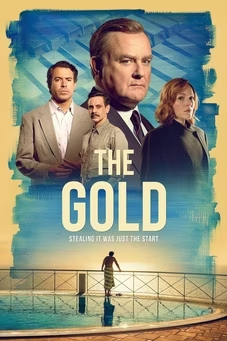
- Drama

Hugh Bonneville stars in a crime drama inspired by one of the largest robberies in British history.

 New Season
 New Episode

 New Episode


 New Episode
Support for PBS provided by:
OPT Documentaries is a local public television program presented by OPT