Call The Doctor
Lung Cancer on the Rise: Types & Treatments
Season 34 Episode 2 | 25m 33sVideo has Closed Captions
Did you know there are different types of lung cancer?
Lung cancer consistently ranks as one of the leading causes of cancer deaths worldwide. And we already know it is not just a smoker's disease. But did you know - there are different types of lung cancer? They grow differently and they're treated differently too. We'll check in with lung cancer experts here in the area about trends they're seeing.. and learn more about those different types and tre
Problems playing video? | Closed Captioning Feedback
Problems playing video? | Closed Captioning Feedback
Call The Doctor is a local public television program presented by WVIA
Call The Doctor
Lung Cancer on the Rise: Types & Treatments
Season 34 Episode 2 | 25m 33sVideo has Closed Captions
Lung cancer consistently ranks as one of the leading causes of cancer deaths worldwide. And we already know it is not just a smoker's disease. But did you know - there are different types of lung cancer? They grow differently and they're treated differently too. We'll check in with lung cancer experts here in the area about trends they're seeing.. and learn more about those different types and tre
Problems playing video? | Closed Captioning Feedback
How to Watch Call The Doctor
Call The Doctor is available to stream on pbs.org and the free PBS App, available on iPhone, Apple TV, Android TV, Android smartphones, Amazon Fire TV, Amazon Fire Tablet, Roku, Samsung Smart TV, and Vizio.
Providing Support for PBS.org
Learn Moreabout PBS online sponsorship(gentle music) - [Announcer] The Region's Premier Medical Information program, Call the Doctor.
- [Narrator] There are new estimates out when it comes to lung cancer cases in the US for the year 2022.
More than 236,000 new diagnoses, and more than 130,000 deaths, that from the American Cancer Society.
But it might be helpful to know that there are ways to screen for lung cancer.
There are different types of lung cancer, and there are different ways to treat it.
We talk with area experts on lung cancer about risk factors and screening recommendations.
Lung cancer on the rise, types and treatments, now on Call the Doctor.
(gentle music) - And hello and welcome to Call the Doctor.
I'm Julie Sidoni.
I'm the news director here at WVIA.
And this season, I will also be your moderator for this show, bringing some of the best and brightest medical minds of the area right to you.
On this episode, we're talking about something I think most people might not think too much about on a daily basis.
Lungs and what happens when they're not functioning properly.
We're really proud to welcome two experts in the field to the WVIA Studios today.
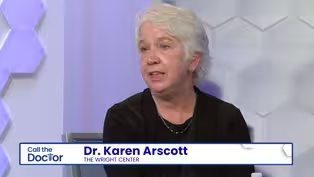
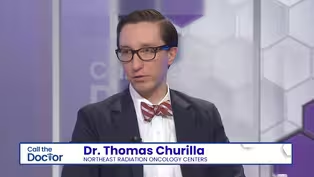
I'd like to introduce Dr. Karen Arscott from the Wright Center and Dr. Thomas Churilla from Northeast Radiation Oncology Center.
Thank you both so much for being here with us.
- Happy to be here.
- Thanks, really.
- The first thing I wanna do is just sort of open the floor to both of you.
Tell me a little bit about who you are, where you work, where people can find you and what it is that you do on a day's time.
- Okay, so I'm Dr. Karen Arscott, I'm a physician, I've been here in this area for a long time.
I work with the Wright Center.
In particular, I'm currently board certified in addiction medicine.
So it doesn't have a lot to do with lung cancer.
The reason I'm here tonight is because I've actually had lung cancer twice and being a physician and somebody who's had lung cancer, and I feel that it's my obligation to be here to talk a little bit about that process, what it was like, even though it was over 14 years ago.
- We can't wait to get into that with you, Karen.
Thank you so much.
And Dr. Churilla.
- And my name's Tom Churilla, so I'm a practicing radiation oncologist at Northeast Radiation Oncology Center, NROC.
I'm also a assistant professor of medicine at the Geisinger Commonwealth School of Medicine.
So I was born and raised in the area.
I went in West Scranton.
I went to University of Scranton followed by TCMC, now Geisinger Commonwealth School of Medicine as a part of the charter class.
So that was really exciting.
I got to meet my future work partners as a medical student, did my training out in Philadelphia Fox Chase Cancer Center.
And then was lucky enough to be able to come back and have an opportunity to work as a practicing radiation oncologist in the area.
- (indistinct) class, huh?
- Yeah, so it was an amazing experience and met colleagues for life, but I'm happy to be here because as a practicing oncologist, we see cancer every day and we're always happy to share some guidance in terms of how to reduce risk, how to get the best possible treatment in the area and a pleasure to be here.
- Well, episode number one talked a lot about different types of screenings.
We didn't get into lung cancer screening in particular, but I'm really interested in what the two of you had to say just a few minutes ago about lung cancer screenings.
I'd like to know a little bit more about what that screening is, and maybe who might be the person who doctors are hoping get that screening, how often it has to happen.
I'm not real familiar with the lung cancer screening recommendations if you want the truth.
- Sure, so lung cancer screening has been around for almost 10 years now.
It's been covered by insurance and I believe Medicare Medicaid caught on in 2013.
So nine years ago.
Lung cancer screening is by far the easiest screening.
I laugh and say, there's, you don't have to prep for it.
You don't, nothing gets squished and nothing gets poked.
You literally just lay down on a table, put your arms over your head, - Take hands up.
- And take a deep breath in.
And it takes just couple minutes to do.
Who is eligible for it?
Currently it's anybody who has smoking history of 20 pack years.
So 20 pack years is a pack a day for 20 years.
So if you smoke a half a pack a day for 40 years, that's 20 pack years or two packs a day for 10 years, all of those equal 20 pack years.
And then you have to fall within the age range of 50 to 80.
And if you quit within 15 years.
So let's say you were 50 years old or 50, let's say 50 years old, you smoked 20 years, but you quit 10 years ago when you were 40, you would still qualify and it would be covered by insurance for you to have lung cancer screening.
And the key with any screening, as I'm sure you talked about in your other episode is to catch it early.
The idea with cancer is the earlier you get it, the easier it is to treat and the more likely the patient is to survive.
So that's the goal with lung cancer screening.
- And that is the case with lung cancer as well, as well as any other type of cancer.
- Yes.
- So Dr. Churilla, nine years really isn't that long, it's a fairly new screening.
Wouldn't you say what types of, 'cause I don't wanna put you on the spot with statistics, but what are you seeing?
What's the medical community seeing in those nine years from those screenings?
- Yeah, so I'd just like to echo what Dr. Arscott had mentioned about how we have really strong data.
There's been several large randomized controlled trials showing a benefit.
The national lung screening trial was one of them that was performed right here in the United States.
We had about 50,000 people that were randomized to simple chest radiograph versus these low dose CT scans.
And it showed a 20% reduction in lung cancer mortality, which is a strong number, particularly for how common lung cancer is.
So I'm an advocate, we see and deal with cancer every day and we see it firsthand that the cancers that are most curable are the ones that are early stage.
The problem at lung cancer is that the small curable tumors don't really cause symptoms.
So unless you are enrolled in a screening program, it's not until the tumors become larger causing symptoms, or if they've spread and they're no longer curable that they can be found through traditional methods.
So I think, Dr. Arscott and I were talking a lot about awareness among clinicians, among people, I'd encourage everyone who might fit the criteria that Dr. Arscott had already outlined to discuss with their primary care physician, the pros and cons of screening and engage in shared decision making and consider it.
- Are there cancer screening?
- So there could be some cancer screening.
In total, the benefit outweighs risks.
We have large organizations like the USPSTF, the United States Preventative Task Force that evaluate kind of the pros and the cons of screening And they found a net benefit that reduction in mortality outweighs some of the cons, but there are some cons.
As you go through lung nodules are common.
A lot of people have lung nodules that aren't tumors.
So you can get false positives or false alarms whereby you could have some anxiety that and maybe even need further testing in rare cases, you might even need an invasive procedure to find that there's no lung cancer.
So there that's the false positive could be a consideration.
There's in terms of other cons you could have over diagnosis, there's sometimes it's less common lung cancer, but it's possible that a lung tumor may never have caused a patient a problem.
So over diagnosis is another consideration in anxiety associated with the process.
There's also a small amount of radiation associated with a low dose CAT scan.
If you look at some studies, they quantified about 2.4 milli C-VATS.
If you look at the amount of background radiation, someone just by living encounters, it's about that much.
So there's a small amount of radiation each time.
So there are some cons, but that net benefit of reducing risk of dying from lung cancer outweighs those cons.
- Anecdotally, have you seen lung cancers that were caught very, very early in these very tiny stages?
- We certainly have, yeah.
So we've in my practice, I've seen a lot of patients that had been engaged with screening programs with either their lung doctor or their primary care physician, had a low dose screening, had a nodule, had subsequent imaging and, or a biopsy that proved a lung cancer and then went on to successful curative therapies.
So we do see it.
It's nice to see not only in the trial, but being born out in real practice as well.
- So Dr. Arscott, you had an interesting statistic, again, not to worry so much about the numbers, but it seems as though overall lung cancer diagnoses are up, but lung cancer deaths are actually going down.
- Yeah, so I'm the co-chair of the PA Lung.
So that's in organization locally.
We're more about awareness and support for people who are diagnosed with lung cancer and their families.
And for the past couple years, we've put flags on Courthouse Square in Scranton.
Many of you have probably seen them.
And so for so many years we put 1600 flags out 'cause 160,000 people died of lung cancer every year in the United States, which is a huge number and this, but over the last three or four years, what we've found is that the number of people diagnosed with lung cancer, that number's going up, it went from 220,000 for a fair enough, for a period of time.
So about 235, 240, something like that.
But the number of people who have died went from 160,000 to 135,000.
So that's a really interesting number that, so we have an increased number of people being diagnosed, but fewer were people dying from it.
And so this year when we did our flags, we actually did a segment for the number of people who didn't die this year.
So we put a different color flag over there and we thought that was kind of an interesting perspective to show that there is hope.
- It's all about screening.
It sounds like that particular statistic.
I mean, it sounds like you're catching it that much earlier.
- I think so, I think so.
- Well before we get to the different types of lung cancer and we're gonna get there next, but I do wanna hear a little bit about your personal story If you don't mind sharing that, how you found lung cancer, how yours was treated in particular.
- So my initial lung cancer was found when I was 46 years old, very healthy.
I have no known risk factors whatsoever.
And it was an incidental finding.
I was having a problem with my hand and they did some scans.
They found a scan.
They found a nodule in my right upper lobe, felt it was inconsequential because again, I had no risk factors.
- Right upper of the lung?
- No, it was my right upper lobe, right in the middle of the lobe too.
It had nothing to do with what was going on with my hand.
So they said, "Just have a repeat CAT scan in four to six months."
And I said, okay, I really put it in the back of my head.
Didn't really think about it.
I was worried about what was, I was having some problems with my hand.
And five months later I went for my CAT scan and when I had it, I went to a 3D CAT scanner, which I had never, and as a physician, I was like, I wanna see this 3D CAT scanner.
So I asked if I could take a look after it was over.
And the technician said, "Sure, you can see what the scan looks like."
So I had it, and when I looked, the nodule had doubled in size in that five months and it was speculated.
And so I knew then what it was.
- What does speculated mean?
- So it means it has like things coming off of it.
And so I knew that it was a lung cancer.
And so here I am, 46 years old, healthy, no risk factors whatsoever.
And I'm facing lung cancer.
So I had to go through all the workup and everything.
And so they did the surgery and it was a stage 1A, it was only one and a half centimeters.
So they felt it was a surgical cure.
Unfortunately, I had, 16 months later, I had a metastatic lesion.
So it spread to the middle of my chest.
So outside the lung, but into the mediastinum in the middle of my chest, which made me a stage three.
And with that, then I had to have, I had chemotherapy and then I had another chest surgery.
And then I had chemotherapy and radiation at NROC.
And that was 14 years ago.
And so here I am after stage three.
- So people seem to think in many cases, lung cancer, that's it.
I've heard that from a couple of people and you are, here you are right here saying it's not, that's not always a case.
- It's not a death sentence.
And even now I had through this, I became an advocate for lung cancer.
I have friends from around the country.
I had a woman friend of mine who was diagnosed about the same time as me, six months before me who was stage four at diagnosis.
And she literally, she just passed away this past November at 61, but 15 years stage four, which is just unbelievable.
I mean, she did a lot of clinical trials and such, but the thing that lung cancer's changing, it's the treatment for it.
And the screening, but also the treatment.
Treatments have changed drastically for lung cancer.
So it's not a death sentence like it used to be.
- Perfect segue to go back to Dr. Churilla when it comes to the different types of lung cancer.
I didn't even know that, that there were different types.
Can you explain what those are?
- Sure, so the way I look at it, whenever you have a mass or something suspicious for lung cancer, you have to in general, do a biopsy to figure out if it is a cancer, and if so, what type?
So for lung cancer, there's two major types.
There's what we call small cell lung cancers, and then non-small cell lung cancers.
That just refers to the type of cell that they are.
Small cell lung cancers are rarer.
There may be about 15% of all diagnosed in the United States.
They tend to be more rapidly growing.
They tend to spread faster, involve more organs of the body, and are treated differently than say a non-small cell lung cancer.
So non-small cell lung cancers, there's two major types.
There's what we call adenocarcinomas and squamous cell carcinomas.
Again, that refers to the specific cell type in the lung that they arise from.
And what we're learning a lot about now is that the biology of lung cancer is being better elucidated.
So as Dr Arscott was mentioning, there's a substantial proportion of lung cancers that are not associated with smoking that tend to have different mechanisms that drive them, things like EGFR mutation and ARCHER arrangements.
These are molecular underpinnings that tend to make these cancers stick, and there could be some targeted therapies that could be beneficial for patients like this.
So in general, when you have the type of lung cancer it is, the next most important thing is to determine the stage or how big it is or how far it has spread.
So there's three broad groups, you can have a localized lung cancer, one that's localized to just the lung.
You could have a regional cancer, one that has spread to some of the lymph nodes in the center of the chest.
And then you can have distant spread or metastatic spread or stage four.
Those are all synonymous terms, whereby a cancer has left the lung and went to an area far away, such as the brain, the bone, the liver, or the other lung.
- So is there, I mean, this is kind of an elementary question, that is there a type that you want to have?
Is there a type if you hear that you have lung cancer that it's more treatable than others, or are they all simply did a front and treated differently?
- So in general the prognosis is better for a non-small cell lung cancer than it is for a small cell lung cancer.
And the next most important thing is the stage.
So if you look at those cancers that are non-small cells that are localized to the lung, if you look at about five year survival rates, it's about 60%.
In general for cancers that are more advanced or more regional, it's about 30% survival at five years.
And those that have spread to distant parts of the body, it's about a 6% survival.
With that said, there's a broad range in how people do and how they respond to therapy.
So you can have patients that have widespread spread of cancer that has been checked, kept in control at some of the newer biologic therapies or some of the immunotherapies.
So there's an wide range in terms of how people do and how any one person would respond and how their tumor would respond.
- Biologics as in the same things that are used to treat autoimmune issues, or, I mean the same type of not to get brand names into the mix, but those same type of home injectors, or is there something different, a different kind of immunotherapy that I'm not aware of?
- So they have targeted therapy.
So in my particular case, I was adenocarcinoma with an EGFR mutation.
They didn't have targeted therapy 14 years ago, so I did not receive it, but now they do.
So they have specific types of treatments that target like the epidermal growth factor receptor in particular, or the ALK mutation in particular.
So they look for the target the specific mutation to see if there is a way to target it with these treatments.
Oftentimes they do give the targeted treatment along with a standard chemotherapy, and I'm not an oncologist, but I do believe that oftentimes you get both of those.
- You've mentioned that treatment has come a long way.
What's an example of that?
And you can each give one 'cause you each had a lot to say about this particular topic that this is kind of broken wide open, really.
- So I think probably the targeted therapy and the immune system, the immune modulator says the therapy, those two are within the last.
The targeted therapy for EGFR came out right around 14 years ago when I was diagnosed.
Again, I didn't get it, but it was just starting to come out then.
But the immune modulate, that's within the PD-L1, that's been the last five years maybe, I would say.
So there's new treatments coming out all the time.
And even as we sit here, I'm sure that there are new treatments going through all the different clinical trials and such.
- Surgery is different as well.
- Yes, surgery is very different.
So I was fortunate in 14 years ago, well, 16 years ago when I had my first, I had what's called the VATS procedure.
So that's the video-assisted thoracoscopic surgery.
So it's a mini thoracoscopic surgery.
So people know about laparoscopic surgeries, where they go through your belly button with little scope and they can do all sorts of things.
With this, they go with a little scope through your ribs and they can remove parts of lungs that way.
And so the incision might only be this big as opposed to the large thoracotomy incision.
And so that's become the minimally invasive procedures for lung cancer.
And for lung surgeries has become widespread.
There are a lot of doctors doing that now.
- Do you think that has also contributed to the reason that fewer people are dying and better screening, of course, but it sounds like the treatments have gotten that much better over the last, how many years?
- I would agree with that.
So I think when you look at the decline in lung cancer mortality, I think screening can have a benefit efforts to decrease smoking, less lung cancers.
And also our therapies have gotten better.
As Dr. Arscott mentioned, advancements in surgery, some of these neuro-systemic or whole body treatments, like the targeted therapies, the immune therapies, and as a radiation oncologist, our radiation techniques have gotten a lot better too.
So our specialty revolves around treating cancers with high energy X-rays.
And one of you know of the most fascinating stories that we've seen is the use of what's called SBRT or stereotactic body radiation therapy.
It's this technique where instead of giving a six week course where you give a little bit of radiation each day, you can condense that entire course into say five large sessions where you give more of an ablative dose of radiation.
So for an example, if you think about someone with say an early stage, say a stage one non-small cell lung cancer, surgery is the gold standard.
That's the most appropriate treatment.
Sometimes patients are too frail for an operation.
Maybe their lungs wouldn't tolerate an operation, and they otherwise would not have had any other good curative therapies.
SBRT has been shown to have local control rates or being able to treat that tumor, have it scanned down in excessive about 90% in a completely non-invasive fashion.
So basically using X-rays alone.
And then when you think about as cancers get to be more advanced, we hit kind of a point of diminishing returns where we're using combinations of chemotherapy and radiation therapy.
Newer trials have shown that when you add certain immunotherapy therapies like the avelumab after standard courses of chemotherapy and radiation, you can improve survival in that fashion.
So our radiation techniques and how we integrate those with surgery and systemic therapies like chemotherapy and immunotherapies has really advanced the field as well.
- We talked briefly about risk factors and obviously people think smoking.
You're smoking, there's lung cancer.
That's not necessarily, I mean, I know you and I had a conversation just a few minutes ago.
- Right.
- Risk factors are important.
So we'll tackle that first.
What are some of the risk factors, smoking included?
- So smoking is a risk factor.
And, but there is a disconnect with that because we all know people who smoked 60, 70 years and don't get lung cancer.
Smoking causes a lot of other harms though.
Smoking is I always say the only benefit to smoking is to Big Tobacco, but smoking is a risk factor.
Really what I say is the biggest risk factor for lung cancer is having lungs.
- And there it is.
(laughs) - That's it.
- But what kind of stigma still exists though?
We know we have all of this information in front of us that people like you who do not smoke, still get lung cancer.
And still there's a stigma.
- Almost 20% of those diagnosed with lung cancer are never smokers.
And then 60% are people who already quit, who maybe started smoking when they were 15, 16 years old, smoked for maybe 20 years.
When they hit their 30s, started having families, decided to quit, but they have a 20 pack year smoking history now.
So those people are at risk and need to be screened if later on.
But the thing is that 80% of people diagnosed with lung cancer are actually not currently smoking.
And so we need to remember that.
There are 20% who are current smokers.
So what I always say is, first of all, if you have lungs and you have symptoms of anything that is concerning, please get checked.
But the other thing is, and I always say this, please don't, if somebody is diagnosed with lung cancer, please don't ask them if they smoked, because it's a very judgemental question and it's unfair, you know?
So if somebody smoked for two years in college and now 40 years later, they get lung cancer, that's a hard question to answer.
And it's did an unfair question.
- Certainly.
- Just echo Dr. Arscott's comments.
Other risk factors also include secondhand smoke that's to much lesser degree and also Radon.
That's another leading cause of non-smoking related lung cancers.
And I always recommend for people to get home Radon test kits to see if they might be at risk, but those would be other factors as well.
- Are there others that people don't know?
I mean, others that I'm missing?
- Well, I mean, there's asbestos for a specific type of mesothelioma and asbestos is an interesting one because you don't usually even develop it until 20 years after the exposure.
We're pretty good now with keeping asbestos at bay.
We know the dangers behind it, but for many years we didn't.
So asbestos, that's a specific type of lung cancer, but that is a risk factor also.
- So final thoughts if someone's watching this, what's the message that you would love for people to take home?
- If you fall in the category between 50 and 80 and you smoke 20 pack years and you quit within 15 years, please get screened.
It is so much easier to be treated when it's an early stage.
And if you have symptoms, please find someone to take care of you and ask for help because even if you didn't smoke or even if you smoked for a little bit, you can get lung cancer.
- And Dr. Churilla, how about you?
- Yeah, I'd just like echo those comments.
Lung cancer in America has a tremendous burden.
I think the best chances for cure is finding those early stages and encourage everyone to talk with their primary care physicians to engage whether or not screening might be appropriate.
And although it remains the number one leading cancer death in America.
I think there's hope on the horizon.
Our therapies are constantly improving.
We are seeing real gains when you look at data and seeing lung cancer mortality drop the United States.
So I think there's a lot of room for optimism as well.
- All right, thank you both for joining us.
It was really great conversation.
I appreciate your time very much, and we wanna thank you for tuning in for this episode of Call the Doctor.
We didn't have any questions from viewers this time around, but we hope you're gonna check out the list of topics that we're planning this season.
That list is at our website, wvia.org/ctd.
Check that out, then call the number on your screen and leave us a message.
There's a chance your question will be answered on a future show.
I'm Julie Sidoni, thank you for watching from all of us here at WVIA, and we'll see you next time.
(upbeat music)
Clip: S34 Ep2 | 1m 6s | Dr. Thomas Churilla - Northeast Radiation Oncology Centers (1m 6s)
Lung Cancer on the Rise - Preview
Preview: S34 Ep2 | 30s | Watch Wednesday, March 9th at 7pm on WVIA TV (30s)
Providing Support for PBS.org
Learn Moreabout PBS online sponsorship
- Science and Nature

Explore scientific discoveries on television's most acclaimed science documentary series.

- Science and Nature

Capturing the splendor of the natural world, from the African plains to the Antarctic ice.












Support for PBS provided by:
Call The Doctor is a local public television program presented by WVIA