
Making Character Inferences - Deirdre Fedison - Fifth Grade
4/9/2020 | 57m 30sVideo has Closed Captions
Play with words, discover characters, and celebrate your curiosity on this fun journey.
Play with words, discover characters, and celebrate your curiosity on this fun-filled journey. Created by NJTV in partnership with the NJEA and the NJ Department of Education, NJTV Learning Live remote learning classes are for grades 3-6, taught by NJ public school teachers. One-hour lessons include math, science, English language arts, social studies, physical education and more.
Problems playing video? | Closed Captioning Feedback
Problems playing video? | Closed Captioning Feedback
NJTV Learning Live is a local public television program presented by NJ PBS
Making Character Inferences - Deirdre Fedison - Fifth Grade
4/9/2020 | 57m 30sVideo has Closed Captions
Play with words, discover characters, and celebrate your curiosity on this fun-filled journey. Created by NJTV in partnership with the NJEA and the NJ Department of Education, NJTV Learning Live remote learning classes are for grades 3-6, taught by NJ public school teachers. One-hour lessons include math, science, English language arts, social studies, physical education and more.
Problems playing video? | Closed Captioning Feedback
Where to Watch NJTV Learning Live
NJTV Learning Live is available to stream on pbs.org and the PBS app.
Providing Support for PBS.org
Learn Moreabout PBS online sponsorshipMore from This Collection
NJTV Learning Live is a class for fifth graders taught by NJ public school teachers.
Galloping through Art Movements - Jason DeMaria -Fifth Grade
Video has Closed Captions
Students will identify artworks from art movements throughout the 19th and 21st centuries. (56m 24s)

National Holidays: Why Celebrate? -Jason Glezman-Fifth Grade
Video has Closed Captions
Students will explore the national holidays that are celebrated in the United States. (58m 46s)
Spoken Word Poetry - Thais Jackson - Fifth Grade
Video has Closed Captions
Students will learn the craft of writing, listening, and performing Spoken Word Poetry. (57m 27s)
Coordinate Planes with Corey Plane -Lauren Proda-Fifth Grade
Video has Closed Captions
Students will learn how to graph points on the coordinate plane to create and read maps. (57m 1s)
Design a Creature - Maria Montroni-Currais - Fifth Grade
Video has Closed Captions
Students will analyze attributes of ecosystems and then create a brand-new creature. (53m 38s)
ASL: Language & Community - Amy Andersen - Fifth Grade
Video has Closed Captions
Students will learn the three dimensions of American Sign Language. (55m 26s)
Decimal Dash! - Melissa Winters - Fifth Grade
Video has Closed Captions
Using a variety of sports statistics, students will compare, add, and subtract decimals. (56m 59s)
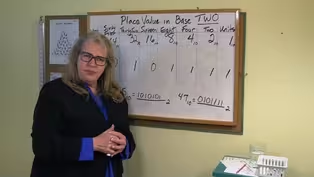
Exploring Place Value - Kristin Baker - Fifth Grade
Video has Closed Captions
Students will examine the structures of the Base Ten and Base Two place value systems. (56m 57s)
Close Reading - Tanya White - Fifth Grade
Video has Closed Captions
Students will explore how to closely analyze a text using the Close Reading method. (56m 2s)
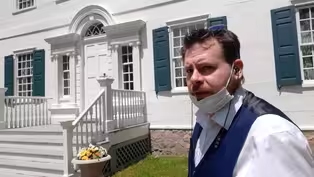
Survival at Morristown - Christopher Kopitar - Fifth Grade
Video has Closed Captions
Students will learn about the Continental Army's survival during the American Revolution. (56m 37s)
The Elements of Drama - Maleesa Lamatina - Fifth Grade
Video has Closed Captions
The students will learn basic terms for the elements of drama. (55m 38s)
Descriptive Writing: Snacks - Christine Skalka - Fifth Grade
Video has Closed Captions
Students will learn how to write a descriptive paragraph, using their favorite snack food. (57m 57s)
Providing Support for PBS.org
Learn Moreabout PBS online sponsorship>> Hello.
My name is Deirdre Fedison, and I teach specialized reading at Swimming River School, which is located in Tinton Falls, New Jersey.
I work with kids from third grade all the way up to fifth, and we work on all the aspects of reading, from understanding small sounds to reading complex text.
And whenever I'm teaching... Ooh!
I just turned the lights out.
...I'm always thinking about you, the reader, right?
But this is a little different because I don't know all of you.
Right?
So I need to think about what you could use with the books you love to read.
And I think you're gonna be able to take one of these concepts that we learn today and use it with the books you love.
So, we're going to be making inferences about characters.
And making an inference is really interesting because I need you to bring your unique experiences to the text.
So, you bring your unique experiences -- Do the hand motions with me -- and you bring it to the text, and that's how an inference is formed.
So, let's do these hand motions.
It's your unique experiences brought to the text to form an inference.
But sometimes people call this reading between the lines, meaning it's not directly there.
You have to pull it out.
[ Exhales ] Pull with me!
Come on!
Pull it out!
[ Grunts ] Yeah.
So, we have to pull it out.
And to do that, we're gonna have to be reading detectives.
So pretend you're a detective.
That's my magnifying glass.
Alright.
So, we're going to be great reading detectives, and what you need to be a reading detective with me is something to write with.
Could be a pencil, could be a marker, whatever you want.
And something to write on.
Okay?
Those two things.
It can be scrap paper, whatever you have.
Okay?
So, I'm going to hit -- when I find the pause button.
Where is that?
Oh, okay.
It's right there.
I'm gonna hit that button.
[ Groans ] Work.
There it goes.
And I'm going to let you gather your stuff.
Okay?
Alright.
Go get them.
And then come back and join me.
Are you ready?
Okay, let's start.
Okay, we're going to start with a word ladder, and a word ladder is just how it sounds.
Ladders are a series of steps, and in a word ladder, it's going to be a series of words that are going to get us to our final word.
Alright?
You ready to play?
My students should be watching and should be loving this game.
Okay.
So, we're going to start with the word "orange."
Now, this isn't a spelling test.
I'm not going to make you spell orange.
You have it right there in front of you.
So, just write it.
Okay?
I'll give you a minute.
Did you get it down?
Good.
Okay.
Alright.
I want you to take away the first letter, that "O."
What do you have now?
Cool.
Rearrange those letters to make a word that means disappointed or frustrated.
It's an emotion.
Do you need a hint?
Well, it also could be represented by an emoji that looks like this.
Do you have it now?
Yes, it's "anger."
Good.
Okay.
Awesome.
So, we're going to rearrange those words to make a word that means series of mountains or hills.
So you're gonna... Changing the order to make a series of mountains or hills.
I'll give you a picture clue.
Does that help?
Okay.
It's "range."
And you saw that before, I know.
Alright.
Range, awesome.
Now, I want you to drop the last letter and make a word that's the past tense of ring.
Should get that one.
"Rang," right?
This is more tricky, so stay with me.
Replace the A with two E's.
Okay.
Now, that's not a real word.
Now I want you to change the order of those letters.
So, you're not adding anything, you're just changing the order.
And I want you to form a color.
Think a color that represents early spring.
Right?
Do you need a hint?
I'll go get something here.
This is the color.
Okay?
Do you know now?
"Green"!
The color is green.
Awesome!
I'll drop that.
Great.
And today, we're going to be reading an excerpt, so part of, a book called "Anne of Green Gables."
And "Anne of Green Gables" was written by Lucy Maud Montgomery in 1908.
So it's really old.
Really old.
But the story is timeless.
So, I'm gonna set the stage for you.
So, we're going to meet Anne, the main character, and she's an orphan.
So, her parents have died, and she's coming to this home that she is so hopeful that will be her forever home.
And she's meeting Marilla for the first time.
And that's the interaction we're going to look at.
Okay.
So, before we start reading, we are going to preview the text.
So, one of my students calls this "taking a sneak peek."
Right?
We're going to take a sneak peek at the the words, right -- at the passage.
So, I want you to look for a couple things.
I want you to look for what stands out to you.
So what's bolded?
What grabs your eye?
How is the text organized?
Right?
And also, I want you to look for words you might not understand.
Remember, this was written in 1908 -- A long time ago.
Over 100 years ago.
So a lot of the words, we don't usually use nowadays.
So there might be a lot that you notice, and that's awesome.
Okay.
If you have that piece of paper and that pencil, you can jot down what you notice.
Okay?
So... This is about you, remember?
So I'm going to turn me off so you can look at the text.
Go away.
[ Click ] [ Chuckles ] [ Click ] [ Click ] And here it is.
Okay, so, first, what stands out?
What are you noticing?
Do you notice anything?
I notice the bolded M. That really grabs my attention.
And the author does that because they want us to start there.
I also notice that there are some words that are italicized.
And the author did that purposefully too, because those words are going to be read with expression -- a little extra oomph.
Right?
And then I look for, how is it organized?
So, I'll let you look at it.
I'll stop talking.
Do you know how it's organized?
There's a lot of "she," right, and "her."
So, it's third person, meaning a narrator is telling the story.
What else do you notice?
There's a lot of dialog.
I think you saw that, too.
Yeah, there's a lot of dialog in this text.
There's talking, right?
And now I want you to take a second to look for words that you don't understand or aren't familiar with.
And jot them down.
You can write them down.
There's a lot, I know.
But we'll bisect the text together.
We're in this together.
So, some words that stood out to me were -- I'll put my pointer on -- the word "roving."
But then, when I kept on reading, I noticed that it said, "Roving from one to the other."
So seeing it in context helped me figure out that it means, like, wandering back and forth, or drifting.
Right?
Her eyes were drifting back and forth.
And then I looked at this word "carpet bag."
And at first, I said, "Ooh, I don't know if I know that word.
Hmm.
That's obscure."
But then I remembered Mary Poppins has a carpet bag, and that's the bag that she keeps all her things in, right?
So that's what carpet bag means.
It's like our -- nowadays, we carry bookbags around.
But they had carpet bags that they would bring as a small piece of luggage.
And then I noticed the word "mellowed."
Her expression mellowed.
That's how they used it.
And that means to soften, okay?
Her expression softened.
So...now, we're going to read it chorally.
That means we're going to read it together.
And you don't have to read it with me if you don't want to, but I'm inviting you to.
And don't worry -- I can't hear you.
It's all good.
So, just try your best.
If you want, you can just read it along as I'm reading it to you.
>> So now we are going to read the passage.
You can chorally read it with me.
That means that we can read it together at the same time.
Or you can choose to follow along and have me read it to you.
So whatever way works best for you.
I'm going to read it dramatically because that helps me better comprehend the character's feelings and emotions.
Okay, let's begin.
"Marilla came briskly forward as Matthew opened the door.
But when her eyes fell on the odd little figure in the stiff, ugly dress, with the long braids of red hair and the eager, luminous eyes, she stopped short in amazement.
'Matthew Cuthbert, who's that?'
she exclaimed.
'Where is the boy?'
'There wasn't any boy,' said Matthew.
'There was only her.'
He nodded at the child, remembering that he had never even asked her name.
'No boy!
But there must have been a boy,' insisted Marilla.
'We sent word to Mrs.
Spencer to bring a boy.'
'Well, she didn't.
She brought her.
I asked the station-master.
And I had to bring her home.
She couldn't be left there, no matter where the mistake had come in.'
'Well, this is a pretty piece of business!'
exclaimed Marilla.
During this dialogue the child had remained silent, her eyes roving from one to the other, all the animation fading out of her face.
Suddenly she seemed to grasp the full meaning of what had been said.
Dropping her precious carpet-bag she sprang forward a step and clasped her hands.
'You don't want me!'
she cried.
'You don't want me because I'm not a boy!
I might have expected it.
Nobody ever did want me.
I might have known it was all too beautiful to last.
Oh, what should I do?
I'm going to burst into tears!'
Burst into tears she did.
She proceeded to cry stormily.
Marilla and Matthew looked at each other.
Neither of them knew what to do -- what to say or do.
Finally Marilla stepped lamely into the breach.
'Well, well, there's no need to cry so about it.'
'Yes, there is need!"
The child raised her head quickly, revealing a tear-stained face and trembling lips.
'You would cry, too, if you were an orphan and had come to a place you thought was going to be home and found they didn't want you because you weren't a boy.
Oh, this is the most tragical thing that has ever happened to me!"
Something like a reluctant smile, rather rusty from long disuse, mellowed Marilla's grim expression.
'Well, don't cry any more.
We're not going to turn you out-of-doors tonight.
You'll have to stay here until we investigate this affair.'"
Okay, so thank you so much for reading with me.
That was awesome reading virtually.
And now we're going to take a close look at the character Anne.
So let's do that.
There I am.
So the question is, what can we infer about Anne?
And that is such a common question.
We see that all the time, especially my fifth graders, right, making inferences about the characters.
So in order to do that, we need to think about who?
You, right?
So we're going to take your background knowledge, your rich perspective, and then bring it to the text.
And the text is evidence.
And then together, they form an inference.
Right?
But these inferences can be hard to see, right?
So we need to pull them out.
Pull them out.
Okay?
And I want you to notice, evidence plus background knowledge equals inference.
We're doing math.
Oh, my goodness.
It's a math problem.
I'm just teasing.
Okay, so let's go to the next slide.
Oh, where did I go?
Okay.
Evidence.
So sometimes when a teacher says to annotate a passage or a piece of text, we get overwhelmed and we don't know, what should we write down or what should we highlight and what should we leave, right?
And that's a really hard thing to understand.
But we are going to look at the characters.
So we're going to focus on four things.
We're going to focus on actions.
And I have a motion for it.
That's it -- an action.
Okay.
We're going to look at thoughts, right?
What they're thinking, what the character's thinking.
We're going to look at feelings, what the character's feeling.
And we're going to look at dialogue, what the character's saying.
And I'm sure you're familiar with these four things from your own writing, right?
When you write your fictional stories, you use this to reveal the characters and describe the character.
So we're just doing it in another way.
Rather than putting it in, we are... pulling it out, right?
Okay, so the first one I talked about was actions, and that's the motion for actions, okay?
'Cause those are what the character is doing.
The next is thoughts.
That's what the character's thinking.
Show me your pondering face.
Now we have dialogue.
That's what the character's saying, right?
So that moves the story along, too.
Feelings.
That's what the character feels.
Let's review.
So, now, this is sort of like "Simon Says."
I'm going to show you the word, and you're gonna do the motion.
And I'm going to try to keep my hands behind my back so I don't do the motion.
So hard.
So... I'll do it and then -- Feelings.
What is it?
Right?
I hope you got it.
Love that one.
Actions.
That's a fun one, too, right?
What they're doing.
Dialogue.
Do you remember that one?
What they're saying.
Good.
Thoughts.
I'm holding back.
I'm not gonna do it for you yet.
Do you know it?
Right?
What they're thinking.
Ponder, pondering face.
Awesome.
Now we're going to be making inferences.
And we're going to be making our own graphic organizer.
Okay, so... we're going to be looking at the character Anne, right?
And you can see that's the final product.
But we're going to start with a piece of paper, a piece of scrap paper, okay?
Do you have your paper?
Okay, let's get started.
First, who are we talking about?
Anne.
Good.
Okay, so I'm going to write that in the center.
"Who?
Anne."
I'm gonna hold that up.
You see it?
Okay, perfect.
Now I'm going to fold it.
Remember this fold?
Hamburger fold, right?
Okay.
Now we have two halves.
We're doing math again -- fractions.
Oh, my goodness.
Okay, then we're going to fold it into fourths.
And let me pull this down for you so you can see my paper.
I bring one to the center... and then the next side to the center.
Now it should look like a door opening.
Right?
Okay.
Now...if we open it up... Hey, nothing's there.
We got to turn it over.
There it is, okay?
Alright.
We unfolded it.
Boom.
Now we have to label it.
Now, we talked about evidence and background knowledge and an inference.
And we need to now add them.
Okay?
Now I'm going to put "E" for "evidence," "B" for "background," "I" for "inference," and "W."
There was no "W."
Hmm.
I'll write it, and then we'll talk about it, okay?
Alright, add lines.
So we're gonna add our lines, make our columns.
And we're just going to freehand it.
Don't worry.
It's okay if it's not straight.
And I have to make one line going from here to here.
Okay.
So yours should look sort of like mine, right?
Okay.
Now we're going to add our visuals.
Remember those motions we just did?
Well, we're going to add them 'cause they're going to help us understand the types of evidence.
So we'll do action and we'll do thoughts and a heart for feelings...and... a dialogue bubble.
Does yours look like that?
Awesome.
I'll zoom in.
Ooh!
Zoom out.
Okay.
Now, "W."
The "W" stands for "wonder."
And I think it's really important to make room and space for wondering, okay, because when we make inferences, we often have another question, okay, 'cause that's thinking, right?
And that's awesome.
So we're going to make two little question marks.. for wondering.
Okay?
Ooh, there is.
I'm here.
I'm not there.
No, I'm teasing.
Okay, now we're ready for a close reading.
Okay?
So you got your graphic organizer.
Okay, and the first one we do I'm going to show you, and you can choose to write it down, okay, as I show you.
Okay?
Okay, so we're close reading like we have a magnifying glass.
Right?
Detectives.
Okay.
So we're very familiar with this, right?
We just read it.
Now we're examining it.
And I wish this bubble would disappear.
But we're looking at -- Oh, thank you.
"Precious carpet-bag."
Okay?
And when the author writes "precious carpet-bag," that's a feeling, alright?
So if I write that down, and you can do it with me.
I made a little heart.
Right?
'Cause it's a feeling.
Okay.
The other piece of evidence I found was, "Nobody ever did want me."
Whoa.
When I read that, that made me sad.
"Nobody ever did want me."
Ooh.
Okay.
And, now, we see that that is said.
So it's dialogue, okay?
So it's dialogue.
And I'm going to make... my little... dialogue symbol.
Okay.
Ah, what happened?
Oh, there I am.
Oh, there I'm not.
I'm got to go down here.
Awesome.
So now we're going to look at "precious carpet-bag."
What does "precious" mean?
Do you know?
If something's precious to you, you really value it, right?
Precious.
I'm looking for something that's precious to me.
Oh, here.
This is a wooden fish my father-in-law made -- oh, actually, my husband's grandpa made.
And he made it.
And so it's really precious, right?
It's precious to my husband, so it's precious to me.
It's very valuable to us.
Okay?
So "precious" means "valuable."
Okay?
And carpet-bag.
Do you remember what that was?
Remember?
Picture Mary Poppins.
Yeah.
Carpet-bag.
So a carpet-bag is a small piece of luggage.
Okay.
And so what can I infer from her saying her small piece of luggage is precious?
Do you know?
Well, I can infer that she might not have much.
If that's really precious to her, she might not have many belongings, right?
Okay.
So it should look like that.
Alright?
Okay, let's move on... to our next piece of evidence.
"Nobody ever did want me."
Oh, that's such a sad statement.
So when we look at that... "nobody," that means not one single person out of everyone.
Wow.
So... The author didn't write -- or Anne didn't say, "Some people didn't want me."
She said "nobody."
Whoa.
Okay?
And then she said "ever."
And "ever" means "at any time."
Meaning that there was a time before this.
So my inference is... that she's felt unwanted before.
And now what are you wondering?
Are you wondering what happened to her in the past to make her feel like that?
I know.
I'm wondering that, too.
Okay.
So it should look like this.
So what can we infer about Anne?
What can we infer?
Now, I don't want you to say, "Oh, she's talkative.
She is -- She's very imaginative."
What can we infer based on the evidence we found?
Stick to the evidence.
What can you infer?
She might not have a lot, right?
And she's felt unwanted before.
Okay, so that's what your teacher means when they say, "Provide text-based evidence."
Alright?
Great job.
Alright, let's see.
Now you're going to try it on your own.
>> So, now we're on to a more complex question -- What can we infer from Marilla's interaction with Anne?
So, before, we were just looking at Anne, right?
Making inferences about Anne.
But now, we're looking at how Marilla and Anne interact, which is a harder concept.
But you guys are my fifth graders, right, so you can do it.
Okay.
So, again, we're looking at the evidence from the text, right?
In particular, we're looking at evidence about their interaction, right, and we're looking at what they're looking at, their actions, their thoughts, their feelings.
Right?
And their dialogue, right?
What they're saying.
And then we're adding it to our own unique background knowledge, right?
Our own perspective.
And then that forms our inference.
Remember that?
So we're bringing our own unique set of -- our own unique background, right, and we're bringing it to the text, and we're making an inference.
Okay?
Alright.
I think you can do it.
And just like what I said.
Evidence is from... Evidence is -- We're looking at it from the characters' actions, their thoughts, their feelings, and their dialogue, right?
That's what we're looking at, those four things.
Okay.
So, making inferences.
Who are we looking at right now?
Who?
Marilla, right?
We're looking at Marilla.
Okay, so, we're going to make our own graphic organizer, just like we did before.
Right?
And this one, you're not going to watch me do.
You're going to be working, too.
We're going to do it.
Okay?
Alright.
So, we're going to start with the top.
We're going to say who, and we're talking about Marilla.
Okay.
That's what it's going to say at the top.
Okay?
Now we're going to fold it.
Hamburger fold.
Corner to corner.
Looks like that, right?
Now we're going to fold it into fourths.
You got it.
Okay, it looks like two doors.
Right?
And now, you can do it like an accordion.
Yeah.
I'll play some music.
♪ Ah, do-do, do-do, do-do ♪ Teasing.
Okay.
So, now, we're going to put our labels -- E for Evidence, B for Background, I for Inference, and W. What's W for?
That's my favorite column.
Wonder!
Wonder, right, because when we have all these great ideas flowing and we're having great moments of thinking, we often have more questions.
And that's awesome.
Okay, now we're going to make our columns.
Okay.
And then we're going to bring one across...so we have a little table.
Now we're going to add our pictures -- our visuals for action, our visuals for thought, our visuals for feelings, our visuals for dialogue.
It should look like that.
Now we need to go to the Wonder box, and we're going to put some question marks 'cause we're wondering.
So, you should be set.
Your grid should look like this.
Is it -- Does it?
Awesome.
Okay.
So, we're going to read closely.
We're going to do a close read.
Right?
But when we're reading, what are we focusing in on?
Marilla's interaction with Anne, right?
That's what we're zooming in on.
And we're looking at what four things?
What are we looking at?
They're her actions, right, her -- what she her thoughts are, her feelings, and her dialogue -- what she's saying.
Okay, so, those four things.
Now, I'm going to move myself out of the way, and I'm going to put a timer on for four minutes, and we'll let you read the text.
As you're reading, have your graphic organizer out and start recording things.
Okay?
Alright?
And even if -- even if you want to start with Wondering, if you just have a question, you should just plop it there.
Oh, you can't see it.
Okay?
And you don't need to start with Evidence.
You could start with an Inference -- a feeling, a hunch -- and put it there.
That's fine, too, okay?
Alright.
So, now I'm going to get myself out of the way and put the timer on.
Okay.
Where's the timer?
Ooh.
Okay.
Alright, we're on.
Ready?
[ Thud ] Move myself over.
[ Thud ] [ Timer chirps ] Okay, time's up.
Okay.
I hope that doesn't go off again.
Alright.
So, I wrote down a lot.
No, I'm sure you did, too.
I was just trying to get it all down as fast as I could because I want to see what you got down and see if I could speak to it.
Okay.
So, in the first paragraph, it talks about her walking briskly.
Did you guys notice that?
So she's -- "came briskly forward."
So that means she's moving fast.
That's my background knowledge.
I know what that means.
So my Inference is, she's walking with a purpose, right?
And I wonder... And my Wonder is, I wonder why?
And then, another one I had is, "No need to cry about it," which is said...over here.
"Well, well, there's no need to cry so about it."
So, my background knowledge is, if someone's crying, I would give them a hug, right?
But when Anne cries, she kind of... It's like, "There's no need to cry."
So that was really rather harsh, I felt like.
I inferred that she was harsh on that.
And I wonder -- I wonder why that is.
And then, I also have -- In the last paragraph, it says... Ooh, and I'm sorry, I forgot to say, "briskly" is a what -- how she walked, right?
So that's describing her action.
"No need to cry about it."
That was dialogue, right?
And then, when she says, "We're not going to turn you out-of-doors tonight," that's also dialogue, right?
And my background knowledge is, I know that "tonight" means the following day.
Sorry, the day it is today.
And then, tomorrow, maybe she will have her leave.
Right?
So that makes me infer that Anne doesn't really feel like she's in a trusted environment.
Right?
So, that doesn't make you feel secure, when someone says, "We're not gonna do it tonight."
But that implies they might do it the following day.
Okay, now I'm gonna take a deep dive into "reluctant smile," which is another thing that was said, so that's a dialogue.
Okay?
"Reluctant smile."
And there it is.
And I put this for -- Oh, this isn't dialogue.
It's action because it's something you would do.
Reluctant smile.
Silly.
Okay, reluctant smile.
So, I'm gonna dive a little more deeply into that.
Let's look here.
And I'll move myself here so you can see it.
Okay, so, we have reluctant smile.
And "reluctant," it actually means an "inner struggle."
The term means that.
So I can infer that Marilla is having -- is trying to make up her mind about Anne.
She doesn't know how she should feel about her.
And I wonder -- I wonder, will Marilla start to grow to like Anne, right, and to accept her?
You'll see, right?
We shall see.
Okay.
So, I hope that one of ours matched up, right?
That would be really neat.
Let's go to the next.
Oh!
This keeps happening.
Someone shut off the lights!
I don't know where I am!
Oh, again!
I'll go down here and do it this way.
Okay.
So, what can we infer from Marilla's interaction with Anne?
Now, that's a very specific question, right?
And so we have to look at our Evidence.
So, if you didn't record it as Evidence, then you shouldn't use it in your answer here.
Right?
You need to have the evidence to back it up.
Okay?
Alright.
So, you can refer -- infer, rather, from the evidence for "reluctant smile" that Marilla's still making her mind up about Anne.
Right?
But I always go back to my evidence.
Like a good detective would.
Right?
Okay.
Now, if you were to read this on your own, independently, what would you like to take a look at?
Would you like to take a look at Matthew's interaction with Anne or Matthew's interaction with Marilla?
So think about that.
What intrigues you?
I think I would look at Matthew's interaction with Anne, and I want to see if there's any inkling that he's starting to warm up to her.
Right?
So that's what I would look at.
But I wonder what you would look at.
Okay.
>> This is our vocabulary bonus, and we're going to take a deep dive into the word "reluctant."
Ready?
Let's dive.
Ready?
We're going to... [ Chuckles ] We're going to dive down into it.
Okay?
So, let's look at the word "reluctant."
We just used it, and we're talking about it in context.
Right?
We said that Marilla had a "reluctant smile."
She didn't want to smile, but she started to, right?
[ Cat meows ] Kitty!
No.
[ Sighing ] Oh, my cat.
Sorry.
So, reluctant.
So, when I want to know a word, I actually look at its structure because the meaning is there.
So we can look at the prefix "re," and that means "against."
And then, "luct" comes from a root that means "wrestle" or "struggle with."
And "ant" tells us it's an adjective.
So, sometimes, just by looking at the parts that are already there, you can gain the meaning.
[ Click ] So, now... We learn words by using them.
Right?
So we're going to try to use the word reluctant, and we're also going to know ourselves a little bit better.
So, we're gonna talk about what you are reluctant to do.
So, I'm going to read...the examples, and I want you to record what you are reluctant to do.
So if you're reluctant to dance at a wedding, you're going to write down the number one.
Okay?
Oh, let me move that.
Okay, just like that.
So, I'll read them aloud, and you record.
Dance at a wedding.
Speak in front of your class.
Try out for a team.
Ask for help from the teacher.
I know many students are really reluctant to do that.
Go to the doctor's office.
Eat broccoli.
Read a new book.
Play with your brother or sister.
Start a long writing assignment.
So think about which examples cause you to feel reluctant -- You have that tension or struggle.
Okay?
I know that I can sometimes be reluctant to ask for help.
But I love broccoli, so I didn't put that down.
Okay.
[ Click ] Now that we used the word, let's think about the word in context -- in relation to other words, right?
We don't just learn a word in a vacuum.
We learn it in relation to others -- other words.
So, I made a little continuum from "enthusiastic" -- just like a cheerleader, right?
Whoo-hoo!
-- to "opposing," which is saying "no way," right?
And then there are these other words -- "unwilling," "agreeable," "hesitant," "uncertain," and "reluctant."
And we have to decide where they belong on the continuum.
Now, there are no right and wrong on this continuum, right?
It's all about understanding the words better and thinking about them.
Right?
So, when we're doing this, we're really thinking about the word in relation to other words.
So...I'm going to start with "enthusiastic," and then I'm going to say, "Hmm.
Which means slightly less than enthusiastic?"
Hmm.
Enough.
We have our paper, right?
So, I'm going to put "agreeable."
But I'm not going to write the whole word.
I'm just going to write "AGR" because I don't want to take that much time.
Okay?
So that's all.
I just put it there.
And then I have to decide what will come next.
Hmm.
What should I put?
[ Cat meows ] Kitty!
No!
Oh, I know.
Okay.
Let's see if your response and my response match up.
[ Click ] Okay, so I started with "enthusiastic," and then I went to "agreeable," "hesitant," "uncertain."
[ Cat meowing ] My cat wants me to go to bed.
Stop!
Mm!
Mm!
"Reluctant," "unwilling," and "opposing."
Okay, so that's how I organized them.
But remember, this is about understanding the word, and there's no right or wrong.
[ Click ] Okay.
Now I want you to lasso up what you learned.
Ready?
Make that motion.
Ready?
Lasso it up.
Okay.
It might not be making inferences, even though we talked a lot about making inferences about characters.
But maybe that's not what you're going to take with you.
Maybe it's having a place to jot down your wonders, right?
Or maybe it's looking at parts of words.
Maybe that will stick with you.
Okay?
Whatever is important to you.
Now...I want you to think about what's important to you, and I want you to think about how you can bring it to your own life.
So, maybe you have to remember to get a piece of paper when you're reading, and so you can jot down your wonders, right?
Or maybe you're going to keep a list of the words you find that are interesting to you, and then you're gonna try to take them apart to look at the structure.
So, I hope you were able to get something useful out of this lesson.
Right?
Thank you so much for learning with me.















Support for PBS provided by:
NJTV Learning Live is a local public television program presented by NJ PBS