
Managing Fire with Traditional Burns
Clip: Episode 3 | 3m 9sVideo has Closed Captions
Traditional burns are methods First Nations people have managed for thousands of years.
As the season of Barrkana progresses, smoke starts to appear on the horizon. But these aren’t wildfires. For countless generations, First Nations people have used fire to manage Country. Burning in the cool dry season keeps the fires low and the burn scars small. Managing fire is key to preserving the ecosystems, and First Nations people have understood this for thousands of years.
Problems playing video? | Closed Captioning Feedback
Problems playing video? | Closed Captioning Feedback
Managing Fire with Traditional Burns
Clip: Episode 3 | 3m 9sVideo has Closed Captions
As the season of Barrkana progresses, smoke starts to appear on the horizon. But these aren’t wildfires. For countless generations, First Nations people have used fire to manage Country. Burning in the cool dry season keeps the fires low and the burn scars small. Managing fire is key to preserving the ecosystems, and First Nations people have understood this for thousands of years.
Problems playing video? | Closed Captioning Feedback
Where to Watch The Kimberley: Australia’s Wild West
The Kimberley: Australia’s Wild West is available to stream on pbs.org and the PBS app.
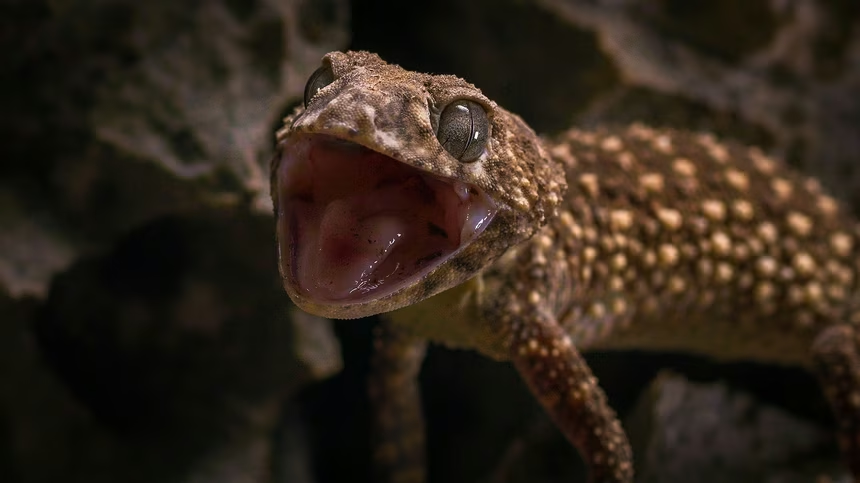
Share Inspiring Moments From The Film
Explore the PBS Giphy collection for The Kimberley.Providing Support for PBS.org
Learn Moreabout PBS online sponsorshipAs the season of Barrkana progresses, smoke starts to appear on the horizon.
But these aren't wildfires.
They're carefully conducted traditional burns.
OK, yeah, this is the spot we might do.
Smith: For countless generations, First Nations people have used fire to manage Country.
These burning practices are a conversation between people and the land.
The wind, soil, animals and trees all inform us of when and how to burn, and no two places are the same.
Burning in the cool, dry season keeps the fires low and the burn scars small.
[Bird calling] [Music] Smith: It preserves the food, shelter and nesting trees that so many animals rely on.
The burned areas also create a patchwork of fire breaks.
If we don't reduce the fuel load now, lightning storms will spark catastrophic wildfires later in the year.
[Fire roaring] When Europeans forced our traditional owners from their land, the long-running burning practices were severed.
For decades, late-season wildfires ravaged the landscape, pushing many species towards extinction.
Creatures like the Gouldian finch now hang on by a thread.
These tiny rainbows used to flock all over our savannas in their thousands.
But years of hot fires have destroyed their food source and the old trees with their precious nesting hollows.
Managing fire is key to preserving the ecosystems, and First Nations people have understood this for thousands of years.
[Indistinct radio transmission] Recently, ecologists have studied the traditional burning techniques and recognized how effective they are.
[Helicopter blades whirring] Now they're working with traditional owners, combining modern technology and timeless wisdom to apply these practices on a huge scale.
[Indistinct radio transmission] And the rewards of all this hard work are being seen all over the Kimberley.
[Animals calling]
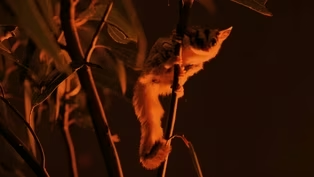
Video has Closed Captions
Clip: Ep3 | 3m 17s | The stormy wet season of Jirrbal returns and a baby glider must escape the wall of flame. (3m 17s)
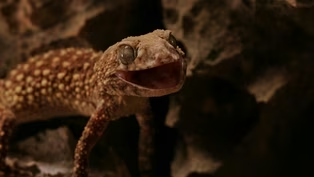
Video has Closed Captions
Clip: Ep3 | 1m 58s | With their sticky feet, geckos climb up the Kimberley’s labyrinth of caves in style. (1m 58s)
Providing Support for PBS.org
Learn Moreabout PBS online sponsorship
- Science and Nature

Explore scientific discoveries on television's most acclaimed science documentary series.
 From My Station

 New Season
 New Season


 New Season

Support for PBS provided by: