
Many Lessons Later
Season 27 Episode 1 | 57mVideo has Closed Captions
Five short films from students at CSUN, CSUF, UCSB, and UCSC.
CSUN documentary “The Successor” follows musical director Larry Blank’s career. A dog chases a diploma in animated short “Dog Brain” from CSUF. Santa Barbara activists voice offshore drilling concerns in UCSB documentary “Hydra on the Horizon." A girl learns funny and heartbreaking life lessons from her grandparents in “Swimming Lessons" from UCSC. Followed by animated short "Unikid" from CSUF.
Problems playing video? | Closed Captioning Feedback
Problems playing video? | Closed Captioning Feedback
Fine Cut is a local public television program presented by PBS SoCal
Many Lessons Later
Season 27 Episode 1 | 57mVideo has Closed Captions
CSUN documentary “The Successor” follows musical director Larry Blank’s career. A dog chases a diploma in animated short “Dog Brain” from CSUF. Santa Barbara activists voice offshore drilling concerns in UCSB documentary “Hydra on the Horizon." A girl learns funny and heartbreaking life lessons from her grandparents in “Swimming Lessons" from UCSC. Followed by animated short "Unikid" from CSUF.
Problems playing video? | Closed Captioning Feedback
Where to Watch Fine Cut
Fine Cut is available to stream on pbs.org and the PBS app.
Providing Support for PBS.org
Learn Moreabout PBS online sponsorshipMan: Funding for "Fine Cut Festival of Films" is generously provided by The Bridges Larson Foundation.
[Upbeat music playing] [Upbeat music playing] [Orchestra music playing] [Applause] Woman: Thank you very much.
And our conductor, Mr.
Larry Blank.
[Applause] Larry: There was music in my house all the time.
There's music on the piano, music on the radio, and there are great TV shows, so I got to see everything in kinda the golden age of musical theater.
[Upbeat music playing] [Man vocalizing] Larry: I play the piano reasonably well and I knew all the show tunes, so I started getting hired for low-budget shows.
There were a lot of shows in New York at that time.
Aside from Broadway, there was Off-Broadway, there was school productions.
They needed people who play the piano.
At this point, I had no mentorship so much as just an interest, and because I was the right price and played reasonably well, I got hired, but I met a lot of important people.
Don Pippin, who was one of the major music directors on Broadway, took me under his wing and we remained friends until he died just a few years ago at the age of 95.
My good friend and conductor, Don Pippin.
[Applause] [Upbeat music playing] Larry: He was my first mentor.
He took me under his wing.
Don was a very good pianist.
And even though I played piano rather regularly, he said, "When you go to the piano, try not to be too good."
He said, "Because if you do, you'll be chained to the piano as a rehearsal pianist, rather than walking around the room talking to people," which was a good piece of advice.
Man: I remember it well.
We dine with friends.
Larry: We dine alone.
Man: A tenor sang.
Larry: A baritone.
Man: Ah, yes.
I remember it well.
Larry: I met Don because he seems like a very good name, and I went to the stage door and waited for him to talk to him, but then I was starting to get jobs.
And some of the musicians in the pit of local shows I was doing said, "Do you know this kid?
He's pretty good," and Don called me up and started recommending me for jobs on the basis of hearing it from some of his pals.
At that point, I then became his student.
I was doing these Broadway shows.
Here I was between the age of 22 and let's say 30, 31.
I was doing one show after another.
Some were flops, some were hits.
And I was in the pit every night.
Now, think about this, that meant eight shows a week.
Every night, I had to get something to eat, head over to the theater for an eight o'clock show.
No musician went to school thinking, "Wow, I can't wait to get into a hole in the ground," so no one can see me playing my instrument.
So, your days are planned around going to a theater, conducting the show, and it's the same show every night.
There's no time for life.
Later on, the other person who became my surrogate father was a man named Irwin Kostal, who was very well-known because he orchestrated "West Side Story" and "The Sound Of Music" and most importantly, "Mary Poppins," the movie.
He lived out in LA and I was living in New York at the time, so when I came out here for something, I called him up and said, "We're going to be working together.
Can we meet?"
He was so flattered that I knew who he was because even though he was famous within the business, you know, arrangers, conductors, and piano players are unknown to the general public.
And when I finally came to New York, and Irwin and I were doing a show together, so the first time we actually worked together was in a recording studio, and I was conducting the orchestra.
And he observed me conducting and he came out, and he put his arm on my shoulder and he said, "I have to tell you," he said, "I've done a lot of shows," he said, "You're one of the most talented conductors I've seen do this sort of thing," which flattered me no end.
[Orchestra music playing] Larry: He taught me the teachings of a man named Nicolai Malko.
At which point, I was looking at Irwin, there was a tear in his eye, and I said, "Something wrong?"
He said, "I was Malko's last student," and that was, uh, kinda the beginning of my career.
Presenter: There are four musicals nominated as best of the season.
The first nominee is They're Playing Our Song.
Larry: About the time I was doing "They're Playing Our Song" on Broadway, which was a big hit show written by Marvin Hamlisch, I had done "Chorus Line" on the road, I forgot to mention that one, because of Don Pippin.
I did that for a year, and that was a very big success.
So I said, "I gotta get out of here," and I left New York and moved to California, hoping to get into movies.
So then, I started trying to find some work on television, writing music.
There were so many TV shows going on, and each one had music.
Now, with the synthesizers and everything else, you don't have the same thing.
So, every day, there would be recording sessions with a whole bunch of musicians, recording the soundtracks for TV shows and movies.
That, over time, has now disappeared to nothing.
[Soft music playing] Larry: Well, a very sad thing happened.
In 1994, when Kalen was home, and we invited him for lunch, "Irv" Irwin, he sat down at lunch, and I asked him some advice.
He started yelling at me, which he had never done, ever.
He said, "You're 42 years old, you don't need my advice anymore, you don't need my help, you're successful, you're conducting shows, you're writing music."
You know, it was terrible.
I was, you know, almost in tears at lunch.
So when Irv passed, it changed my attitude about a lot of things.
And I remember sitting in my office in this house in the back at two o'clock in the morning, and I had lots to do, and I put my head down and I said, "Wow, I have no one to call to help me.
I have no one to call and say, 'How do I do this?
I need help with this.
I don't have the foggiest idea.'"
And that was a big-- it--this was eight years after he died that I made this revelation that I had no one to call.
Yeah, I have other friends and people I could have asked for advice, but I didn't have him to call and help me with this.
And it was--it was a big revelation to me.
So, I have my associate, Adam Jones, who's worked with me on a few projects.
Very talented young guy.
We all have our gifts, and he--he's got a lot going for him.
Adam: I can tell you that the first call I ever got from Larry was actually a text while I was in Trader Joe's in North Hollywood, and I'll never forget looking at it.
And he--and he was like, "Are you busy?"
And I said, "Of course, I'm not.
Whatever you need."
And he just said, "We just got the Dolly Parton Christmas on the Square film."
And that was the ultimate goal, when moving here, was to get a text like that.
Larry: So I called up Adam and said, "Wanna do a movie?"
And I didn't know what was gonna be involved, and it turned out to be like a--you know, a lot of music.
And I was able to assign a lot of stuff to him, and he was great at it, and everybody loved him.
Adam: Larry had known that I had done some Dolly Parton work previously, so I was kinda, like, tied in with their team.
But this was the big fish that I was waiting for.
It just, like, luckily popped up... Larry: Uh-hmm.
Adam: ...got the text.
My--all my stuff was still in the car, and I was parking it outside his house and coming in and meeting somebody that I had seen his name on so many things.
Obviously, I was begging for work, but trying my best not to come across desperate for work.
Larry: It sounded wonderful.
The saxophone part, first grade.
Adam: I didn't even realize I needed somebody to really show me the light of the land here and how things really work in Los Angeles, which is completely different than the way that they work in New York.
Luckily, he had understood both being in New York for so long, and then moving out to LA sort of was able to tell me where things were going to be different.
Other than that, it was not a meeting where he was like, "Let me bring you under and show you everything and hire you for everything that I'm doing."
There was a lot of time of just me hoping that he was somebody that I could send an email to or call if I needed some assistance.
[Orchestra music playing] Adam: The biggest piece of advice Larry has given me is make sure they take the music seriously, especially when you're hired on a project, to give them a reason to be happy that they hired you, but also to hire you back.
And I have been able to confidently take that approach with me, knowing that that comes handed down through other mentors, but also through him.
My whole experience with Larry has been a reference in that exact sense.
And whenever I find myself, like, in the thick of it and can't come up with the answers, I call Larry.
He tells me to come up and he shows me something that he has just recently done that solves that puzzle, or if not, an orchestrator that he knows that has solved that exact puzzle.
I had an intuition that mentorship was going to be a very important part of the process, and I'd always looked for teachers to help me or at least, like, tell me what I was missing.
And all I felt was the luck... how lucky I am to have met the people that I have met that have given me such good role models, and how that is not always the case.
[Somber music playing] [Upbeat music playing] Richard: The effects of the oil disaster in the Santa Barbara channel are widespread.
Man: The people of this community have gone on record officially opposing the drilling and wanting the removal of the platforms.
Man: It is a monster that, far from serving its master, the public interest has gone mad and bites the hand that feeds it.
Man: There are no assurances possible by the oil industry that will protect us from a disaster such as we are suffering.
Man: It is unlikely that the controversies surrounding oil drilling in the Santa Barbara Channel will be solved this month or even this year.
Protesters: End oil now!
End oil now!
End oil now!
Man: The oil slick has expanded to about four miles.
It's about 21,000 gallons of oil that were spilled.
Woman: This is in a highly toxic situation, and people should stay away.
Man: We do not want offshore oil drilling.
We do not want more spills on our coast or anywhere else.
Bruce: We apologize for the damage that it's done to the wildlife, and we're very sorry for the disruption and inconvenience.
Man: But it could take upwards of years before the area is completely returned to its normal state.
Julia: I am here because I'm a resident of Santa Barbara County, and I can smell a rat, and this project is a rat.
Woman: They have violations for destroying wetlands.
They have violations for destroying habitat.
Man: It's not a stretch for the Congress members to ask the state to do what they're supposed to be doing in the first place.
Woman: If this gets passed, it's gonna be incredibly detrimental to our community.
Woman: This is the moment before the tragedy happens.
This is the moment we'll all look back on and say, did we make the right decision?
Jenna: I started a lot with communication, so I think I've always had that background of, like, talking and being a speaker and, like, being a voice in a lot of ways.
And obviously, the environment, I mean, it can't speak for itself, so it does need people to talk for nature.
Without the environment, without the world, without nature, what else is there?
I feel like my hometown is super affected by wildfires.
My whole childhood neighborhood burnt down when I was in high school.
And that was, like, the first time I ever saw climate effects in my space ever.
Watching the community shift so much because of fires that we kept having every single year, and nothing was being fixed, and it was pretty easy to see like who was at the root cause of a lot of these fires, and it was the corporations that ran our electricity and gas.
Like, it was PG&E.
That was who caused fires in my hometown.
Chris: I was born in '61 and grew up during the oil spill of '69 in Santa Barbara that led to a lot of awareness, national awareness, to our need to take care of the environment.
And so, I was fishing at, you know, 13, 14, 15.
And so I was always, you know, engaged with the ocean at a young age and I was just drawn to the marine environment.
So I look at myself with a little bit uniquely positioned to be President of CFSB, which represents all the different fishing interest that, uh, exist in the Port of Santa Barbara.
If you remember the details associated with that spill, we were precluded from fishing.
And it started as like a six-mile area of coast up there, and then they expanded it, and it was offshore.
So we weren't allowed to fish in that space for a fairly long period of time.
And then there was this broader market impact that, okay, Santa Barbara's had an oil spill, and the fish that come from Santa Barbara may have oil on them.
Alex: The amount of oil that spilled into the ocean was huge.
This is one of the biggest oil disasters that we've ever had in California.
I mean, there was oil that spread all the way down to Redondo Beach, like a hundred and fifty miles away, killed untold numbers of animals in the channel.
If we have another oil spill here, that affects everybody's livelihoods.
That is an economic disaster.
Ava: From the commercial fishing perspective, they got payouts in the past couple years because of those spills.
But no fisherman wants to be paid not to work.
They love their job.
They need their job.
It's ingrained in who they are.
It's their identity.
It's why they get up every day.
It's what they know how to do.
It gives them a sense of purpose.
So getting a check is almost just like a slap in the face.
It's like, "Here, we soiled your office and ruined and killed everything in it, but here's a check."
Alex: The Company announced on the 10th anniversary of the oil spill, they had restarted production at one of these platforms, and they were kind of celebrating.
That's really disrespectful to people here who lived through this disaster.
The way they built it and designed this pipeline, it doesn't work.
So we know this technology is not effective for this pipeline, and it's not gonna be effective for this pipeline.
Right now, we're at a point where this has been moving forward with zero environmental review of any kind.
The way they have operated here has made a lot of people think that this is not a company that we can trust to follow the law.
So they started digging up coastal habitats and sensitive areas here.
What they would say is in order to fix those defects on the pipeline.
Jenna: It honestly became so all-enveloping.
Like, I would wake up and go to sleep and think about this.
We see it as there's no question.
There's no question that this isn't the right project.
There's no question that these aren't the right owners.
Alex: The Coastal Commission gave them notices and eventually ended up issuing cease and desist orders, which Sable did not comply with.
They just kept working.
I think the company would tell you the same thing.
The Commission ended up giving Sable an $18 million fine, which is the largest fine, I think, the Commission has ever issued to anyone.
Jenna: The insurance policies that we're looking at that Sable wants to still bring up today and use today are the ones when the pipe was put in.
And that was in the '80s.
I think it was 1984.
Alex: We should be able to weigh in and be part of this decision-making process and submit expert testimony.
You know, the public is supposed to have a say in this.
Jenna: It's hard to keep people sustained in an action that doesn't necessarily have big wins to celebrate.
I mean, this is a fight that's been going on for at least two years.
It's a super long, interesting legacy.
I feel like we had to keep that alive.
It all started in Santa Barbara.
It all started with that horrible spill.
And now, it's like we're back again at this dark, sad place that is on the horizon that could happen again.
This was the Coastal Commission hearing where they had an $18 million fine.
This was in April.
Yeah, and students got a feature, which is super cool.
Alex: All the students at UCSB who have showed up to all of these different public hearings and events and made these incredible arguments.
Man: Not a single representative from an almost $2.3 billion company could be bothered to show up for the single largest project in their company's history, which also happens to be one of the most destructive we've seen on this coast.
Alex: We should have standards for companies that are operating in California.
In particular, companies that are operating a dangerous, high-risk project affecting people's lives.
You know, not just the people that live along the route of this pipeline.
A project like this has a major impact on all of us who live in this area.
Ava: My dad was a commercial fisherman for his whole life, and he fished for abalone and urchins, crab and lobster, and pretty much everything else in between.
So I was fortunate to have a lifestyle on the water and to be around a very unique industry, especially as a child.
He just taught me a lot about what's important in life, which is, in my opinion, the relationships you have with people and the relationships you have with Mother Nature and how you engage with the natural environment.
Because my dad passed when I was 12 years old, it's an age when people tend to still take you in as a child.
And I'm so fortunate, though, because I had this harbor community, and they still embrace me just the same.
To be able to work with those types of people and make my livelihood in that environment is really a special thing.
Jenna: It's the health of our oceans.
It's the health of our ecosystems.
It's all of these creatures that we depend on.
Our whole life would fall apart without this super fragile network that exists out in the water out there.
Chris: There are those oil producers that aren't going to relinquish their grip on their captured market.
So, we're in a bad place as a serious, you know, industrialized nation that produces a lot of oil, exports oil, to have our government captured by oil interests that then distort our ability to make good decisions moving forward.
Jenna: I don't have a lot of faith in the California regulatory agencies.
It just doesn't feel like it's strong enough, and that's a pretty scary thing to say.
I think Sable is stronger.
Ava: Everyone feels sort of involuntarily neutral.
I think everyone, like, sort of feels like this type of thing is too big for us to have any say because it's federal.
Alex: What's the next thing that they're gonna ignore?
If they don't feel like something should apply to them, then how can we trust that they're gonna follow anything here in California?
Jenna: The pipeline didn't burst, it didn't leak, it corroded.
It's pretty crazy that this pipeline that they're seeking to restart, the thing that they're ignoring is the corrosion controls, cathodic protection.
Alex: There could be a spill every year, a major rupture every four years from this pipeline if it restarts.
A major rupture is--could be up to twice the size of the 2015 spill.
Ava: It just can be so discouraging, and the discouragement can probably be the hardest part because it just feels like so daunting and depressing, and every day there's so much to learn that kills your spirit.
Chris: It's like a flea on a dog.
The thing we really need to do is try to regain control of the system.
Jenna: I think on a national scale, we're definitely fighting a really big beast.
Sable is kind of like a figurehead of this bigger, more horrible, ugly thing that we are all trying to fight against right now.
These policymakers and laws and all these different things that are changing, I think they want to keep us tired and keep us not wanting to work hard and keep us down.
What else can be done?
If a huge fine doesn't work, if legal action isn't working, what would stop them?
Alex: This Company making money should not outweigh the risk to everybody here in California, the damage that this does to the Earth's climate, the potential for another spill.
A few people from Texas and Las Vegas making money should not outweigh the potential devastating hit that all of us here could take if this goes wrong again.
James: Our rights as individual citizens have been grievously violated by a long train of abuses and insertions.
Our local government in Santa Barbara has acquiesced to the intimidation by federal and state government in consort with irresponsible activities of legal private enterprise to rob us of our uncorroded natural environment.
It is our feeling and perhaps your own that legal mass nation has now superseded justice, and the legal ritual has been performed but justice has not been fulfilled.
[Upbeat music playing] [Water flowing] Meloddy: Growing up, my parents made sure my sister and I were prepared for anything no matter how unlikely the scenario.
They decided to enroll me in swimming lessons at age five in case of a typhoon.
We lived in the Chicago suburbs.
It's been five years since we've been here together.
My mom and sister came to China to visit family, but I'm here to learn more about my younger cousin.
She was always prettier, smarter, more successful than me.
I can't stop thinking about her.
[Soft music playing] [Man on TV speaking in Chinese] [Sister in Chinese] [Grandma in Chinese] [Sister chuckles] [Grandma in Chinese] [Sister in Chinese] [Grandma in Chinese] [Sister in Chinese] [Grandma in Chinese] [Upbeat music playing] Meloddy: After I graduated college and moved back home, my parents sat my sister and I down at our dining room table.
"Remember your cousin?"
they asked.
Of course, I remember the person I could never live up to.
"Remember your cousin?
She passed away three months ago."
Worried it would distract my senior year of college, my parents waited to tell me.
By then, there was no funeral to attend, the mourning period had ended, and there was no trace of her left.
[Water rippling] Meloddy: Of all the things my parents prepared me for, why didn't they teach me how to say goodbye?
I asked my family to tell me more about my cousin, but no one wants to talk about her, especially not on camera.
There are other deaths that are easier to talk about.
We visit the cemetery where my dad's parents rest.
[Mama speaking in Chinese] [Meloddy in Chinese] [Mama in Chinese] [Meloddy in Chinese] [Mama in Chinese] [Soft music playing] [Mama in Chinese] [Meloddy in Chinese] [Mama in Chinese] [Soft music playing] [Sister giggling] [In Chinese] [Pretend snoring] [Grandpa in Chinese] [Sister giggling] [In Chinese] [Grandpa snoring] [Sister in Chinese] [Pretend snoring loudly] [Laughter] [Sister pretend snoring loudly] [Laughing] [Coughs] [Grandpa in Chinese] [Sister in Chinese] [Grandpa in Chinese] [Soft music playing] [Sister squeals] [Indistinct chatter] [Mama in Chinese] [Soft music playing] Meloddy: During the visit, some small disaster seemed to happen every day.
First, the AC broke in the middle of a heat wave.
Then, the washing machine exploded.
[Grandma in Chinese] [Sister in Chinese] [Grandma in Chinese] [Meloddy in Chinese] [Grandma in Chinese] [Meloddy in Chinese] [Grandma in Chinese] [Meloddy in Chinese] [Sister speaking in Chinese] Meloddy: After we got sick, my grandpa decided we needed to cook everything we ate.
[In Chinese] [Grandpa in Chinese] [Upbeat music playing] Meloddy: I was a great swimmer.
My dad always reminds me that one of my biggest accomplishments in life was when I came in second to last place at a triathlon.
But as much as I love swimming, I'm still afraid of going to the bottom of the swimming pool.
I'm terrified that if I go too deep, I won't make it back to the surface in time.
Being here with my grandparents kind of feels the same way.
The more time we spend together, the more impossible it feels to leave them again.
[Soft music playing] [Grandma in Chinese] [Mama in Chinese] [Grandma in Chinese] [Mama in Chinese] [Grandma in Chinese] [Soft music playing] [Grandpa in Chinese] [Meloddy in Chinese] [Grandpa in Chinese] [Meloddy playfully crying] [Grandpa in Chinese] Meloddy: Tofu.
[Grandpa speaking in Chinese] [Grandma in Chinese] [Soft music playing] [Mama in Chinese] [Grandma in Chinese] [Mama in Chinese] [Grandma in Chinese] [Mama in Chinese] [Grandma in Chinese] [Soft music playing] [Mama in Chinese] [Soft music playing] [Sister in Chinese] [Man speaking in Chinese] [Sister in Chinese] [Mama in Chinese] [Sister in Chinese] [Mama in Chinese] [Sister in Chinese] [Mama in Chinese] Sister: Hmm.
[Mama in Chinese] Sister: Hmm.
[Mama in Chinese] [Sister in Chinese] [Mama in Chinese] [Sister in Chinese] [Mama in Chinese] [Soft music playing] Meloddy: Even though my cousin died in an accident, my mom questioned how she could leave her parents without saying goodbye.
I was furious when she told me, but I realize now that she's searching for her own answers.
How are parents supposed to survive without their children?
My mom can't teach me how to say goodbye because no one ever taught her.
She doesn't know how to prevent her children from leaving, but she can teach us how to swim, so we don't drown in a place that never floods.
[Soft music playing] Meloddy: I'll always have questions about my cousin.
When we leave, my grandparents will be alone again in their Beijing apartment that my mom once called home.
Why do we keep leaving each other behind?
[Soft music playing] [Theme music playing] [Upbeat music playing] [Watch alarm rings] [Soft music playing] [Crowd cheering] [Dog barks] [Soft music playing] [Upbeat music playing] [Kid bleats] [Bell rings] [Kid grunts] [Goat groans] [Unicorn grunts] [Goat grunts] [Unicorn grunts] [Goat grunts] [Unicorn grunts] [Goat grunts] [Kid gasps] [Unicorn and goat bleats] [Kid bleats] [Wolves growl] [Kid bleats] [Wolves growl] [Kid bleats] [Goat bleats] [Unicorn neighs] [Goat bleats] [Unicorn neighs] [Pots clanging] [Wolves howl] [Kid bleat] [Birds chirping] [Wolves growl, howl] [Kid bleats] [Bell rings] [Wolves growls] [Wolves bark] [Bell ringing] [Kid bleats] [Wolves growl, bark] [Goat grunts] [Wolf barks] [Wolf yelps] [Goats bleat] [Cat noise] [Kid giggles] [Bell rings] [Upbeat music playing] [Mellow music playing] [Foreboding music playing] [Upbeat music playing] Narrator: Funding for "Fine Cut Festival of Films" is generously provided by The Bridges Larson Foundation.
 New
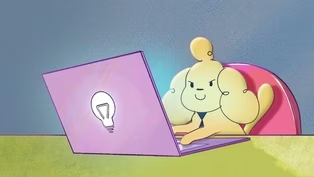
NewClip: S27 Ep1 | 1m 59s | A dog goes on a journey of education after his owner leaves for work. (1m 59s)
 New
NewVideo has Closed Captions
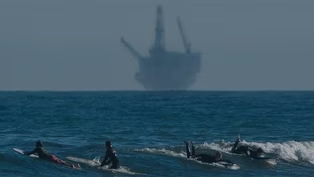
Clip: S27 Ep1 | 14m 50s | A community haunted by decades of oil spills rises again as Sable Sable Offshore moves to restart. (14m 50s)
 New
NewVideo has Closed Captions
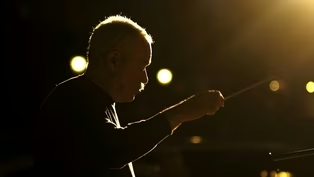
Clip: S27 Ep1 | 12m 22s | In the world of music, legacy isn’t written in notes but in the people who carry them forward. (12m 22s)
 New
NewVideo has Closed Captions
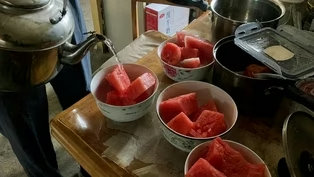
Clip: S27 Ep1 | 21m 8s | Swimming Lessons is a personal, reflexive film that follows a daughter of Chinese immigrants. (21m 8s)
 New
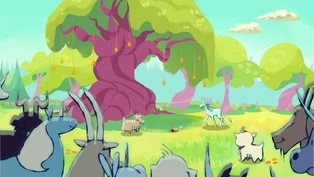
NewClip: S27 Ep1 | 5m 14s | When an important bell preventing danger breaks and a feud breaks out between the goats and unicorns (5m 14s)
Providing Support for PBS.org
Learn Moreabout PBS online sponsorship New Episode
- Arts and Music

Innovative musicians from every genre perform live in the longest-running music series.










 New Episode
 New Episode

Support for PBS provided by:
Fine Cut is a local public television program presented by PBS SoCal