Careers that Work
Mason
Season 1 Episode 5 | 5m 17sVideo has Closed Captions
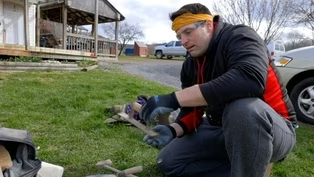
Matthew Clark, Owner/Foreman of Clark & Fry Masonry, shares a day in the life of a mason
Matthew Clark, Owner/Foreman of Clark & Fry Masonry, shares a day in the life of a mason - what background is required, what happens in an average day, and how this career path helped him realize some of his passions outside of work.
Problems playing video? | Closed Captioning Feedback
Problems playing video? | Closed Captioning Feedback
Careers that Work is a local public television program presented by WVIA
Careers that Work
Mason
Season 1 Episode 5 | 5m 17sVideo has Closed Captions
Matthew Clark, Owner/Foreman of Clark & Fry Masonry, shares a day in the life of a mason - what background is required, what happens in an average day, and how this career path helped him realize some of his passions outside of work.
Problems playing video? | Closed Captioning Feedback
How to Watch Careers that Work
Careers that Work is available to stream on pbs.org and the free PBS App, available on iPhone, Apple TV, Android TV, Android smartphones, Amazon Fire TV, Amazon Fire Tablet, Roku, Samsung Smart TV, and Vizio.
Providing Support for PBS.org
Learn Moreabout PBS online sponsorshipMy name is Matthew Clark.
I am a foreman slash business owner of a masonry company called Clark and Frye.
And we are based out of Montoursville, Pennsylvania.
A typical day on the job would consist of.
It depends on what part of the job you're doing.
The first part of the job is obviously getting the work going to the person's house and assessing how much damage there is.
Unless you're doing something like what I'm doing here today, it's grinding all joints out and replacing them with new mortar, which is called pointing in mortar.
You have what's called an aggregate and you mix it with your binding agent.
So there's the binding agent in the aggregate.
And what's happening in this foundation is that the the the glue that holds the stones together has all but washed away.
And all that's left is the aggregate, which in this case, because it's mortar is sand.
So we're removing the sand and then we're going to put a new mortar.
And now these tools are actually almost 100 years old.
And you can see the difference.
These are from my great great grandfather and great grandfather, Danford, notonly all passed down through them to Tom Clark, which is my grandfather, and he gave them directly to me.
This is what's known as an edger, and this is cast iron.
So you can see the difference in this and what they sell today in the stores.
This is a lot thinner and more cheaply made and this is obviously more expensive.
My great great grandfather, Danford Clark and his son, which is my great grandfather, Elton Leo, they started actually building foundations like this.
That actually wouldn't surprise me, like if they had had their hands on, like, a foundation somewhere around here.
They eventually started building stone bridges for the state of Pennsylvania, starting that'd be Bedford County.
My grandfather, he taught me masonry when I was about like 15 or 16.
I went to school.
I went to college because I didn't know what I wanted to do.
I had no clue what trajectory of my life was going to take.
I was kind of a lost cause for a little bit because it's it's hard to tell what you want to do.
It's a big question, like everybody wants to know what they're going to do for the rest of their life.
After college, I job hopped.
It's tough because you you want to make good money and you don't know like what you want, what you want to do.
So I was in the city, I was in Williamsport, and I saw a crew of guys working on a block wall.
And one of the people approached me about working for him, and I actually told him that I had some history in masonry, so I ended up doing some apprentice work for that person after they took me under their wing with the skill sets that I already had and with their knowledge combined, I thought to myself, because I was working for this, this person that I was like watching them get rich, watching them make lots of lots of money.
And I thought to myself, like, well, you know, how really how hard is it to start your own business?
You know, I have the degree.
Like, I felt like I knew enough about it.
That's what I did.
I started a business under my family's name and then a partnership with the person that I know that I trusted .
So, yeah, that's how I landed.
The money that I make from Masonry has allowed me to do a lot of different things that I've always wanted to do.
The first thing that it allows me to do is I bought a it's called up Ableton Push two and Software and then the computer to put the software on and to make the music on together.
You know, those things were like I think 2300 or 20 $400.
I would have never had 20 $400 before I started Masonry.
So, you know, I got into that and because I've always wanted to make music, I was able to find a jujitsu coach because I always wanted to do that too .
I'm actually working on a book series.
The big thing like like I can provide for my family.
I wouldn't have a house right now unless I had started my masonry business.
At the end of the day, you could be covered from head to toe and sometimes you could be drenched in sweat.
But at the end of the day, you know, when you're done with your project and it's and you've like literally brought history back to life, like that house gets to keep its character.
There's a huge sense of accomplishment when you feel when you finish the job.
Video has Closed Captions
Clip: S1 Ep5 | 5m 29s | Matthew Clark, propietario/capataz de Clark & Fry Masonry, comparte un día en la vida de (5m 29s)
Providing Support for PBS.org
Learn Moreabout PBS online sponsorship

- Home and How To

Hit the road in a classic car for a tour through Great Britain with two antiques experts.












Support for PBS provided by:
Careers that Work is a local public television program presented by WVIA