Signature Dish
Masters of Spice
Season 1 Episode 4 | 28m 7sVideo has Closed Captions
Muu som (fermented pork); junglee laal maas (goat curry); steamed fish with peppers.
Seth meets three chefs who are masters of using hot peppers and balancing the intense heat with incredible flavors. Along the way, he samples muu som, a stir-fried rice-fermented sour pork dish at Thip Khao in Columbia Heights; junglee laal maas, a spicy goat curry at Pappe in Logan Circle; and a whole steamed fish with fermented peppers and scallions at Q by Peter Chang in Bethesda, MD.
Problems playing video? | Closed Captioning Feedback
Problems playing video? | Closed Captioning Feedback
Signature Dish is a local public television program presented by WETA
Signature Dish
Masters of Spice
Season 1 Episode 4 | 28m 7sVideo has Closed Captions
Seth meets three chefs who are masters of using hot peppers and balancing the intense heat with incredible flavors. Along the way, he samples muu som, a stir-fried rice-fermented sour pork dish at Thip Khao in Columbia Heights; junglee laal maas, a spicy goat curry at Pappe in Logan Circle; and a whole steamed fish with fermented peppers and scallions at Q by Peter Chang in Bethesda, MD.
Problems playing video? | Closed Captioning Feedback
How to Watch Signature Dish
Signature Dish is available to stream on pbs.org and the free PBS App, available on iPhone, Apple TV, Android TV, Android smartphones, Amazon Fire TV, Amazon Fire Tablet, Roku, Samsung Smart TV, and Vizio.
Providing Support for PBS.org
Learn Moreabout PBS online sponsorshipWOMAN: And now, Signature Dish, a WETA original series.
SETH: Today on Signature Dish, we're turning up the heat.
After gathering some chilies fresh from the source... Those peppers, they don't mess around.
SENG: Definitely.
It has more heat than you thought.
SETH: We'll try a regional Indian dish loaded with spices.
SANJAY: This is the Indian chili peppers.
They're really fiery hot peppers.
SETH: Fiery sounds good to me.
And be wowed by a legendary DC area chef.
PETER: Very spicy?
SETH: That is just impossibly good.
I'm Seth Tillman, WETA producer, and DC native, and I love good food.
That's why I'm traveling to restaurants across the DMV, at each stop, looking for the one thing you just gotta try: that Signature Dish.
Making food spicy is no challenge.
Add enough chili peppers and any dish can start a five-alarm fire in your mouth.
That's why I'm off to meet three chefs who have mastered the far more difficult craft: balancing intense heat with incredible flavors.
My first stop will take me to Columbia Heights to visit Thip Khao where Chef Seng Luangrath has introduced countless diners to the scorching cuisine of Laos.
SENG: I left Laos in 1981 when I was 12 years old.
With the Lao cuisine, it's very unknown back 10, 20 years ago.
A lot of Lao people, they have been working in Thai restaurants because we share so many similar cultures, so many similar ingredients, similar language as well.
I kind of have my mind set that if I ever open a restaurants, I want to do Lao food.
SETH: In 2010, Seng took over Bangkok Golden in Seven Corners in Falls Church, and began quietly adding Lao dishes to the menu.
SENG: Lao food, we don't use a lot of sugar.
Lao still focused on the bitterness and also a lot of fermentation of fish, fermentation of pork.
So a lot of funkiness.
And so a lot of focus on the chili peppers.
But the good things about Lao food, even though you get that heat, you still get that flavors.
All of everything.
SETH: As the popularity of Seng's Lao cooking took off, she began the Lao Food Movement.
SENG: So Lao Food Movement is pretty much start up to uplift Lao culture to also supporting, mentoring.
It's okay to serve the food that you grew up eating.
You don't have to water it down.
It's okay to come out as who you are, be brave, and be honest.
SETH: Before heading to Thip Khao to prepare Muu Som, Seng's signature fermented pork dish, we're first meeting in the backyard garden where she and her husband grow a bounty of hot peppers.
Wow, chef, these banana leaves, these peppers.
I know we're in Virginia, but I feel like I've been transported somewhere very far away.
SENG: Yeah.
So basically you don't need a passport to go to Southeast Asia.
And here, we have Lao jungle right in our backyard in Northern Virginia.
SETH: The Lao jungle.
I love it.
Well, it certainly puts my backyard garden to shame.
And these peppers, I'm kind of just scared looking at them, imagining just how spicy these are.
And so what are you looking for with these red peppers?
SENG: These are bird's eye chilies.
The reason we call bird's eye chili is because of the way it's stuck up toward the sky.
So the red one is not only has such a great heat, it also add nice color to the dish, which is what we are going to be doing in the kitchen later.
SETH: Well, that's so of cool that you're able to grow everything you need for your dishes right here in your backyard.
So I guess we should take the peppers back to Thip Khao and get started?
SENG: Yeah, let's do it.
SETH: Great.
Thanks, chef.
SENG: Thank you.
SETH: Oh, wow.
So what's this, chef?
SENG: This is the pork that we are going to make Muu Som, which is a fermented pork belly.
SETH: Fermented.
Now, when I think of fermentation, I think of pickling.
I think of maybe you know, vegetables, cucumbers.
I don't think pork would've come to mind.
SENG: Yeah.
It's very common in Laos because in Laos, we don't have a lot of refrigeration, so a lot of people tends not to just cure vegetable or pickle vegetable.
We also do meat; with pork, fish.
It could be like beef as well.
The main important for fermentation is rice because in Laos, rice is, sticky rice is very important for Lao culture.
So I'm going to grab about a handful of this.
And I'm adding water, and I'm going to add garlic, and of course salt, a little bit of sugar.
SETH: Oh.
SENG: And black pepper.
So I'll mix it up.
And I'm going to grab pork belly.
So basically, we're going to give this a little massage.
So I'm going to add the next piece and I will keep massaging it, and then we'll add it more until we are done.
SETH: And how long is it going to take for this to get as fermented as you'd like?
SENG: In Laos, we leave it out for a few days.
But here, we leave in our cooler, in our walk-in cooler for two to three weeks.
SETH: Oh, wow.
Okay.
SENG: Yeah.
Until it gets nice fermentation.
And what I have here is already done.
SETH: Oh, wow.
Yeah.
You can already see what's changed.
SENG: So you see the rice has kind of like melted it into the pork.
SETH: Just the aroma of it.
I can already tell it's been fermenting for a while.
SENG: Yeah.
Yeah.
It's been fermenting.
So basically it's kind of salty and also sour.
So I'm going to be slicing it and I will be cooking it up in the wok to get the nice and smokey flavor.
SETH: Can't wait.
Let's give it a shot.
SENG: Yeah, let's do it.
All right.
It is going to be very quick, very fast, very simple.
So basically, I'm going to char most of the ingredients here.
So this is a ginger and onion.
Then I will toss in the pork belly.
SETH: This is the one that's been fermenting for a few weeks now.
SENG: Yeah.
Yeah.
The Muu Som that has been fermented for a few weeks.
I will do next is adding the mushroom.
I like to put the wood ear mushroom in there for nice texture.
Okay.
And the next thing is the tomato.
And of course the chilies from the garden.
SETH: Oh, of course.
SENG: That I picked from the garden, yeah.
And then I will put the fish sauce mixture.
Roll down the heat just a little bit.
And it's all set.
That's it!
SETH: So much of the work is involved with fermenting it and taking weeks, all the work that has to go in the garden to grow the peppers, and then when it's time to cook, it's just... SENG: Right.
Right.
It's very cook and fast.
SETH: Flash in the pan.
SENG: As long as you have a nice heat on your pan.
So now, we're going to top it with the herbs.
The herbs' also from the garden.
SETH: Well, it looks and smells delicious.
Can't wait to try it, chef.
SENG: Yeah.
Let's go and try with sticky rice.
Okay.
So what you do is you are going to use sticky rice as utensil.
SETH: Okay.
SENG: As vessel.
You're going to roll into a ball flat like that.
And what you're going to do is you're going to put it in here and just grab it like that and you just eat it.
SETH: Okay.
And take a little bit.
SENG: Yeah.
SETH: I'll be an old pro at this in no time, chef.
You make it look so easy.
SENG: You already is a pro.
There you go.
SETH: Grab a delicious piece of fermented pork here.
SENG: Mm-hmm.
Yep.
Grab that.
And... SETH: And little bit of hot pepper from the garden.
I can already tell this first bite's going to be hot.
SENG: Yes, of course.
All right.
Cheers.
SETH: Oh, that is wonderful.
A little bit of heat from the pepper there.
SENG: Mm-hmm.
SETH: The rice makes such a nice compliment.
That is just delicious.
And it's nice and smokey too.
SENG: So the next bite, try it with the wood ear mushroom and a piece of tomato, and of course, a piece of pork belly.
SETH: Of course.
SENG: And maybe a piece of chili for the heat, right?
So you get all different textures and flavors.
SETH: This is going to be a pretty stacked bite.
SENG: Yeah, very stacked, yes.
SETH: That is so good.
The freshness too, of the produce and tomatoes.
SENG: And I think you should move forward to the next level.
SETH: The next level?
SENG: So you should try the papaya salad.
Are you ready?
SETH: I'm not sure I am ready.
SENG: Yes.
All right.
SETH: I hear papaya, I'm thinking nice and sweet.
I'm guessing here going to be another level of spice altogether.
SENG: Maybe get the sauce a little bit.
SETH: Okay.
SENG: Yes.
There you go.
SETH: Oh boy.
Ooh.
SENG: So you get this another level, which has also a lot of flavors that you still tasting every single ingredients in there.
SETH: And I'm glad there was a little sticky rice in that bite because you're right.
Those peppers.
SENG: Yeah.
SETH: It was great to be able to pick them right from the plant, but they don't mess around.
They pack a lot of heat.
SENG: Oh yeah.
Definitely.
It has more heat than you thought.
SETH: All these Lao flavors, they pack such a punch.
What do you see is sort of next for this Lao Food Movement?
SENG: We have been supporting a lot of Lao community.
So our future, we look forward to supporting other cultures, other countries as well, to be able to give them some sort of courage to be honest and true to themselves, their food, and their culture.
SETH: Wow.
I hope a lot more people follow your lead because this is so good.
Thanks for showing me the garden.
SENG: Thank you.
SETH: Thanks for taking me in the kitchen.
I really appreciate it, chef.
SENG: Thank you.
Thank you so much.
It's been fun.
SETH: About two miles due south on 14th Street, just off Logan Circle, Pappe is serving up Indian dishes with an extra burst of heat.
SANJAY: I'm from the outskirts of New Delhi, Haryana to be exact.
And my dad was a diplomat, so we traveled all across the globe, learning about different cultures and cuisines.
I do love spicy food and Pappe was opened with a friend of mine.
And he loved, we both loved spicy food.
And we got together and he said, "Okay, let's open a restaurant that would showcase Indian cuisine as it's supposed to be: fiery, spicy, and just real as if you were in India."
SETH: I'm heading to Pappe to learn more about Junglee Laal Maas, a centuries old dish created for the kings and royals of Rajasthan.
The region is famous for its spicy Mathania peppers, which thrive in Rajasthan's hot and dry climate.
Sanjay.
SANJAY: Hi, Seth.
SETH: Nice to meet you.
SANJAY: Nice to meet you.
SETH: So, wow.
Look at these vegetables, and peppers, and spices.
It looks beautiful.
So what are you making today?
SANJAY: We're making our signature dish.
It's called Junglee Laal Maas.
The dish is actually from Rajasthan, and which was made with a game meat.
But today, we're making it with goat.
And the very fiery peppers are used in this dish to reduce the gaminess of the meat.
SETH: All right.
Well, fiery, that sounds pretty good.
How hot are we talking here?
SANJAY: We're talking about six or seven.
SETH: Six or seven?
Okay.
Well I'm sure that's going to be a lot for me to handle.
But what kind of peppers are you using to create that heat?
SANJAY: We're using Guajillo because it has that bright red color, which is very important to the dish.
On the heat level, this is about like zero.
But this one here is the Indian chili peppers.
This is, on the scale, it's about nine.
And they're really fiery hot peppers.
Also, we are using some jalapeños and some Thai chili peppers and habaneros to give that extra kick to the dish.
SETH: Oh man.
Five different types of peppers.
So what are the next steps here in the process?
SANJAY: So first, we marinate our meat.
So we take the goat and we'll put that in the bowl.
So first, we're going to add turmeric, then Deggi Mirch, which is a blend of different kind of red peppers, coriander, cumin.
This is garam masala, which is very essential in Indian cooking.
And this is also a meat masala spice blend.
Some salt for taste.
Then we add yogurt and definitely some ginger and garlic paste.
SETH: This is a lot of flavor.
SANJAY: Oh yeah.
Indian food is all about spices and flavors.
Now, we'll mix it all together.
It helps retain some of that spice flavor into the meat before you start searing it.
Now, we have to set it aside for 45 minutes, but fortunately we have one that's already been marinating for 45 minutes.
SETH: Yeah.
Came prepared, Sanjay.
SANJAY: Yeah, we did.
We're going to sear the meat first, but one by one.
SETH: Oh, I like the sound of that sizzle.
SANJAY: Oh yeah.
So after you lay out the meat, we're not going to touch it for a minute or two.
Make sure we have a nice golden crust on one side of the meat.
SETH: And goat, it's kind of tough, right?
SANJAY: Yeah.
It's much more leaner than lamb and it takes a lot of time to braise.
And then we'll just flip it.
SETH: I probably don't eat enough goat myself, but I think Americans more and more are pretty comfortable with eating goat these days.
SANJAY: Oh yeah.
Yeah.
More and more every day.
We source our goat from a local butcher in Maryland.
And he's able to do the cuts that I want.
SETH: Nice.
So it's local and fresh... SANJAY: It's local and fresh.
So the next step is to take out the goat and add the whole spices and onion, so we can extract the sweetness out of the onion.
So after we brown the onion, we'll add the goat back in with some more spices, and then we'll add water to the pan and braise it for an hour, hour and a half.
So while all this is happening, we're going to make the Laal Maas sauce.
So we're going to take the vegetables and the peppers, and we're going to grill them to form a nice char on the vegetables.
But when we blend all these veggies and peppers together into a coarse paste, and that's going to be our Laal Maas, which is going to give it a really bright red color that's essential in making the dish.
SETH: Oh my God, chef.
This looks so good.
The color is so beautiful.
I'm a little worried about how spicy it's going to be.
But I'm ready... SANJAY: It's going to be okay.
SETH: Right?
Let me dig in here.
SANJAY: You should be feeling the sweetness first and also the bone marrow, and it's incorporated in the gravy.
SETH: That goat is so tender and so flavorful.
And you know, the spice doesn't hit you right away, but it gets you, it's just... SANJAY: Right.
Yes.
It gets you like after.
So that's the right way to taste, experience.
Indian food; is first you should feel sweetness on the first bite and then you should feel all those aromatic and fiery spices in the back palate.
SETH: You have customers who come in and they're used to kind of the toned down version of Indian food, they're a little surprised at the levels of heat?
SANJAY: Yeah.
But I've heard not that many complaints.
I think people would be more adventurous and would like a spicy cuisine if the spiciness is balanced with the right kind of sweetness in a dish.
And Indian food has tremendous potential in balancing some of those fiery peppers.
SETH: But, you know, as I've taken a few bites, the heat level's starting to show up as well.
SANJAY: Right.
SETH: And so what do people do to counter if the spice is a little too much?
What are your strategies?
SANJAY: So yeah.
Just to cool down things, we have our in-house Raita that you can have in between eating spicy food.
SETH: All right.
I got to go for some of this Naan and Raita because the Naan itself is glistening, which I know is a good sign.
So refreshing.
SANJAY: Yes.
SETH: It makes me want to go back.
SANJAY: Clears your palate every time.
SETH: Have a little bit more of the Junglee Laal Maas.
It's so good, Sanjay.
And I got to say, when you told me it was going to be a six or seven on the heat scale, I was worried that was going to be a nine or ten for me, but it's so balanced, so flavorful, nice heat throughout.
Fascinating watching the Junglee Laal Maas being prepared.
Thank you my friend.
SANJAY: Thank you.
SETH: Cheers.
SANJAY: Cheers.
SETH: After Pappe, I'm off to Maryland to meet Peter Chang, a legendary local chef who created a devoted following through his authentic and fiery Szechuan cooking.
It's here in Bethesda that he has planted his flagship restaurant, Q. SETH: After graduating, Chang worked for more than a decade as a chef aboard a Yangtze River cruise line.
In 2001, he won a national cooking competition, which brought him to Washington to work as the chef at the Chinese embassy.
When his two year term was almost up, he struck out on his own working in nondescript Chinese restaurants throughout the Mid-Atlantic and Southeast.
Some savvy diners took notice.
LYDIA: I remember, hey, we have a group of non-Chinese coming to the tiniest restaurants in a strip mall in Fairfax City; a group of foodies order all this like, really spicy... Something that we would be, um, a little worried.
"Hey, are you sure what you're ordering?"
SETH: The "Changians" as his followers came to be known, swapped rumors of the chef's whereabouts on internet message boards.
When the trail got too hot, Chang would pick up and leave for a new city.
LYDIA: It's a catch-22 where there are a lot of attention following him, but the attention also comes with, "I don't want to be find out."
SETH: Today, Chang is settled in the DC area, opening up a string of restaurants bearing his name.
I'm meeting Peter and his daughter, Lydia, at Q right after the annual harvest of the chili peppers they use in their signature dish.
Peter.
PETER: Hi.
Hi.
SETH: Lydia.
Nice to meet you.
LYDIA: Hi, Seth.
Welcome.
SETH: Thank you so much for having me.
I'm so excited.
I'm thrilled to be here.
And I know that you are a master of Szechuan cooking, but I see these peppers here that I'm pretty sure are not Szechuan peppers.
So what are you preparing today?
LYDIA: You're right.
We are preparing our signature dish, which is steamed branzino with fresh chopped chili peppers.
It's actually a longtime family recipe that has been made by his grandma, my grandma; and my mom continues to make them.
SETH: That sounds really good.
A recipe that's been handed down from generation to generation.
And so Peter, tell me about these chilies here.
SETH: That's where all the heat is found?
LYDIA: The flavors.
SETH: The flavors.
LYDIA: That precisely goes to why there is a perfect season to harvest.
You want to get enough sun exposure.
You also don't want it to retain too much moisture where it loses all the brightness and the sharpness.
So we are pickling this fresh chili.
Typically, we like to make a jar of chili paste.
And it helps to preserve the product that we only harvest once a year.
SETH: Peter, you don't mess around with that garlic.
SETH: Okay.
LYDIA: Are you ready to taste it?
SETH: I'm willing to try it.
I'm not sure what I'm getting myself into here.
SETH: Lydia, am I going to come to regret this?
LYDIA: No, it will be very balanced.
SETH: That is a delicious paste, and amazing from so few such simple ingredients as well.
And so are you going to steam the fish along with the peppers?
LYDIA: Seth, while my dad finishes steaming up the fish, we should do a classic toast.
And we always treat the guest with some Chinese Baiju.
SETH: All right.
LYDIA: It helps with spicy food.
It also helps you relax, helps you enjoy most importantly.
SETH: Oh, I know I'm going to enjoy it.
But I say Cheers.
LYDIA: Ganbei.
SETH: Ganbei.
LYDIA: Ganbei.
SETH: That is... LYDIA: It's good.
SETH: That's a powerful way to start the meal.
PETER: Hello, hello.
SETH: Oh my goodness.
Chef, I don't think anything could have prepared me for that.
LYDIA: Look at the color.
SETH: I was already excited, but now it's just through the roof.
Should we dig in?
LYDIA: Of course.
SETH: Yeah.
LYDIA: Now, what we like to do is ask a guest, "Which part of the fish would you prefer?"
There are different parts of the fish offers different texture.
SETH: Ooh, which part should I start with?
I know that... LYDIA: I'll say the best starts with the belly.
SETH: Belly it is.
(speaking native language).
LYDIA: And Dad is reminding me to give you plenty of peppers.
(speaking native language).
LYDIA: And that's "the soul of the dish."
SETH: Excited is an understatement for how I feel right now.
PETER: Very spicy?
SETH: It's spicy.
LYDIA: Or shall we say is this spicy enough for you?
SETH: It's spicy, but in no way does it overwhelm the fish.
Oh, so rich.
And the oils and the scallions and the way it all plays together.
I mean, it's one of the most beautiful dishes I've ever seen.
This is a real, real privilege to eat this.
LYDIA: And the point of this is also for you to want to drink more.
So are you thirsty?
Is it spicy enough?
SETH: Well, it's making me thirsty.
It's also making me hungry for all these other beautiful dishes.
LYDIA: Yeah.
Well, essentially we order everything so that everyone on the table can try a little bit of everything.
It normally involves with some dim sum, we have bubble pancake, we have some dumplings, and we have some green veg so that nothing you taste is overly overwhelming, too intense.
It's supposed to be a very balanced meal.
SETH: Well, I like that.
Like, yeah, if the spice gets a little too much, go for some green beans, have a dumpling.
And then when you're ready, come back because it does have some heat to it for sure.
But yeah, it makes me want to eat more.
It's made me want to drink more.
LYDIA: Yeah.
We need to Ganbei again.
SETH: Yeah.
That's intense.
And Peter, I'm glad you've put down roots here in this area.
I'm glad you're sticking around.
I can't wait to come back and try this again, and hopefully bring some friends and family over here to share this with them as well.
So Ganbei.
LYDIA: Ganbei.
SETH: Ganbei.
PETER: Ganbei.
♪ ♪ ♪ ♪ WOMAN: To find out more about great food in the Washington Metro area, visit weta.org/signaturedish.
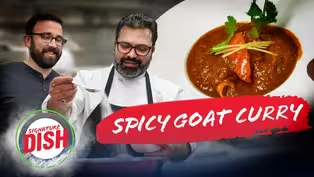
Can Seth Handle Pappe's Fiery Goat Curry?
Video has Closed Captions
Clip: S1 Ep4 | 6m 18s | Host Seth Tillman heads to Pappe and tried their signature dish, Junglee Laal Maas. (6m 18s)
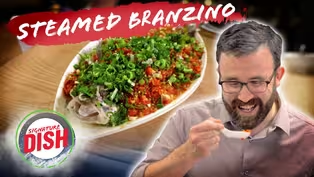
Chef Peter Chang's Secret to Whole Steamed Fish
Video has Closed Captions
Clip: S1 Ep4 | 7m 27s | Chef Peter Chang shares his signature whole steamed fish with fermented peppers and onions (7m 27s)
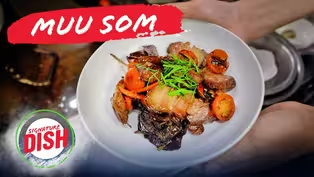
Homegrown Chilies and Fermented Pork Are Key to Lao Cuisine
Video has Closed Captions
Clip: S1 Ep4 | 6m 47s | Seth Tillman heads to Thip Khao where Chef Seng Luangranth cooks Muu Som. (6m 47s)
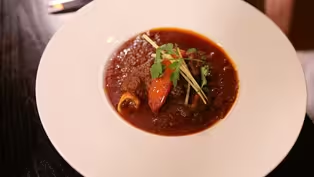
Preview: S1 Ep4 | 30s | Muu som (fermented pork); junglee laal maas (goat curry); steamed fish with peppers (30s)
Providing Support for PBS.org
Learn Moreabout PBS online sponsorship

- Food
Christopher Kimball’s Milk Street Television
Transform home cooking with the editors of Christopher Kimball’s Milk Street Magazine.











Support for PBS provided by:
Signature Dish is a local public television program presented by WETA