
May 19, 2026 | Carolina Impact
Season 13 Episode 1327 | 27m 50sVideo has Closed Captions
Paying More, Getting Less; Defend The Fatherless; Charlotte’s Nature Legacy; & Marshallene Iris
Charlotte families paying more for less as shrinkflation squeezes budgets and food banks; Defend The Fatherless assists in Foster, Adoptive and Kinship care in York County, SC; Charlotte’s natural spaces reveal a legacy of conservation, growth, and community; & Marshallene Iris pulls people in with her flavorful, handmade island jams.
Problems playing video? | Closed Captioning Feedback
Problems playing video? | Closed Captioning Feedback
Carolina Impact is a local public television program presented by PBS Charlotte
May 19, 2026 | Carolina Impact
Season 13 Episode 1327 | 27m 50sVideo has Closed Captions
Charlotte families paying more for less as shrinkflation squeezes budgets and food banks; Defend The Fatherless assists in Foster, Adoptive and Kinship care in York County, SC; Charlotte’s natural spaces reveal a legacy of conservation, growth, and community; & Marshallene Iris pulls people in with her flavorful, handmade island jams.
Problems playing video? | Closed Captioning Feedback
Where to Watch Carolina Impact
Carolina Impact is available to stream on pbs.org and the PBS app.

Introducing PBS Charlotte Passport
Now you can stream more of your favorite PBS shows including Masterpiece, NOVA, Nature, Great British Baking Show and many more — online and in the PBS Video app.Providing Support for PBS.org
Learn Moreabout PBS online sponsorship- [Narrator] This is a production of PBS Charlotte.
- Just ahead on Carolina Impact, let's break down shrinkflation.
And find out how families can adjust for it at the grocery store.
Plus we take you to Mecklenburg County Parks to see how it's more than a place to relax.
And you get to meet a local neighbor tonight who connects through her flavorful island jams.
Carolina Impact starts right now.
(upbeat music) Good evening.
Thanks so much for joining us.
I'm Amy Burkett, Charlotte families are feeling the squeeze at the grocery store, and it's not just because prices are higher.
In many cases, packages are getting smaller too, leaving shoppers paying more for less.
Carolina Impacts' Chris Clark takes a closer look at shrinkflation.
- [Chris] For a lot of Charlotte families, the grocery bill doesn't just feel higher, feels like the food runs out faster too.
In many cases, shoppers aren't just paying more, they're paying more for less.
- Just because the box is bigger doesn't mean that there's more in.
They're getting skinnier and taller.
- [Chris] It's called shrinkflation.
When products get smaller or packages hide less inside, while the price stays the same or goes up.
Product can still look familiar.
Even when the value has changed.
- The price goes up at the store, customers can respond, but if the packaging changes a couple ounces get cut, a lot of consumers might miss that.
- And that quiet change adds up.
According to the Bureau of Labor and Statistics, American households paid an estimated $8.6 billion more in 2024 for products that quietly got smaller.
M&M's are up 102% per ounce since 2020.
Frosted Flakes now cost 51% more per serving with fewer servings inside.
And products like chips, sports drinks, peanut butter, coffee and packaged cheese have all found different ways to give shoppers less while charging more.
Gatorade made it pretty obvious.
The bottle that people remember, that was 32 ounces.
Now it's just 28, so you're getting less right off the top.
And with these potato chips, the bag looks familiar, but Lay's cut it standard size from 10 ounces to eight.
And all that does is leave people paying more for less product.
This final example is by far one of the sneakiest.
And it's peanut butter.
That's right, peanut butter.
I mean the jar still looks the same.
So what's the big deal?
Well, if you check out the bottom here, it dimples in.
That's what takes it from 18 ounces in its original shape down to 16.3.
It gives companies a way to protect sales without drawing the same reaction as a straight price jump.
- If we raise a price that's really gonna hurt sales and revenue, but if instead, if we reduce packaging and the amount they're getting, we can keep revenue the same or maybe even higher through that mechanism.
So it's kind of, it's an indirect way to raise prices.
- [Chris] His advice is simple, shop by the numbers, especially with packaged foods.
- The number one step is to just, you know, look at the price per unit, you know, price per ounce or whatever it is.
And the other key thing to think about is that most of the shrinkflation happens in packaged goods.
- [Chris] And for families already stretched thin, even a small cut in size can become a big problem.
- It makes it difficult, especially if you have a family.
If you have a family now you gotta stretch it out a little bit more and if you don't have the money for it, then it could be real difficult.
- [Chris] This isn't just sticker shock.
For families already on a budget, it means harder choices about what goes in the cart and how long it lasts - The families that we serve, this is a critical impact for them.
If you are on a budget and you have X amount of dollars to spend on food and your dollars that you have allocated aren't buying, isn't buying the food that it's necessary to feed your entire family, that puts you between a rock and a hard place.
- [Chris] And sometimes it means shopping week to week, not because that works better, but because that's what the budget allows.
- I don't really try to go too heavy or anything.
I just try to go for like something for the week.
So a little pack of chicken that could last me for, you know, two, three days.
- When you are on a fixed income, you are shopping the middle aisles and for canned goods for non-perishable items, and most of those items are filled with fat, sugar, and salt.
And so if you have to really shop cheaply, then oftentimes you are buying food that's not all that nutritious for you.
- [Chris] And for some families, the squeeze goes beyond what kind of food they can afford.
It comes down to how much food they can afford to bring home in the first place.
- We like to say here in Charlotte that rent eats first.
And so we know far too many people that go to bed hungry every night in order to keep a roof over their head.
- [Chris] And it's not just hurting families, it's hitting food banks too.
- Our food drive donations have gone down drastically because a lot of middle class families when they were out grocery shopping historically, you know, if there's a buy one get one, you know, they would buy one and then donate the other one.
But when the middle class families are feeling the pinch, they too can't even donate regularly.
- [Chris] If the trend keeps going, it could threaten something Nourish Up has managed to avoid for decades.
- We've been in this business of feeding people for the last 50 years, and I knock on wood when I say it, but we've never had to turn anybody away because we ran out of food.
If numbers continue at this rate, if we continue to break records and not in a good way, I don't know how much longer we can continue that promise.
- [Chris] It's what makes shrinkflation more than a grocery store annoyance.
It's changing what families can afford, what they eat, and how much help food banks can provide.
And for Charlotte Shoppers, what looks familiar on the shelf may not be the same value once you get at home.
For Carolina Impact, I'm Chris Clark.
- Thank you, Chris.
Shrinkflation may be easy to miss on a single trip to the store, but it adds up fast.
Experts say it's more important than ever to look beyond the price tag and pay attention to what's actually inside the package.
It's those ounces that we gotta pay attention to.
While shrinkflation quietly chips away at what families can afford.
There are other systems placing even greater strain on households, where the stakes go far beyond the grocery bill.
For thousands of children, instability isn't about lessen the package, but uncertainty about where they'll call home.
That's where the foster care system comes in.
It's a state run, federally funded program providing temporary out-of-home care for children who were removed from their families due to safety concerns.
With over 420,000 kids currently in foster care, it's a system that many feel is broken.
Carolina Impact's, Jason Terzis joins us with the story of one local organization doing all it can to help.
- Well, like many things, the US foster care system was designed with the best of intentions.
But the unfortunate reality is it's riddled with issues such as inadequate resources, mental health challenges, and poor outcomes for many who age out of the system.
It's estimated that some 90% of foster kids experience some form of trauma.
25% will attempt suicide and 97% of young adults who age outta the system each year will immediately enter into chronic poverty.
- 5 investigates with just a horrific case of abuse that's been kept hidden for years by the state and in courts.
- The abuse, all involving a single foster home in Massachusetts and at least six children reported.
- [Jason] You've likely heard just some of the disheartening stories.
- I call what we went through torture.
- [Jason] The US foster care system simply put is not in a good place.
- [Narrator 2] When a child enters foster care, that child has likely experienced instability causing a disruption in brain development.
- [Jason] But there are those with a servant's heart working to make a difference.
- Defend The Fatherless.
Totally different.
They meet all the needs that we have of foster parents, kinship and adoptive.
I've never seen anything like it.
- [Jason] Defend The Fatherless is a Fort Mill based nonprofit supporting foster, adoptive and kinship families throughout York County.
- Kinship, is when a grandparent and aunt and uncle, close family friend is caring for a vulnerable child in their home.
- [Jason] And a passion project for founder and executive director, Caitlyn Sund.
- It has been one step of faith after another.
- [Jason] Caitlyn's life journey is always centered around assisting others.
Working as a pediatric occupational therapist, she made in-home visits to help special needs children.
- Just have had a really big heart for kids with special for my whole life.
- Caitlyn always had an insatiable appetite to help small children.
- [Jason] Caitlin and husband Brad had two biological children, Kyrie and Brooks.
- I have known since I was a young child that I wanted to adopt.
My husband was like, "All right, if we're gonna do this, we should probably do it now."
- [Jason] Their decision.
Go to China.
And adopt this special needs little girl.
- God shut every door except for the one to China.
- [Jason] They brought home 14 month old Olivia who was born with a hearing impairment.
- Adopting Olivia was one of the scariest things we've ever done.
Like we knew that we were called to do this.
We were passionate about it, we were excited about it.
The moment we saw her face, we knew she was ours.
- [Jason] But soon after getting settled in back home reality set in.
- You know, people were there for the first couple weeks and then it gets quiet, really quiet.
- We also realized how isolating it could be when you're welcoming a child into your home that has a traumatic background.
Your family's just a little bit different and a lot of your friends maybe don't understand that, or your church community doesn't understand that life just changes.
- And honestly, we felt kind of alone.
You know, we had friends, we had a great church network, but we didn't have people who understood what we were going through.
- [Jason] And even with Olivia now home, Caitlyn still wanted to go out and give back.
- I went back to China on a couple mission trips and just loved the work I was doing there.
One of my teammates on one of the trips that I took, had started a Foster Closet out of her church in another state.
I was really inspired by that work.
- [Jason] With the help of her church, she launched the York County Foster Closet operating out of a couple of storage units, working to meet the various needs of new foster and adoptive families.
- We had a chandelier, a rug, shelves, all the things that made it feel like a boutique within a storage unit and families could come shop for car seats, baby equipment, diapers, clothing, kind of all that they needed.
And then we realized, you know, we're just really outgrowing this storage unit.
We're serving more and more families.
We wanna build a strong community.
We need a space.
- [Jason] In 2019, The Foster Closet evolved into Defend The Fatherless, a biblical term for help the weak.
- Our mission is for families to have one more reason to say yes to vulnerable children through foster care, adoption and kinship care.
We know that walking the road of caring for a vulnerable child is really hard, and statistics show that 50% of foster families end their journey within the first year because it's really hard and really isolating.
- [Jason] The Foster Closet is still in operation, but now under the Defend The Fatherless umbrella.
It moved out of its storage unit and into its own home.
- Thank you very much.
I just got him a bunch of little shorts.
Yes.
- [Jason] With five full-time employees and a slew of volunteers, they sort donated supplies offering up new and gently used clothing, car seats and other needed items.
- These are the two girl tables, these are the two boy tables.
Everything is labeled by size.
So 12 month, 18 month, 24 and on.
- And then just watching her turn it from, you know, her and two other women starting this thing into now what it's become is kind almost like a volunteer opportunity.
Now, a full-fledged organization that is just making a huge impact on the communities.
- [Jason] And along the way, Caitlyn made the difficult decision to leave her occupational therapist job and focus on Defend The Fatherless full time.
- It didn't come without a lot of thought and prayer.
And a lot of resisting God, to be honest.
Yeah, I resisted it.
I resisted the decision for, for a long time.
- [Jason] In these days, it goes well beyond just The Foster Closet.
Defend The Fatherless also offers all sorts of programming, including parents nights out and scholarships.
Anything to assist families of foster and adopted families.
- They have all kinds of grants and programs and they give us respite.
Nights where we if need a break, we can get a break.
They have one tonight.
As a matter of fact.
I mean, I've never seen anything like it.
"Don't feed the kids, bring 'em, we'll feed them, drop 'em off."
They don't rush you to get back.
"We know things come up.
Take your time, we got 'em."
I mean, I've never seen anything like that.
I don't know a ministry, not even a church that does that.
- [Jason] Those utilizing Defense services.
Can't say enough.
- It takes a village to, you know, to do something like this.
And this is a great starting point and it takes a lot of the pain and anxiety away when you have something like this that you can lean on.
- It's an organization and a ministry that God has ordained and sent for such a time.
- [Jason] Between individual donors and church partnerships Defend The Fatherless serves about 400 people every month and gives away thousands in adoption grants in mental health scholarships.
Not bad for an organization that started out not too long ago in a storage unit.
- Defend The Fatherless has some big upcoming events as I understand.
- Yeah, they have a full calendar.
June events include a family walk and talk and ice cream, a bowling event and family movie night.
And information sessions called The Inner Circle with a trained therapist to answer people's questions.
There's also an annual sporting Clays Tournament in October.
We have a link to their calendar on our website, pbscharlotte.org.
- Well, another example of finding stories anywhere.
I was standing in line at the post office when one of their board members approached me and told me about the organization that I knew nothing about.
I'm so glad you went and did the story.
- Absolutely.
As we say, anything can be a story.
- Absolutely, well, from creating safe spaces for children in foster care to preserving spaces for all of us to recharge, many people see Mecklenburg County's Parks as a place to walk, breathe and reset.
But those spaces didn't happen by accident.
They're part of a larger effort to protect land in the county that's growing so incredibly fast.
Carolina Impact's Heather Burgiss joins us from the Reedy Creek Park and Nature Preserve.
- And Amy, it is a beautiful day to be out on the trail.
And what you see behind me is only part of the story.
Mecklenburg County Park and Recreation has worked behind the scenes for years to help preserve and identify what areas in Charlotte need a little special attention.
And that includes with plant species and animals.
They make sure these areas are thriving.
Even as Charlotte is growing.
In a fast growing place like Charlotte, land like this can feel increasingly precious.
But across Mecklenburg County, there are still places where the noise fades, the tree canopy takes over and nature replaces the urban.
- It feels like I'm not in the city when I'm in the middle of the woods, so it allows me to rest my brain and get some fresh air and be in nature.
I love Reedy Creek.
Living so close, it's so easy for me to kind of pop in in the middle of my day to get some respite, get some sun.
It's a great park, so we love it here.
- I love that it feels like we're at the lake, but we only drive five minutes away.
So it's great for the kids to be able to walk and get out in nature and run around and have a lot of free space.
- We hope that people can come to this very urban section of town and spend a few minutes out here and in nature just walking a trail and just kind of forget the fact that they're gonna have to get on Central Avenue or get on Independence.
- [Heather] As division director for Mecklenburg's Nature Preserves and Natural Resources, Chris Matthews and his team work to keep the vibrant network of Preserves and Parks like this healthy and thriving.
But it all started decades ago with a desire to protect the land around Charlotte before it was gone.
- In 1974, Mecklenburg County decided that they would develop a park and Rec system that had a little bit different focus.
And that focus was to create these large park spaces similar to a state park type feel and to do greenways and greenway trails.
- [Heather] That early approach helped shape some of Mecklenburg County's signature natural spaces, including large preserves, early greenways, and places like Reedy Creek.
Over time, the mission grew beyond access to protecting forests, habitats, streams and open spaces in one of the region's fastest growing counties.
- One of the most important things that I think I do on behalf of the department is helping to be strategic with our land acquisition, to try and buy properties that will provide access to parks for the residents.
Also to protect what little natural resources we have left.
- [Heather] Research cited by UNC Charlotte's Urban Institute projected that as much as 97% of Mecklenburg County could be developed by 2030.
- I think that we are probably still on track to be mostly developed within the next 5 to 10 years.
- [Heather] That disappearing land makes the push to protect open space even more urgent.
For Chris Matthews, this work is personal.
He grew up watching his father renowned botanist, Dr.
James F. Matthews worked to identify, protect, and establish places like Reedy Creek.
- Dad was instrumental in acquiring Reedy Creek Park and Nature Preserve for the city of Charlotte at the time in the early 80s.
So Reedy wouldn't be there had dad not been successful at doing that.
- [Heather] But Charlotte's story of Parks and Nature is not only preserved outside on the trails, inside the Reedy Creek Nature Center is another part of that legacy.
A scientific archive of the region's natural history.
- This is the natural history of our region preserved.
I mean, these specimens go back decades, sometimes even longer than that.
- How many species are are we looking at in this room?
- Oh, thousands.
And not just from this region.
So we have specimens from every county in North Carolina and every state in the country.
And actually, from most countries in the world, - [Heather] The Dr.
James F. Matthews Center for Biodiversity Studies at Reedy Creek houses more than 52,000 preserved plant specimens along with a growing zoological collection that includes more than 2,000 moths.
It is both archive and evidence, a record of what has lived here, even when the landscape itself has changed.
- A lot of these places where these plants collected are gone.
We have cases where we have plant species that no longer occur in Mecklenburg County, and we have specimens here to prove that they once did.
- [Heather] Some specimens in the herbarium date back to 1872, and others tell a regional story of ever changing and fading habitats.
- To know that there was ever Galax in our region.
Again, we wouldn't have that knowledge, if unless it was for herbarium specimens like this.
- [Heather] The work is not only about preserving the past.
Biodiversity monitoring helps staff understand what species are still here, what habitat they need, and how to manage these preserves as development continues around them.
- Monitoring for biodiversity is super important because this tells us, you know what we can protect, you know what we can save.
- [Heather] The herbarium becomes both archive and tool.
Something scientists can return to as names change.
Species are reclassified and new research questions emerge.
Sometimes an old specimen can help reveal something entirely new.
- It was one of his original collecting spots.
So to go back and revisit that and make a collection of a specimen that, you know, he had once collected decades and decades before, that was significant.
- [Heather] That work is still happening.
Through biodiversity monitoring, Mecklenburg County is tracking what is still here and what it will take to protect it.
For Chris Matthews, his focus remains on his legacy of preservation.
- Gotta make sure that that thing keeps on going.
So I have a few more years left, not a lot, but I wanna make sure that, that they're set up for, you know, success in the future.
Charlotte's a great city.
Our park system's phenomenal.
- And as the growth continues, the bigger question is how do we hold on to these open spaces?
Because once they're gone, they're not easily replaced.
Amy.
- Thank you, Heather.
County leaders say protecting open space also means helping shape the best path forward when infrastructure projects affect Parkland by working with other agencies for the best outcomes.
After spending time in natural spaces, it's clear those connections don't end when the trail does.
For some nature becomes inspiration.
You can practically taste.
In tonight's "Meet your Neighbor" segment, we introduce you to Marshallene Iris, who's turning the flavors of her home island of Bermuda, into handcrafted jams.
♪ I have always wanted to have a neighbor just like you ♪ ♪ I've always wanted to live in a neighborhood with you ♪ ♪ So would you be mine, could you be mine ♪ ♪ Won't you be my neighbor ♪ Hi, neighbor.
(bright music) - [Dara] Aah, it's that time of year again.
Spring is in the air.
The flowers have blossomed.
And local strawberries are ready for picking.
- We are in a strawberry patch.
And this is where I come to get my strawberries every year.
- [Dara] Which means, it's time for Marshallene Iris to grab her wagon and roll back out to her favorite strawberry patch in Midland, Dear Run Farm.
- It's a beautiful day.
Nothing like strawberries, fresh.
- [Dara] Marshallene doesn't choose just any old strawberries when she's out here.
- I go through 'em.
I don't pick 'em all because if they're white on the bottom they're not finished ripening.
- [Dara] With a keen eye.
She's looking through to make sure she's grabbing the reddest, juiciest one she can find.
- That's why you have to check 'em before you pick 'em.
It's a process, - [Dara] One that brings her peace.
- It's therapy, you know, I love doing it.
- [Dara] When she's ready to roll out, she has three white baskets that are a gallon each, overflowing with strawberries that she'll soon turn into fresh jam for her company.
Bermuda Jamsations once she's home.
And of course we had to follow Marshallene there so we could see all the fun for ourselves.
She begins by cleaning the strawberries in a bowl of water and vinegar.
Research shows that vinegar is helpful because it removes bacteria and slows down mold growth.
Then she chops off the leafy green parts.
Now it's time for her to smash some berries.
All arms, no machines, just how she likes it.
- It's better this way.
Homemade stuff always better because first of all, you're putting yourself in it.
- [Dara] It takes Marshallene five cups of smashed strawberries to make about a dozen jars of jam.
While the strawberries cook down she adds all her special ingredients, including pectin, which is a natural substance from fruits that helps the jam to thicken and set.
After the mixture reaches the perfect texture, she pours it into mason jars, puts the jars in boiling hot water to seal them.
- And that's what they call water canning.
- [Dara] And in a few days, once they're properly set.
- Hey, girl.
- Hey.
- Hi, Marshallene, how are you?
- I'm fine.
- [Dara] They're ready for customers like Melissa Morrison.
- She's making all her jams, I feel like, with a lot of love, and she just takes her time.
- [Dara] Marshallene started Bermuda Jamsations back in 2009 from her Matthews kitchen.
In addition to jams, she makes jellies, sauces, and salsa.
The flavors are pretty unique too, like mangapricot, tomato strawberry and pickled daikon radish and pears.
- Every time I look, I'm doing some combinations and that's how I have so many different kinds.
- [Dara] For Marshallene, who was born and raised in Bermuda, working with fresh fruit isn't anything new.
- We used to go out, climb the trees to pick loquats, pick cherries and stuff.
- [Dara] When she started her business, she made sure to pay homage to her roots.
- First we were gonna say Bermuda Sensations, and then since most of it was gonna be jam at first, we decided Bermuda Jamsations, so that's how we came about the name.
- [Dara] Marshallene has been in the US since 1994, but she and her husband Harry, who's also from Bermuda, have pieces all throughout their home that remind them of the island.
- This is just one of the dancers.
Gombey is something traditional that like when we have a parade, you have your dancers, you have the "Whip Man," and you have the drummers.
What they do is when they get into a circle, people make a circle for them and throw out money, and they collect money.
- [Dara] This electrifying tradition of Gombey dancing has deep roots in Bermuda.
According to historians, during the period of slavery, enslaved Africans would gather with their loved ones during Christmas time and dance.
These dances mock their British enslavers, so they wore masks.
Despite the British restricting these gatherings, the traditions still managed to survive because of secret performances and oral teachings.
- Where we stayed, we can actually see these feathers on the hats coming down through the hill, coming down to the street.
It was really interesting as a kid.
- [Dara] Because Bermuda is a British colony, tea, is another big part of the culture.
And if you browse around the couple's kitchen, you'll find tea everywhere.
- You can look in there and see.
We've got different types of teas in here.
- This is lavender that's from my garden, my own lavender flower.
You drink it as tea.
- [Dara] Whether it's tea with herbs straight from the earth, or jam made with freshly picked fruit.
Marshallene's passion for handmade products not only brings joy to others, but gives them a taste of the island she'll always call home.
For Carolina Impact, I'm Dara Khaalid.
- Thank you, Dara, Marshallene is another wonderful example of the amazing neighbors that surround us and make our region so special.
If you're interested in purchasing one of her creations, we've got a link to our information on our website at pbscharlotte.org.
Well, if you have an interesting neighbor, we should meet.
Email us the details to stories@wtvi.org.
Well, that does it for this evening.
Thanks so much for joining us.
We always appreciate your time and I look forward to seeing you back here again next time on Carolina Impact.
Goodnight my friends.
(upbeat music) - [Narrator] A production of PBS Charlotte.
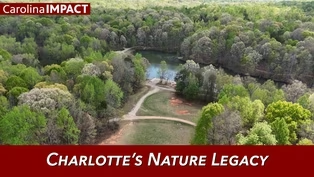
Charlotte’s Nature Legacy | Carolina Impact
Video has Closed Captions
Clip: S13 Ep1327 | 6m 25s | Charlotte’s natural spaces reveal a legacy of conservation, growth, and community. (6m 25s)
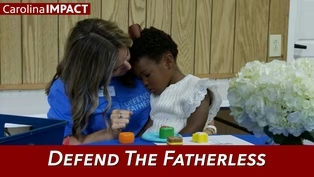
Defend The Fatherless | Carolina Impact
Video has Closed Captions
Clip: S13 Ep1327 | 7m 25s | Defend The Fatherless assists in Foster, Adoptive and Kinship care in York County, SC (7m 25s)
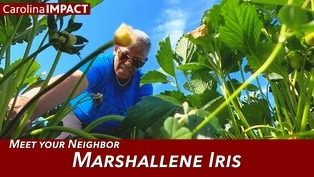
Meet Your Neighbor: Marshallene Iris | Carolina Impact
Video has Closed Captions
Clip: S13 Ep1327 | 5m 57s | Marshallene Iris pulls people in with her flavorful, handmade island jams. (5m 57s)
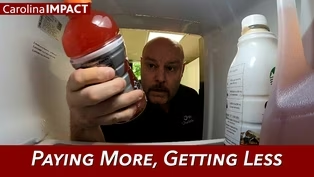
Paying More, Getting Less | Carolina Impact
Video has Closed Captions
Clip: S13 Ep1327 | 5m 37s | Charlotte families paying more for less as shrinkflation squeezes budgets and food banks. (5m 37s)
May 19, 2026 Preview | Carolina Impact
Preview: S13 Ep1327 | 30s | Paying More, Getting Less; Defend The Fatherless; Charlotte’s Nature Legacy; & Marshallene Iris. (30s)
Providing Support for PBS.org
Learn Moreabout PBS online sponsorship New Episode
- News and Public Affairs

Top journalists deliver compelling original analysis of the hour's headlines.

- News and Public Affairs

FRONTLINE is investigative journalism that questions, explains and changes our world.
 New Episode
 New Episode
 New Episode
 New Episode
 New Episode
 New Episode
 New Episode
 New Episode

 New Episode
 New Episode
Support for PBS provided by:
Carolina Impact is a local public television program presented by PBS Charlotte