
Meet the People Rescuing Food, Feeding Neighbors & Helping the Climate
Clip | 6m 32sVideo has Closed Captions
Saving perfectly good food from dumpsters
California has bold ambitions to both battle hunger and reduce organic waste by slashing the amount of perfectly edible food that gets dumped into the state’s landfills every year, much of that organic waste comes from supermarket chains, and when it rots in landfills it releases methane, a potent greenhouse gas that accelerates climate change.
Problems playing video? | Closed Captioning Feedback
Problems playing video? | Closed Captioning Feedback
Earth Focus is a local public television program presented by PBS SoCal
Meet the People Rescuing Food, Feeding Neighbors & Helping the Climate
Clip | 6m 32sVideo has Closed Captions
California has bold ambitions to both battle hunger and reduce organic waste by slashing the amount of perfectly edible food that gets dumped into the state’s landfills every year, much of that organic waste comes from supermarket chains, and when it rots in landfills it releases methane, a potent greenhouse gas that accelerates climate change.
Problems playing video? | Closed Captioning Feedback
How to Watch Earth Focus
Earth Focus is available to stream on pbs.org and the free PBS App, available on iPhone, Apple TV, Android TV, Android smartphones, Amazon Fire TV, Amazon Fire Tablet, Roku, Samsung Smart TV, and Vizio.
Providing Support for PBS.org
Learn Moreabout PBS online sponsorship[music] -Today, we're at our Friday distribution here at Tellefson Park in Culver City, and we are bringing food from grocery stores that our drivers have collected this morning and distributing it here in the park.
The beauty of it is we're doing two things with this one type of work we do.
We're both feeding people, and we're doing something that's really important for climate change.
-Martin.
-[chuckles] Pull the lever.
-Pull the lever.
-Volunteer.
Any Volunteers over here, help me unload, please.
-All hands on deck.
-Grab a cart.
These guys have been out doing pickups at the stores this morning.
They start about five o'clock.
They go do their routes, and then they all come back here, and we have about 30 to 45 minutes to get everything out and processed on the tables and open the lineup because once we start to go, that's it.
We won't stop until the line is finished.
-FoodCycle's mission is to feed people, not landfills, and basically what we're doing is create an infrastructure to ensure that all the food that is edible goes to feed people instead of getting thrown into the landfills.
-Offload him quick, and he's got to go right back out.
-What would have happened to this food 10 years ago, 20 years ago?
-It would have gone into the landfill.
Everything would have gone into the landfill.
-One of the reasons that FoodCycle exists is that here in the US, it's estimated that between 30% and 40% of our edible food is getting thrown away.
This is millions and millions of pounds of food.
We started doing this work more than 20 years ago at a time when we would go to grocery stores, and even though we would show up every day, they would still throw food in the dumpster.
-Reducing waste is the most important thing that we can do to reduce our greenhouse gas footprint.
Organic waste is anything that, when it ends up in a landfill, it produces methane.
It can be your food scraps.
It can be your yard waste.
It can also be cardboard or textiles, but food and yard waste are what break down the quickest and generate the most methane in landfills.
By keeping them out of landfill, by first recovering them for human consumption if possible, and then recycling what can't be rescued, we're keeping that material out of landfill, and so reducing the greenhouse gas impacts of that material as it's rotting in the landfill.
-Today, we're going to go to a few markets and pick up some donations of food.
We'll hit three stores, four stores the most, and then we'll come back and unload and distribute the food.
It's hard for people to pay their bills and do this when they can have some food and make sure no kids or anybody's starving or hungry, and they get fed.
-The laws here in California that have been requiring businesses to donate food, to not throw away food, that's the reason why we're able to collect more than 11 million pounds of food now.
This went from one dumpster to us doing 11 million pounds of food a year because of the support of legislation.
-Senate Bill 1383 requires that 75% of organics are diverted from landfills, and those organics are everything from food and yard waste to cardboard to textiles, so anything that, when it's in the landfill, produces methane.
It also requires that 20% of edible food is rescued to feed people instead of landfills, and that's critically important because one in five Californians are still facing food insecurity.
-What we found with SB 1383 in particular, which requires businesses to donate food and requires cities to help enforce that, as it became clear that they didn't have any choice, we saw a huge shift.
We saw that businesses that had been throwing things away in the past now started to donate, and a lot of businesses, it inspired them to make it a priority for themselves and their staff to get this food to people.
-Remember, everything that we have on the tables is all that we have, so be very considerate of that, and try to move through quickly so that we can get the main line open.
-Why do supermarkets even give this stuff to you?
It looks perfectly good.
-It is perfectly good.
All of this stuff, it has to be edible food.
They can't just give us their garbage.
There's nothing wrong with this food.
Some of the food may be close to expiration, or it could be overages that the stores have.
A lot of the stores don't have the additional storage space inside of the markets, and it doesn't make financial sense for them to take it back to their warehouse and redistribute it.
That's the type of stuff that they donate to us.
We work really hard with the grocery stores so that they understand what types of donations they can give to us and what types of donations they should be composting.
-If we were to have done anything different, what I think that would have been is getting that education campaign front and center, along with building the program, because one of the biggest obstacles we've seen is this need for behavior change.
-I learned that we're wasting a lot of food, and we shouldn't, because there are so many people that need it.
I think about it at my house, how I can save food and not just throw food away.
-At home, I tend to cook more, honestly, instead of wasting food.
I don't just let it sit there.
When I go grocery shopping, I'm more mindful, "Am I really going to use this, or do I want it just because it's on sale?"
Definitely just being more mindful of what I'm bringing in the house, mindful more of what I'm putting in my body too.
-I think people need to know more about success stories around the environment to also understand that it's possible to move the needle instead of feeling like, "It's so big, let's walk away."
It's not too hard.
[chuckles] It just needs to be one step at a time, and the past 20 years have shown me that.
-Thanks for watching.
If you liked this story, don't forget to like, comment, and subscribe for more.
Stick around for the next video.
I think you're going to love it.
 New
NewSun, Sand and Climate Change: The Fight to Save California’s Coast
Video has Closed Captions
Clip | 6m 53s | What’s being done to save Southern California’s beaches from being washed away for good? (6m 53s)
How to Create a Sustainable, Zero Waste Meal Plan
Clip | 7m 11s | A climate change activist tells us how to create a more sustainable kitchen. (7m 11s)
The Community That Transforms Food Scraps Together, Stays Together
Video has Closed Captions
Clip | 5m 50s | L.A.’s garden activists create a composting movement. (5m 50s)
 Now Playing
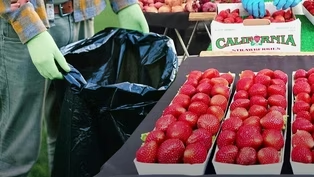
Meet the People Rescuing Food, Feeding Neighbors & Helping the Climate
Video has Closed Captions
Clip | 6m 32s | Saving perfectly good food from dumpsters (6m 32s)

Video has Closed Captions
Clip | 6m 27s | We explore why enough water couldn’t be pumped through fire hydrants to protect homes from burning. (6m 27s)
Goodbye Plants, Hello Fire Safety
Video has Closed Captions
Clip | 7m 53s | Controversial proposal to protect homes from wildfires by forcing homeowners to remove vegetation. (7m 53s)
Can You Build a Fire-Proof Home?
Video has Closed Captions
Clip | 7m 46s | How to rebuild after L.A.’s devastating wildfires. (7m 46s)
Earth Focus Environmental Film Festival 2023 (Preview)
Preview | 30s | The fifth annual Earth Focus Environmental Film Festival features five days of screenings. (30s)
Clip | 8m 17s | Taylor Yard is now an undeveloped and still-contaminated site adjacent to the L.A. River. (8m 17s)
Earth Focus Environmental Film Festival
Preview | 1m 18s | Earth Focus Environmental Film Festival (1m 18s)

Cold Rush? The Changing Arctic
Clip | 14m 41s | "Earth Focus" looks at the changing face of the Arctic today. (14m 41s)
Fukushima: Can it Happen in the US?
Clip | 7m 21s | Fukushima was not a Japanese nuclear disaster. (7m 21s)
Cambodia: Fight for Areng Valley
Clip | 10m 47s | The Chong people are fighting to protect their forests. (10m 47s)
Inside Illicit Ivory and Rhino Horn Trade
Clip | 6m 41s | Inside Illicit Ivory and Rhino Horn Trade (6m 41s)
Unacceptable Risk: Firefighters on the Frontline
Clip | 12m 52s | Fires are becoming more frequent, larger and more devastating than ever. (12m 52s)
China: Religion and Environment
Clip | 13m 37s | Filmmakers Gary Marcuse and Shi Lihong capture a surprising trend in China. (13m 37s)
Hope for Rhinos? New Approaches to Save Endangered Species
Clip | 14m 31s | Rhino horn is more expensive than gold or platinum. (14m 31s)
Making Coastal Communities More Resilient to Extreme Weather
Clip | 5m 48s | Joshua Saks looks at how America's communities can be protected. (5m 48s)
Paying for Climate Change: A Reinsurance Industry View
Clip | 6m 32s | Climate change is anticipated to have a big impact on the insurance industries. (6m 32s)
Encroaching Tides: What's at Stake for the US
Clip | 6m 32s | The eastern coast of the United States has one of the highest rates of sea level rise. (6m 32s)
Sacred Economics: A Post Money World?
Clip | 11m 55s | Charles Eisenstein speaks to Earth Focus about his new book Sacred Economics. (11m 55s)
Neonics: Toxic Until Fully Tested
Clip | 8m 58s | Scott Hoffman Black speaks about the impact of neonicotinoid pesticides. (8m 58s)
Neonics: Driving Declines in Biodiversity
Clip | 8m 26s | Dr. David Goulson speaks about the impact of neonicotinoid pesticides. (8m 26s)
Clip | 5m 43s | Earl Blumenauer talks about why protecting pollinators in the US is the national interest. (5m 43s)
Clip | 11m 29s | Shrimp farmers tell us to reject contaminated shrimp from Bangladesh. (11m 29s)
Killing the Senate Filibuster Could Inspire Bipartisanship
Clip: Special | 27m 36s | Jon Christensen moderates a conversation with former Nevada Sen. Harry Reid. (27m 36s)
Sen. Cortez Masto: Pursuing a Green Economy
Video has Closed Captions
Clip: Special | 1m 9s | Cortez Masto has a goal to grow a clean energy economy that includes jobs for the future. (1m 9s)
Sen. Cortez Masto: Protecting the Outdoors is Nonpartisan
Video has Closed Captions
Clip: Special | 37s | Protecting the environment should not be considered a partisan issue, Cortez Masto says. (37s)
Sen. Cortez Masto: On Reid’s Environmental Legacy
Video has Closed Captions
Clip: Special | 54s | Sen. Harry Reid struck a balance when crafting inclusive environmental policy, she says. (54s)
Sen. Cortez Masto: On Growing Up in Rural Las Vegas
Video has Closed Captions
Clip: Special | 40s | Cortez Masto grew up in a rural Las Vegas with cowboys and ranches. (40s)
Sen. Cortez Masto: ‘A Microcosm of America’
Video has Closed Captions
Clip: Special | 1m 17s | Sen. Catherine Cortez Masto describes her state’s role in national politics. (1m 17s)
The New West and the Politics of the Environment (Preview)
Video has Closed Captions
Preview: Special | 1m | A quiet, little-known revolution is taking place in American environmental politics. (1m)
Moapa Solar Plant Addressed Injustice, Economy and Energy
Video has Closed Captions
Clip: Special | 5m 7s | Behind-the-scenes negotiations helped establish the Moapa transition from coal to solar. (5m 7s)
How SNPLMA Wove Urban Las Vegas Back Into the Environment
Video has Closed Captions
Clip: Special | 2m 17s | The legislation helped balance urban growth in Las Vegas with environmental conservation. (2m 17s)
Black Rock-High Rock: The Negotiation Behind Conservation
Video has Closed Captions
Clip: Special | 8m 2s | A proposal to protect Nevada’s Black Rock Desert-High Rock Canyon received much criticism. (8m 2s)
Providing Support for PBS.org
Learn Moreabout PBS online sponsorship














Support for PBS provided by:
Earth Focus is a local public television program presented by PBS SoCal