
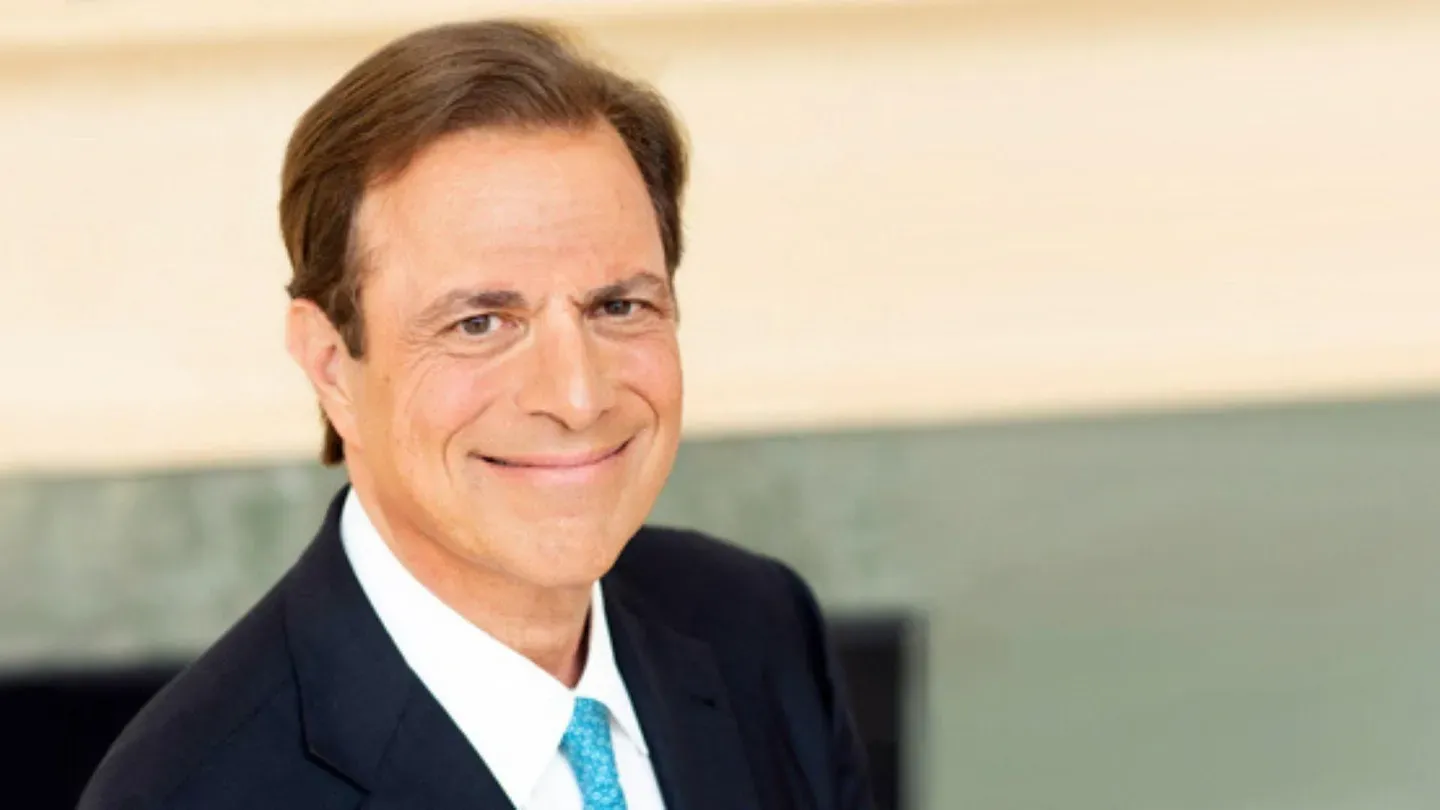
Michael Beschloss
Season 1 Episode 102 | 26m 40sVideo has Closed Captions
Presidential historian and New York Times bestselling author; PBS NewsHour contributor
Presidential historian and New York Times bestselling author; PBS NewsHour contributor
Problems playing video? | Closed Captioning Feedback
Problems playing video? | Closed Captioning Feedback
Michael Beschloss
Season 1 Episode 102 | 26m 40sVideo has Closed Captions
Presidential historian and New York Times bestselling author; PBS NewsHour contributor
Problems playing video? | Closed Captioning Feedback
Where to Watch History with David Rubenstein
History with David Rubenstein is available to stream on pbs.org and the PBS app.
Providing Support for PBS.org
Learn Moreabout PBS online sponsorship♪ ♪ (theme music plays) RUBENSTEIN: I'm David Rubenstein, and I'm honored to be here today with Michael Beschloss, presidential author and scholar and writer, and a person who I've known for many, many years and admired for many, many years.
We are today at the Robert H. Smith Auditorium of the New York Historical Society.
Michael, you grew up in the Chicago area, and did you know you wanted to be a historian of presidents when you were growing up?
BESCHLOSS: Uh, not, not maybe at birth, but not too, uh, long after that.
I went, when I was about eight years old, to Springfield to see the Lincoln sites.
And in Illinois, that's almost a religious experience.
And I remember being shown the chair in Lincoln's house where Lincoln read to his children.
And I wish I had had the presence of mind and, you know, to say, what would Lincoln think about civil liberties or something like that.
But I was eight years old and I asked the guide, when Lincoln, so, uh, sons misbehaved, did he spank them?
(laughter).
And as I remembered, the guide said with this disgusted look, he said, "No, you know, can you believe it?
Lincoln did not believe in discipline?
He let those brats run wild through this house."
And I heard that and Lincoln was the man for me.
I began reading books on Lincoln and other presidents and really had a lot to do with what I'm doing now.
RUBENSTEIN: So you went to Williams college.
BESCHLOSS: I did.
RUBENSTEIN: Where you came under the spell of one of the great presidential historians and writers.
Who was that?
BESCHLOSS: Uh, wonderful man, James Macgregor Burns, do you all know that name?
Mainly known for writing a two volume biography on Franklin Roosevelt: The Lion & The Fox and The Soldier of Freedom, second of which came out in the 1970s.
But also later wrote a book called Leadership that has had a lot to do with the fact that if you go to a university or college now, oftentimes they'll have a leadership studies department or institute or classes to a great extent that goes all the way back to that book.
RUBENSTEIN: So, uh, most historians that I have interviewed over the years after they went to college, they might've gotten a PhD, or they might've become a, uh, writer right away, or they might have, uh, taught.
Uh, you went to Harvard Business School.
BESCHLOSS: I did.
RUBENSTEIN: Now, how many historians, uh, the presidency come at a Harvard business School?
BESCHLOSS: Zero.
Uh... RUBENSTEIN: So why did you go to Harvard Business School?
BESCHLOSS: It's nice to have some distinction of some kind.
RUBENSTEIN: But why did you go to Harvard Business School?
BESCHLOSS: Uh, what happened was, I talked to Jim Burns, and I said, "You know, for years, I've always wanted to write history books about presidents, but I don't think I could do that well and also teach well."
And he said, "Well, why don't you think of becoming a foundation executive because if you went to an academic foundation, they'd probably liked the fact that you were writing books and they'd probably encourage it?"
Why don't you go to Harvard Business School, get an MBA.
Even they have some pretty good programs in not for profit.
And if you want to go on later on and get a history PhD, even though you won't be teaching, you can do that if you feel like it."
And the result was that I did go, uh, but my senior thesis I had written under Jim Burns at Williams was on the relationship between Joseph Kennedy and Franklin Roosevelt.
And, uh, so it was accepted by Norton to publish.
It was published about three minutes after I got out of Harvard Business School, and I was offered a job not too long after that by the Smithsonian in Washington as an historian.
RUBENSTEIN: Let's talk about, uh, this new book that you've written, Presidents of War.
Um, it took you 10 years to write that.
Now, Leo Tolstoy took only seven years to write War and Peace.
Why did you want to write this book?
And specifically, what was your objective?
BESCHLOSS: I wanted to find out the answer, particularly to one question, and that is, those of you who know about the founders know that one of the things the founders, including James Madison, were almost obsessed with was, they knew that the kings and queens and other leaders of Europe oftentimes became very authoritarian, grab more power by getting their nations involved in un, unnecessary wars.
So they were always worried that presidents of the United States would become dictators.
And the way they tried to stop that was to make sure that in our system, decisions about whether to go to war or not were made not by presidents but by Congress.
And so what I wanted to tell the story of was over 200 years, how we got to the point from 1787 to uh, in the 21st century where, uh, at least I've noticed presidents have an awful lot of power over whether we go to war or not.
And if you look at American history, which I do tell, you know, across the, the space of this long book, you know, if you're looking for times when presidents really sort of exceed their boundaries during war time, a president can declare martial law.
Uh, the public will cut, and congress will cut the president, and Supreme Court too, by the way, will cut the president an awful lot of slack in doing things that they would not do in peace time.
So if you were president, and if you wanted to be a much more powerful president, the shortcut to that is getting involved in war.
That's what the founders were worried about, and that's why I think they failed.
RUBENSTEIN: How many declarations of war has a congress actually passed?
BESCHLOSS: Uh, they passed declarations of war from 1812 to 1942.
And we have not had a congress passing the declaration, a declaration of war as required by the constitution since 1942.
Have we had any wars since then?
RUBENSTEIN: Well, the Korean War did not have a declaration.
BESCHLOSS: Did not, Did not.
RUBENSTEIN: The Vietnam War, no declaration.
BESCHLOSS: No.
RUBENSTEIN: The Kuwait war, the Iraq war.
BESCHLOSS: Nope.
RUBENSTEIN: Afghanistan, nothing.
BESCHLOSS: Right.
RUBENSTEIN: James Madison was one of the drafters of the constitution.
He became president.
He went to war, the war of 1812.
Did he say, "I don't need a declaration of war," or what did he do?
BESCHLOSS: Well, that's one of the tragedies here because if I were in 1812, and I was an American who was worried about a president taking too much power and starting another unnec, unnecessary war, taking the country into one, I'd say, "Well, James Madison is president.
I don't have to worry."
James Madison, great founder, terrible war president.
Uh, and the reason he was a terrible war president was because he was extremely weak.
He allowed the "War Hawks" as they were called of Congress, to basically push him into a war with England.
Uh, it was not supported by the public in any great degree.
It barely passed Congress.
And the whole idea of the founders was America should never get involved in a war unless it's absolutely necessary for our security.
And also, unless the public supports it.
RUBENSTEIN: On the civil war, did we have a declaration of war against the south?
BESCHLOSS: We didn't, but I would honor that because Lincoln never went to Congress to ask for a declaration of war because if you go to Congress and say, "Let's have a declaration of war," that is accepting the South's point of view, that they have succeeded and they are a separate country, whereas Lincoln's whole thing was, this is an insurrection by a part of the United States that has to be put down.
But he did go to Congress and asked Congress's sanction for the, some of the things he had done in the spring of 1861 in response to the South seceding.
Remember I was talking about how presidents do bad things... RUBENSTEIN: That's right.
BESCHLOSS: Sometimes during wars that they wouldn't get away with otherwise.
Lincoln suspended Habeas Corpus.
He did other things that were absolutely authoritarian.
But at the same time he said, 'Later presidents should not take what I have done as a precedent for their own behavior.
This was a unique experience.
A part of the country had succeeded.
So I did it.
I'm happy I did it because it was necessary, but do not use me as an excuse to do bad things in the future.'
RUBENSTEIN: And the Korean War, what happened to Korea during World War II?
What, how did it get divided and who was in control of Korea during World War II?
BESCHLOSS: Well, in, in the wake of, of World War II, what, what happened was as par, part of the settlement, we divided Korea in the same way that we did Germany, and there was a demilitarized zone of the middle.
And the idea was that that would be, not the best possible result, but that would be part of the arm truce at the end of the Cold War.
So in the late 1940s, there was North Korea that was part of the Soviet communists sphere.
And South Korea was part of us.
But we had a problem because we had a secretary of state who made a horrible mistake.
RUBENSTEIN: Now, the secretary of state was Dean Acheson?
BESCHLOSS: Right.
Acheson, at the beginning of 1950, gave a speech at the National Press Club in Washington, uh, essentially saying that North Korea was outside of the American defense perimeter.
So the Soviets and the Chinese, assuming wrongly, that everything that a secretary of state says is very carefully thought out, and said with a purpose.
They said Acheson must be telegraphing to us that he's not going to defend the South if we try to grab it.
So why don't we try to grab it if it's not too much of an effort to do so, which they did in June of 1950.
RUBENSTEIN: Okay.
So the reader, the leader of North Korea was Kim Il Sung.
BESCHLOSS: Right.
RUBENSTEIN: Who is... BESCHLOSS: The ancestor of the current leader.
RUBENSTEIN: It's the grandfather of the current leader, Kim Jong Un.
BESCHLOSS: Right.
RUBENSTEIN: So the grandfather, Kim Il Sung, said, "I saw what Acheson said, so I need to get some support.
So I go to this Soviet Union, I go to the Chinese," and what do they say about the invasion of the South?
BESCHLOSS: They say, "Uh, grab it if you can.
We're not going to give you much support.
So if you can do it cheaply, great.
But don't expect, um, on the Soviet side, us to go to a nuclear war with the United States for this."
RUBENSTEIN: All right.
So he begins to go across it then 38th parallel... BESCHLOSS: Right.
RUBENSTEIN: Which where the dividing line was.
So what does the American reaction?
BESCHLOSS: This was an absolute shock to Truman and Acheson.
And I think that Harry Truman was a great man, but he sure wasn't a great man, I think, in 1950 or in many of the decisions having to do with Korea because if he were more effective, this would not have caught him by surprise.
And in fact, someone in his government should have said to him three seconds after Acheson put his foot in his mouth in January of 1950, "We've got a problem.
Acheson had said something that may encourage the North Koreans to invade.
You, Mr. President, better say something to make sure that they don't get the wrong idea."
That never happened.
RUBENSTEIN: So the North invade.
Uh, the South don't have enough military troops presumably to really, uh, repel them.
So what does Truman decide to do?
BESCHLOSS: He, uh, gets in touch with his viceroy in Japan, who's a general named Douglas Macarthur, uh, and says, "Please go and take large numbers of ar, American armed forces to South Korea and try to turn back this invasion"”.
RUBENSTEIN: And his main strategy initially was to have a landing in Incheon, is that right?
BESCHLOSS: Right.
RUBENSTEIN: All right.
What, what, explain what, why was that brilliant?
BESCHLOSS: That was September of 1950, so it was a few months after the invasion, and you'd have a spectacular amphibious invasion that would scare the north and basically turn back the, turn the course of the war in the direction of a victory for the United Nations.
RUBENSTEIN: So, uh, did the President Truman, and when he authorized, uh, MacArthur to do this, did he say, "I better go to Congress and get a declaration of war?
BESCHLOSS: No, he didn't.
After the invasion of South Korea, in the summer of 1950, Truman's aides went to him and said, "You know, Mr. President, when will you be going to Congress to ask for your war declaration, the same as FDR did after Pearl Harbor, and Woodrow Wilson did in 1917?"
And Truman said, "I'm not going.
I don't have to worry about Congress."
And they said, "Why is that?"
And they said, "Well, uh, this was something that was essential for me to do.
If I go to Capitol Hill, and I get involved and asking them for war declaration, it's going to be a political mess.
I've got midterms this fall, 1950, with a time of Joseph McCarthy.
There'd be hearings that would get into all sorts of other areas."
So the result was that he did this on his own authority as president, but he said the one difference is, unlike 1917 and 1941, there's the United Nations this time.
So we'll go to the United Nations and get the United Nations to sanction this.
RUBENSTEIN: Right.
The United Nations Security Council had a veto, right?
BESCHLOSS: Right.
RUBENSTEIN: By any members.
So the Russians could have presumably vetoed, uh, approving this.
So what happened?
BESCHLOSS: Uh, the Russian delegate was absent.
So lucky for us.
(laughs).
So we got a resolution unanimous of those, they're saying, "Go ahead in Korea."
RUBENSTEIN: Now, Truman had never met MacArthur, is that correct?
BESCHLOSS: Mm-hmm.
RUBENSTEIN: So where did they meet?
BESCHLOSS: Uh, they had met in the middle of the Pacific.
They met for a number of hours.
I'm, on an island in the Pacific, and they actually got along more or less.
And one of, uh, Truman's assistants said, "Mr President, this is going well with MacArthur.
Do you want to keep going?"
And Truman says, "Hell no.
Let's get out of here before he and I get into a fight."
RUBENSTEIN: So MacArthur, took the meeting to mean and that he could basically do what he wants or...
So he started making public comments about what he wanted to do more than he had before?
BESCHLOSS: Not only public comments.
He would write privately to members of Congress, would write privately to members of the press, criticizing his commander in chief, Truman.
And so, if you were someone who worries about, you know, the military being subor, subordinate to a president of the United States, this was a problem that began building as early as the summer of '50.
RUBENSTEIN: So eventually, Truman feels that MacArthur's being somewhat insubordinate.
BESCHLOSS: Right.
RUBENSTEIN: And what does he decide to do?
BESCHLOSS: Fire him.
RUBENSTEIN: And at the time, who was more popular, Truman or MacArthur?
BESCHLOSS: MacArthur.
And so it was a courageous thing of him to do.
He fired MacArthur in April of 1951, and he knew that all hell would break loose because as bad, bad as it was to have MacArthur, you know, in Korea fighting this war, writing in the occasional letter to an editor of the "Chicago Tribune" or something like this.
Much worse for MacArthur to come back and probably run for president as he wanted to do.
So MacArthur comes back, and there were pageants all over the United States.
And MacArthur gave this famous speech to Congress saying, "I could not understand why my president would not let me pursue a victory, and old soldiers never die."
And it was said at the time that, um, as MacArthur spoke and gave this emotional speech on the Republican side of the House Chamber, there was not a dry eye.
On the democratic side of the house, there was not a dry seat, because Democrats were all worried that MacArthur would run against Truman for president and win.
RUBENSTEIN: And then the 1952 presidential campaign starts, and somebody that Harry Truman had once offered the Democratic nomination to Dwight Eisenhower actually decides to become Republican nominee.
BESCHLOSS: Right.
RUBENSTEIN: Uh, what does Eisenhower say about Korea?
BESCHLOSS: Uh, he suggested that Korea was a mess and had been mismanaged by the democratic administration.
And once Eisenhower was nominated and was running that fall against Adelaide Stevenson, gave this famous speech saying, "If elected, I will go to Korea," which doesn't sound like much now, but at the time, this war had been stalemated for years, and it was essentially making a promise that, you know, Americans need not worry if I become president of the United States, as president elect I'll fly to Korea, I'll see what's wrong and I'll fix this.
RUBENSTEIN: So Eisenhower did go to Korea.
But then what was his solution?
BESCHLOSS: Eisenhower later said that the way I solve Korea was that I decided to use American nuclear power to scare the North Koreans and, and, and the Russians in a way that Truman was not willing.
And he said, "I sent over at least three different circuits, private suggestions to other countries that if this war isn't settled soon I'm going to use nuclear weapons."
And, and Eisenhower was of the belief, which we can't prove, may have been the way it happened, that these third parties, such as the government of India, sent back to Moscow and Beijing, you know, "You'd better watch it.
Eisenhower is privately saying he'll use nuclear weapons," and that scared them into a settlement.
RUBENSTEIN: Now, today we generally think that the likelihood of, let's say the United States using nuclear weapons is very much a last resort.
But in those days, just a few years after we'd used them in Japan, it wasn't considered so outrageous that we might do it, is that correct?
BESCHLOSS: Right, right, we have not gone through all these years when they weren't used.
RUBENSTEIN: So, uh, in the end, the war stays in this armistice for as many years as we are today.
BESCHLOSS: Right.
RUBENSTEIN: We're still... We haven't actually ended that war.
BESCHLOSS: Rumor has it, it's still an issue.
RUBENSTEIN: Okay.
So let's go to the Vietnam war.
Johnson is now president United States.
We have 16,000 troops there when he takes over and then something happens that's called the Gulf of Tonkin.
Uh, I guess incident, right?
What is that?
BESCHLOSS: At the beginning of August of 1964, there was an attack on an American ship by North Vietnamese and Johnson got word of this and said I wish privately, I wish it hadn't happened, but we had been provoking the north Vietnamese and I'm not surprised.
And if it happens once, I'm going to look the other way, which it did.
Shortly thereafter, a few days later, he got word from his defense secretary, man named Robert McNamara.
And we know this because these are all on these tape recordings that LBJ made of a lot of his private conversations, Johnson gets a call from McNamara saying there is a report by intelligence.
There was an a second attack on an American ship.
Johnson did what he should, he said, "Look into it and see whether it was a real attack or not."
Near the end of that day, there was another call from McNamara saying, "We're still not sure if it was a real attack or not, but it's leaked to the press.
They're saying now there was a second attack on American ship, and you, Mr. President are concealing it from the public."
Johnson was running against Barry Goldwater.
He wanted to win the election, so that night he went on TV saying there's been an unprovoked attack on an American ship.
A, there was no attack.
B, it wasn't an unprovoked attack anyway because... RUBENSTEIN: Explain what you mean.
I mean, we had been doing some provocation.
BESCHLOSS: We had been provoking the north, North Vietnamese "Pinpricks" as they were called by the people that we were involved.
RUBENSTEIN: We were attacking some sites there?
BESCHLOSS: We were trying to keep them off balance... RUBENSTEIN: Okay.
BESCHLOSS: And we we're doing this through our covert operations.
RUBENSTEIN: Okay.
Okay.
So Johnson goes on TV... BESCHLOSS: And says that there has been an unprovoked attack.
He knew that whether it was an attack or not was unproven.
He knew that if it wasn't attack, sure wasn't an unprovoked.
But that night, as he says on one of these tapes, he bombed hell out of the North Vietnamese for the first time in our history.
And the result was a rock slide that led within months to number of juntas in Saigon falling, big demands by the beginning of 1965 by the government of South Vietnam on us saying, "Please, you have to send ground troops or Viet, Vietnam will fall to the communists.
RUBENSTEIN: But uh, after the Gulf of Tonkin attack or non-attack, President Johnson says to Congress, "I'd like a resolution about what I should do," and what was that a resolution?
BESCHLOSS: He went to Congress and asked for a resolution to use armed force in Southeast Asia.
RUBENSTEIN: And was the a lot of opposition in Congress?
BESCHLOSS: Two senators Greening and Morse, almost unanimous.
RUBENSTEIN: Unanimous in the House and only two dissenting votes in the Senate.
BESCHLOSS: So Congress said, you know, let's have the armed forces in there based on an incident that very soon Johnson realized never happened.
RUBENSTEIN: So, um, subsequent to that Gulf of Tonkin resolution, uh, did we ever go back to... did Johnson ever go back for a, another resolution or a declaration of war?
BESCHLOSS: No.
And Johnson, as I say, quickly found out the second attack never happened.
Instead, he let this resolution go on for the next nine years.
The whole Vietnam war was fought on the basis of a resolution that was voted in response to an incident that never happened.
RUBENSTEIN: Now, in that resolution, uh, the result of that was we had 58,000 American soldiers were killed in Vietnam.
BESCHLOSS: Ultimately.
RUBENSTEIN: And 220 some thousand were injured.
BESCHLOSS: Right.
RUBENSTEIN: And obviously millions of people in Vietnam.
BESCHLOSS: And the suffering had caused this country we're still, we are still suffering from Vietnam to this moment.
RUBENSTEIN: So Johnson begins to have a build up and the general in charge there.
Westmorland says, I need more and more troops.
So did Johnson ever say, "Well, you know what, I, I'm done with this.
I've had enough troops, uh, sent there, or he does not; he's afraid to do that?
BESCHLOSS: At the very beginning, 1965, he wanted to get voting rights.
He wanted to get Medicare.
He wanted to get aid to education, all these important bills that most of us honor Lyndon Johnson for today.
He felt that if he had to get into a fight with Congress, especially with Republicans saying, "Why aren't you defending Vietnam?"
It would ruin his whole domestic program.
So a big motive was to make sure that that didn't happen.
So in February of '65, he sends in huge numbers of ground troops for the first time.
And at that time he has this, to my mind, horrifying private phone call with McNamara.
RUBENSTEIN: Which says, we can't win?
BESCHLOSS: I was listening to the tapes, and I get up to this call February of 1965 and he says to Robert McNamara, "Defense secretary, I cannot think of anything worse than losing the war in Vietnam.
And I do not think we can win."
February of '65 the beginning of the war, just at the moment that LBJ in public is going off to these air bases and telling these young kids who are going off to die, "We win the wars that we fight.
Go nail the coon skin to the wall."
You know, I love LBJ in so many ways and especially for that domestic program, but I can't think of a lot of things worse than a president telling the kids who are going off to fight the war and die something different from what he really thinks.
RUBENSTEIN: So we had, at the peak, how many American troops there, 580?
BESCHLOSS: Over, over, half a million in 1968.
RUBENSTEIN: And we ultimately were losing sometimes on average, we averaged 300 men killed a week on average.
BESCHLOSS: You and I remember watching the nightly news in those days and they would say, "How many people had died that week?"
Those were large numbers.
RUBENSTEIN: Some weeks we actually lost 900.
BESCHLOSS: Right.
Right.
Right.
RUBENSTEIN: Almost 1,000.
And to finish on the Vietnam situation, did... Johnson still is president and um, he is escalating.
Nothing's really happening.
So he decides that, uh, he can't really win this war and, uh, or at least can't resolve it while he's running for reelection.
So he decides March 31, 1968 to say, "I'm not" BESCHLOSS: "I will not seek and I will not accept the nomination of my party for another term as your president," for a couple of reasons.
One was Johnson... Men tended to die around the age of 60.
He had had a massive heart attack.
He was worried that he wouldn't survive another term.
Another was he wanted to get peace in Vietnam, knew we couldn't do it as a candidate.
And number three, uh, he really would have liked another term and he thought that if he had made peace in Vietnam, the delegates at the Democratic convention in Chicago would demand that he run again.
RUBENSTEIN: Now, two subsequent wars we've had, just to conclude, we... Did we have a declaration of war on Kuwait or Iraq?
BESCHLOSS: Nope.
RUBENSTEIN: And we just had resolutions?
BESCHLOSS: Resolutions.
And the rationale there is that presidents know that if they get a resolution, it's really tough.
I mean, George Bush '41 it was very hard for him to get one on the Gulf War.
Same thing with George W. Bush when he was worrying about Iraq.
Uh, but they know that if they were going to Congress to ask for an old fashioned declaration of war, that elevates that to a level that makes it even harder, scares the public.
My whole thing is, I think that's a mistake because I think if we, as the constitution says, if we said to presidents, "You want a war, go to Congress and ask it to declare one," that's what the constitution says.
It's harder, but it involves the public and what's going.
It involves the Congress, makes it much more difficult for members of Congress if the war goes badly, as it did, at least in one of the cases I mentioned to say, "Well, I wasn't really aware that this was going to be a big war.
I was just voting for resolution."
RUBENSTEIN: You think members really want to vote on these resolutions or they prefer not to?
BESCHLOSS: Uh, oh, they don't like to commit themselves.
I mean, this is one of the most dangerous votes they can cast.
RUBENSTEIN: Michael, thank you for this interview and thank you for this book.
Very good.
Thank you.
BESCHLOSS: Thank you so much.
(music plays through credits) ♪ ♪
 New Episode
- News and Public Affairs

Top journalists deliver compelling original analysis of the hour's headlines.






 New Episode


Support for PBS provided by: