
Michigan Placemaking, Design Industry, Deviate Fashion
Season 6 Episode 47 | 26m 46sVideo has Closed Captions
Michigan Placemaking, Design Industry, Deviate Fashion
Future of Work host Will Glover examines the important role of placemaking in growing Michigan's economy and populations, and residents' quality of life. Then, design experts talk about the efforts underway to develop Michigan's budding design industry, and attract new employers and jobs. Plus, Deviate Fashion talks about whether Detroit has what it takes to become a recognized fashion city.
Problems playing video? | Closed Captioning Feedback
Problems playing video? | Closed Captioning Feedback
One Detroit is a local public television program presented by Detroit PBS
Michigan Placemaking, Design Industry, Deviate Fashion
Season 6 Episode 47 | 26m 46sVideo has Closed Captions
Future of Work host Will Glover examines the important role of placemaking in growing Michigan's economy and populations, and residents' quality of life. Then, design experts talk about the efforts underway to develop Michigan's budding design industry, and attract new employers and jobs. Plus, Deviate Fashion talks about whether Detroit has what it takes to become a recognized fashion city.
Problems playing video? | Closed Captioning Feedback
How to Watch One Detroit
One Detroit is available to stream on pbs.org and the free PBS App, available on iPhone, Apple TV, Android TV, Android smartphones, Amazon Fire TV, Amazon Fire Tablet, Roku, Samsung Smart TV, and Vizio.
Providing Support for PBS.org
Learn Moreabout PBS online sponsorship- [Will] Just ahead on "One Detroit," we're dedicating our entire show to Detroit Public Television's Future of Work Initiative.
We'll examine the important role of placemaking in growing Michigan's economy and population.
Also, can Detroit become a top city for fashion design?
The co-founders of the brand Deviate talk about putting the city on the fashion map.
And design experts talk about the efforts to build Michigan's up and coming design industry by attracting employers and generating jobs.
It's all coming up next on "One Detroit".
- [Speaker] From Delta faucets to Behr paint, Masco Corporation is proud to deliver products that enhance the way consumers all over the world experience and enjoy their living spaces.
Masco, serving Michigan communities since 1929.
Support for this program is provided by: the Cynthia & Edsel Ford Fund for Journalism at Detroit Public TV.
The Kresge Foundation.
- [Speaker] The DTE Foundation is a proud sponsor of Detroit Public TV, among the state's largest foundations committed to Michigan focused giving.
We support organizations that are doing exceptional work in our state.
Visit DTEFoundation.com to learn more.
- [Speaker] Nissan Foundation, and viewers like you.
(mellow music) - [Will] Just ahead on this week's "One Detroit," we're taking a closer look at the future of work in Michigan.
The creators of the Detroit based fashion brand Deviate talk about the resources needed to make the city a creative hub for fashion like New York and Los Angeles.
Plus, a larger discussion about making Michigan a design capital, whether it's in fashion, architecture, websites or interior design.
Our Future of Work Initiative looks at efforts to develop and expand the state's design industry.
But first up: a candid conversation about placemaking in Michigan.
That's the term used to describe the process of turning a space into a quality place that attracts business owners, workers, and families.
During a virtual town hall on the future of work, I spoke with some of the state's top experts on placemaking, journalist John Gallagher, Detroit Future City CEO Anika Goss, TechTown President Ned Staebler and SEMCOG Planning Director Kevin Vettraino.
(bright music) Michigan is aging and the population growth rate has been relatively flat over the last decade.
Attracting young talented people to live, work and play in the Glove State is a major factor in Michigan's growth and future economic health.
One way to lure entrepreneurs, new families and knowledge economy workers to the region is placemaking.
Veteran journalist and author John Gallagher has covered placemaking for years.
- There's general agreement that placemaking involves a variety of building types and sizes and uses.
So you're mixing retail, residential, civic, entertainment, commercial, I mean almost everything but industrial.
There needs to be a variety of transportation options.
Not limited to cars, but including buses, trams, bicycles, bike lanes.
The district needs to be very walkable and a very heavy emphasis on what's good for pedestrians.
So wider sidewalks, a lot of sidewalk cafes.
Really safe intersections where people can cross quite easily.
Probably some civic space like parks or plazas and all done up in a very lively walkable way.
So as you said, people can live and work and play within a relatively compact area.
- Anika, I'd like to bring you in because I think the term placemaking and the thought process behind it can be a little elusive for anyone who's not directly familiar with it.
So with the work that you do, I would ask if you could just explain a little bit about what the specifics are, what are we talking about when we're talking about what makes a good place?
What are the physical elements that go into that type of planning and makes a place attractive for someone to wanna live?
- When we think of placemaking, we should be thinking about communities that are amenity rich, that are places where you would want to raise your family, that you can thrive no matter where you are in your life, whether you're a single person, as a single young person or a single older person.
- Ned, I'd like to bring you in to talk about what creating good places and designing and developing places around those accommodations.
What does that do for business?
- Businesses especially, well, all businesses thrive on people.
So it could be people walking by that are customers, or it could be employees that are coming to work in an office location and in both cases, those folks are looking for the same thing.
And I think sometimes we over complicate this.
We think of it as something that they have in other places as Anika said in Europe or in bigger cities or whatnot.
But placemaking to some extent is pretty simple.
Places that people feel comfortable, that have safety, that have lighting, that have crosswalks, that are designed with the current residents in mind.
Now you say, oh, that will attract other people.
Well sure, because people want to be around those things.
- [Will] Director of Planning for the Southeast Michigan Council of Governments Kevin Vettraino points out that this isn't just a matter of having more cafes and nicer crosswalks.
- What we need to be thinking about is how are we designing our spaces and our land use, regardless of where you are in the region.
Are our roads and our sidewalks and our transportation networks supporting places that people feel comfortable, people feel safe that are accessible.
I think that word has come up a couple times and accessible is for all ages.
We're a aging region, we're an aging nation and that's not anything that's new.
We've been thinking about it for a long time, but we have to make sure that our places are accessible, open and equitable for all.
- [Will] Although progress is being made all around the state, the debate about how public investment is allocated remains.
- I can tell you for statewide and some of the trends that we're seeing is that we continue to lose younger people, right?
Because we are not investing with young people in mind for our urban centers.
With losing young people as an economic base, you end up losing your future middle class working family base, right?
And that is regardless of race.
We're seeing across the board, younger people are going to school in Michigan and then leaving and finding other places to live.
- Where does Michigan stand regionally in comparison to Ohio, Illinois, Wisconsin, these other places that are Midwestern towns and states that we are in direct competition with?
- Yeah, well, I think we've lost ground in a lot of ways.
Our output, our economic output statewide, even though it's growing, is growing a lot slower than other cities.
We used to be a top 10 state in terms of economic output.
Now we're about 13th or so.
We were dead last in some areas.
That was a big discussion point up at Mackinaw recently.
I don't think Ohio or Illinois are necessarily better than we are in terms of placemaking.
I think the modern American urban landscape is mostly sprawl land, but I think Michigan really needs to wake up.
In terms of educational achievement, we're lagging.
In terms of amenities for young people, we're lagging.
Our population is just flat, whereas the Sun Belt continues to grow.
- Since 19990, 1980, 1990, we've dropped in per capita income in Michigan precipitously.
We're now down to 34th in the country whereas we used to be in the low teens.
We are relatively a much poorer state than we were 30, 40 years ago.
And I will even challenge your premise of how are we competing with Ohio and Illinois?
The answer is John's correct.
We're not competing very well with them, they're beating us.
But I'd argue that we don't even wanna compete with them 'cause he also correctly pointed out that even Ohio and Illinois aren't really doing all that well in this area.
But other states like Minnesota, or I think he mentioned Seattle and Washington and Boston, Massachusetts.
Those are the states we should be competing with and they're kicking our butts, so let's just be honest with it.
They're moving right up.
And going to what Kevin talked about on the things we need to do, these aren't accidents.
It's not like, oops, we accidentally made a nicer place.
These are investments.
They require us to make long term investments in things like transit and walkability and safety and education in schools.
And Michigan's dead last in almost all of that stuff.
Behind Ohio and Illinois, but way behind Washington, Virginia, Colorado, California, a lot of other states are intentionally doing a lot more than us and if we don't change that, we're gonna keep slipping further and further behind.
And I think the very first thing we need to do is change our mentality of who we're competing with.
- John, I would like to give you the last word.
What is your thought as to what is the low hanging fruit, what should be our main focus?
- Public transit.
We have an appalling lack of public transit and if you travel to any of the great cities, London, Paris, Berlin, New York, Chicago, Washington, you can get anywhere on public transit and you don't need a car.
And that is an economic development tool as well.
That's great for business.
It's not just that it's kind of convenient to get around.
It really is the stuff that makes the whole society go.
So reliable, safe, relatively inexpensive public transit is the key.
- [Will] When most people think about Detroit, they think of the city's rich history in the auto industry or being the birthplace of Motown Records.
But what about fashion?
Is the city poised to become an international hub for fashion design?
I spoke with the co-founders of the fashion brand Deviate about what it will take to make Detroit a design capital.
(bright music) (lively music) The word was fashion.
You said it has a bad connotation.
Why is that, what frustrates you about it and what is being missed when people have that perspective on it?
- Yeah, I think in some settings it has a negative connotation where there isn't a level of seriousness that comes with industry.
It's a giant industry and design, there's so many different avenues.
There's manufacturing, product design, retail, there's the creative direction that goes into it.
There's just so many opportunities.
It's a giant industry.
And I think when people think of fashion, they think of the sensationalized portions that maybe don't necessarily scream business, but fashion is a giant business.
And I think it would really benefit the city to take it seriously in terms of being the future of the city, where an industry can really develop and flourish and where we can push boundaries in the national global industry.
Detroit can be a major player.
It should be a major player.
We have the infrastructure here for manufacturing.
We have a skilled workforce, we have super creative talent.
We need to bring it all together and really take it seriously as a fashion industry hub.
- How is business going?
Are you doing well?
Is there anything that you guys currently need that could help you expand?
Is it a tough environment because you're here in Michigan?
What is this outlook?
What kind of things are you navigating?
- The fashion industry specifically is an antiquated industry.
There's a lot of notorious characteristics in terms of exclusivity and not really being an industry that the majority of the population can participate in, whether it's unaffordable prices or gatekeepers or whatever it may be.
It's an industry that is not easy to participate in.
And so I think being based in Detroit, Michigan is our greatest strength and our greatest weakness at the same time.
So I think it's interesting that we're able to participate in it from a city that a lot of people in the external industry don't necessarily see Detroit as a fashion city even though we know it here, it's been here, we're a creative community, we're a hyper creative city, but that perspective isn't necessarily shared outside of Michigan.
And so when we're able to say we're a Detroit-based brand, that gets people's attention and they wonder how are you operating there?
How is it different than the rest of the industry?
And that helps us a lot I think, because it's an immediate icebreaker, it actually gets us a lot of conversations.
We'll cold DM people on Instagram and they're interested because we're different in that way.
'Cause we deviate in that way.
But I think it's also really difficult too.
It for sure comes with its challenges.
We're obviously removed from a lot of the larger industry hub, like New York or LA.
♪ I'm losing my mind ♪ ♪ Sha la la la la la la ♪ - What about New York, Los Angeles makes these places able to be a fashion hub that we don't have here?
- I think that just the way that the mindset is of you leave Detroit and you go to New York to build your business, like that's kind of what people think already, is I can get educated here or I'll go to school in New York, but I'm gonna stay there after and build my network there and then one day come back and have a family here.
But if we had the resources and all these things that we've been talking about in this conversation and there are so many people creatives who are entrepreneurs.
They're grinding and living off of not enough money to live their dream.
But it's without those resources and stuff here, we can all keep working towards these things.
But it's without the glue to connect everyone, the resources, the pipeline, then people are gonna leave and they're gonna go think that they need to do that in New York and then come back here eventually.
Whereas if we had that infrastructure, they could do it here and stay here.
- Do you think, do you see your cohort coming here?
What would get them on board?
- Yeah, we actually say this to everyone we meet in New York.
We're always like, you gotta come visit us.
Come to Detroit, come to Michigan.
And actually, a lot of people are interested by it or they'll say, oh, I've been there.
I haven't been there in a while.
I heard that there's a lot going on and that's kind of you know, but we actually are bringing people here and showing them around.
And I think that's another big thing that we should probably invest more time and effort in.
Really, if the fashion industry is something we wanna take seriously, I think we should.
But if that is decided, I think we seriously need to think about the gatekeepers or those in the larger industry that can help the city get to the next level and plug in and bring them here and show them all these things that are going on.
Show them the industry club, fashion design industry club, working with youth, helping them get internships at Carhartt and product design collaborations with Fortune 500 brands.
And let's show them the brands that are here making it and showcasing their work in New York Fashion Week.
Let's show them the schools that are here, the workforce that's here, all the infrastructure that's here and just ultimately the opportunity.
Fashion's looking to be more inclusive, fashion's looking to grow and be pushed in new boundaries just given the climate and everything that's happened over the last couple of years so let's be that solution, let's do it.
But we need to take it seriously, make a deliberate decision to do so and then bring those people here.
Show off what we're doing in a really meaningful way.
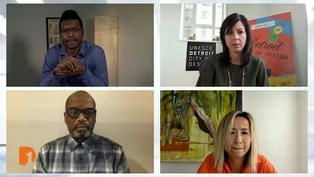
- [Will] Design covers a lot of industries and the creativity of designers can be seen throughout Michigan, but how can we develop more design jobs and how do we prepare the designers of the future for these careers?
Our July Future of Work virtual town hall focused on getting companies to invest in Michigan's design industry.
With guest panelists Jocelyn Chen of Design Connect, Olga Stella from the College for Creative Studies and Dr. D'Wayne Edwards from Pensole Lewis College of Business and Design.
(bright music) Design.
A word used in virtually every industry.
A category so integral to our lives, it often goes completely unnoticed.
Could you give us an example of something that is designed well and something that is designed poorly that we might interact with on our daily day-to-day lives?
- Sure.
So I like to use examples of inclusive design.
And so one example is sidewalk ramps.
Those are designed really well because they're designed for everyone.
And originally they were designed for people in wheelchairs, but if you're a parent with a stroller or you're a delivery man with a push cart, it creates benefit in all of our lives in navigating a public space.
Something that is often designed poorly and this is one of Don Norman's favorite examples, he's a well known designer, he's written books on functional design, good design, is doors in buildings, right?
Do you push 'em, do you pull them, how do I use the door?
If you can't figure out intuitively how to use something, it's probably not designed well.
- What kind of education levels need to be attained to even consider going into design and Jocelyn, I'll pose this question to you because you're kind of building the pipeline to get kids into this space.
- The obvious choice I think that the most visible choice is a four year degree in an arts college, like Creative College for Creative Studies, but there are just many different pathways to design career.
And that's what we want to make students and parents aware.
There are two year associate degrees, you can be self taught and even out of high school, if we provide the right education in high school, kids can start their own business.
And we also have Pensole Lewis College of Design Business that provides more continuing education to students who may not have the college degree.
And one example of associate degree is the clay sculpting degree at Macomb Community College.
I came from an automotive design background so I know that in automotive industry, clay sculptors are in high demand.
And a two year associate degree can lead to a very, very stable, well paying job in the automotive industry.
So we want to make that known, it's not just a four year degree pathway, there are multiple.
- [Will] Design is a field that requires all sorts of skills that thrust some into the spotlight of celebrity, while others like the inventor of the modern anti-lock breaks on your car, Mario Palazzetti remain mostly invisible, yet ever present.
This is to say that the skills required to be a designer vary, but according to one of history's most prominent footwear designers, Dr. D'Wayne Edwards, some things are necessary no matter the discipline.
- Good design is something you don't even recognize because it's so intuitive and it just functions the way you need it to function.
And we really only recognize bad design because something went wrong or a problem happened.
But I would say common sense through the lens of we're ultimately problem solvers.
And if we are connected to the consumer that we're trying to solve that problem for, then we have to become those people that we're creating products for with the idea of making their lives easier and more and more intuitive.
The thing that we look for most at the college is really passion, because I don't think the world needs more designers, I think the world needs better designers.
And I wish that people who took up the idea of trying to become a designer was really passionate about it because through that passion comes the tireless days and nights, but what comes from that are some amazing solutions along the way.
- What would it look like if there was more emphasis, more investment, more focus on this particular area?
- Well, as I mentioned at the start, we consider this as Jocelyn was also explaining, it's applied, right?
It's creative problem solving.
And if we had more of an emphasis in middle school and high school throughout the state of Michigan, I think we'd just have a more competitive economy.
We'd have more young people ready to enter the workforce, regardless of what they're doing, really understanding some of these design concepts.
I think many of the viewers are familiar with the concepts of design thinking and the way that's really changed the business world.
Well I mean, that's fundamentally the parts of the design process, right?
Identifying and conceptualizing what a problem is.
Ideating and being creative about what different solutions are, prototyping and testing those potential solutions and then iterating that.
What company, what business doesn't need people, young people who can do those things regardless of whether or not they have the technical skills that are absolutely essential to be a professional designer, but all of us need more creative problem solvers in the workforce.
When Detroit was designated UNESCO City of Design, we did a big economic study.
And one of the things that we found was that while only 1% of the industries and 5% of the workforce in 2018 were classified as design, when you draw the connection to all the other businesses, all the other industries, that small but mighty group of creative problem solvers were powering over 20% of the rest of our regional economy.
So the impact of designers and these kinds of creative problem solvers is far, far greater than their volume.
To D'Wayne's point, we don't need thousands, but we need to make sure that we don't lose this strength as a region, as a state, because that is ultimately what has powered Michigan's success over the last hundred years.
- [Will] You can see all of our Future of Work conversations at OneDetroitPBS.org.
Plus, we hope you'll join us for our next virtual town hall on Wednesday, August 10th at noon.
We'll look at the state of teaching in Michigan as more educators retire and others choose to leave the profession.
It's an important conversation you don't wanna miss.
That's August 10th at noon streaming on Facebook and OneDetroitPBS.org.
That will do it for this week's "One Detroit".
Thanks for watching.
Make sure to come back for "One Detroit Arts and Culture" on Mondays at 7:30 PM.
Head to the "One Detroit" website for all the stories we're working on.
Follow us on social media and sign up for our weekly newsletter.
- [Speaker] From Delta faucets to Behr paint.
Masco Corporation is proud to deliver products that enhance the way consumers all over the world experience and enjoy their living spaces.
Masco, serving Michigan communities since 1929.
Support for this program is provided by: the Cynthia & Edsel Ford Fund for journalism at Detroit Public TV.
The Kresge Foundation.
- [Speaker] The DTE Foundation is a proud sponsor of Detroit Public TV, among the state's largest foundations committed to Michigan focused giving.
We support organizations that are doing exceptional work in our state.
Visit DTEFoundation.com to learn more.
- [Speaker] Nissan Foundation, and viewers like you.
(bright music) (piano playing)
Detroit Brand Deviate Fashion Discusses Design in the City
Video has Closed Captions
Clip: S6 Ep47 | 6m 41s | Can Detroit become an international fashion city? Detroit's Deviate Fashion thinks so. (6m 41s)

Placemaking Increases Quality of Life, Talent Attraction
Video has Closed Captions
Clip: S6 Ep47 | 8m 34s | How Michigan's placemaking efforts help attract, retrain the future of workforce talent. (8m 34s)

The State, Future of Michigan's Budding Design Industry
Video has Closed Captions
Clip: S6 Ep47 | 6m 44s | Design is everywhere. Explore the state and future of Michigan's budding design industry. (6m 44s)
Providing Support for PBS.org
Learn Moreabout PBS online sponsorship
- News and Public Affairs

Top journalists deliver compelling original analysis of the hour's headlines.

- News and Public Affairs

FRONTLINE is investigative journalism that questions, explains and changes our world.












Support for PBS provided by:
One Detroit is a local public television program presented by Detroit PBS