Call The Doctor
Missed Health Screenings Due to COVID
Season 34 Episode 1 | 25mVideo has Closed Captions
2 years later, there's another growing concern: all those missed routine health screenings
COVID-19 has dominated so much of the medical community's time and attention, as an entire nation works to control the spread of the virus. Now, some two years later, there's another growing concern: all those missed routine health screenings. Doctors are reporting a high number of check-ups that haven't happened because of COVID concerns. We'll talk about what that could mean for the next few yea
Problems playing video? | Closed Captioning Feedback
Problems playing video? | Closed Captioning Feedback
Call The Doctor is a local public television program presented by WVIA
Call The Doctor
Missed Health Screenings Due to COVID
Season 34 Episode 1 | 25mVideo has Closed Captions
COVID-19 has dominated so much of the medical community's time and attention, as an entire nation works to control the spread of the virus. Now, some two years later, there's another growing concern: all those missed routine health screenings. Doctors are reporting a high number of check-ups that haven't happened because of COVID concerns. We'll talk about what that could mean for the next few yea
Problems playing video? | Closed Captioning Feedback
How to Watch Call The Doctor
Call The Doctor is available to stream on pbs.org and the free PBS App, available on iPhone, Apple TV, Android TV, Android smartphones, Amazon Fire TV, Amazon Fire Tablet, Roku, Samsung Smart TV, and Vizio.
Providing Support for PBS.org
Learn Moreabout PBS online sponsorship(upbeat music) - The region's premier medical information program: Call the Doctor.
- One topic has dominated health headlines for two plus years; COVID-19.
It's infected millions of people across the globe.
The medical community has been forced to focus on the virus and its many variants, but there's another wave of worry coming in those two years, how many people missed routine health screenings, mammograms, colonoscopies, even blood work, how big of an issue that could become and what you can do if you're behind on your appointments, missed health screenings due to COVID 19.
Now, on Call the Doctor.
Hello, and welcome to Call the Doctor.
I'm Julie Sidoni.
I'm the news director here at WVIA, and I'm gonna be the moderator for Call the Doctor this season.
We are all very excited to kick off this new season as you know, Call the Doctor's a show that's been on for more than 30 years, but we are proud to show off a new set here and a whole new list of topics to tackle.
As you heard there in the open we're tackling, what could be coming up next?
This is missed health screenings because of COVID-19.
We're taking it a little bit, literally here today with calling a doctor.
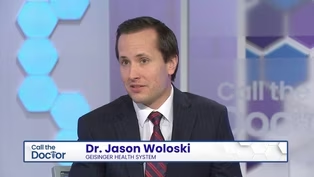
We have Dr. Jason Woloski with us.
It's really nice to have you here, doctor.
- Yeah, my pleasure.
Thanks Julie, for, for having me.
- Sure.
The first thing we're gonna do, I just want you to tell people a little bit about yourself, who you are, where they find you and the patients that you typically see in a day's time.
- Yeah.
Great.
So I have the pleasure of taking care of the Northeastern PA community at my clinic in south Wilkes Barre.
I'm a family doctor, so I love to do it all.
I do hospital admissions.
I see patients in the clinic.
We do cradle to grave care.
So any ages, and then I also get to spend some time teaching, which is another passion of mine at the medical school.
And we also have a family medicine residency program where we're training the future of family medicine.
- And I know you're local as well.
- Yeah.
I grew up in Northeastern PA and it's great to be back home and practicing and taking care of friends and people I grew up with.
- You might actually be the perfect person to be talking about this topic only because you mentioned cradle to grave care.
You see people from the very earliest, you know, the newborn stage all the way up to geriatric care.
So let's start with really what we're looking at here, because I understand this is an overarching topic that we're never gonna be able to cover in half an hour's time.
Sure.
But let's talk about some of the biggies, the biggies in screening, particularly the cancer screenings, what comes to mind first, when we talk about some of the things that people have missed while they were at home because of the pandemic.
- Yeah.
So great question, Julie, you know, part of my job every day is I tell my patients, we gotta prevent bad things from happening, and it's much easier to be proactive than reactive.
And so when you mention screenings that potentially people missed, we're talking about things like mammograms for breast cancer, colonoscopies for colon cancer, pap smears for cervical cancer.
Those are the kind of things that maybe the pandemic really just caused people to put on the back burner.
And the interesting thing that is a little bit worrisome is that it seems like this pandemic has caused us to lose a little bit of sense of time.
So I have people come in and they'll say to me, well, I just had that last year.
And I'm like, well, no, actually it's been three years and we kind of lost those couple years.
And so it's very important that people connect with their family doc and say, Hey, what am I missing?
What do I need?
- There's actually a study that was published in the journal oncology back in April of 2020, that particular study found that there was a 90% decline in breast cancer screenings just in April of 2020.
And of course that was the beginning of everything.
That's one statistic.
And I don't wanna get too bogged down in numbers, but what are you seeing locally, regionally?
Is it that many people who have not called their doctor or kept in touch with the doctor when it comes to their routine screenings?
- Yeah.
I don't know if I'd be able to quote you a statistic, but I think, you know, as the pandemic is maybe dwindling a little bit, not to say COVID is not around, it's still around, but what we're seeing is now a lot of people are trying to catch up and when you catch up, you also reach a bottleneck of the availability of actually getting that screening.
So it's one thing to say, hey, maybe I delayed my mammogram a year or two, but now if you want that, well, maybe you're gonna have to wait yet another six months just to get in and get it.
So I think even the delay is adding on to the scheduling problems that we're seeing now.
- So these next few questions are quite elementary, but let's just start baseline here.
When a woman gets a mammogram, I know you're looking for cancer, but what's a doctor looking for?
How soon can you catch something?
So, to illustrate, if you go for three years without one, the danger of where the cancerous growth could go?
- Yeah, Julie, you, you know, mammograms are like we said a screen.
Okay.
So sometimes, you know, you might get a result and say, there's an area of concern and you have to do a follow up test, whether that be an ultrasound, a diagnostic mammogram.
And in some case, even maybe a tissue biopsy to actually take a piece of those tissues to see if it's cancer.
So, you know, the challenge becomes, you know, the mammogram may not be the, be all end all.
And so sometimes people will go for that mammogram and then they say, okay, I finally got it.
And then if you do need that extra imaging, now you're waiting even longer to get that follow up imaging.
- Interesting.
You mentioned the bottleneck too, because I see happening even in just regular pediatrician's visits.
Sure.
We're really trying to get into any doctor anywhere.
Do you think that's, what's behind it?
- Yeah.
I think it plays a role and, and, you know, the challenges we, we learn more about COVID every day.
So when we, since we were on the topic of mammograms after COVID vaccines, we started seeing some data that maybe some lymph nodes are swelling up from the COVID vaccines and maybe women should not get the mammogram within a certain time period of actually getting the COVID vaccine.
But we would've known that at the start of the pandemic.
Those are things that we've learned along the way.
So I think sometimes people hear those messages and they're like, okay, well maybe is it too soon or, or not.
And, and where do I actually go with that?
And that's why I always said, you know, give us a call.
The beauty of medicine nowadays is we have patient portals.
We have the ability to do telemedicine.
We have the ability to still come in for an appointment.
So there's a lot of ways to reach us.
And we're more than happy to answer those questions for patients.
- Since you brought up telemedicine, we're doing an entire telehealth episode on Call the Doctor, that's coming up a little bit later in the season, but that's a really interesting part of this.
What did you see when it came to treating patients remotely?
Were there people who were a little bit hesitant to do that?
- Yeah, and especially I, of my older patients, you know, they're used to always being there in person, always seeing their doctor, seeing the nurse that roomed them for 40 years and things like that.
And to say, hey, I'm gonna connect with you via telephone or, or, you know, a smart device.
It's, it's a bit scary.
Don't get me wrong.
But I think the coolest thing about the, you know, the development of telemedicine in the last two years is that it's actually become much easier to connect with patients.
You know, if you have a smartphone it's as easy as getting a text message, clicking the link and boom, the portal pops open.
So it's really not that burdensome as people may think.
And I tell people, give it a try.
You know, you have nothing to lose.
If, if I can't connect you and see your face, I'll give you a call and we'll do the visit that way.
- Although obviously when you're talking about a screening, such as a mammogram, if that's what we were discussing, that's something you have to do in person.
That's something that really can't be done via telehealth.
Correct?
Or am I wrong?
- Oh, no, you're, you're absolutely correct.
But I think it's just that refresher of saying, Hey, you're due for it.
Let's order it.
Let's talk about it.
You know, are you a candidate for other screenings too?
You know, there's a lot of screenings that may start at age 45.
And maybe in the last two years, when the pandemic happened, you went from 43 to 45 and you don't even realize you're due for things because that was never a discussion before.
And so that's why it's so important to if you're overdue for that visit, you know, follow up with your primary care doc.
- So you said 45.
And I know we were just talking a little bit earlier that colonoscopy recommendations went from your first, your baseline at 50, they've pushed that back.
I say, they, who are they?
Who has pushed that back to 45?
- Yeah.
So when we talk about screenings and, and, you know, screenings from everything, from screening, from diabetes to screening for cancers, there's a lot of organizations who come out with recommendations, you know, in family medicine, I tend to follow the US preventative task force and they grade these recommendations as well.
So they'll say grade a is definitely, you know, a hundred percent we recommend it, do it, you know, and then it kind of goes down the scale.
And, and so, you know, it's still standard of care 50, you gotta start really talking about colon cancer screening, but what they did introduce like you alluded to is now at 45, we should be probably, maybe talking about that discussion a little bit sooner.
And that's a great B recommendation, but speaking of colon cancer.
When we talk about screening, the nice thing now is that a colonoscopy for some people may not even be needed.
And we have other tests, for example.
So we have, what's called a Cologuard.
It's a home stool test and sounds funny, but believe it or not, you open the door, your package is there.
You do the sample, you follow the instructions and you drop it off at UPS and they send it in.
- I was gonna ask you about those actually.
I'm sorry if I cut you off there, you can continue if you like.
- Go ahead.
- The saliva tests, for instance, there are saliva tests out there for breast and ovarian cancer, the colonoscopy tests that you brought up or the, the colon test, I should say that you send back in the mail.
Are those usable?
Are they good?
Is a doctor gonna say, yeah, you took that test.
So that's good enough for me or are they gonna order something else anyway?
- Yeah.
Great question, Julie.
So the saliva test, I think are up and coming.
I think there's still a lot to be learned, but for something like the Cologuard, which is the home test to screen for abnormalities in the colon or colon cancer, that has very good data behind it so much so that, you know, it actually, if I get a, if you qualify for a Cologuard and I get a negative result, I say, hey, for three years, we're good.
Minus of course, you know, the development of, of any new symptoms.
But the reason I say you have to have these discussions with your doctor is because every test is not designed for everyone.
And so for example, some of these tests, if you have a family history, you don't qualify for that home test.
If you have a personal history of say, colon polyps, even not colon cancer, but just polyps, you're not gonna be a candidate.
So we don't on people trying all these new tests.
If they're not a candidate for them.
- Really, what I keep hearing you saying is it's about the relationship with the doctor.
So not just the missed screening, but if you haven't been to see the doctor in two or three years, two and a half years, you've also not spoken with your doctor, presumably in that long.
Is that part of what you're saying?
That the relationship is the important part.
- Absolutely.
That's why I love my job every day as a family physician is it's all about the relationships, the continuity learning, individual preferences, learning to meet your patient, where they are.
And you have to have these discussions because nothing is just, you know, cut and dry.
It's simple as this.
- And we're sticking with, first of all, the, the biggies that we were talking about, so to speak the breast cancer and colon cancer.
I know pap smears are another one.
I mean, that used to be the recommendation was once yearly.
I think that has changed as well.
Hasn't it for some people?
- Absolutely.
And, and once again, not to get into the nitty gritty, but for some women who have no negative history of, of an abnormal pap and they have negative testing for a virus called HPV, you're talking, you can now go every five years for between your pap smears, which is big difference than, hey, every year.
- That would still kind of scare me though, to go five years between, do you have patients who say, I'd rather get it done?
- Yeah.
And I think, you know, change sometimes is scary.
You know, myself included, you know, you make a big change and it's, you know, sometimes it filled with a little apprehension.
But what I always say is we have to trust the data.
And I think what makes medicine in, in the United States so great is that we have really good evidence based data.
So this is not someone just, you know, throwing out, oh, let's spread it to five years.
This is backed by years and years of research and data that say, we don't need to overutilize this resource when we know that we're not putting the patient at increased harm by spreading it out.
- Cervical is particularly scary though.
I mean, I believe I'll ask the question is cervical one of those cancers, that's very difficult to find, unless you have screened unlike breast cancer, maybe you'll feel it for instance, eventually, or colon cancer.
Maybe you have some symptoms.
Is cervical cancer a little different in that?
- Yeah.
I think you're right.
But I would say any cancer in general sometimes can be, you know, hidden in the sense, you know, sometimes it's just very subtle that you go for your routine blood work and you say, wow, your, your hemoglobin level, you know, is, is down a little bit.
What's going on?
Your iron is a little low and maybe you're actually, you know, losing a bit of blood because you have a colon cancer.
So it may not be as obvious as, as people think that they're gonna wake up one day and say, oh, I have pain in my stomach.
And, and I saw blood when I had a bowel movement, you know, it must be cancer.
- You brought up hemoglobin.
I mean, that's a blood measure.
Correct?
- [Jason] Mmhm.
- So we're going from the cancer screenings, of course.
But you brought up that there are lots of other types of screenings.
I didn't even think about that.
people have missed over the course of the last couple of years.
- Absolutely.
And, I think one of those things to remember is that while medications are great and your doctor probably gave you that medicine for a very good reason, a lot of the medications do require monitoring.
So for example, there's a lot of patients in this area who are on thyroid supplements and sometimes whether it's age, whether it's a variety of other factors that change in your health, that thyroid medicine needs to be changed based on your lab work.
But if you went two years without the lab work, it's very difficult to just say, I'm gonna change your dosing without having that data to support it.
- And if a patient's dose needed to be changed, you would only know that through the blood work that you're looking at, correct?
- Yes.
And, and sometimes we have clues, you know, the patient will say, oh, you know, maybe I'm having more sweats or I'm gaining or losing weight, or I'm having hair changes.
But at the end of the day, you know, that blood work is really gonna be our, our kicker to say, something's different here.
- You mentioned also, was it kidney issues or is there medicines that you were on for kidney failure or some sort to kidney issues that someone is having that would also be possibly some sort of an example of when you don't get that blood work when your doctor calls for it?
- Yeah, absolutely.
Julie, so for example, there's a lot of medicines that get excreted solely through the kidneys so we wanna make sure those kidneys are working so that the medicine you're taking are not causing you harm because like anything else, too much of a, of one thing that you think may be helping, you may actually be harming you.
So it's very important that, you know, routine blood work is actually performed so that I know, hey it's okay that I'm giving you this medicine because I know your kidneys are doing okay, but I may not wanna keep you on, on this medicine if your potassium is through the roof, or if your kidneys show that they're maybe taking a little bit of a hit from it.
- What are some of the other screenings that people need to know about?
We've mentioned a, a couple, but what, what comes to your mind?
- Yeah.
So one of the things that people may not think about very commonly now is that there's actually a screen for lung cancer and this area, there were a lot of people who grew up, you know, smoking or exposed to smoke, and they may or may not qualify for this lung cancer screen.
And interestingly, during the height of the COVID pandemic, the screening guidelines actually changed.
So now they're actually more inclusive where at a young age and less of a smoking history, you may actually qualify for this test.
So not only did we see people who may have historically qualified getting a delay in this screening.
Now we added this whole extra group of people who should be screened that may not even know they should be screened because they missed the appointment.
And once they find out, we, we talked about that bottleneck is just gonna get worse and worse.
- So if, if I'm hearing you correctly, it sounds like there's a chance that for some people they're never really going to get caught up, can you get caught up on a screening if you miss it and it's missed, are you always going to be a little bit behind, you know, I worry.
What if people say, well, "It's been a couple years and I've been fine ever since, I guess I don't need to do that every year" or whatever the case may be.
Yeah.
What is the message to people about if you haven't done it so far, here's why you need to get back under your routine.
- Absolutely.
I would say it's as simple as do it now, you know, yes there's maybe a little bit of a bottleneck, but we'll catch up and, and the important thing is knowing that you need it and then trusting your physician to, you know, navigate the system.
Maybe the person you always went to for your colonoscopy isn't available, but someone as equally qualified can do it for you.
And sometimes, you know, you have to take, you know, away pros and cons and maybe getting that screening.
And then the next time seeing that person that you, you may have had that relationship with previously.
- So in your opinion, people can get caught up if they do it soon or immediately, or just start to start that conversation again with their doctor about where am I, where did I leave off now what?
- Absolutely.
I think one of my, my biggest satisfactions is sometimes taking someone who may have went years and years without any screening.
And then all of a sudden they're like: hey, you know what something happened in their life.
Maybe they had grandkids.
Maybe they had, you know, retired and wanna make sure they're healthy for retirement.
It's never too late to say.
Now I wanna make sure that I'm doing everything I can to not only maintain the health I have, but prevent things from happening.
Things like, for example, the colon polyps, sometimes those are, if they're found early and sniffed out, they don't become that colon cancer.
So doing that colonoscopy, finding those polyps, taking them out may have just saved you from even getting colon cancer in the first place.
So I would say never too late and work with us and we'll get you where you need to be.
- So, because you're from the area, I think I'll, we'll go into a little bit about this area in particular.
I think there's a pretty high instance of colon cancer here in this area.
What's another one that might be above the national average?
- You know, I think our, our breast cancers are a little bit higher too.
And, and I would say just cancer in general, when you, when you just look at some of the statistics, and I think the there's a lot of theories out there why that may be or you know, different environmental factors, genetic factors, things like that.
But I think the important thing to know is that we do have a higher incidence of cancer in this area.
And while we've come a long way with treatments and, and things like that, we also wanna make sure that people who are at risk get screened and caught early.
- Do you think people were frightened to go into a hospital frightened to go to their doctor's office?
Or do you think it was a little bit, the other way around where the, the medical community was saying; hey, listen, we, we have to sort of handle this over here.
We'll get back to you here.
- Yeah, that's a great question, Jo.
So I, I think it's mixed, you know, I think, I think some of the health systems said, hey, you know, when it's all hands on deck and we have no beds available because the COVID wings are full, you know, we shouldn't really necessarily be, you know, doing routine procedures and, and screenings and things like that, you know, but then I think at the same time, like you mentioned, there's some hesitancy on the patient's part where wow, you know, if I know the hospital's filled with COVID, do I wanna, you know, walk into that door and get that x-ray or get that blood test and, and potentially expose myself.
So I think it was mixed, but I, I think when we talk about some of those novel things, I mean, for example, we have a mobile lab team that if you're home bound and you really can't get outta your house, they'll come to your house and draw your blood work for you.
We have, and it might sound crazy, but we have mobile mammogram buses.
So some of our clinics, the bus will pull up, you walk into the bus, you get your mammogram and you be on your way.
So I think you have to learn that you may not even know these options exist until you inquire with your physician.
- Is there that long of a wait for those come to you options?
That seems like why wouldn't everybody choose that option?
- Yeah, and I think, you know there there are some limitations and like I mentioned, you know, you really have to be home bound and, and can see, get out of the house to qualify for the phlebotomist, to come to your house and draw your blood work.
But some of these mobile vans and other units that come out like the mammogram and DEXA screening for osteoporosis and things like that, you know, I there's availability, you know, maybe not tomorrow, but the sooner do you get on that schedule, we'll get to you.
- As soon as we're done here, I'm gonna come up with 10 other screenings we didn't get to talk about, but I'm interested in the, we're not really out of the woods yet when it comes to COVID, we just saw a huge wave over the winter season.
And I know that there's a lot of talk about where we're just gonna keep going up and down, possibly in perpetuity, who knows what's about to happen with this virus.
So what would be the message to people who are saying I'm still not going back and not hospital?
I mean, it might not be March of 2020, but I don't know.
People might be a little leery.
- Sure.
Well, you know, I think first of all, I would say get vaccinated because I think there's really good data out there that says, Hey, your risk of hospitalization and death goes down drastically by getting those vaccines.
So I think adding that little extra layer of comfort may make you feel a little bit better.
The other thing is most healthcare institutions are keeping the mask mandate for now.
So, you know, everyone you interact with in the hospital setting everyone who greets you, who checks you in, we're all wearing masks all long while we're at work.
So I think knowing that, you know, hospitals are doing the best they can, there's things you can do such as get vaccinated to lower your risk, and then realizing that, you know, those other screenings we talked about are just important, just as important for your health as, as staying free from COVID.
- So do you think it is time for people, I think I know the answer to this question, but time for people to not be so scared and to get back into whatever they were doing before, or even maybe it's a opportunity to start screenings if they hadn't thought about it before?
- Yeah, absolutely.
And, I think, you know, we continue to monitor every day.
So if, if the cases start going back up, you have to trust that, you know, healthcare administration will do the right thing and maybe, you know, cancel your procedure or, or reschedule it to a different day.
But I think right now you just have to realize that I think all those screenings are very, very important not to put on the back burner anymore.
- We can all just hope the wave isn't coming.
Absolutely.
We have a little bit of a wait and see.
I suppose.
- [Jason] Absolutely.
- Dr. Woloski thank you so much for your time.
You were fantastic and answered so many of our questions.
We definitely want to thank you for tuning in as well.
This episode of Call the Doctor.
Now you may have noticed we didn't have any questions from you, the viewer this time around, but we do hope you will check out the list of topics that we're planning this season.
That list is available at our website, wvia.org/ctd.
Check that out and then call the number on your screen.
Leave us a message.
And there's a chance.
Your question answered on a future show.
I'm Julie Sidoni.
Thank you for watching from all of us here at WVIA, and we'll see you next time.
(upbeat music)
Missed Health Screenings Due to COVID - Preview
Preview: S34 Ep1 | 30s | Watch Wednesday, March 2nd at 7pm on WVIA TV (30s)
Providing Support for PBS.org
Learn Moreabout PBS online sponsorship
- Science and Nature

Explore scientific discoveries on television's most acclaimed science documentary series.

- Science and Nature

Capturing the splendor of the natural world, from the African plains to the Antarctic ice.












Support for PBS provided by:
Call The Doctor is a local public television program presented by WVIA