
The Most Beautiful Man in the World
Clip: Season 7 Episode 3 | 8m 8sVideo has Closed Captions
The dancer and artist known as "the most beautiful man in the world."
He was once heralded as the "Most Beautiful Man in the World." Noted artist, poet and dancer Paul Swan grew up in Crab Orchard, NE but made a name for himself in Paris and New York, painting and sculpting the likes of Isadora Duncan, Willa Cather & John F. Kennedy, among others. Through exhibits & artifacts on display at the Museum of Nebraska Art in Kearney, we explore the story behind the man.
Problems playing video? | Closed Captioning Feedback
Problems playing video? | Closed Captioning Feedback
Nebraska Stories is a local public television program presented by Nebraska Public Media
The Most Beautiful Man in the World
Clip: Season 7 Episode 3 | 8m 8sVideo has Closed Captions
He was once heralded as the "Most Beautiful Man in the World." Noted artist, poet and dancer Paul Swan grew up in Crab Orchard, NE but made a name for himself in Paris and New York, painting and sculpting the likes of Isadora Duncan, Willa Cather & John F. Kennedy, among others. Through exhibits & artifacts on display at the Museum of Nebraska Art in Kearney, we explore the story behind the man.
Problems playing video? | Closed Captioning Feedback
Where to Watch Nebraska Stories
Nebraska Stories is available to stream on pbs.org and the PBS app.
Do you have a Nebraska Story?
Do you have a story that you think should be told on Nebraska Stories? Send an email with your story idea, your name, your city and an email address and/or phone number to nebraskastories@nebraskapublicmedia.org. Or, click the link below and submit your information on nebraskastories.org.Providing Support for PBS.org
Learn Moreabout PBS online sponsorshipRUSSEL ERPELDING: Paul Swan was a dancer, an artist, a poet, he was what they referred to as a Renaissance Man, he was America's Leonardo.
He was always searching for beauty, and he did everything he could to try to find that.
NARRATOR: Curator Russel Erpelding has spent the last five years searching for beauty as well.
Trying to find the paintings, sculptures and other lost works created by a once-famous and now obscure former Nebraskan.
ERPELDING: He was meticulous about collecting and preserving his own accolades.
He would collect these and would paste them in his own scrapbooks.
His arrival in any city was big news at that time.
He was a celebrity.
He traveled all over, he was in Paris, he was in London, he was in Berlin, South America.
NARRATOR: In this first major retrospective of Swan's work, the Museum of Nebraska Art hopes to shine a light on the life and work of this forgotten artist.
ERPELDING: Interesting about Paul Swan was that he was famous at one time, and then fell into obscurity.
He was a great artist.
He knew lots of famous artists as well.
He was in the circles of art on a major level.
NARRATOR: Paul Swan created sculptures of some of the most famous people of his day.
Like John F. Kennedy and Willa Cather.
The Cather bust resides at the state capitol.
ERPELDING: But Paul Swan did not see himself as an artist, he saw himself as a dancer.
And the artwork was his ways of financing his passion for dance.
NARRATOR: This worldly, refined artist came from humble beginnings.
His family moved to a farm outside Crab Orchard in 1889 when Paul was just six years old.
ERPELDING: His existence was to be working out on the farm with the other boys, and that was not his passion.
That's where there was a lot of animosity between the children.
Paul basically got away with doing what he wanted to do, while the other children had to work.
But he knew he was always different.
He needed a bigger stage.
And for Paul, the world was his stage.
NARRATOR: From a young age and throughout his career, Paul Swan's good looks served him well.
ERPELDING: In the early 1920s, Paul was dancing and Isidore Duncan called him out.
She was the one that referred him as "the most beautiful man in the world".
She was a pioneer of modern dance and that's what Paul was wanting to do as well.
NARRATOR: He starred in an early silent film called "Diana the Huntress" featuring his dancing.
In the 1920's he was cast in Cecil B. DeMille's "The Ten Commandments".
ERPELDING: He was one of the Egyptian guards.
There was supposed to be this elaborate dance scene.
There was a disagreement between Paul and Cecil B. DeMille, and Paul left the set and never returned.
NARRATOR: In later years, The Most Beautiful Man moniker may have been a burden.
ERPELDING: He tried so hard to stay beautiful.
At the end of his life, he was wearing considerable amounts of makeup to try to maintain the beauty.
Bathing in olive oil.
If his stomach was sticking out a little too much he would pencil it in, draw it over the top of things.
By the 1950s, most of his family had started to pass away.
He started to experiment with a lot of different forms of artwork, delving into his own sexuality.
He was not dancing as much, but people were still coming to see Paul dance.
He was no longer the most beautiful man in the world he had become more of this eccentric oddity.
In 1961 when Paul was evicted from Carnegie Hall, he did go to live at the Van Dyke Hotel, which was where Andy Warhol was at at the time, and that's how they met.
PAUL SWAN: Great pleasure to introduce the most famous, unknown person in New York.
NARRATOR: Warhol made a film featuring the artist simply called "Paul Swan".
ERPELDING: Paul had early signs of forgetfulness.
When the films came, he didn't even remember that he had filmed these.
It's basically making fun of an old man, past his prime, trying to dance, and trying to please.
He's even hollering out "You can cut that!"
But basically Andy did not do that.
JOHN SPENCE: This was the kind of work that I was doing at the time.
NARRATOR: A few years later, in 1969, Swan's great-nephew visited the 86-year-old artist in New York.
SPENCE: I was always just curious to know who he was.
I happened to be in New York City on a photo shoot job, and went over to see Paul.
When I came to the door of Paul's studio and it was a large door, and I pushed it open slowly I think it even creaked a little bit.
Stepped inside and discovered that the door was covered with tapestries on the back.
And artwork was hung, salon style, floor to ceiling on all the walls.
And it just felt like I'd stepped back in time, 50 years.
I asked him if I could make a photograph of him, and he was very gracious, he didn't hesitate at all.
As I got the camera set up, he just immediately started posing.
There was no communication.
And he picked up a fragment of a bust and gave me the profile and holding it up.
I'm just going, "Whoa," you know.
This is the real deal, I mean this is a guy who's been there and done it.
I didn't have to say a word.
He gave it all to me.
And I just clicked the shutter, and that was it.
NARRATOR: In 1972, Swan came back to Nebraska for the final time, escorted by his brother Reuben.
ERPELDING: They had a small funeral for him in New York and then he was cremated.
Reuben drove those to Crab Orchard, placed them in a coffee can and buried them between his mother and father in a small cemetery.
NARRATOR: While Paul Swan is no longer the toast of the elite his works live on in private collections and galleries around the world, including at the Museum of Nebraska Art in Kearney.
With a larger than life reputation, this eccentric, prolific artist will also be remembered as an ordinary person.
SPENCE: His presence was not as shocking as I kind of anticipated it to be.
I found him to be just a perfectly fine fellow, very cooperative, friendly, generous with his time.
Went away thinking, "Gosh, he's pretty much "a regular guy."
♪ MUSIC ♪
Video has Closed Captions
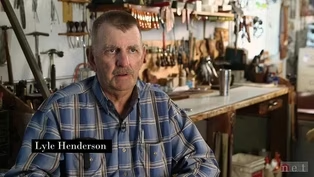
Clip: S7 Ep3 | 4m 14s | A visit with second-generation saddle maker Lyle Henderson. (4m 14s)
Providing Support for PBS.org
Learn Moreabout PBS online sponsorship














Support for PBS provided by:
Nebraska Stories is a local public television program presented by Nebraska Public Media