Prairie Sportsman
Moving Mussels
Clip: Season 17 Episode 11 | 7m 57sVideo has Closed Captions
Learn about the importance of native mussels in our waterways.
Learn about the importance of native mussels in our waterways as the Center for Aquatic Mollusk Programs works to move mussels out of harm’s way. Unlike invasive zebra mussels, native species are key contributors to the aquatic food web.
Problems playing video? | Closed Captioning Feedback
Problems playing video? | Closed Captioning Feedback
Prairie Sportsman is a local public television program presented by Pioneer PBS
Production sponsorship is provided by funding from the Environment and Natural Resources Trust Fund and Shalom Hill Farm. Additional funding provided by Big Stone County, Yellow Medicine County, Lac qui...
Support provided by:


Prairie Sportsman
Moving Mussels
Clip: Season 17 Episode 11 | 7m 57sVideo has Closed Captions
Learn about the importance of native mussels in our waterways as the Center for Aquatic Mollusk Programs works to move mussels out of harm’s way. Unlike invasive zebra mussels, native species are key contributors to the aquatic food web.
Problems playing video? | Closed Captioning Feedback
Where to Watch Prairie Sportsman
Prairie Sportsman is available to stream on pbs.org and the PBS app.
Providing Support for PBS.org
Learn Moreabout PBS online sponsorship(heartfelt guitar music) - So today, we are out doing a mussel relocation around Olson's Island.
We're partnering with the Minneapolis Parks and Recreation Board to restore Olson's Island by improving the head of the island over here through some restoration efforts.
To make that happen, we're going to be disturbing mussels.
So our objective today is to get the mussels out of harm's way.
- [Bret] Freshwater mussels inhabit lakes and rivers throughout the world, and North America has among the greatest number of mussel species.
These bivalve filter feeders are a vital part of the aquatic ecosystem.
The degradation of our waterways from runoff of silt and chemicals as well as physical changes from damning channeling and dredging have taken their toll on native mussels.
Of the 302 known species recognized in North America, nearly two thirds are considered imperiled.
Here in Minnesota, 28 of our 51 native freshwater mussel species are listed as either endangered, threatened, or of special concern.
So when the city of Minneapolis decided to restore the head of Olson's Island in the Mississippi River, they reached out to Minnesota DNR'S Center for Aquatic Mollusk Programs, or CAMP, to help them relocate any mussels before construction begins.
- We're trying to find all of the mussels that are in the area of impact around Olson's Island, where like the heavy equipment is gonna be driving and doing all the construction work.
So we're trying to get the mussels out of those areas so they're not crushed or disturbed in any way, and then we're gonna be moving them upstream of this site, just like a hundred meters, so that they can continue to serve, you know, their purpose in the environment.
- Well the waters, it ranges from four to eight feet deep.
So we're using scuba.
We'll send two divers down that are tethered to the boat, going down for 20 minute intervals, collecting all the mussels we can find in that area that we're at.
- [Bret] And in the notoriously muddy Mississippi, that's no mean feat.
- The visibility's actually like okay here a couple feet.
Sometimes our divers are in conditions where the visibility's really low and you really have to depend on your touch to find the mussels.
- We're basically covering every square foot of area that is the designated impact area by hand and digging through the sediment by hand, collecting all the mussels that we find, and putting them in a bag that we have attached to our equipment.
- [Bret] Once collected, the mussels are brought to the boat where they're counted, cataloged, measured, and sorted.
- [Woman Off Camera] Patterned one.
- [Bernard] This is nice mix of species.
- [Bret] Freshwater mussels have a soft body enclosed by a hard shell made up of two halves called valves.
Inside the shell, a thin tissue called the mantle completely surrounds the soft body and secretes the two valves of the shell.
Young mussels are tiny and nearly translucent.
- [Kate] This is the juvenile, and this is the adult.
So you can see the amount of growth that happens over time.
- [Bret] Once they've been inspected, the mussels are held in the river until being relocated upstream.
- The spot that we picked is a spot that's similar to the habitat here around Olson's Island, and it's a spot where we feel like, you know, they'll just have good access to their host fish, good substrates, and they're not gonna be at risk of being like stranded in low water conditions.
- Mussel beds have been likened to coral reefs because they provide good structure that attracts algae and aquatic insects, which in turn, attracts larger predators.
- In the process of filtering the water, they're pulling out nutrients, that's actually what they're eating, but anything that they don't use is released by the mussel and it's in a form that other aquatic animals can eat, in particular aquatic insects, and then, you know, small fish eat the aquatic insects and larger fish eat the smaller fish.
So you just have a transfer of nutrients from the mussels up through the food chain in our aquatic environments.
So it just kind of is this nice little self-sustaining like environment that the mussels are kind of the base of.
- [Bret] 100 years ago, the Mississippi River was famously declared dead due to severe pollution and ecological degradation.
Industrial waste, untreated sewage, and agricultural runoff, particularly near urban centers, devastated aquatic life.
A century later, thanks to decades of conservation efforts, clean water legislation, and community engagement, much of the river's ecosystem has been revived.
- Mussels were not common.
I mean actually aquatic life in general was depauperate in the Minneapolis St.
Paul area and downstream.
Water quality has improved, and over the last several decades, we'll say 30 years, there's been a recovery in mussel species and fish and water quality's a lot better.
You know, just in the last couple days, we are moving 16 species of mussels that occur in this area, and those species weren't there three decades ago.
- [Bret] It's thanks to the consistent efforts of conservation groups like CAMP that our native species are making a comeback across the state.
- Our group has been around for like over 25 years now, and we started off doing survey work to inform our conservation needs for the mussels, and you know, now we've moved into propagation and monitoring of our mussel populations is really fulfilling to see the mussel conservation full circle, and also it's great that our program has been in existence for so long, because mussels are long-lived animals, and you can't make a difference with them in just a couple years.
This is gonna be a long haul effort to restore them throughout the state.
- [Promoter] We can stop aquatic hitchhikers from infesting more lakes and streams by cleaning up everything we pull out of the water.
It's a simple drill, clean in, clean out.
Before leaving a water access, clean your boat and water equipment, remove and dispose of all plants and aquatic species in the trash, drain water from your boat, ballast tanks, motor, live well, and bait container, remove drain plugs and keep drain plugs out while transporting equipment, dispose of unwanted bait in the trash, to keep live bait, drain the water and refill the bait container with bottled or tap water, and if you have been in infested waters, also spray your boat with high pressure water, Rinse with very hot water, dry for at least five days.
Stop the spread of AIS.
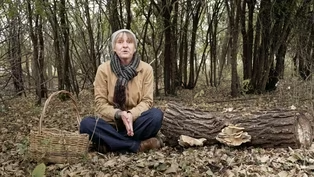
Fast Forage: Fall/Winter Oyster Mushroom
Video has Closed Captions
Clip: S17 Ep11 | 5m 40s | The fall/winter oyster mushroom is common to find on dead or dying trees right before winter comes. (5m 40s)
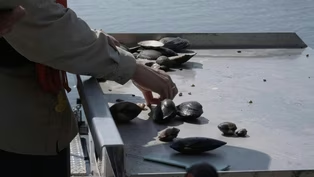
Muzzleloaders, Mussels, and Mushrooms
Video has Closed Captions
Preview: S17 Ep11 | 30s | A Veteran deer hunt, MN DNR’s Center for Aquatic Mollusk and foraging for Oyster Mushrooms. (30s)
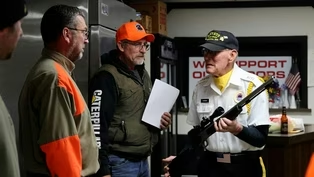
Muzzleloading with the Military
Video has Closed Captions
Clip: S17 Ep11 | 11m 17s | Warriors and Walleyes says thank you to those who served our country with a muzzleloader deer hunt. (11m 17s)
Providing Support for PBS.org
Learn Moreabout PBS online sponsorship New Episode
- Science and Nature

Explore scientific discoveries on television's most acclaimed science documentary series.






 New Season


 New Season

Support for PBS provided by:
Prairie Sportsman is a local public television program presented by Pioneer PBS
Production sponsorship is provided by funding from the Environment and Natural Resources Trust Fund and Shalom Hill Farm. Additional funding provided by Big Stone County, Yellow Medicine County, Lac qui...