Oregon Field Guide
Mudbone Grown, Puffins, Hydrofoiling
Season 32 Episode 8 | 29m 26sVideo has Closed Captions
Mudbone Grown, Puffins, Hydrofoiling
Shantae Johnson and Arthur Shavers are rewriting the narrative of what it means to be a Black farmer in Oregon. Oregon's Haystack Rock is the last spot on the West Coast to see these charming seabirds from the shore, but the question is: for how much longer? Columbia River Gorge wind sports have continued to evolve since wind surfing became popular in the 1980s-hydrofoiling is the latest rage.
Problems playing video? | Closed Captioning Feedback
Problems playing video? | Closed Captioning Feedback
Oregon Field Guide is a local public television program presented by OPB
Oregon Field Guide
Mudbone Grown, Puffins, Hydrofoiling
Season 32 Episode 8 | 29m 26sVideo has Closed Captions
Shantae Johnson and Arthur Shavers are rewriting the narrative of what it means to be a Black farmer in Oregon. Oregon's Haystack Rock is the last spot on the West Coast to see these charming seabirds from the shore, but the question is: for how much longer? Columbia River Gorge wind sports have continued to evolve since wind surfing became popular in the 1980s-hydrofoiling is the latest rage.
Problems playing video? | Closed Captioning Feedback
How to Watch Oregon Field Guide
Oregon Field Guide is available to stream on pbs.org and the free PBS App, available on iPhone, Apple TV, Android TV, Android smartphones, Amazon Fire TV, Amazon Fire Tablet, Roku, Samsung Smart TV, and Vizio.
Providing Support for PBS.org
Learn Moreabout PBS online sponsorshipMajor support for Oregon Field Guide is provided by... [ ?
?? ]
MAN: My rappel!
MAN: Oh, my gosh, it's beautiful.
MAN: Good morning, everybody.
Woo!
Let's do it again!
MAN: Nicely done!
MAN: Oh, yeah!
Fourteen and a half.
Yes, that was awesome!
[ people cheering ] There you go, up, up... ED JAHN: Tonight on Oregon Field Guide: Puffins are striking to behold, but these popular birds are also growing increasingly rare along the Oregon Coast.
Then, it's another way to ride the wind in the Gorge.
But first, Jule Gilfillan has a powerful story about the joys and challenges of farming in Oregon while Black.
[ birds screeching, chirping ] MAN: I remember a time when me and Shantae started talking about our story.
So many people looked at us with disbelief on their face.
They were like, ''So you're telling me you don't have any land, you both quit your jobs, you have six kids between the two of you, and you think you're going to be a farmer in the city?''
Full-time.
[ laughs ] Full-time?
And I was like -- We were like, ''Yeah.''
Yeah.
Yeah.
''That's exactly what we think.''
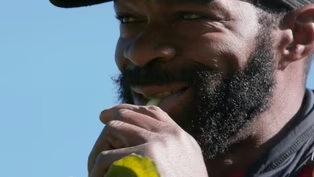
GILFILLAN: As unlikely as their dream sounded, five years later, Arthur Shavers and Shantae Johnson are still living it.
SHANTAE: These are huge.
[ chuckles ] ARTHUR: Shantae and myself wanted to switch from urban living to move in to the rural.
We wanted to learn how to homestead and raise our kids in that kind of environment.
[ motor rumbling ] The couple borrowed a half-acre plot from the Oregon Food Bank and began growing produce for a handful of local families.
But nourishing their community meant more to them than just food.
SHANTAE: Are you going to eat all those peppers?
Um, I would probably eat, yeah, a lot of those.
[ laughs ] SHANTAE: We wanted to really help to incubate agricultural businesses for Black, indigenous and POC farmers.
That was important, because there's not very many Black, indigenous and POC famers in Oregon.
POC, or people of color, make up a tiny fraction of Oregon's farmers.
A 2017 USDA census counted more than 67,000 farm producers in the state.
Of that figure, only 64 were Black.
That lack of diversity has deep historical roots.
In 1857, Oregonians voted to specifically exclude African Americans from settling in the territory.
Black exclusion laws were enshrined in the Oregon constitution until 1926 and effectively deterred Black people from moving here.
There was also the Oregon Donation Land Act, where, if you were white or half indigenous and half white, you could acquire 640 acres.
When you look at land, that's how people build generational wealth.
ARTHUR: 640 acres given out for free to people who moved here?
I mean, that -- how impactful, how amazing could that have been if African Americans were able to realize that?
[ rooster crows ] SHANTAE: It's a lofty goal, but we really want to reimagine what it looks like to be a Black farmer here in Oregon specifically.
I'm going to start making the criss-cross pattern like we do, and then you guys come through, pop in.
Digging out every resource they could find, Mudbone Grown began training new farmers of color not just how to grow... ARTHUR: Root down, tail up, just like that.
but also the important step of marketing their crops.
The next year, they teamed up with the local VA to train veterans.
Kwame Bey was part of that first veteran farming program at Mudbone.
For me, the most important thing about growing food, really, is the soil, the soil itself.
When you're in the military, it kind of forms a certain concept in your mind, and some handle it well, some don't do as well, and then war on top of that.
But now we're back here in the States, trying to reform our life.
This is where they can kind of get that therapeutic aspect by being in the dirt, touching the earth.
It smells peppery.
KWAME: If you really look at it, those that have a consideration for the earth have a certain peace about them.
Those not acknowledging the beauty of the earth, there seems to be some chaos going on.
Mudbone's sense of mission, hard work and resourcefulness have won them grants, forged partnerships and opened doors to farmers of color.
In 2018, that same combination secured them a long-term lease on this 19-acre property near Corbett.
ARTHUR: In the last two years, we've put in an access road, we've built a greenhouse... we're building aquaponics.
We've opened up probably about eight acres where we have crops in, put in irrigation throughout the whole thing.
Been a struggle, but we're just moving by faith.
We're -- We're putting everything we've got into this.
2020 turned out to be a year that tested everyone's faith.
As the COVID-19 pandemic descended on the world outside, Arthur and Shantae's farm became a haven.
Hey, Fenix.
Hey.
We came here by right when the quarantine thing was starting.
And then coming here was just a lot less stressful and a lot more rooted into doing the work.
I sleep better.
That's the first thing.
It feels good out here.
Smells better.
[ laughs ] Fenix is here to learn the growing and marketing skills he'll need to run his own farm business one day.
SHANTAE: Look to see what the biggest heads are.
FENIX: Right now, we are shadowing them by learning the way things work, the what-to-do's and what-not-to-do's.
Like that.
FENIX: Cool.
And then I like to take the leaves off.
FENIX: I feel like I'm in the dojo and I'm just watching my senseis do their art.
SHANTAE: There's a lot of historical trauma that people have around farming, and there's a lot of people pushing away from that, a lot of younger people that are like, ''Well, I don't want to be out in a field.
I don't want to do that type of work.''
But it is honorable work.
And reconnecting community to farming and growing food, it's like you're helping to activate a seed within people.
All right.
I think we're good.
[ laughs ] FENIX: It's never not a good time.
Even walking up the hill with 20-pound squash, it's still a good laugh.
Hot day, still a good laugh.
Rainy day, still a good laugh.
You know, they're good people.
They've been looking out.
And we just, like, enjoy the happiness that's around them and around us.
[ squealing ] While most businesses struggled through the shutdown, Mudbone Grown was an island of abundance.
SHANTAE: For this season, we really thought about who in the community is being missed?
And when we both thought about it, we thought, ''It's our elders.''
And where can we find them?
It's the church.
Mudbone Grown partnered with Life Change Church in Northeast Portland to supply 20 elders with four weeks of fresh groceries.
This one is missing tomatoes.
Yeah.
ARTHUR: We approached them and basically said, ''Hey, we have plenty of crops, plus we've got a little funding.''
So we were able to not only supply vegetables, we would also purchase about $25 worth of other goods per week for those 20 elders.
SHANTAE: We tried to do themes each week.
So there will be ground beef, potatoes, onions, celery, everything basically to make a meatloaf.
And also some household items.
I think we're good.
WOMAN: Hi, Sister Joan!
I need to do my three people.
Okay.
Wanessa Lawrence and Barbara Perry run the health and wellness program at Life Change Church.
Oh, good, they're here.
We'll be working as a team today, assisting mostly elderly, maybe disabled, and with the COVID-19, they're afraid to go to the stores, so we're going to take it to them.
They're very excited, and they love it.
It means that they want to eat every day and it's healthy food.
ARTHUR: There's two there.
WOMAN: Okay, thank you.
They look forward to Tuesday.
[ laughs ] [ people chattering ] Okay.
Everybody get four bags.
I was very grateful that they said, ''We're here.
We've got extra.
Here.''
And it's like, that was so amazing to me.
I know.
I understand.
It's okay.
You know what, it's okay.
It's okay.
We appreciate it.
Thank you.
Yeah, you're going to make me cry, so...
It's just, I've been being blessed so much, and God is just showing me himself.
ARTHUR: There's a weird thing that happens to me.
I can go through a day, have all kinds of challenges, struggles, you know, my body aches.
But when I wake up the next day, sometimes I have to try really hard to remember what were the things that really were bothering me the day before, because I wake up every day refreshed, ready to start again.
I feel like there is something healing about sleeping under these stars, listening to these crickets and playing with this earth, microorganisms all over me every day.
I feel like it is doing something internally.
SHANTAE: We really love what we do, and we are going to farm probably till the day that we die.
[ sighs ] We have a -- a genuine love for the land and for people and building community.
Just the support along the way from so many different community partners and people, that's what really fuels us to keep going.
Even in our hardest moments, we never, ever want to be the only ones at the table.
And so we reach our hands out to invite more people in to this movement around farming.
[ ?
?? ]
AARON SCOTT: In the world of seabirds, no one stands out like the tufted puffin.
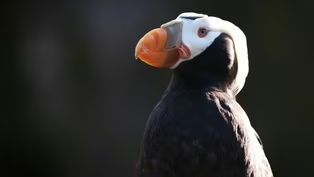
With big, colorful beaks, white faces and their namesake tufts, they've earned the nickname the parrots of the sea.
Although their delightful waddle makes us think more of a tipsy maitre d. WOMAN: I think generally people consider the puffins the clowns.
When the birds are in the water, splashing around, that gets the biggest laugh because they are very enthusiastic, splashing, sometimes their feet are in the air.
But I think also because of the nice yellow tufts, they also seem a little bit comical to people.
And they think they're quite cute.
GIRL: Happy feet, happy feet, happy feet!
Most people only get to see puffins in captivity, because the birds spend most of their lives at sea... and only come near the coast during the summer to nest.
But there is one spot in the lower 48 where you can see puffins from the shore: Haystack Rock in Cannon Beach.
Come on over.
We've got these scopes fixed on the puffins.
They're nesting up on Haystack Rock.
Tiffany Boothe is a board member with the nonprofit group Friends of Haystack Rock.
Every July, the set up scopes for what they call Puffin Watch.
TIFFANY: Okay, so if you just look through there and down to the bottom...
BOY: Oh, yeah, I see them.
TIFFANY: You see them, the black guys with orange beaks?
BOY: So many!
They're awesome.
TIFFANY: Most of the people don't know that tufted puffins are on the Oregon coast.
GIRL: They're adorable.
TIFFANY: So to be down at Haystack Rock and set up the scopes and allow people to look at them up close in their burrows and their interactions is really fun to see the people's excitement about it.
Oh, there they are.
I see them, yay!
BOY: I think it's really cool how they're all centered into one rock.
It's like a big puffin village.
But the annual Puffin Watch isn't just about sharing the joy of puffins.
It's also about sharing the fact that the birds are in danger.
Their population has plummeted.
There have been highly publicized die-offs in Alaska, and their colonies are disappearing along the West Coast.
Washington listed them as endangered, and puffin watchers fear Oregon could be next.
No one is following the plight of the puffins on Haystack Rock like Tim Halloran.
From their arrival in the spring to nest until the last little puffling flies out to sea at the end of summer, he's here with his scope, keeping a detailed record of their activities.
Okay, it looks like there's a couple of them up there.
So I will write down the time and the location and a little bit about them.
For nine years, Tim has worked as a volunteer for the U.S.
Fish and Wildlife Service to monitor these puffins.
We've got a population of about 130 here that's been pretty stable for 10 years.
MAN: Oh, that's good.
TIM: Now, 60 years ago, there would've been 800 just here on the rock.
Wow.
And thousands more up and down the coast.
No kidding?
So their population is down.
So where are you guys from?
Tim also doubles as an avian ambassador to all the birders who come from around the world to see these puffins.
So we're looking for tufted puffins up there.
TIM: Yeah, well, we've got 'em.
BIRDERS: Cool.
TIM: However, conditions are such... [ laughs ] There's a puffin carrying food.
Not carrying food.
Carrying nesting material.
And landing...
They have this really amazing breeding plumage, and they're a really uniquely beautiful type of bird.
And this is also one of the only places in the state where you can see them without them being a fly-by way out at sea, so they're really a unique and local bird in this place.
So that's why we would come all the way out here to see them.
Which is also why Tim and the U.S.
Fish and Wildlife Service are keeping a tight eye on the puffin population.
No one wants to think of Haystack Rock without them.
Monitoring Haystack Rock is just part of Fish and Wildlife's research.
They also periodically survey the few offshore islands where puffins nest.
MAN: So let's go up to Middle Rock and do a count, and then we'll come back and do a count at Finley Rock.
Shawn Stephensen oversees the agency's puffin research in Oregon, and he relies heavily on volunteers like Tim, Tiffany, and the other folks he's brought along for today's survey.
1988, a burrow nesting survey was done along the entire Oregon coast.
They estimated approximately 5,000 tufted puffins.
And then in 2008, I conducted a survey, and we documented several hundred puffins along the entire Oregon coast.
And that threw up a red flag.
And what had been the biggest colony, here on Three Arch Rocks, fell from almost 3,000 puffins to less than a hundred.
So the stakes are high today to see if they've returned.
TIFFANY: There seems to be more birds on land this time around than last time.
Granted, I've only counted three, but I just started, so... SHAWN: Oh, yeah, there's a bunch.
This side of the rock is good nesting habitat for murres and cormorants, but not so much for the puffins.
Oh, there's just not enough soil.
They like to burrow into the soil, and the soil depth is probably minimal along here, as well as it will be on the other side.
It's this unique geology and the incredible seabird colonies it supports that earned Three Arch Rocks the first National Wildlife Refuge designation west of the Mississippi.
To protect the birds, the area's off limits to the public during nesting season.
But that doesn't stop other types of seafarers from visiting.
There's a whale.
Right in between the rocks.
In between the islands.
TIM: Is that a gray, probably?
SHAWN: Yeah, a gray whale.
No one knows for sure why the number of puffins returning to nest on islands like these is falling.
Some scientists think warming ocean temperatures caused by climate change are disrupting the food web and, in effect, starving the birds.
They also blame things like oil spills and human disturbances near breeding sites.
But it's hard to draw firm conclusions when we know so little about the lives of puffins out on the open ocean.
Since these guys hunt further offshore, is it typical for me not to be seeing them on the water?
They could be, and they may not be on the water.
And they could be further offshore, definitely, finding food for their chicks.
This is where puffin lovers like Tiffany and the Friends of Haystack Rock come in.
They're raising money to fund research to place transmitters on the birds.
So we can follow their movements, track where they're going during the breeding season as well as during the winter.
That research is still in development.
For now, the volunteers are focused on today's survey.
WOMAN: How many did you have?
TIFFANY: I had zero on the water.
What about you, Brent?
I had 17 in the sky.
And I had nine in the land in front of their burrows.
The numbers are larger than I expected.
Sounds like we've got several hundred so far, so that's a good sign.
Our count completed, Shawn offers to take us out to the Tillamook Rock lighthouse.
It might be known as Terrible Tilly, but at the moment, it just seems terribly crowded with Steller sea lions, who take an incredible interest in us.
Like an aquatic twist on the hand-slap game, they come up to our boat to slap the hull and dart away.
The hope is that one day, the puffins on Haystack Rock and Three Arch Rocks will again be as plentiful as these sea lions on Tillamook Rock.
But as Shawn sees it, it really is going to take a village: scientists and everyday puffin lovers working together.
[ ?
?? ]
[ wind whistling ] WOMAN: Wing foiling is amazing because of the sense of flight it gives you.
You're hovering above the water, just like Aladdin on some magic carpet.
It's just -- it's a really amazing feeling.
MAN: I really love the speed, I have to say.
It's super fun.
It's super exhilarating.
MAN: You're just focused.
You're in the moment.
And it's super quiet, just carving turns.
But every time I get any little bit of a ride, it's so exciting.
GILFILLAN: Rod Parmenter, Cynthia Brown and Felix Louis N'Jai are all riding this latest wave in board-sport evolution.
In fact, hydrofoil technology has been around for more than a hundred years.
But it didn't really grab the sailing spotlight until just a few years ago.
ANNOUNCER: This is a new sport that we are witnessing here in the 34th America's Cup, and they're foiling almost all the time, foiling more and more upwind.
MAN: In 2013, America's Cup did their race in San Francisco Bay, and they had foil sailboats.
WOMAN: And that was the first time ever, like, a big international event happened on hydrofoils.
ANNOUNCER: They're using it to their advantage.
And so we were like, you know, it was over.
Everybody was on foils the next year.
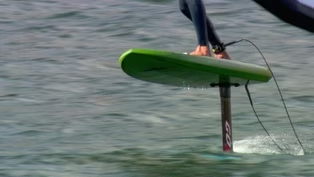
A hydrofoil is like a wing on an airplane.
As it moves through the water, it creates lift and eventually makes enough lift to boost the craft up and out of the water.
The reduced drag that results allows the craft to go faster.
That increased speed holds true no matter how the board is being propelled.
And it was the main thing that attracted Felix to the sport of kite foiling.
It's going to be spaghetti, but over time, you actually become pretty proficient at untangling these messy lines.
Don't do this at home.
Put your kite away very nicely.
[ laughs ] He started kiteboarding about ten years ago in San Francisco.
Full confession: I was not a fan at first.
Because to make it run flash in choppy waters, as you know San Francisco Bay is, it takes a lot.
And so I took -- It took me a while to master being able to go fast on that board.
And then all this changed overnight.
We went from formula boards to hydrofoil, and, you know, put in my first race board, went fast, and I was hooked.
And now, like, I cannot tell you.
Like, it's so fun when you crank and you go and you are in the groove.
But the tendency is, when you're riding, you're going that fast, everything slows down.
And so it feels very, very peaceful.
Until, heh-heh, you hit something in the water or you fall.
Then you know how fast you're going.
[ pumping air ] WOMAN: Oh, here's the painful part.
Cynthia, also known as Cynbad, has been a powerhouse in the world of wind sports since the 1980s.
But it wasn't until 2019 that she found exactly what she was looking for.
This sport that I'm doing, wing foiling, the minute I saw it, I knew I had to do it.
And so I've been a wing foiler now for as long as it's really been in existence.
Oh, it's windy.
It's good.
It's really strong.
The feeling of wing foiling is absolute freedom and quiet.
You hear no splashing, no noise.
There's no pressure and bouncing.
I mean, you fly.
It's so much fun.
The other cool thing about the hydrofoil being no resistance and high speed is that you can jump.
You don't even really need a wave.
Whoo!
And there's no lines, no bar, no masks, no boom.
You have this little inflatable toy, and you're flying across the water with a big smile on your face.
It can't be beat.
[ laughs ] She might get an argument on that from Rod Parmenter.
In the river here, we have these wind swells that you don't really think of as waves, but you can ride them.
To surf those swells, Rod uses a stand-up paddle foil, or SUP foil.
What we do with our SUP foils is we ride the swells on the river.
And so we have to paddle just to get up on the swells.
So you paddle your brains out, and you can pop up on the foil, and then you just ride the swell.
Of course, each swell only lasts a little while, but Rod can cover the eight river miles from Viento State Park all the way to Hood River in less than an hour.
What's really cool about it is that you can pump the foil under the water and go to the next swell and then ride that, and get a little bit of a rest, pump to another one, and then ride.
So I can go the whole way staying up on foil.
If that sounds like kind of a lot of effort, well, it is.
That extra effort it takes, I get the endorphins from paddling, and it feels so good.
It really -- When I'm done with a run, I'm super energized.
So whether your thing is speed... or a sense of flying... or a big rush of endorphins, you might want to check out hydrofoiling.
But there are a couple things you should know first.
CYNTHIA: A hydrofoil is like riding a unicycle.
Because you are balancing not just side to side, you're balancing fore and aft.
So it's a constant balance.
[ laughs ] And also, every time you add a hydrofoil to the mix, you do up your danger factor.
I'm going to try a jump.
Woo-hoo!
You know, when you crash at 30 miles an hour, it's more violent than crashing at 10 miles an hour.
And the hydrofoils are very sharp, like razors.
I have several stitches from several accidents with hydrofoil sports.
[ chuckles ] FELIX: It always could be challenging.
But we are still here.
So, you know, something went right.
And now I think a lot more people, I'm sure, will get into the sport, because it's super exciting.
And we're super lucky to have a front-row seat in seeing a sport like this evolve.
It's just like, you know, the sky is the limit.
I can't wait to see what they're going to come up with next.
[ ?
?? ]
Major support for Oregon Field Guide is provided by... Additional support provided by... And the following... and the contributing members of OPB and viewers like you.
Video has Closed Captions
Clip: S32 Ep8 | 7m 47s | Hydrofoiling is the latest rage in Columbia River Gorge wind sports. (7m 47s)
Video has Closed Captions
Clip: S32 Ep8 | 10m 50s | Rewriting the narrative of what it means to be a Black farmer in Oregon. (10m 50s)
Video has Closed Captions
Clip: S32 Ep8 | 8m 31s | Oregon’s Haystack Rock is one of the last spots on the West Coast to see Tufted Puffins. (8m 31s)
Providing Support for PBS.org
Learn Moreabout PBS online sponsorship

- News and Public Affairs

Top journalists deliver compelling original analysis of the hour's headlines.













Support for PBS provided by:
Oregon Field Guide is a local public television program presented by OPB