
Mussel Pains
Season 1 Episode 23 | 26m 46sVideo has Closed Captions
Invasive mussels are a big problem but science — and round gobies — could help fight them.
Invasive mussels are hastening the deterioration of historic Great Lakes shipwrecks, like the submerged Prins Willem V off Milwaukee. Zebra and quagga mussels are also a big problem for water treatment and power plants. But science — and another invader, the round goby—could help fight them.
Problems playing video? | Closed Captioning Feedback
Problems playing video? | Closed Captioning Feedback
Great Lakes Now is a local public television program presented by Detroit PBS
Mussel Pains
Season 1 Episode 23 | 26m 46sVideo has Closed Captions
Invasive mussels are hastening the deterioration of historic Great Lakes shipwrecks, like the submerged Prins Willem V off Milwaukee. Zebra and quagga mussels are also a big problem for water treatment and power plants. But science — and another invader, the round goby—could help fight them.
Problems playing video? | Closed Captioning Feedback
How to Watch Great Lakes Now
Great Lakes Now is available to stream on pbs.org and the free PBS App, available on iPhone, Apple TV, Android TV, Android smartphones, Amazon Fire TV, Amazon Fire Tablet, Roku, Samsung Smart TV, and Vizio.
Providing Support for PBS.org
Learn Moreabout PBS online sponsorship- [Narrator] On this edition of Great Lakes Now, the lakes are home to some incredible shipwrecks.
- These are time capsules.
It's a moment frozen in time when we go to the bottom.
- [Narrator] But, they're under threat.
- Most of the shipwrecks in Lake Michigan are completely covered with quagga mussels and that is really causing the breakdown of the shipwrecks.
- [Narrator] Is there any way to fight quagga mussels?
The mussel bed is now gone and there were just empty shells, essentially.
- [Narrator] This program is brought to you by the Fred A. and Barbara M. Erb Family Foundation, the Charles Stewart Mott Foundation, Laurie and Tim Wadhams, the Consumer's Energy Foundation is committed to serving Michigan, from preserving our state's natural resources and sustaining our future, to continuing business growth, academic achievement, and community involvement, learn more at consumerenergy.com/foundation, the Richard C Devereaux Foundation for Energy and Environmental Programs at DPTV, the Polk family Fund, Eve and Jerry Jung, the Americana Foundation, the Brookby Foundation Founders Brewing Company, and viewers like you.
Thank you.
- Hi, I'm Ward Detwiler.
Welcome back to Great Lakes Now.
The Great Lakes may not have sharks or dolphins or whales, but we do have shipwrecks that make the lakes into a kind of other worldly museum.
Partner station, Milwaukee PBS brings us the story.
- Well, shipping was, on the Great Lakes, was really the way we were founded.
Buffalo to Milwaukee was an immigration path.
Prior to the railroads in Chicago, Milwaukee was actually larger than Chicago and was really an immigration disembarkment point.
And then, even after the railroads hit Chicago it was the trade and the commerce using water as the as the interstate highway system.
Water was the trade lane well into the 20th century on the Great Lakes, but really it was the waterways and the shipping industry that built up and settled this this region of the country using the Great Lakes.
- [Driver] Ready?
- [Bystander] There you go.
(guitar music) - [Ship Captain] I'm a captain and I take scuba divers out on the Great Lakes to shipwrecks that have been here for hundreds of years.
The reason I started diving is because I got really interested in the history of the shipwrecks and the stories behind the shipwrecks.
I wanted to know more, I wanted to go see them, what's left of them.
(unintelligible radio communication) - [Ship Captain] Alright, is good, neutral.
- [Shipmate] Dive, dive, dive.
(water splashes) (soft music) - The Prins Willem is one of the most dived shipwrecks around Milwaukee for a number of reasons.
It's intact, still.
And also it's accessible to most people because the wreck starts at about 55 feet.
(air hose hisses) We are very lucky in the Great Lakes because the water is fresh and cold.
On the bottom, it's usually always 40 degrees.
It doesn't change.
So the shipwrecks are preserved.
They don't deteriorate.
They don't fall apart in like in, like in the ocean.
- Prins Willem V was a regular visitor to Milwaukee.
It was on its third of what was going to be another four voyages in 1954, when it left Milwaukee late in the afternoon.
And as it headed out a mile and a half or so outside of the Milwaukee breakwater, it collided with a fuel barge, it was carrying fuel oil.
This fuel barge actually punctured like a 20 foot gash in the side of the Prins Willem, and it sank.
But before it did go down, The Coast Guard cutter Hollyhock from Milwaukee came out and made sure everyone was rescued.
So there were no casualties during the, the loss.
What's really interesting about the Prins Willem historically, was that it was actually built in 1939 near Rotterdam.
And it was actually in the process in, during World War II, of being converted into a vessel by the German Navy, and in 1944 as Rotterdam was under assault, on D-Day assault, the Germans actually sank it, near Rotterdam, to kind of slow the oncoming allied forces.
And it was, it stayed there until like 1947 when it was raised, cleaned up, rebuilt, and put into service and trade, ultimately with the Great Lakes becoming its trading route.
(bird calls) - You can take the open water diver to here but you could also take the guy who does 300 foot dives on a regular basis.
- Yep.
And they're going to love this, right?
- Yep.
Because it's a really good one.
- Starts at 55 feet.
You know, you, you jump into water you go down and there it is right there.
(water splashes) As divers, we get trained properly, and if you follow the proper protocol it's a very safe sport.
My advice would be, get out get certified, get experience, find buddies you can trust, you can dive with and just have fun.
(soft music) - These are time capsules.
When you go down there and you see these wrecks, 'cause it's, it's a moment frozen in time When they go to the bottom.
It's the only place you can see 'em.
There's no museums that have all these old wooden schooners and there are schooners that went down in the 1800s that look like the day went down.
Sometimes, suddenly it'll hit you that, oh my goodness, all these people died on this wreck.
You're, you're very, you get somber a little bit about it and you, you deal with respect.
- We have a law in, in the Great Lakes.
You cannot take artifacts off of ships.
So a lot of the ships still have artifacts on them.
People from the east coast, west coast, from the ocean, they take things off of ships.
So then there is nothing to see.
On these ships you can go and see still some china.
You can see the wheels, even ballast on some of them.
Masts standing upright.
- If they could raise them, they tried to raise them because they want to reuse them and sail them again.
Prins Willem, they wanted to raise it.
They tried to raise it, and it was just proved too difficult to do it.
In some cases it's incredibly expensive.
And in other cases, sometimes in raising them you disturb them, and they are filled, in some cases, with a lot of fuel oil.
In some cases, it's more of a tomb situation.
Let's keep it entombed and encased.
(air hose hisses) (door opener creaks ) (ship's horn blows) - Zero nine one point five.
(cable clanks) - Now we are just outside of the main gap.
This is the main gap between the Milwaukee Harbor and Lake Michigan.
Our goal is the Prins Willem, which is about three nautical miles off shore, and we'll be sampling every mile on the way out.
(water splashes) - So this hickey gave us what, 10.5, no nine.
- [Shipmate] 10.4.
Alright, it gave us 9.5.
Nine, and the other side?
- Other side, 6.7.
- 6.7.
So the quagga mussels started invading in Lake Michigan around 2003, in a substantial rate.
And when you see the shipwreck you'll start noticing that in between the mussels now you can have algae.
So the algae are gonna be also attaching to there.
And what happens is that you have organic matter now depositing into your sleep ship wreck.
It starts degrading it as well.
So very slowly, but you start changing the characteristics of the surfaces.
- Three, two, one sample.
12, 10, 50, number 10.
Now we're going to deploy a remotely operated vehicle or ROV, that we will use to collect samples from the bottom.
We'll also use it to survey the shipwreck and see what kinds of changes have occurred since last time we were here.
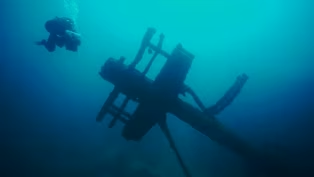
(bubbles splash) - Here we are looking at the edge of the Prins Willem and we're near a railing.
And you can see that the surfaces are largely encrusted with a growth, which is mostly mussels.
There are several ways in which the animals alter the shipwrecks.
And in the case of a shipwreck any alteration is permanent.
Stressed by currents, for example, during a storm, and pulled off they will pull a small piece of wood along with them.
(motor purrs) - Most of the shipwrecks in like Michigan are completely covered with quagga mussels.
And that is really causing the breakdown of the shipwrecks.
It's become accelerated.
Really our understanding of those ships also develops over time, as new technology becomes available to us, we try to use that to really understand how these ships are, to monitor their, their status, and then also to protect them for future generations to come visit and enjoy.
- For a link to the full documentary, Shipwrecks in Milwaukee visit greatlakesnow.org.
They're now an estimated 450 trillion quagga mussels in Lake Michigan alone, covering not only shipwrecks but much of the lake bottom.
They cause a lot of problems, but by banding together researchers are finding ways to fight back.
- Zebra and quagga mussels are one of the first big invaders to the Great Lakes ecosystem.
They were brought into the Great Lakes in the 1980s via ship's ballast water, from Europe, and they're small fingernail-sized mussels but they create dense colonies, so they create problems for water infrastructure, they clog water intake pipes, they can colonize docks and boats and other equipment.
They've also dramatically changed the ecosystem and the food web dynamics that affect our valuable sport and commercial fishery.
- [Narrator] With so much at stake, a collection of researchers, resource managers, environmental engineers, industry representatives, as well as state and federal agencies joined forces to form the invasive mussel collaborative, with one hope.
If this group of diverse managers and researchers from different agencies and different institutions and stakeholders, and affected industries could get together as a collaborative, we could work together to, and leverage each other's resources and expertise in order to move solutions forward to managing zebra and quagga mussels.
The collaborative has been conducting research at Good Harbor Reef in Lake Michigan, just off of Sleeping Bear Dunes National Lake Shore, known mainly for its massive sand dunes left behind by glacial migration.
What is lesser known are some of the issues that have been brewing under the waves.
Sleeping Bear Dunes National Lake Shore was actually voted the most beautiful place in America by Good Morning America.
- Good Harbor Reef is a reef that's right off of that.
It's a fairly significant reproductive area for lake trout, lake whitefish.
- It's also close to Leland, Michigan, which is well known for the Great Lakes Fishery.
And the mussels have really just covered that reef.
- [Narrator] When mussels cover a reef they can choke critical spawning habitat used by native fish.
- The Great Lakes fisheries generate right around $7 billion annually.
Recreational fisheries, commercial fisheries, as well as tribal.
So it's a very significant economic engine for the region.
- [Narrator] Invasive mussels impact the environment by literally sucking the life out of the water, depriving it of nutrients at the bottom of the food chain relied upon by native fish populations.
- Right now with lake whitefish, we've seen a fairly significant decline in bondants as well as the yield of, of those species.
- [Narrator] The mussels can also give rise to harmful algae.
- As the zebra mussels and quagga mussels came in and ate all of the plankton and things up, they also left a lot of nutrients and that nutrient served as fertilizer for liquid algae, which produces toxin.
Aquatic insects, eat it, fish eat the insects, and then birds eat those fish.
We had a large avian botulism die off.
So we started doing some long-term studies trying to get a deep understanding of what invasive species impacts might be on our fisheries and reef systems.
- [Narrator] The research in Good Harbor Bay grew out of conversations between researchers and resource managers, who realized they could help each other.
The National Park Service mentioned that they had been doing experimental mussel removal, sending divers down to the bottom of the lake to actually scrape the mussels off.
They were also establishing a good baseline understanding of what the local ecosystem was like.
So if a treatment was implemented, you could not only look at what the effects of those treatments were on the mussels but also understand how it might change the ecosystem.
We had a site with ecological data and a need for a larger treatment, and they had a larger treatment and a need for an ecological site.
- [Narrator] LimnoTech is an environmental engineering firm that helps solve problems in lakes and rivers.
- The invasive mussel collaborative presented us with some options that they had in mind.
We basically selected as a team, the most effective one, which we thought was the Zequanox treatment.
- [Narrator] Zequanox is an EPA approved treatment that kills zebra and quagga mussels with no known impacts on other aquatic organisms.
- The ideal aspects of the Zequanox are that it's target specific, it only affects quagga and zebra mussels - Prior to Zequanox, there were a couple of tools that could be used in open water environments but they were highly toxic to other organisms.
- We're trying to minimize the amounts of product that's being used in the open waters.
- [Narrator] But how do you apply as Equinox to a reef at the bottom of a lake and keep it from just floating away?
- So, we set up this array of tarp systems that were basically framed underneath the water.
And then we worked with the divers to develop a way to actually use a wand to pump from the boat down through the wand and spread that out.
- So this is a really unique application and we're really curious to see how effective it is.
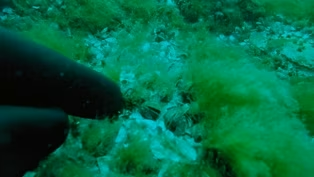
- [Scientist] You can clearly see in photos of the reef immediately after treatment that all of the algae that was there before covering the mussel beds is now gone, and there were just empty shells, essentially.
- [Narrator] A dive team from the University of Wisconsin Milwaukee, led by Harvey Bootsma, observed a mortality rate of around 95% in areas treated with Zequanox.
- We've been monitoring the site over time looking at what's happening to the quagga mussels, what's happening to the nuisance algae, what are the numbers of round gobies down there, how are they being affected when we remove mussels from this area?
And we actually are seeing evidence that there is less nuisance algae growing where we've removed these mussels.
- It uncovered a lot of the substrate that are used by the fishes for reproduction.
Those were completely encrusted by the invasive mussels.
- [Narrator] This approach doesn't mean that we can get the invasive mussels out of the Great Lakes, but it holds promise for controlling mussels in small sites, like critical reef habitats that native fish depend on, and at water intakes, at power plants, or water treatment facilities.
- I end up being hopeful, given the passion and the progress that we've been making.
- Good Harbor Reef was a great laboratory, essentially, to start with, and we already had a good foundational knowledge and partners in place that could help us implement this project.
So we're going to be looking for what the next set of tools are that we want to test and what the next set of locations are that we want to look at.
The problem of zebra and quagga mussels and the Great Lakes region is a complex problem and it's a large problem, but we do have expertise and resources and knowledge, and if we work together and leverage each other's expertise I think we can be successful.
- This isn't the first time we've told you about research on quagga mussels and good Harbor Bay.
In fact, several years ago, some of the same researchers you just saw conducted a different experiment involving quagga mussels and another invasive species the round goby.
Great Lakes Now's Nick Austin set out to connect the dots for us.
- Round gobies, come from the Black and Caspian Seas and were brought to the Great Lakes in ballast water just like zebra and quagga mussels.
In fact, the mussels may have facilitated the gobies' invasion by providing an abundant food source In the Great Lakes, the round gobies' diet consists largely of mussels.
- [Narrator] Harvey Bootsma is a professor at the University of Milwaukee School of Fresh Water Science.
He and a team of researchers have discovered that the round goby may be an ally in the fight against invasive mussels.
- We wanted to see if there was any potential for controlling mussels, at least at a small scale in Lake Michigan.
So in 2016, with support from the National Park Service and the Great Lakes Restoration Initiative, we decided to start a mussel removal project.
- [Narrator] The research was done on a rocky reef in Good Harbor Bay, between at Leland, Michigan, and Sleeping Bear National Lake Shore.
There not far from where the more recent Zequanox experiments would be done, the team took on the daunting task of removing mussels from a section of lake bottom.
- [Scientist] The number of volunteer divers working with us spent several weeks that summer just going down diving and scraping the mussels off of rocks, trying to create a significantly large area that was mussel free.
And then after that, the objective was to monitor that to see what happened to that patch of rock.
- [Narrator] Surprisingly, four years later, there are still almost no mussels in the area.
The research team suspected round gobies might be responsible.
- [Scientist] We think what's happening, is the mussel larvae, or what are called veligers, settle on surfaces where they grow into hard shelled mussels.
If mussels try to recolonize these rocks, the gobies are eating them before they can grow to any significant size.
- [Narrator] To test that hypothesis, the researchers put in devices called Hester-Dendy traps, which has spaces in them that are big enough for mussels but too small for gobies.
- And sure enough, we're seeing mussels in those traps now.
So it does seem like the gobies are instrumental in keeping the mussels from recolonizing the rocks that we cleared some time ago.
- So mussels are speeding up the deterioration of shipwrecks but it looks like we've discovered a way to kill invasive mussels in a small section of lake bottom.
And if round gobies can keep mussels out of that area, by eating them, does that mean we could preserve a shipwreck by clearing out the mussels?
And would gobies, keep them cleared out?
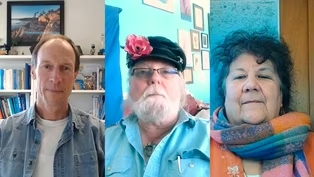
We wanted to know, so I asked the experts, doctors, Harvey Bootsma, Russell Cuhel, and Carmen Aguilar, of the University of Wisconsin Milwaukee, School of Freshwater Science.
How completely have the quagga mussels covered Great Lakes shipwrecks?
- I would say that there's very rarely a square inch that's not covered on the outside.
Inside the holes are not nearly as heavily contaminated with mussels because they can't get food there.
What effect can these mussels have on the wrecks themselves?
- So for example, one of the things is that when the little tiny veligers are creating their shell they deposit into crevices of the wood.
When they start growing, they split the wood.
Then they have this mechanism to attach to shipwrecks, which is the Byssal threads.
And they attached to the paint very, very strongly, and so there's recurrent in that they can chip the mussels with the paint and that starts deteriorating the, the shipwreck, especially if it's wood.
- Another feature of the mussels is that they eat and poop all day.
Bacteria that live in the crevices between the mussels, turn the water anoxic by breathing all the oxygen in the water.
And when they do that, they create chemicals that are capable of dissolving iron and other metal pieces of ships - In terms of Great Lakes shipwrecks, is it possible to use Zequanox to clear mussels on Great Lakes shipwrecks?
- It would be challenging for a couple of reasons.
When we applied this method a couple of years ago it was on a relatively flat lake, bottom.
Rocky but relatively flat, So you could put this cage, so to speak, over the bottom and seal it.
That would be much more difficult to do for an entire shipwreck.
You might be able to do it on small sections, if you could close them off completely, but it would be tough to do for an entire ship wreck.
The other challenge is that to do this work you have to have divers going down putting all of this stuff in place.
And we did our work at a depth of 10 meters.
So, about 33 feet, and a diver can stay at 33 feet for quite a while without running into problems, of what we call, decompression sickness, where you're just breathing too much compressed air over time.
A lot of shipwrecks are deeper than that.
So if divers have to go down deeper than that and spend quite a bit of time putting these containment systems in place you start to run into problems of time limitations, because if a diver spends too much time down there, he or she is going to get too much nitrogen gas in the blood.
And that causes problems when they come back to the surface.
- [Narrator] If we could use Zequanox to clear mussels off of a shipwreck, would gobies keep the mussels from returning?
- That's an interesting question.
There, again, it may depend in part on the depth of those shipwrecks.
The gobies prefer to be in warmer water and in the summer most of the gobies are in shallow waters because those tend to be warmer.
So if those shipwrecks are deep and they're constantly cold you may not have the goby numbers on those wrecks to keep eating the mussels as fast as they are in shallower waters.
But we're still learning a lot about round gobies how they move throughout the year.
We're pretty sure that a lot of them do move to deeper water in the winter.
So it's possible that gobies could start eating small mussels on a shipwreck if you did clear them off of a certain area.
- Thanks for watching.
You can find out more about shipwrecks, invasive species, and all other stories at greatlakesnow.org.
When you get there, you can follow us in social media or subscribe to our newsletter to get updates about our work.
And you can see my interview with Edichi Yogesh, the winner of the 16th annual Oakland County Kids Clean Water Calendar Contest, which I recently had the pleasure of judging for the second year in a row.
See you out on the lakes.
(soft music) - [Narrator] This program is brought to you by the Fred A. and Barbara M. Erb Family Foundation, The Charles Stewart Mott Foundation, Laurie and Tim Wadhams, the Consumer's Energy Foundation is committed to serving Michigan from preserving our state's natural resources and sustaining our future, to continuing business growth, academic achievement, and community involvement, learn more at consumersenergy.com/foundation, the Richard C. Devereaux Foundation for Energy and Environmental programs at DPTV, the Polk Family Fund, Eve and Jerry Jung, The Americana Foundation, the Brookby Foundation, Founders Brewing Company, and viewers like you.
Thank you.
(majestic music)
Video has Closed Captions
Clip: S1 Ep23 | 7m 21s | Scientists team up to try to protect an important reef from invasive quagga mussels. (7m 21s)
Video has Closed Captions
Clip: S1 Ep23 | 7m 9s | Can we protect shipwrecks from the damage caused by invasive mussels? We ask the experts. (7m 9s)
Video has Closed Captions
Clip: S1 Ep23 | 10m 28s | Invasive mussels are hastening the deterioration of historic Great Lakes shipwrecks. (10m 28s)
Providing Support for PBS.org
Learn Moreabout PBS online sponsorship
- Science and Nature

Explore scientific discoveries on television's most acclaimed science documentary series.

- Science and Nature

Capturing the splendor of the natural world, from the African plains to the Antarctic ice.











Support for PBS provided by:
Great Lakes Now is a local public television program presented by Detroit PBS