Oregon Field Guide
Najiah Knight, Condit Dam Update, Dog Mountain Photo Essay
Season 32 Episode 10 | 27m 31sVideo has Closed Captions
Najiah Knight, Condit Dam Update, Dog Mountain Photo Essay.
In many small towns, rodeo is a big part of community life. Meet Najiah Knight, a 14-year old Native American rodeo star from Arlington, Oregon. When Condit dam was blown up a decade ago, everyone had high expectations for what the future of a free-flowing white Salmon river might look like. How did things turn out? A visual journey to Dog Mountain, thanks to the photography of Michael Bendixen.
Problems playing video? | Closed Captioning Feedback
Problems playing video? | Closed Captioning Feedback
Oregon Field Guide is a local public television program presented by OPB
Oregon Field Guide
Najiah Knight, Condit Dam Update, Dog Mountain Photo Essay
Season 32 Episode 10 | 27m 31sVideo has Closed Captions
In many small towns, rodeo is a big part of community life. Meet Najiah Knight, a 14-year old Native American rodeo star from Arlington, Oregon. When Condit dam was blown up a decade ago, everyone had high expectations for what the future of a free-flowing white Salmon river might look like. How did things turn out? A visual journey to Dog Mountain, thanks to the photography of Michael Bendixen.
Problems playing video? | Closed Captioning Feedback
How to Watch Oregon Field Guide
Oregon Field Guide is available to stream on pbs.org and the free PBS App, available on iPhone, Apple TV, Android TV, Android smartphones, Amazon Fire TV, Amazon Fire Tablet, Roku, Samsung Smart TV, and Vizio.
Providing Support for PBS.org
Learn Moreabout PBS online sponsorshipMajor support for Oregon Field Guide is provided by... [ ?
?? ]
MAN: My rappel!
MAN: Oh, my gosh, it's beautiful.
MAN: Good morning, everybody.
Woo!
Let's do it again!
MAN: Nicely done!
MAN: Oh, yeah!
Fourteen and a half.
Yes, that was awesome!
[ people cheering ] There you go, up, up... ED JAHN: Tonight on Oregon Field Guide: [ detonators popping ] When Condit Dam was blown up... everyone had high expectations for what the future of a free-flowing White Salmon River might look like.
A decade later, we return to see how things turned out.
[ birds chirping ] Then, it's a visual journey to Dog Mountain.
But first... ANNOUNCER: Here we go!
an Oregon rodeo star in the making.
A big part of what we like to do on Oregon Field Guide is introduce you to people and places from every corner of our state.
In many small towns in particular, rodeo is a big part of community life.
So big, in fact, that one of the nation's youngest and brightest stars is from right here in Oregon.
GIRL: Arlington is very small.
I mean, it's not a very big town, but, you know, it's my hometown.
I just love it to death.
[ chuckles ] [ chick chirping ] You're so little.
Shh.
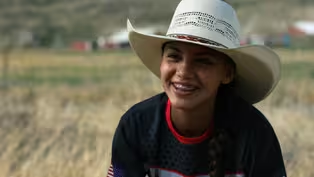
My name is Najiah Knight.
I am 13 -- 14, my bad.
JULE GILFILLAN: It's an easy mistake to make on your actual birthday... NAJIAH: I'm excited.
and everyone's throwing you a party.
Hello, thank you.
Fourteen, huh?
Yes, ma'am.
And in a lot of ways, Najiah Knight is a very typical teenager.
This is my turtle, Toodles.
Her favorite food is Indian tacos.
And it's so, so good.
I love it.
Her favorite color is turquoise.
Oh, snap!
And it's my color.
[ all laughing ] Her favorite cake is chocolate.
ALL: ?
Happy birthday to you ?
But she has an outsized passion for the number 8.
You have to ride them for the full eight seconds.
You can't touch the ground and you have to have at least part of the rope in your hand for you to make it.
[ buzzer sounds ] ANNOUNCER: There you go!
I am a mini bull rider.
They might be called mini bulls, but they're still pretty big.
They're kind of just like a smaller breed, and they're fully grown and they weigh to 500 to 1,000 pounds, I think.
Somewhere in there.
And, yeah.
GILFILLAN: And how much do you weigh?
I weigh 80 pounds.
[ chuckles ] Present her with the plaque.
Najiah, so glad to have you here with us... NAJIAH: Right now, I am ranked number seventh.
That would be in the world.
And if that's not impressive enough, she's also the only girl competing with a whole lot of boys.
Most of the time, they're very nice.
And they just accept you.
But sometimes, they'll be like, ''So I can't get beat by a girl.''
But, you know, you just gotta show 'em who's boss.
This boss has been doing that in and out of the arena.
She's been featured in Vogue magazine, and appeared on The Kelly Clarkson Show.
She's got product endorsements, a modeling contract, and even her own trading cards.
But for Najiah, all of this is run up to her real goals.
Well, my short-time is to be number one in the world, just the champion.
[ chuckles ] But my longtime goal is to be the first girl in the PBR.
ANNOUNCER: Here we go!
PBR stands for Professional Bull Riders.
Not only are the men involved in the most dangerous sport in the world... And if it's not the most dangerous sport in the world, it's definitely one of them.
To get there, Najiah's gotta stay in the game till she's 18.
NAJIAH: Four more years.
ANNOUNCER: A woman of the PBR...
In January 2020, she not only became the first girl to ride a bull at Madison Square Garden, she also beat all her competitors in the third round.
But just as her star was on the rise, the Covid-19 pandemic hit.
I had rodeos almost every month, so, I mean, it canceled a lot of my rodeos.
That was a big disappointment.
Instead, Najiah and her coach, also known as Dad, do their best to stay rodeo-ready.
ANDREW: We try to work out five days a week.
I think, if anything, we probably went harder through that, and it kind of blocks out everything else and just focus on what you've gotta do, and you just get it done.
Can you do ten of these?
Mostly we work on lifting light, keep the muscles toned but able to be flexible to move with the bull.
Good job.
Great.
All right.
You want to be able to meet each move and be right there on top of him, so if he decides to change his mind, you're able to snap back into the next position.
He would know.
That's great.
Andrew Knight's been riding in rodeos since he was a kid and still competes now and then.
She used to go to every rodeo with me, and she'd be back there and I'd be getting ready, and she wanted to always get on something.
I mean, she was 3 years old, and was like, ''Dad, can you put me on, can you put me on?''
And I'm like, ''You're too little.
Your time will come.''
NAJIAH: Your turn, old son.
I'm like, ''You best put me on one,'' because I just fell in love with it.
ANDREW: So I finally decided, ''Hey, let me put her on.''
And from there on, there was really no holding her back.
ANNOUNCER: Here we go, folks!
[ all cheering ] Like a lot of young riders, Najiah started on sheep, a sport known as mutton busting.
ANDREW: She was a champion mutton buster.
I mean, she just gripped on there like Velcro, and there wasn't no getting her off.
Oh.
Oh, thank you.
Then came calves and steers and now mini bulls, something she found out about from her great uncle Jim.
Okay, the horse is here.
JIM: Bulls, I wasn't too sure about, because she was awful tiny, but she stuck it out.
She's a tough little girl.
ANNOUNCER: Here we go!
[ crowd cheering ] NAJIAH: I haven't broken any bones from bull riding yet, thank goodness, but I have got stepped on a couple times.
I also had my spur caught in my handle before, so I was like upside-down on the bull.
I didn't have my boot straps on that time, and so my boot slid off.
And I finally got off the bull, and I was like, ''It's a good thing I didn't wear my boot straps today.''
ANNOUNCER: Let me tell you something, this young lady took a bigtime shot last night.
I was really impressed.
ANDREW: Every parent worries about their kid getting hurt.
My stomach goes up and down probably every rodeo.
ANNOUNCER: If you would, give her a round of applause... ANDREW: But she gives a wave every time, no matter if she's hurt or not.
She'll let 'em know she's all right.
NAJIAH: I know if it's my time, then it's my time.
But it's not my time yet, so I'm doing pretty good.
Jesus is blessing me, thank goodness.
So, yeah, I'm not afraid to get back on at all.
I'm just, you know, perfectly fine and ready to ride.
ANNOUNCER: Doesn't matter about your gender.
Be a cowboy.
JIM: She doesn't have any fear, which is a big factor.
And she's got a lot of people to talk to, so it makes it easier behind the chutes.
That fearless streak runs deep on Najiah's maternal side.
Rodeo's been a part of our life for as long as I can remember.
Her great-great grandpa was a world champion bronc, bare-backing bronc rider, Irwin Weiser.
And then Bunny Weiser, her great grandpa, he was a champion bronc rider three different states, Nevada, Oregon, and California.
I rode the PRCA and the Indian rodeo circuits, done pretty good myself.
My son is still riding.
We just grew up, everybody, we all rodeoed.
And she's right in the middle of it.
She's a legacy coming up.
NAJIAH: Thanks, uncle.
Part of that legacy is her Paiute ancestry, a heritage she hopes to represent someday in the PBR Global Cup.
NAJIAH: There's two American teams, Team Eagles and then Team Wolves, which is the Natives.
I would be part of the Team Wolves, because I am Native.
And I think that would be so cool.
JIM: If she keeps going and keeps focused right, there's a good chance she can do it.
She's got some potential and the love for the sport.
She's got a lot of backup.
Her cousins think she's great.
And doing what she does, her mom and dad are really proud of her, and I'm really proud of her.
ANDREW: My wife and I, we're really proud of her, what she's becoming and how she's opening up doors for other women to do, you know, pretty much anything they want.
Right now, Najiah's attention is focused no the next four years... playing out eight seconds at a time.
ANNOUNCER: Make some noise for Najiah Knight from Arlington, Oregon.
[ crowd cheering ] [ ?
?? ]
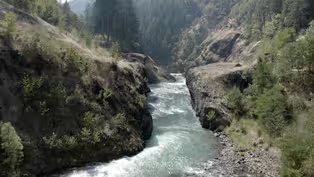
I'm on the White Salmon River.
Ten years ago, this was a lake.
Today, it's rapids.
[ bird cawing ] The Condit Dam held back the water of Washington's White Salmon River for a century, until one crisp October day in 2011, when engineers pushed a detonation button.
MAN: Fire in the hole!
[ detonators popping ] [ all cheering ] WOMAN: We had no idea what was going to happen, and so we were just sort of watching history unfold before our eyes.
This was the largest dam removal that had ever been attempted, an incredible engineering feat.
Perhaps more importantly, it symbolized hopes for the White Salmon's future.
When the dam was breached successfully and things started moving out, whew, it was kind of the dawn of a new era for the White Salmon River.
The hopes of river runners, biologists, and local tribes were all staked on one unknown premise: if the dam were gone, the White Salon would return to its natural state.
But no one could say for sure how long this would take and what it might even look like.
Now a decade has passed, and some of those answers are starting to be seen.
The White Salmon is one of the most unique rivers in the Pacific Northwest.
It flows year-round from the glaciers of Mount Adams.
The water rushes cold and fast through forests and farmlands for some 45 miles.
It ends when it meets the Columbia River.
Ecologically, it sits almost exactly on the dividing line between the wetter west and the drier east.
And since time immemorial, it has been the traditional fishing and gathering grounds of tribes such as Wishram, Klickitat, and Yakima.
More recently, it has gained a reputation as one of the best whitewater rivers in the Northwest.
MAN: Nice.
MAN: Yup!
You guys only really need to paddle when I'm telling you to.
Stay together.
I've kind of grown up around this river, whether it be through just kayaking or even just playing in it when I was younger.
MAN: No need to jump that far.
Well, it's funny, but I'm only a river runner to keep up with my kids.
Oh, gosh!
Even when the dam stood, the upstream section was a river runner's delight, with playful, splashy rapids, sudden small drops, and rock gardens to deftly weave through.
The White Salmon cuts a narrow channel through solid basalt cliffs.
And in some spots, the river is so pinched that boaters get out and walk and send their rafts on their own.
Even experienced kayakers sometimes skip the falls and do a seal launch off the cliffs below.
This section of the White Salmon is officially designated as Wild and Scenic.
It's the special quality of the river's natural wildness that had river runners intrigued.
If the river looked like this above the dam, what would the rest of the river look like if the dam were gone?
Would there be new rapids to run, waterfalls revealed, and could they travel with the river all the way to the Columbia?
MAN: Right up in here, we're starting to see some of the first spaces where you actually started to see the river has changed and eroded some.
Prior to the dam removal, when this bridge came into view, paddlers knew that their time on the river was over and they would soon take out.
But from this point forward, the river ahead is one they had only been able to imagine, especially since this part of the river was deep underwater.
This section used to be the reservoir of Condit Dam, once known as Northwestern Lake.
You can still see the line of cabins perched above the river which were once lakefront.
Yeah, it's a river again, as opposed to a lake.
Like, we would be paddling against the wind here.
Breaching the dam was the equivalent of pulling the plug on an enormous bathtub.
But it wasn't the water the engineers were worried about.
The big unknown was what would happen to the estimated 2.4 million cubic yards of sediment that had been building up for nearly a century.
[ horn blowing, detonators popping ] Watching the lake drain, it was phenomenal.
It was like watching a million years of geology happening in the space of minutes.
Football-field sizes of land and dirt that would just kind of like start to liquefy and then spin and swirl and turn into mud and just go downstream.
One of the biggest hopes of removing the Condit Dam and draining the reservoir was that the White Salmon would return to its original river channel and that the plants and trees along its banks would regrow.
But no one knew how long this would take to recover or if it even would.
Jeanette Burkhardt has been at the forefront of the revegetation efforts.
We have to not expect this to behave the same way as a site that has soil, like across the river.
We have to treat this more like something like a Mount St. Helens, where you're starting at ground zero.
With the help of more than 500 volunteers, some 7,000 plants, shrubs, and trees have been planted.
But it hasn't been without setbacks.
Both flood and drought have taken a toll.
But some of the hardier species planted here have managed to hang on.
This one here is Oregon white oak.
It has sort of leathery leaves that help it to be very drought-tolerant in dry conditions.
And it has a deep taproot, so it can get water from a long ways down even when the surface has dried out.
Some of the tallest trees that you'll see out here right now are ponderosa pines.
And just remember, if you look at the site, there would've been nothing here.
So these are becoming established, and the worst is hopefully behind them now.
And it will be just gangbusters from here on out.
[ laughs ] We are coming up to where Condit Dam used to be.
This is the old dam site right here.
If you didn't know the dam had been here, the former site looks simply like a narrow spot where two cliffs squeeze the river.
This natural narrow is the reason that the original builders picked this spot to build the dam in the first place.
Work started in 1912.
Using the canyon's own basalt to make concrete, the Condit Dam rose 125 feet tall, about the height of a 12-story building.
It took the original workers a year to build.
And even with heavy equipment, it took modern workers a year to dismantle.
When the last of it had been removed, exactly a century had passed.
For some, their history of the river goes much further back.
Yellowash Washines' grandparents and generations before them saw the river prior to the dam.
He witnessed it the day the dam was breached.
This is the first time he's been back.
This river was a big part of our homeland to what is known as the Klickitat people.
We always had this belief, since the beginning of our time here, our people, that this water is the life of our mother here, this ground, this earth.
When you hear the sound... it's alive.
And that has a big meaning.
In our language, it's [ speaks Native word ].
And it's life.
Water is life.
So when they took the dam out, that was like a renewal to the way that the creator had intended for this water to flow.
I'm just glad to be back down here.
I could just put a camp right here and just listen to the sound of this river, you know, that it makes.
It's soothing.
It soothes you.
Renews your spirit is what it does, you know?
The company that ran the dam, PacifiCorp, still owns land below the former dam site.
Now, the Confederated Tribes and Bands of the Yakima Nation have the first right to buy it, one more step toward the cultural restoration and stewardship of the White Salmon.
Below the former dam site is one of the most beautiful secrets of the White Salmon, a gorge so deep and narrow that it is accessible only to those who come by the path of the water.
But when the dam was in place, this canyon often had too little water to boat and too little water for salmon to swim upstream.
When Condit Dam was due for recommissioning in the 1990s, environmental regulations required building new fish passage facilities.
The cost of updating the dam to modern standards exceeded the value of the electricity it supplied.
In the end, it was an economic decision to remove the dam.
But the hope for the future was an ecological one.
With the river unblocked and allowed to flow free again, would it bring back the endangered salmon?
It's fall, and the Chinook have returned.
These are bright fall Chinook swimming up the lower White Salmon.
They have come all the way from the Pacific, back to the place of their birth.
This is the very last moment of their life cycle, where they will spawn and die.
A female will lay some 8,000 eggs, but only about 1 percent of her offspring will make it back here as adults.
Seeing the carcasses of the Chinook, you understand why this river is called White Salmon.
Once they come into freshwater, they're quickly deteriorating, and their meat is almost always white.
They don't have the color that you think of, the salmon color.
Biologists pull the carcasses to record important data.
Got a fresh one.
WOMAN: Yeah.
Scale card number?
16107.
We're going to get a sex on the fish and a fork length as well as some scales.
And we get age data from the scales.
Elise and her team have been tracking the fall and spring Chinook runs since the removal of Condit Dam.
SEAN: I'll count from the bank to you if you want to count from you to the other bank.
ELISE: Perfect, yeah.
So definitely some redds in between us.
There's definitely been some pretty drastic changes.
When the dam was removed, the first couple years after, there wasn't a ton of spawnable habitat down here, not a lot of really good gravel for them to create their nests and their redds.
We have since seen a lot more gravel down the river here lower and a lot more fish activity and spawning just down in the river in general.
So I had 16?
Sixteen?
I had 17.
Seventeen?
Seventeen, yep.
Sweet.
The overall counts of returning salmon have fluctuated over the past several years.
Most of the lows and highs seem to correspond with the annual counts in the Columbia River.
And larger-scale factors, like ocean conditions and climate, complicate the effort to understand how much of a role dam removal has in salmon recovery.
Chinook return between the ages of 3 and 6, so in the ten years without the dam, there hasn't been enough cycles for biologists to see a trend, and it will take a few more generations.
What is clear is that the river conditions have improved for the salmon to come home.
Might be a little bit of a splash here.
The White Salmon now can move at its own pace.
And river runners can move with it... all the way to the Columbia.
TODD: For us to be able to paddle all the way to the Columbia is pretty special.
You feel like you've made the river's natural journey.
It's a pretty rare experience for a river runner to actually, like, run all the way out to the mouth of a river, and here we do.
[ ?
?? ]
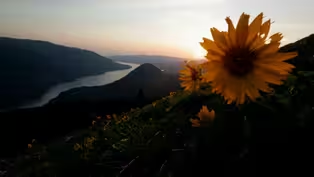
Dog Mountain has long been a go-to hike in the Columbia Gorge.
It's also insanely crowded in the summertime.
So might we suggest you enjoy this one remotely thanks to the stunning photography of Michael Bendixen.
[ ?
?? ]
[ wind whistling, birds chirping ] JAHN: You can now find many Oregon Field Guide stories and episodes online.
And to be part of the conversation about the outdoors and environment here in the Northwest, join us on Facebook.
[ birds chirping ] Major support for Oregon Field Guide is provided by... Additional support provided by... And the following... and the contributing members of OPB and viewers like you.
Video has Closed Captions
Clip: S32 Ep10 | 13m 29s | A look at how the White Salmon river has recovered 10-years after Condit Dam demolition. (13m 29s)
Video has Closed Captions
Clip: S32 Ep10 | 1m 32s | A visual journey to Dog Mountain, thanks to the photography of Michael Bendixen. (1m 32s)
Video has Closed Captions
Clip: S32 Ep10 | 9m 1s | Najiah Knight is a 14-year old Native American rodeo star from Arlington, Oregon. (9m 1s)
Providing Support for PBS.org
Learn Moreabout PBS online sponsorship














Support for PBS provided by:
Oregon Field Guide is a local public television program presented by OPB