
Native American Leaders
Season 13 Episode 6 | 28m 46sVideo has Closed Captions
A look at Native American leaders of Nebraska
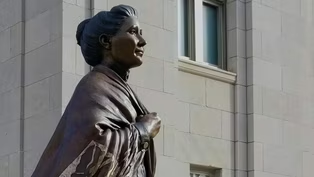
A Legend in Bronze, a visual essay on the new Dr. Susan La Flesche Picotte sculpture. Against the Current, Susan La Flesche Picotte, the first Native American doctor to build her own hospital on Omaha reservation. Return of the Pawnees, Roger Welsch and his wife returned their parcel of land to the Pawnees. The Chief Goes to Washington, statue of Chief Standing Bear unveiled at US Capitol.
Problems playing video? | Closed Captioning Feedback
Problems playing video? | Closed Captioning Feedback
Nebraska Stories is a local public television program presented by Nebraska Public Media
Native American Leaders
Season 13 Episode 6 | 28m 46sVideo has Closed Captions
A Legend in Bronze, a visual essay on the new Dr. Susan La Flesche Picotte sculpture. Against the Current, Susan La Flesche Picotte, the first Native American doctor to build her own hospital on Omaha reservation. Return of the Pawnees, Roger Welsch and his wife returned their parcel of land to the Pawnees. The Chief Goes to Washington, statue of Chief Standing Bear unveiled at US Capitol.
Problems playing video? | Closed Captioning Feedback
How to Watch Nebraska Stories
Nebraska Stories is available to stream on pbs.org and the free PBS App, available on iPhone, Apple TV, Android TV, Android smartphones, Amazon Fire TV, Amazon Fire Tablet, Roku, Samsung Smart TV, and Vizio.
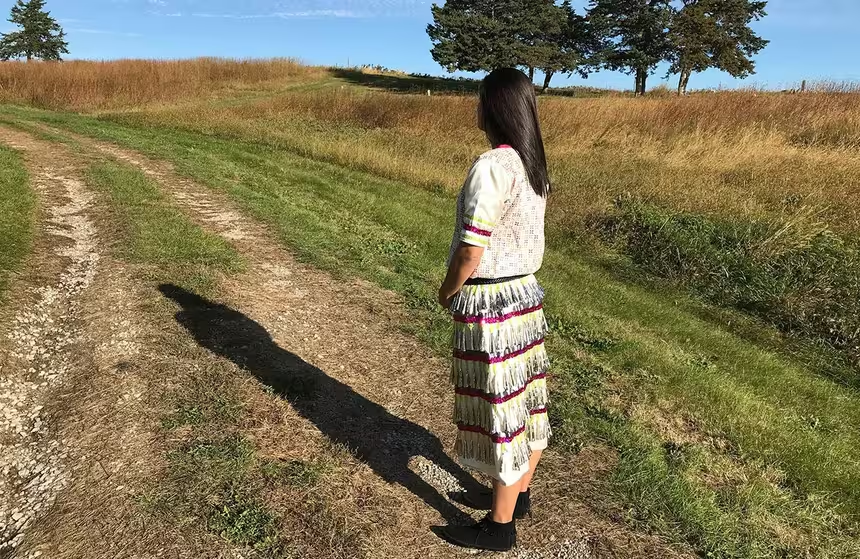
Do you have a Nebraska Story?
Do you have a story that you think should be told on Nebraska Stories? Send an email with your story idea, your name, your city and an email address and/or phone number to nebraskastories@nebraskapublicmedia.org. Or, click the link below and submit your information on nebraskastories.org.Providing Support for PBS.org
Learn Moreabout PBS online sponsorship- [Narrator] In this edition of Nebraska Stories, a look at Nebraska's remarkable Native American history and culture.
Coming up, a statue honoring the first Native American doctor and the story behind her extraordinary life, the repatriation of land to the Pawnees, and Chief Standing Bear goes to Washington.
(steady rock music) (suspenseful orchestral music) (orchestral music swells and crescendos) (music crescendos further) (music resolves) (music crescendos to finish) (birds chirping) Words of Dr. Susan La Flesche Picotte: - I believe in prevention of disease and hygiene care more than I do in giving or prescribing medicine.
And my constant aim is to teach these two things.
Plenty of fresh air and sunshine.
That is nature's medicine.
(birds chirping) - [Stabler] To have a hospital back in that time and to have our own doctor to run it, and her being one of us, I'm sorry it was a short life, but look what she was able to accomplish.
She built a hospital on our reservation long before Indian health was even thought of.
And those were her principles, you know, fresh air and sunshine.
So to sit on this porch, you know a lot of good memories coming back to me right now.
- [Narrator] In 1913 in the little town of Walthill in Northeast Nebraska, the first Native American doctor built a hospital without government support, on donated land, with money she raised herself.
Susan La Flesche Picotte had learned over a lifetime that if she wanted to help her people she couldn't depend on anyone else.
Words of Dr. Picotte: I was just a girl when I went to comfort a woman who was very ill. A messenger went for the agency doctor, but he never showed up.
The woman died in agony that morning.
It was only an Indian, and it did not matter.
- [Narrator] It was a death that changed her life and drove her to accomplish the seemingly impossible.
She was just being true to her Omaha culture.
- [Drum] Our name, Omaha, means to go against the current.
We travel against the wind very often and travel up river.
We tend to keep to our traditions and try to hang on to those, but at the same time, we are changing.
- [Narrator] Susan La Flesche was born in a buckskin teepee just two months after the assassination of Abraham Lincoln in 1865.
- [Drum] When a child is born, the parents give the child a name four days after birth.
And the child is introduced to the four directions and to the creator.
- [Narrator] But the Omaha world was changing.
Unlike her older sister Bright Eyes, Susan was never given an Indian name.
Their father, chief of the tribe, wanted his youngest daughter to go far in the white man's world.
The son of a French trader and Indian mother, Joseph La Flesche, known as Iron Eye, had been to Washington, had seen the coming flood of white men.
He knew the old way of life would not last.
- [Drum] Turtles and fish live in there.
- [Granddaughter] And sharks.
- No sharks.
No sharks, not in here.
- [Narrator] Lisa Drum walks with her granddaughter at Big Elk Park on the Omaha Reservation.
Not far from here is the sight of the old Presbyterian Mission School, built to educate and Christianize the children of the Omaha tribe.
- [Drum] That was probably the first schooling that our Indian kids had.
It was close to home but miles away, a lifetime away, so it was a sad time for our kids, but you know we had to change.
There wasn't anything to do but change.
- [Narrator] Joseph La Flesche sent all his children to the Mission School, including his daughter Bright Eyes, destined to become a crusader for Native rights, and his son Francis, who would grow up to become a famous ethnologist.
- [JacobsÑ I learned most of what I know about that through reading Francis La Flesche's memoir called The Middle Five.
And this is Francis' memoir of being a child and going to that Mission School.
He's part of this La Flesche family, he's part of this group of people who believe that we need to adapt in some way to the white world to get on and to survive, and yet, boy that book is really hard to read.
The cruelty he documents in there of the teacher to the little boys and little girls at the school.
- [Narrator] Ten years after her brother, Susan went to the Mission School.
Words of Dr. Picotte: I can't say as I learned very much, she remembered.
For sometimes the teacher used to put a newspaper over his head, calmly lean back in his seat, and repose in placid slumber.
- [Narrator] She became a devout Christian and learned English quickly, which pleased her father.
- I think that he knew that intellectually the Omaha could survive and compete and overcome if only we had that education that would allow us to do that.
(train bells) - [Narrator] In 1879, when she was just 14, Susan La Flesche and her older sister Marguerite stepped on a train and went east to the Elizabeth School for Young Ladies in New Jersey.
Their father told them not to look back.
Father's words: My dear young daughters, do you always want to be simply called "those Indians"?
Or do you want to go to school and be somebody in the world?
(training chugging away) - [Narrator] Susan would go farther than anyone could imagine.
(training chugging away) (gentle guitar) (suspenseful music) - The story goes that there were two stars.
They called them the Evening Star, which was Venus, the female, and then, the Morning Star, which was Mars.
So, when they get together, they made the first Skidi, which was a girl.
She was brought down here on a tornado.
The first male was created by the sun and the moon, you know, and of course, we all know when they get together, it's an eclipse.
- [Narrator] In 2017, members of the Pawnee tribe of Oklahoma traveled to view the historic solar eclipse from land once owned by Nebraska folklorist and humorist, Roger Welsch.
- There were 16 tents and camps down here and we had ceremonies going on down at the river and ceremonies here and up on the hill in different ways of celebrating the eclipse.
(inspiring music) - [Narrator] The Pawnee's visit to Nebraska that year capped a nearly four-decade relationship with Welsch.
Roger practically defined Nebraska for the nation.
He presented more than 200 postcards from Nebraska as a correspondent for Charles Kuralt's CBS Sunday Morning in the 1980s and 1990s.
(inspiring music) In 2007, Roger and his wife, Linda, did what few descendants of European immigrants have ever done in the 500-year history of America.
They returned their land to its original owners.
- Every means known to man was used to acquire Indian property during the growth of our nation, but Roger, despite that great lengths that the country went to to get our land by hook or crook, by force of arms, he undercut all of that by simply returning it back to the Pawnee people.
Along all of the major rivers in Nebraska, had permanent earth lodge villages, where we grew mother corn and followed the herd three months in the summer and then, a winter hunt.
So, that was a vast indigenous homeland that we had when the world was young.
- [Narrator] In the 1870s, pressures built for the Pawnees to leave Nebraska and move to Indian territory, today known as Oklahoma.
- Our numbers are dwindling.
Diseases and stuff was taking place.
You know, was kind of starvation was starting to happen.
So, it was about survival.
- My great-great-grandparents walked down from Nebraska and that was Latakuts Walking Bear Fancy Eagle.
She was forced to leave her father to die on the trail and so, she never had any love for Americans.
So, she never learned English.
(inspiring music) - That when we came to Nebraska, it was a real, real, real time of depression, real time of depression for our folks here.
So, we lost a lot of our ceremonies, a lot of our old folks.
- [Narrator] While the Pawnees struggled in their new home, settlers in Nebraska began unearthing the homes they had left behind.
We had no sooner left that people started digging up our cemeteries up there and carting the remains off to federal and state universities and museums.
- We were told that, you know, their spirits can't rest and there was consequences and we felt like it was real imperative to get our ancestors back, and then be at rest.
- [Narrator] In 1988, the Pawnees decided to act.
They wrote to the Nebraska State Historical Society seeking the return of their relatives.
- I was one of the attorneys that were involved in negotiating with the Nebraska State Historical Society and to get our remains.
- I was on the board, the highest thing I'd ever aspired to, and the Pawnee, Winnebago, and Omaha came asking for their remains off the shelves.
- [Narrator] The Historical Society said, "No."
- At the present time, there is really a lack of protection for unmarked burials and there is no protection or procedure for the proper treatment of Indian dead.
- Everybody on the face of this earth is allowed to be concerned about what happens to the remains of their ancestors, can be allowed to regard those remains with respect, veneration or whatever it is they feel, to put together appropriate ceremonies, except the indigenous population of this country and the purpose of this bill is to correct that.
- [Roger] Are we digging up any pioneers?
Are we digging up anybody on the Oregon Trail, see what they died of?
What kind of things were they buried with?
No, we weren't and that idea was ridiculous, too.
The more rude the other people got to be and the more I saw just kicked me over the edge.
- He was an enemy at first, but what really shined was when he resigned off that board.
That spoke volumes right there.
You know, and we realized, hey, you know, we do have an ally.
- Almost lost my job, the governor attacked me, the State Historical Society attacked me, the legislature attacked me, but I knew it was on the right side.
- [Narrator] Finally, after a bitter fight, in 1989, the Nebraska state legislature became the first legislative body in America to pass a law to protect Native American graves and return remains to tribes.
- We'd go to the museums of the universities and then, we would go in into the rooms and look over the inventories and lots of times, we would go to the storage facility.
Makes you think, when you have a little skull that big, you know, a child, and you had to put him down, you know, and they're usually in just little brown sacks or some kind of wrapping paper.
- [Narrator] Eventually, the Pawnees were able to regain thousands of their relatives from the storage vaults of the Nebraska State Historical Society, but then, they faced a new issue.
Where would they bury them?
- The first time the contingent came out here to survey a place for the reburials, and I showed them all kinds of places down here and it was easier then.
Right now, it's not easy to get to the river on this side, but we went down to the river and here were distinguished celebrities leading men in the tribe in suits, good clothes, and I had to stand there and watch them wade into the river, crying and pulling the water over their hair, drinking the water, because it was their river.
It's the Loup River, the Loup Pawnee River.
It's Plenty Potatoes River.
- [Pat] That was like a healing type deal, because of that river, the Loup River.
That's where, you know, our ancestors lived all up and down that river.
- I got home that night and then, Linda and I looked at each other and said, you know, they're not visiting us on our place.
We're visiting them on their place and that sealed it.
So, we were gonna leave it to them in our will and then, they needed a place for reburials and it was Linda's idea.
She said, "Why don't we give it to them now?"
And that way, instead of missing all the fun, 'cause we're dead, we can be here and celebrate with them all of these things and boy, it's been that way.
(Native Americans vocalizing) - They retained a life estate, but the Pawnee Nation owns the property now and that sorta led to a land return movement.
(Native Americans vocalizing) - We have made him an honorary member of the Pawnee, you know, gave him a Pawnee name.
Pari Taak, that means white Pawnee, and you know, he likes that name.
(Native Americans vocalizing) - [Narrator] But what would the rest of Dannebrog's residents think about this?
- The Pawnee flag flies on main street.
There's a new mural over here on the American Legion building and while there's a picture of the Danes coming to America, there's also a picture of the Pawnee who were here before and more and more, the Pawnee have become an integral part of this community, which means that the community has accepted them, but I think equally important is that the Pawnee have accepted this town.
- You know, it's not just the land that we received, you know, back and it's the relationships that we've developed in doing that with Roger and so many people who have, you know, been raised here or raised somewhere else and they go to Nebraska and they're Pawnee, they feel that connection, that very, very strong connection to the land and to the water.
- We really do have a strong desire to not only maintain the homeland ties, but to really look into what it would take to have a government presence in Nebraska again.
- I think that, you know, if a person is wanting to heal historical injury or to bring about a reconciliation or a true atonement of a painful past, you know, when it comes to our native people, it's all about the land and there's nothing better that one can do than to return the land.
(suspenseful music) (somber piano music) - [Narrator] The U.S. Capitol, September, 18, 2019, a new American hero is about to be unveiled in Statuary Hall.
♪ Oh say can you see ♪ ♪ By the dawn's early light ♪ - [Narrator] It all began two years earlier, when the Nebraska legislature voted two new heroes into the hall.
- [Speaker] Presence, roll call.
(bell rings) - [Narrator] Statuary Hall began in 1864, when Congress invited each state to contribute two sculptures of prominent citizens from the past.
In 1937, the people of Nebraska chose William Jennings Bryan, three time presidential candidate, and J.
Sterling Morton, founder of Arbor Day.
In the year 2000, states were granted the option of replacing one or both of their statues, Nebraska chose to replace both.
Writer Willa Cather will take the place of J.
Sterling Morton.
In place of William Jennings Bryan, artist Ben Victor's sculpture of Ponca Chief Standing Bear.
(crowd applauds) - [Governor Ricketts] It's an honor to be here today to recognize a Nebraska hero, and one of the most important civil rights leaders in our country that almost nobody knows about.
And we hope to be able to correct that today, and tell his story.
- [Narrator] The story begins in the Ponca homeland in northeast Nebraska.
Here the Niobrara River flows into the Missouri, passing white chop cliffs sacred to the tribe.
A Ponca chief named Standing Bear traveled thousands of miles, many on foot, to return to this place.
His whole life has been a struggle for justice.
- [Larry Wright, Jr.] (speaking in a Ponca language) Great spirit God, it's good to pray to you today.
We thank you for this day.
We thank you for allowing each of us to be here.
I ask that you watch over our Ponca people.
- [Narrator] The Ponca people have never forgotten their trail of tears, when U.S. soldiers with bayonets forced them from their homeland into a place called Indian Territory.
140 years later, they're reenacting that dark moment in history, step by step.
- The main thing that they were up against is the unknown.
Where are we going?
Why are we going here?
If you can imagine being sent someplace that far away, and not knowing what's gonna happen.
(horse neighs) - [Narrator] What happened, was starvation and disease on a reservation in present day Oklahoma.
After the death of his 16 year old son, Standing Bear and a small clan walked 500 miles back to Nebraska, in the dead of winter, to keep a promise.
- He defied those orders, when he was in Oklahoma, to come back up here.
Not only to bury his son's bones, but the blood of his people and the people before him ran in this ground.
So there was a bond there, there was a draw there that brought him home.
- [Narrator] Going home made Standing Bear a criminal in the eyes of the government.
Before he could be free to live where he wanted, he had to prove in court that he was a person under the law.
- [Rep. Fortenberry] It is almost unthinkable to us today, that it wasn't until 1879, after Standing Bear's trial, that Native Americans were declared to be persons for consideration of the law.
Chief Standing Bear didn't seek to be a civil rights leader, he simply wanted to bury his dead son on their ancestral homeland.
And in doing so, he called forth the essence of human dignity.
And he changed the course of history in that transcendent moment, when he raised his hand and said: STANDING BEAR'S WORD: "I am a man, "the same God made us both."
- [Narrator] It's that moment in court, just before Standing Bear speaks that sculptor Ben Victor wanted to capture in bronze.
He began with a clay model and shipped it to Lincoln, Nebraska, where people could watch as he worked on the final touches.
- [Victor] It has been just a packed studio every single day, and it's gotten so much attention for the project and for Chief Standing Bear.
That spirit of Chief Standing Bear is still alive, 'cause he's still having influence over all of these people.
And that influence is growing and thriving, it's not shrinking and dying, and so that's why projects like this are so important.
- [Narrator] From this clay model, Ben Victor cast three nine foot tall bronze statues.
(crowd applauds) The first, was unveiled in Lincoln Centennial Mall.
The second stands on a hill in the Ponca homeland, where Standing Bear died in 1908.
(rhythmic singing) - He was my great-great-great-grandfather, and that's how I knew him growing up, he was family.
Just being on the grounds, having the cemetery close by, having Standing Bear's statue up on the hill, it just feel so close to him.
He's like he's here in spirit.
(rhythmic singing) - [Sen. Pelosi] Now with the statue, we enshrine in bronze our promise to build the better, more just future, of which Chief Standing Bear dreamed.
And we display that promise proudly in the U.S. Capitol, so that thousands of people, everyone who comes through here, will see the statue, and learn the story, and be inspired, and be challenged.
From every part of the world, people can bear witness to it.
From all over America, people can see it every day for generations, perhaps seven generations at least, to come.
Thank you all for making this day so special for this, for the Congress, more importantly for the United States of America.
God bless you all.
God bless America.
Thank you so much.
(crowd applauds) (steady rock music) - [Narrator] Watch more Nebraska Stories on our website, Facebook, and YouTube.
Nebraska Stories is funded in part by The Margaret and Martha Thomas Foundation.
Video has Closed Captions
Clip: S13 Ep6 | 1m 17s | A sculpture of the first Native American doctor (1m 17s)
Providing Support for PBS.org
Learn Moreabout PBS online sponsorship















Support for PBS provided by:
Nebraska Stories is a local public television program presented by Nebraska Public Media