Articulate
Neverending Stories
Season 7 Episode 12 | 26m 46sVideo has Closed Captions
Stories have shaped our knowledge and communication and are core to our shared humanity.
Stories have shaped our knowledge and communication and been the bedrock of how we’ve entertained ourselves since time immemorial. And even as technology advances and the world becomes more interconnected, stories are still core to our shared humanity.
Problems playing video? | Closed Captioning Feedback
Problems playing video? | Closed Captioning Feedback
Articulate is a local public television program presented by PBS39
Articulate
Neverending Stories
Season 7 Episode 12 | 26m 46sVideo has Closed Captions
Stories have shaped our knowledge and communication and been the bedrock of how we’ve entertained ourselves since time immemorial. And even as technology advances and the world becomes more interconnected, stories are still core to our shared humanity.
Problems playing video? | Closed Captioning Feedback
How to Watch Articulate
Articulate is available to stream on pbs.org and the free PBS App, available on iPhone, Apple TV, Android TV, Android smartphones, Amazon Fire TV, Amazon Fire Tablet, Roku, Samsung Smart TV, and Vizio.
Providing Support for PBS.org
Learn Moreabout PBS online sponsorship- [Narrator] Articulate, with Jim Cotter is made possible with generous funding from the Neubauer Family Foundation.
(soft calm music) - Welcome to Articulate, the show that explores how really creative people understand the world.
(instrumental music) I'm Jim Cotter, and on this episode, Never ending Stories.
Stories have shaped our knowledge and communication and have been the bedrock of how we've entertained ourselves since time immemorial.
And even as technology advances and the world becomes more interconnected, stories remain core to our shared identity.
- The stories, you know, classically are kind of lessons in life.
You know, not how we've become good at certain skills but how we become better at the complicated business of living with other people and thriving in a community of kind of conflicting minds.
That's the great challenge of humanity.
- [Jim] And Afrofuturism may be a newer lens for viewing art, media and philosophy but it frames stories that have been thriving since long before their representation in the mainstream.
- Success in the Afrofuturism is just encouraging people to use their imagination to transform their circumstances, giving people a platform to feel comfortable telling stories they didn't feel had an audience before.
- [Jim] That's all ahead on articulate.
(instrumental music) - [Narrator] A long time ago, there lived an earth bound species who really liked to tell each other ornate stories.
Yet this, was not merely entertainment nor enlightenment.
It was the root of their very survival.
You are their descendant.
- [Jim] From ancient cave paintings through the Bible, Hansel and Gretel, Harry Potter and Star Wars, humans have communicated their biggest most important ideas through story.
And those story provides us with enjoyment.
It's also a powerful tool that's shaped us and as times, and one of the most toxic instruments for our manipulation.
- So it really is an extraordinary thing that storytellers do.
And I think what they do, is they're creating this alternative world and they're doing it in such a way that it kind of slips perfectly to the brains of the readers.
- The idea of conflict, it grabs our attention.
It could be an inner conflict, can be an outer conflict, but as an audience we're drawn to that, pay attention to it.
- When I wake up every day all I'm thinking about stories.
When I walk out the door, I'm thinking about stories.
Everything I see is related to story potential.
- [Jim] As a species, we've been telling tales since before we could talk.
And today our earliest understanding of the world begins with stories.
As we grow, other people's accounts and observations of the world, continue to fill in the gaps left by our limited direct experiences.
The power of stories to transmit knowledge and expand our worlds is something the best-selling author, David Baldacci came to appreciate at a young age.
- I didn't have the opportunity to travel as a young person but I traveled the world through books and books opened my eyes.
I read about people that didn't look like me, speak like me, pray like me, eat like me, dress like me but we shared this common humanity.
So I'm always trying to understand other people's perspectives and ideas and opinions.
- [Jim] Stories are effective, but on first glimpse a rather peculiar way to learn.
They aren't exact depictions of reality.
They're intentional distortions of it that highlight character traits and events to capture our attention.
The best stories are so effective at drawing us in that they bypass our rational brains, even for skilled storytellers like Will Storr.
Once upon a time, not really, he went to investigate a man who was counseling people who thought they were being haunted.
He expected to find a fraud but he wound up sharing their ghostly encounters.
He documented his experiences in Will Storr versus the Supernatural.
- Now I understand a bit more about how the brain works.
Lots of the stuff that I experienced makes more sense now.
You know, we don't have an unfiltered experience of reality.
What happens is the information from around the world hits our senses.
Our senses translate that information into billions and billions of electrical pulses and our brain reads the electrical pulses, a bit like a computer reads code and builds this world and tells us it's reality.
And so if you take that machine and put it in a house that you're told is haunted, and you're told you might feel something touch your skin, you might hear some breathing, you know, especially it's night and you're kind of falling asleep.
It's much more likely that the things I experienced there as a result of the fact that reality itself is a hallucination anyway.
- There's a great study that has a bunch of shapes like moving around a screen and people look at them and they say, "Oh, you know, "the square was bullying the triangle, right?"
So we put causal relationships on top of just a series of events.
- [Jim] In truth, any information we absorb and use to live our lives, changes us.
Anne Hamby, an assistant professor at Boise State University studies the way stories shape, how we act in the world.
We don't just leap into action for any old story.
It needs to be a pretty good one.
Of course what good means can sometimes be mysterious.
Most stories that stick with us follow the same recurring structures are archetypes.
There are seven, but among the most recognizable are, the quest.
A person sets out on a journey loses something along the way and comes back changed.
Overcoming the monster for good defeats evil.
Rags to riches.
A poor soul is down and out.
He comes into wealth, but pays a price and in the end, he's better for it.
Despite their common use these story formulas have not bored us over time.
If anything, they are familiar frameworks that hold up against even the most outlandish of tales.
(cartoon playing in background) Don Harmon uses the scholar Joseph Campbell's story circle structure as a framework for his comedic science fiction animated series, Rick and Morty.
And though it's a factor in making Harmon's storytelling successful he also believes it's an integral part of him as a person.
- I can't turn it off.
That's Joseph Campbell's fault.
Like, because his point was that there's something ingrained in the species that makes a certain shape of information more appealing and digestible and effective to us.
And once you get that in you, yeah, you see it everywhere.
I think that living things have like a little bit of story structure ingrained in just that idea of like, by virtue of Darwinian evolution, we are all alive because we're genetic descendants of things that evolved and story is about the importance of moving forward.
(instrumental music) - [Jim] Humans crave predictability and pattern just as much as we want to learn and to be entertained.
But most of all, we want to connect with others.
Poor structure could make a story difficult to follow but the characters within it really are the driving force.
- We've got stories all around us.
We're not changing our behavior all the time or our beliefs all the time but there are the ones that have this, this is really sort of the balance of the art and science, where you've got really compelling characters that people care about just because they care about the characters, right?
I want to find out what happened to this person.
- Don't forget your pal, Hildy Johnson.
- We won't forget.
- And when the road beyond and... (gunshots) - I'm lucky if I know the next paragraph, let alone the ending.
On my theory is, if I don't know, then the reader can't know.
- [Narrator] Jeffrey Archer has been writing long short and tall tales for more than four decades.
Readers have devoured hundreds of millions of his books around the world.
But even this master weaver sees his plots as more organic than manufactured.
- [Jeffrey] I had a rhyme going on between the wicked lady Virginia in the Clifton Chronicles and the wonderful Emma.
And of course all the readers want Emma to win.
They don't want the wicked Virginia to win.
And they're in court having a battle.
And I had the best QC in the land about to beat up Virginia.
And I got up and I wrote the sentence.
And then the next sentence I wrote, it worked nicely the Virginia knocked him on the nose.
And after I'd written five pages of cross-examination she'd killed him.
Virginia won the case.
Emma lost, the goody lost the case and the wicked Virginia had won.
So I would say that was a morning where I had planned to go in one direction and the first sentence I wrote sent me into the exactly the opposite direction and I couldn't resist going with it.
- [Jim] This is storytelling seemingly at its most natural and magical, but it isn't anything inexplicable.
What we experienced as the art of storytelling really comes down to brain science.
At their most basic stories or descriptions of events with characters who have goals who overcome challenges to achieve those goals and are changed in the process.
When a story draws us into conflict our bodies release the hormone, cortisol often described as nature's built in alarm system.
When active it increases our heart rate and focuses our attention.
In the midst of a well-crafted story that focus leads us to what is known as narrative transportation.
- This holistic experience of suspending your disbelief in mentally relocating to the world of the story.
I shift the center of my orientation.
So usually I'm looking at my own eyes at the world around me.
I'm instead in the story world.
- [Will] When you're transported into the story world, the parts of your brain which are involved with your sense of self and what's going on in the here and now are kind of suppressed as the story world kind of takes over.
- The characters are the only way that I can engage the reader on a human level.
What matters is what's going to happen to the people in the plot.
I have to make them as real as I possibly can.
- They did a survey lately recently on my book on the 10 things that most attracted people to reading one of my books.
And I thought storytelling would be top and it wasn't.
Characters were top and storytelling was second.
- [Jim] Resonant characters and conflict are also important because, once those characters were now rooting for resolve their conflict, our bodies release another chemical, dopamine.
- [Narrator] This neuro-transmitters connected with complex thinking, information retention and pleasure.
When dopamine is present, we're more likely to remember whatever we're experiencing at the time.
That's why stories are such an effective way for us to learn and remember.
The super power of narrative transportation is no accident.
It's been formed over millennia of evolution.
For early human communities the role of the storyteller, was a faulted one.
As it had the power to bring me to a sometimes brutally, incomprehensible, senseless world, important information to ensure our survival - Story's democratic.
We don't have to be taught how to speak in stories.
We have to be taught how to think in terms of logic.
The stories either caustically are kind of lessons in life.
You know, not how we become good at certain skills but how we become better at the complicated business of living with other people and thriving in a community of kind of conflicting minds.
That's the great challenge of humanity.
That's the difficult thing about being human is on the one hand we're apes, we're capable of selfishness and aggression, but on the other hand we're very tolerant and we're very good at working with each other and kind of almost manipulating each other.
And stories really tell us how to go about that very difficult business rather than how to master certain skills like an instruction manual.
- [Jim] But today our brains evolved to use story for survival are surrounded by a forest of narratives that spread faster than we can process them.
And this makes us prey to manipulation.
As much as we'd like to think our 21st century lives are guided by careful analysis of facts and rational discussion we really understand the world just as much if not more through the stories we hear from the news, politicians, social media and advertising.
- One of the studies that I've written about looked at the difference in reporting of spree killers and in the West, the reporting of sprinklers tends to be, they're a bad person.
They did this because they're evil.
They're terrible, terrible individual.
Whereas the same kinds of crimes in East Asia are reported very much that they feed much more contextual information and it's a bunch more about they just lost their job, they had an argument with their wife.
There's all this kind of morally less satisfying information you see this pattern and whereas in the West we're much more about the individual character.
Are they a good, or are they bad?
Whereas in this stage they've got much more tolerance for the kind of ambiguity about this stuff.
- [Jim] And the stories we receive from the media and public figures are most effective when they build on the biases and assumptions we've learned from previous stories successfully refuting the assumptions that align with the stories we've already absorbed is a much more difficult task.
- In order to engage our rational mind we need something to really trip that wire to trigger it because it's not our natural way of thinking.
The fact is that on mass, we are emotional beings.
And if there's a good story that we buy into, right?
You might read this in the news vaccines cause autism.
Later on I give you a PSA, vaccines don't cause autism.
Later on I'm going to come back and ask you, you know, what is the truth here?
And people will say they can hold both at the same time, even though you can tell me later on that you saw a PSA that said that it did it.
The most effective way to dispel miss information or these false stories is to give people an alternative causal explanation.
So basically if you think about it like bricks in a wall, these things are all interconnected.
If I pull out a brick, I got to plug it with something else.
If I give you another explanation for it.
So if I tell you that the study was false like there either the authors falsified it or the data was somehow junk people remember that, right?
There's a causal explanation.
- [Jim] Understanding how stories manipulate our brains doesn't dilute their transformative power.
But not all stories prey on our easily charged emotions for the sake of manipulation.
Even in our current saturated storytelling ecosystem they can still bring us together.
They can help us listen to and understand one another no matter what our differences are.
Case in point, 3 letters Jeffrey Archer recently received.
- One was from a 12 year old girl in India.
One was from a Queen's council lady, and one was from a book shop lady.
And the three of them really couldn't be much more different, but yet all three are reading the latest book.
- I think for every book that I've written, it changes me as a person because I've taken something very intimate that I've given a lot of thought to put it down on a piece of paper and send it out to people I don't know all over the world and they read it and interpret it however way they want.
- [Jim] But as one paternal character in a well-known spider centric story memorably explained, with great power comes great responsibility.
In a world where more and more stories compete for our attention and energy we can't afford to be mere passive listeners.
We need to be critical of how our stories can bring us together but also keep us apart.
- One of its sort of really unfortunate ramifications the story sending brain is that we don't see our opposites as people who have sincerely come to a an alternative conclusion about reality.
We see our opposites as these kind of heroic enemies.
They're villains, they're evil.
- It's easier to tell an emotionally evocative negative story.
You know, we're bad is stronger than good.
That's sort of one of our fundamental like wiring principles.
So if I'm going to go to the negative and point to threats it's easier to get or tribe you know, mobilize a tribe on this negative thing.
- [Jim] One remedy might be for us to individually expand the pool of stories we consume.
So one narrative doesn't dominate, not easy, but also not impossible.
Car commercials, social media posts, news articles, novels even rumors or conspiracy theories.
This is the muddy pool of narratives we've been dunked in.
And we're waiting through this modern day morass with brains that evolved to grasp for the stories that would stop us from drowning.
We are formed by story.
The stories we are told, the stories we tell and the stories that are told about us those we choose to listen to and repeat.
And those we choose to not hear will in time become the stories that will be told about us, of nobility, of heroism, of kindness and compassion, of how our rejection of falsehoods, of divisiveness, of hatred helped us in our children and grandchildren to evolve to become more united, stronger or not.
(instrumental music) (upbeat music) If you've yet to encounter the vibrant world of Afrofuturism, get ready to feel the past, the present and the future become one.
- It's both an art and an attitude and it's a culture.
- Afrofuturism is a way of looking at alternate realities through a black cultural lens.
- [Jim] Afrofuturism is a broad concept with its roots in science fiction.
In recent years, the likes of Janell Monae, Beyonce and the Black Panther movie franchise have brought it into the mainstream.
Aesthetics mingling ancient African symbols with high tech, cyborgian imagery.
Stories about a future in which black people and black culture are not merely included.
They are foundational and in a world where the legacy of slavery lives on and public policy and private discourse, Afrofuturism offers an escape as well as a means of envisioning new possibilities for justice and equality of opportunity.
The filmmaker, scholar, and writer, Ytasha Womack believes that this is changing self perception in the black community.
- Many people of African descent aren't always accustomed to seeing images of themselves in the future.
That showcase in and of itself transforms people.
(upbeat music) - Afrofuturism is very much where the people, you know it allows me to fully be creative with the means that I have.
- [Jim] For experimental musician, Moor Mother Afrofuturism is a life philosophy and a path to deliberation.
- I like to use my music as a form of time travel.
So I try to use different things, you know from throughout time, sounds, field sounds just things that may spark some type of memory within people that takes them to another place.
(upbeat music) - Western civilization's mode of time is very much future oriented.
Moving into the future on this progressive linear line.
Ancient African traditions of time flow backwards.
They flow cyclically.
They, you know, they return.
- Rasheedah Phillips is a sci-fi author and with Moor Mother, the co-founder of the artists collective, Black Quantum Futurism.
She says that the term Afrofuturism is relatively new but its guiding principles are timeless.
- We've always speculated but it's been called different things.
And now Afrofuturism is like the, two thousands version of something we've always done.
The term was coined in the early 90's by a white cultural critic named Mark Dery who wrote this essay called, Blacks to the Future where he essentially started off the essay by asking, "Well, why isn't there a presence "of black people "in mainstream sort of science fiction?"
- [Narrator] This is especially perplexing in light of the fact that African-Americans are, in a very real sense, the descendants of alien abductees.
They inhabit a sci-fi nightmare in which unseen but no less than passable force fields of intolerance frustrate their movements.
Official histories undo what has been done to them.
- You know, I wrote this essay one time about this choice that I had to make, you know, just being a book lover, going to the bookstores and having to choose between going to the African-American literature section and the science fiction section, because I don't know where's Octavia Butler going to be?
She going to be in sci-fi or she's going to be in African-American literature?
She's often not in sci-fi.
And so if I go to the sci-fi section and I don't see Octavia Butler how am I as a young person going to know that black people write science fiction or that we are the characters or the protagonist in these stories?
- I mean I think I would find that frightening if there were a futuristic science fiction and people who looked and sounded and walked and talked like me were not in there it would almost feel like, somewhere there was an agenda for me not to be around that future.
- OH yeah.
- You think?
(laughing) - Is that what your reaction to it?
- Yeah, but that was only my reaction after I became aware that we were even absent.
- [Jim] Today, Octavia Butler is considered the godmother of Afro-futurism.
Its godfather is Sun Ra, the late American jazz musician and philosopher who claimed to be visiting from Saturn on a mission to preach peace.
For more than 40 years, he led an ever-shifting roster of musicians the Arkestra, in creating slices of utopia on stage.
(jazz music playing) - His music itself is like the definition of what Afrofuturism would be down to his very instrumentation in the sounds he experimented with.
- He was very much on one level exploring alienation and kind of creating a reason of sorts to justify this alienation by literally saying he came from somewhere else.
But I think, that now we're in a different space and people very much feel like they can make a difference here.
(jazz music) - [Jim] Despite pockets of progress it's clear that life has not really been improving for African-Americans.
Afrofuturism is a powerful tool for radically re-imagining the world.
In her day job, Rasheedah Phillips is an attorney at a free civil legal assistance organization in Philadelphia.
And she doesn't just practice her art at home.
- I was like, "Oh, this is fun and useful."
And how can I apply this to my clients or to the people that I'm seeing in my community who are feeling hopeless about the future because of their they're in poverty or because they've been told, you know, that they don't belong in the future, or because they've seen that, you know, from mainstream ideas of what the future is and who gets to make it into the future.
(upbeat music) - For me, success in the Afrofuturism is just encouraging people to use their imagination to transform their circumstances.
Giving people a platform to feel comfortable telling stories they didn't feel had an audience before.
I would just jump up and down for that in and of itself.
- [Jim] And for those on the front lines for change like Rasheedah Phillips, Afrofuturism offers the chance to look at a world riddled with problems and feel more optimistic.
- Afrofuturism informs me in how I view time and how I view the ending of problems.
I don't live with this notion of finality that, you know, there's this final thing that things are never going to get better and that is the final conclusion.
No, there is this dynamic sense of what changes.
And so, you know, I have hope.
- [Jim] Much traditional sci-fi imagines a dystopian future, one of great injustice and suffering.
Many African-Americans have no use for such fantasies.
They are already living in a dystopian present.
What Afrofuturism presents is an idea, a belief, and a hope for some future eutopia.
(reggae music playing) For more Articulate, find us on social media or on our website, ArticulateShow.org.
On the next articulate, Phoebe Bridgers is one of the most talked about singer, songwriters of her generation with songs that are wise and insightful beyond her years.
And with his iconic classic dance company junk, choreographer Brian Sanders makes provocative work that often pushes at the edges of his audience, his comfort zones.
I'm Jim Cotter.
Join us for the next Articulate.
(soft instrumental music) - [Narrator] Articulate with Jim Cotter is made possible with generous funding from the Neubauer Family Foundation.
(upbeat music)

Video has Closed Captions
Clip: S7 Ep12 | 16m 53s | As the world becomes more interconnected, stories carry greater weight than ever before (16m 53s)
Video has Closed Captions
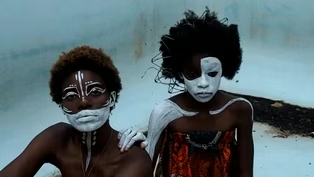
Clip: S7 Ep12 | 8m 40s | Afrofuturism is a newer way of framing stories that thrived long before the label. (8m 40s)
Providing Support for PBS.org
Learn Moreabout PBS online sponsorship

- News and Public Affairs

Top journalists deliver compelling original analysis of the hour's headlines.













Support for PBS provided by:
Articulate is a local public television program presented by PBS39