
No Longer on the Sidelines: Women’s Sports in Las Vegas
Season 9 Episode 3 | 26m 46sVideo has Closed Captions
Women’s sports is a growing business in Las Vegas.
Women’s sports in Las Vegas are no longer sidelined. They’re part of a growing business that is attracting new teams, new investment, new fans and new players. We look at the growth of women’s sports and how it’s becoming big business.
Problems playing video? | Closed Captioning Feedback
Problems playing video? | Closed Captioning Feedback
Nevada Week is a local public television program presented by Vegas PBS
No Longer on the Sidelines: Women’s Sports in Las Vegas
Season 9 Episode 3 | 26m 46sVideo has Closed Captions
Women’s sports in Las Vegas are no longer sidelined. They’re part of a growing business that is attracting new teams, new investment, new fans and new players. We look at the growth of women’s sports and how it’s becoming big business.
Problems playing video? | Closed Captioning Feedback
Where to Watch Nevada Week
Nevada Week is available to stream on pbs.org and the PBS app.
Providing Support for PBS.org
Learn Moreabout PBS online sponsorship(Amber Renee Dixon) A rapper and Las Vegas resident is putting women's sports in the spotlight.
(Flavor Flav) And I said, You know what?
I want you girls to be celebrated the way that you need to.
So that's why I brought them here to Las Vegas.
(Alex Carpenter) I don't think you could have ever imagined this, honestly, because we never saw anything like this.
-What Flavor Flav's SHE Weekend set out to accomplish, plus... (in unison) Girls Learn to Play!
(Maria Silva) Training the next generation of hockey superstars.
I'm Maria Silva.
I'll tell you all about the Girls Learn to Play program.
That's coming up on Nevada Week.
♪♪ Support for Nevada Week is provided by Senator William H. Hernstadt and other supporters.
-Welcome to Nevada Week.
I'm Amber Renee Dixon.
The first-ever SHE Weekend in Las Vegas marked an important moment in women's sports, but is the momentum it created sustainable?
That discussion is ahead.
But we begin with what SHE Weekend entailed.
Las Vegas resident rapper and women's sports advocate Flavor Flav partnered with MGM Resorts to host a four-day celebration of female athletes who represent the United States at the highest level.
Among those athletes were members of the Olympic gold medal-winning U.S.
Women's Hockey Team.
Flavor Flav said he got the idea for SHE Weekend after learning about President Donald Trump's phone call to the Olympic gold medal-winning U.S.
Men's Hockey Team.
(President Trump) I can send a military plane or something.
But if you would like to, it's the coolest night.
It's the biggest-- -In this video, President Trump can be heard inviting the U.S.
Men's Hockey Team to the State of the Union in honor of their gold medal win at the Winter Olympics.
Later in the same call, he said this about the U.S.
Women's Hockey Team, which also won gold.
(President Trump) And we have to-- I must tell you, we're going to have to bring the women's team... (hockey player) Two for two!
Two for two!
(President Trump) ...or I do believe I probably would be impeached, okay?
(hockey players) [laughter] -The U.S.
Women's Hockey Team declined the invitation, citing scheduling conflicts.
Meanwhile, rapper and women's sports advocate Flavor Flav took action.
-Me seeing the girls being cheated--you know what I'm saying--out of a celebration that they deserved to have, that's what really started me with this weekend.
[cheers] -Flavor Flav's SHE Weekend launched in Las Vegas in mid-July and got underway with a grand arrival at Park MGM.
(Hayley Scamurra) I've never experienced the celebration of U.S.
female athletes of this magnitude before, so it's amazing to be a part of it.
And we're just so excited to be here.
-Oh, my gosh.
We were so excited.
Honestly, it's still kind of surreal to think about, and now just kind of seeing the reactions we're getting here.
And it's all for the women, so it's super exciting.
-Honestly, to tell you the truth, this feels unreal, and the reason why is because-- I mean, I'm a little, getting a little sentimental right now because I'm happy.
And if I do cry some tears, this is tears of joy.
(in unison) Whoo!
-And outside Park MGM, several people echoed that same emotion and excitement as they waited to watch a parade for SHE Weekend.
(Penny Hawthorne) I had a daughter that played sports, many sports, and I was very supportive.
And I would be today if she was doing it.
(Sheila Hawthorne) Being a female athlete, you know, growing up, this is what I always wanted to do is be in the Olympics and play basketball.
I almost wish I was a kid again so I could accomplish some of this and redo.
(Emily Tyrell) Oh, it's so powerful for everybody.
I mean, like everybody.
I mean, all of us that, like, didn't have that opportunity to really strive for a professional career in sports that wanted to, and then like the little girls that just, you know, they don't have to not know what that's like.
They don't have to-- It's never going to cross their mind that they don't have that opportunity, you know?
-In Las Vegas, the defending WNBA champion Aces have helped inspire girls to excel in sports.
And joining their efforts this year will be the Las Vegas expansion team of the Professional Women's Hockey League.
-I'll actually be on the PWHL Las Vegas team, so it's super exciting.
And hockey has grown immensely here, especially girls' hockey.
I think I saw a stat; it was like 600%.
And so now that we'll have a pro team here for them to actually see in person, that number is only going to continue to grow.
(Kara Milne) My daughter is super excited about the, the Women's Hockey League.
She was like, Okay, we got to look for this hockey player, this hockey player, and they're like super excited.
I just think it's cool to show that, you know, there's place for women out here as well, and not just guys.
-Kara Milne says her daughter participates in Girls on the Run, a running group which marched in the SHE Weekend Parade.
-She learned that being active is a good thing.
And then her having a voice as a girl or as a female, it's good to be able to stand up for yourself and, you know, empowerment, basically.
(in unison) Girls on the Run is so much fun!
-Lennox Simpson walked in the parade, too, and her mom credits Girls on the Run with giving Lennox confidence.
(Gabrielle Simpson) She herself actually told me that she has-- She has learned that she can come out here and do whatever she wants.
So she was telling everybody at school, If you want to be a professional athlete, you can do it.
-Hey!
What's up?
How you guys doing?
-That self-belief is part of what Flavor Flav says SHE Weekend wants to achieve.
-I want these little girls to know, hey, listen.
If they can do it, if these big athletes can do it, then they have a chance to do it, too.
-Organizers of this parade and the entire SHE Weekend say, Yes, this is a celebration of women athletes who represent the U.S.
at the highest level, but they also stress that they consider it a movement for lasting social change in women's sports.
-I think the future of women's sports is gonna grow crazy right now.
You know what I'm saying?
And I just want to say, women's sports are just as important as men's sports.
Not only that, but a lot of these women are playing their sports better than the men are playing their sports.
-And Flavor Flav says the future could also include a SHE Weekend every year, an event these athletes say they're thankful for and not too long ago could have never imagined.
-Because we never saw anything like this, and I think it's about time that the women get the recognition that we deserve.
And so, yeah, I never could have imagined this as a kid.
-And what did you think about the President's comments that led to all of this?
-Honestly, I'm just grateful for all the outpouring of love and support that we've received since those comments.
I think it just shows, like, how supportive the majority of the United States is for women's hockey and women's sports in general.
-SHE Weekend put female athletes center stage, but will that attention translate into lasting growth for women's sports?
I spoke with Nancy Lough, a professor of Sport Management at UNLV, and I began by asking her how significant SHE Weekend was.
(Nancy Lough) The fact that the community came together to host this event because Flavor Flav put a tweet out and said, Hey, I'll throw a party for y'all, just doesn't get any better than that, because that's the kind of thing that Vegas does.
-We have heard before that women's sports are having a moment.
What is this moment like?
Is it temporary or perhaps sustainable?
-You know, I love that question because I've studied women's sport for several decades now, and we did have many a moment.
We had an undulation of periods of time where it was the big thing everyone was talking about, and then it just kind of faltered and went away.
It went out of the consciousness, out of the, out of the conversation around sports.
So if you think about the 1996 Olympic Games in Atlanta, those were considered the "women's games" for good reason.
We won gold medals in so many different sports on the women's side, but people forget about that, right?
1999, the World Cup.
Just this week I was asked about the last time the U.S.
held the World Cup, and reference was made to 1994.
Well, the reality is that was the Men's World Cup.
The U.S.
has held the Women's World Cup, right?
And we tend to forget these things.
So the interesting thing is this is not a time that's going to go away.
We now have--and by "we" I mean women's sport, because I identify very strongly as an advocate, as a fan, and as a scholar.
I was an athlete.
I was a coach, right?
So it's part of my DNA.
But I believe that there is very strong evidence that we now are in a sustainable position because the economic value proposition has been proven.
So that's the difference.
For decades, the issue was that women's sport was treated like a cause, and causes are things we donate to.
We give a couple dollars here, a few dollars there, and the pockets aren't deep, basically, for causes.
Now we're talking about women's sport as an economic proposition, as a great way for sponsors to invest and get a great return on investment, as a great way for cities to invest to bring teams to their city, grow the participation of the sport through the role models that they can see as both female and male.
And so it's-- This is not something that's going to go away.
There's many a data point to support the fact that women's sport is on an upswing.
In fact, we call it a "hockey stick trajectory," meaning the up, right?
That's what we see with women's sport.
Not saying men's sport isn't growing, because it is, but the reality is the trajectory of women's sport is unlike anything we've seen.
-What are those data points that come top of mind for you?
-Yeah.
The easy one is thinking about our friend Mark Davis here in Las Vegas, who owns the Raiders and purchased the Las Vegas Aces for $2 million.
You cannot buy an WNBA team for $2 million anymore.
In fact, his investment quickly had a 750% rate of return within years, so the valuation of that team is well over $150 million at this point.
Those are the kinds of numbers when we say return on investment that have gotten attention.
Previously, if we're talking about sponsorship, it was assumed that there would be a return on investment if you invested in the NFL or Major League Baseball or what have you, but there was also an assumption that you would not have a return on investment if you had sponsored women's sport.
Well, now it's quite the, quite a different proposition because now that investment in women's sport is probably going to be less, but the return on that investment is likely to be greater.
-What happened for people to reject that assumption and start investing more in women's sports?
-Yeah.
It's been a cultural phenomenon.
There's a number of factors.
I think the two biggest factors are what I was just speaking of, the business case for women's sport.
That's a huge one.
When we start talking about women's sport as a viable business, that first piece leads to the second, which is media.
So most likely the singular--if we were going to point out one really singular change or shift--it's the disruption of social media, because women athletes now can create their own image, their own brand.
They can control the narrative around who they are and what they do as an athlete or as a woman, and, frankly, that was very poorly done when they-- when it was up to the marketing people to try to, try to present them as a commodity, if you will.
Case in point, let's think about Serena Williams, right?
Serena Williams, hands down, I don't believe there'll ever be another athlete that can achieve all that Serena achieved in her career.
It's just unbelievable.
Even in the later years of her career, she was getting between $25- and $50 million in endorsement money, which sounds like a lot of money, but her contemporary Roger Federer was getting 50 to 100.
So twice as much as she was getting, right?
And it wasn't just Roger.
There were several male athletes.
If you went to the rankings, which we have, of who are the most valued athletes, and that's valued based on the endorsement money that they earn, Serena was likely the only woman to show up on those lists.
Meanwhile, we have 10 guys from all different sports that are receiving millions and millions in endorsement money.
The irony of that is Serena had such an incredible value proposition, but the marketing folks, especially the sport marketing people, had no idea how to market a woman well other than to sexualize her, which Serena was not going to do, and they didn't know how to market a black woman.
In fact, they probably said there isn't a good market out there for that.
So one of the cultural shifts that we've seen is the fact that there's now an understanding of what the value proposition a female athlete offers.
And interestingly, this has created the conversation around women as consumers in a way that it never used to.
So, case in point, if you look at the WNBA and you look at who the sponsors are, historically you would have seen a smattering of sponsors but not in the spaces that we see today.
So now you've got State Farm.
You've got Allstate.
You've got the insurance companies.
Now you've got CarMax.
You've got the auto companies, Ford.
All of them want in on it.
Now you've got Google, right?
Now you have these categories of sponsors that are appealing to a much wider market, if you will, as opposed to the sense that, oh, well, back in the day--and this is way back--it was Virginia Slims that saved women's tennis.
That's a cigarette brand that your generation doesn't even remember.
-I do, because my mother smoked them.
-But it was the cigarette brand for women; therefore, they invested in women's tennis, thankfully.
That's the Billie Jean King story.
Without Virginia Slims, the WTA would never have existed.
Tampax, right?
That brand, thank goodness for Tampax because they were one of the top brands that supported women's sport.
But that's what we call endemic, which means it's for women, right?
And that's so short-sighted because that means folks didn't understand that the fan base for women's sport is not just women.
I mean, yes, there are women who are fans, without question, but 50% of the fan base of women's sport are men.
And that's-- You know, it's ironic because the marketing people think they need to appeal to men more broadly, and data tells us that women make 80% of all consumer decisions because they're deciding for themselves, they're deciding for their husband, they're deciding for their children.
So who's deciding ultimately about the car?
Like it or not, if she doesn't put her, you know, her approval on it, her stamp of approval, it's not happening.
You know, one of the big growth areas in women's sport also has been merchandise.
So what merchandise do we need?
Well, historically and even now, we see too much of the one size fits all, which means it fits men; it doesn't fit women.
And now there's been a very bright light shown on the fact that kids want to wear stuff.
Little boys are wearing A'ja Wilson jerseys because we make those available and they they idolize her as a basketball player.
So that's another cultural shift, where, back in the day, if you wanted a basketball jersey, you had to get a Kobe, you had to get LeBron.
But now, even as a little girl or a little boy, you can wear jerseys, you can wear hats, you can represent, right, your team.
-The marketing folks that you keep mentioning and the media, are they correctly doing their job with someone like A'ja Wilson now?
-That's a good question, because I think she's very special.
I think she's-- Not just as an athlete.
As an athlete, she's very special.
She's the best in the game, but she also has a personality that makes her unique.
She's going to do more than basketball.
And so I think she's being very selective because she can.
That's not a privilege that a lot of women have had.
And, still, a lot of women don't have the privilege of being selective.
So let's talk about college sport, because that's how we got here, right?
To some some degree Name, Image, Likeness, that happened very recently, has brought to the fore a number of female athletes that have brought more attention to women's sport.
Caitlin Clark, Angel Reese, right?
The difference is that these athletes, the NIL era, they grew up with social media.
They know how to use it, and they can make decisions about whether they want to be the pretty feminized version of themselves when they're not playing basketball or not.
If you think about one of the things that's phenomenal with the W, it's the walk-ups, right?
They're coming into the arena.
We're looking at what they're wearing.
People love to see their fashion.
-Yes.
-And they're leading in this cultural space that, you know, it's happening in the NHL as well.
Those guys, our VGK guys, we like to see what they're wearing.
We like to see them looking their best.
But that's where sport has this profound opportunity to open people up to more than just the sport itself.
These athletes become celebrities.
-If I'm remembering correctly, though, A'ja Wilson was not part of that Name, Image, and Likeness era.
-Correct.
-She went into the WNBA before that started.
But do you think that's had a big impact on her?
-You know, it's a good question.
It hasn't hurt anybody.
I think it might have created some animosity in some ways for the women who came up without those opportunities.
I know the NCA is trying to make that right for a number of those athletes.
In other words, reparations, if you will, for no Name, Image, Likeness when they were clearly the driving factor behind television coverage for, you know, college sport.
At the same time, I do believe that the W in particular sees it as a sisterhood in the sense that what's good for one is good for others.
It's sort of like Las Vegas.
I've said ever since VGK and the Aces have really gotten going, it's like one of the beautiful things about this city, one of the beautiful things about their example of sport is, one, "a rising tide lifts all boats" sort of thing.
So greater visibility for VGK means greater visibility for the Aces, means greater visibility for the Raiders, and on and on and so forth.
We could compete with each other, but at the end of the day if we all lift the tide, we're all going to benefit, right?
And I believe that's a good metaphor for NIL as well.
You know, would you as someone who didn't have the benefit feel a little bit of animosity about that?
Perhaps, yeah.
I mean, we're all we're all human, right?
But at the same time, it most likely has opened opportunities up that maybe wouldn't have opened up before, because now there's so many more brands that are saying, Hey, there's a sponsorship opportunity here.
And I see these phenomenal athletes that have this social media presence and I see them playing and I see their fans, and I want my brand to be associated with that.
-There are some people who look at Las Vegas and think, because of the multiple championships that both the Aces and the Golden Knights together have had, because of that early success, that's what drove the fandom.
And had they not been as successful so soon, maybe they wouldn't be so popular.
And I'm wondering, with this new professional women's hockey league that is coming, is that what they're facing?
How successful do you think they're going to be?
-It's a fun question.
And it's a fun question because I teach sport marketing.
And one of the things I teach my students is if you are banking on wins to sell your product, you're not doing your job.
The reality of sport is there will be a down season.
There just will.
At this point last year, our Aces were not doing well at all.
And I remember being with Nikki Fargas watching a game, and she said, It's okay, it's okay.
It's going to turn around.
And it did; we won.
We won last year.
Now, as far as championships, no question.
Everyone wants to be affiliated with a champion, and the city of Vegas wants to be affiliated with winning.
Of course, no question.
-Has it hurt the Raiders to move here?
No, it has not.
Have they had phenomenal success and won championships?
Unfortunately, not yet.
We'll hope that that's on the, on the horizon.
The interesting thing with the PWHL, the Professional Women's Hockey League, is that we are the beginning of the movement west.
The real hockey hotbeds, especially for women's hockey, are back east and in Canada.
And so the interesting thing about coming to Las Vegas is it plays more on the model of they've been hosting games in different cities; and when they go to that city, they sell it out, right?
They went to Pittsburgh and they sold it out.
They went to Denver and they sold it out.
So it's a little bit of that model.
Like if we play in Vegas, people are going to come very much like they do for Raiders games.
So I do believe that the economic proposition is a little more similar to the Raiders' economic proposition, which, if you know, if you go to games, it's not always a home game, even in Las Vegas.
-A lot of visiting fans.
-A lot of visiting fans, but then we also have our true die-hard local fans.
So I think you're going to see both at PWHL games, a nice complement of local fans and visiting fans, and that will make it fun.
It'll make it unique and special.
-As Lough explained, Las Vegas's new Professional Women's Hockey League Team will have an opportunity to build both a local fan base and the sport itself.
One Southern Nevada program has already spent years building the girls' hockey community.
Maria Silva shows us how the program is helping girls develop their skills and find their place on the ice.
(Maria Silva) Inside the Las Vegas Ice Center, you will find these young players honing their hockey skills, all part of the Girls Learn to Play program.
(female coach) Who's five years old here?
Who's five years old?
-The beginner-friendly all-girls hockey program... -Good job, good job.
Let's go.
Come on, come on.
You can do it!
-...empowering young girls to hit the ice.
-Awesome.
I'm glad you learned how to get up.
That was good.
-According to organizers, one of the biggest barriers to growing girls hockey is that there are few programs specifically for girls.
In most entry-level programs, girls compete with boys--most dropping out due to the physical and social challenges of being the only girl on the team, and most giving up on hockey before they make it to an all-girls team.
(male coach) Ready and go.
-Equipment costs present an additional barrier.
To counter this, the Girls Learn to Play program provides all necessary equipment rentals in its one-time $100 fee.
-Good.
Outside edge.
Ready, set, go!
-The program also helps these young players develop the hockey skills necessary to succeed at the next level and advance to the Las Vegas Storm Girls program.
(Luciana Severino) I play goalie, and our normal position is knees bent, hands out, stick on the ground.
- 10-year-old goalie Luciana Severino started in the Girls Learn to Play program when she was just five years old.
-They taught me how to skate, stop, skate backwards, to how to do turns and, like, how the stick handles, shoot pucks.
Um, I love being the goalie because they count on you, and they-- and if you save a shot, they're always like, Good job!
Good job!
You saved an awesome shot!
-The awesome shot-saving goalie is part of the 10U Storm Girls travel team.
(Jennifer Severino) I think a lot of parents like me probably had the misconception that, like, oh, it's a boys' sport.
And I'll admit that I first thought that originally, and I was a little nervous about getting her involved in it.
She loves the challenge.
She loves the excitement.
She loves the team environment.
And I would give hockey a chance even if you're not a hockey family.
-Another win for these talented young athletes in training: the seasoned coaching team.
(male coach) All right!
-We're very lucky that we have Brittney Brooks here--having a female lead who played hockey herself, who understands what it takes--and to see the growth in women's hockey that wasn't available when Brittney played.
And now we're going to have a PWHL team here.
That's huge.
So the girls are really excited.
[shouting] -Yep.
Luciana is really excited about our PWHL Las Vegas team and has already set her goal when it comes to her hockey career.
-If I keep doing hockey, I can go up there and be at that level and do it with them.
-Learn to play on 3.
(in unison) 1-2-3, Go!
-What a wonderful program.
Now, the next session of Girls Learn to Play kicks off August 15th, so there is still time to sign up.
And, Amber, I can tell you that watching these young athletes out on the ice, I think I got the hockey bug.
And lucky for me, there are also adult Learn to Play classes.
So sign me up.
Wish me luck.
Back to you in the studio.
-Thank you to Maria Silva for that reporting, and thank you for watching this show filled with girl power.
For any of the resources discussed, including where you can learn more about the Professional Women's Hockey League expansion team that starts play in Las Vegas this year, go to vegaspbs.org/nevadaweek.
And I'll see you next week on Nevada Week.
♪♪♪
The Business of Women’s Sports
Video has Closed Captions
Clip: S9 Ep3 | 15m 4s | Women’s sports are no longer sidelined as they are becoming big business for owners and fans alike. (15m 4s)
Growing Girls’ Hockey in Las Vegas
Video has Closed Captions
Clip: S9 Ep3 | 3m 48s | Hockey isn’t just for the boys. More and more girls are joining the sport and excelling at it. (3m 48s)
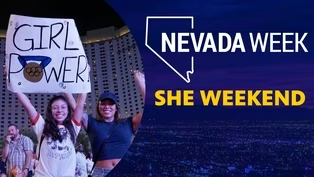
Video has Closed Captions
Clip: S9 Ep3 | 6m 23s | Celebrities and sports stars gather in Las Vegas to celebrate women’s sports at SHE Weekend. (6m 23s)
Providing Support for PBS.org
Learn Moreabout PBS online sponsorship New Episode
- News and Public Affairs

Top journalists deliver compelling original analysis of the hour's headlines.

- News and Public Affairs

Today's top journalists discuss Washington's current political events and public affairs.

 New Episode

 New Episode

 New Episode



Support for PBS provided by:
Nevada Week is a local public television program presented by Vegas PBS