
Norfolk’s Wild Whitewater Park and More
Season 17 Episode 5 | 26m 19sVideo has Audio Description
Surf the Elkhorn River in downtown Norfolk, John Cook trades Husker red for cowboy grit, and more.
Surf the Elkhorn River in downtown Norfolk, John Cook trades Husker red for cowboy grit, Cultivating change, one garden at a time and, a mother’s love blooms eternal for her lost twins. Norfolk has reimagined the historic North Fork of the Elkhorn River, transforming it into a living ribbon of whitewater. For 25 years, John Cook built a dynasty at Nebraska, now he's stepping into a new chapter.
See all videos with Audio DescriptionADProblems playing video? | Closed Captioning Feedback
Problems playing video? | Closed Captioning Feedback
Nebraska Stories is a local public television program presented by Nebraska Public Media
Norfolk’s Wild Whitewater Park and More
Season 17 Episode 5 | 26m 19sVideo has Audio Description
Surf the Elkhorn River in downtown Norfolk, John Cook trades Husker red for cowboy grit, Cultivating change, one garden at a time and, a mother’s love blooms eternal for her lost twins. Norfolk has reimagined the historic North Fork of the Elkhorn River, transforming it into a living ribbon of whitewater. For 25 years, John Cook built a dynasty at Nebraska, now he's stepping into a new chapter.
See all videos with Audio DescriptionADProblems playing video? | Closed Captioning Feedback
How to Watch Nebraska Stories
Nebraska Stories is available to stream on pbs.org and the free PBS App, available on iPhone, Apple TV, Android TV, Android smartphones, Amazon Fire TV, Amazon Fire Tablet, Roku, Samsung Smart TV, and Vizio.
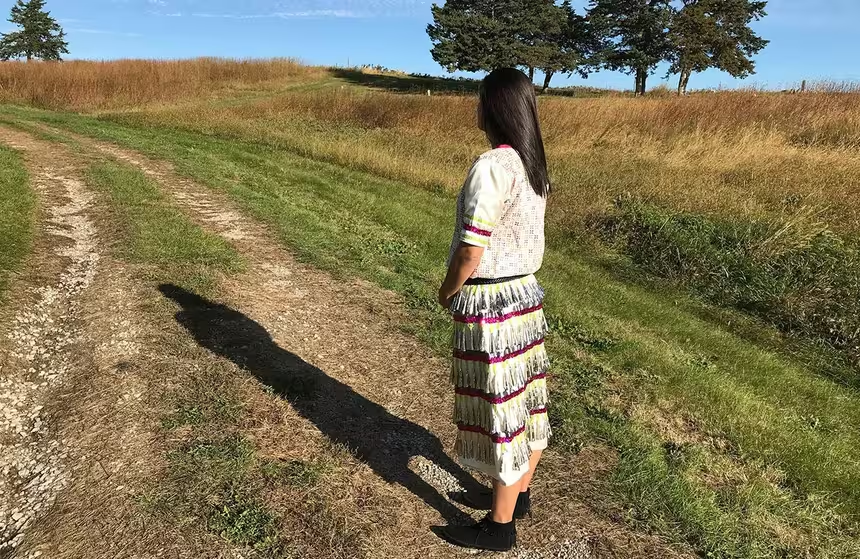
Do you have a Nebraska Story?
Do you have a story that you think should be told on Nebraska Stories? Send an email with your story idea, your name, your city and an email address and/or phone number to nebraskastories@nebraskapublicmedia.org. Or, click the link below and submit your information on nebraskastories.org.Providing Support for PBS.org
Learn Moreabout PBS online sponsorship(upbeat music) -[Narrator] Coming up on Nebraska stories.
Surf the Elkhorn River in downtown Norfolk.
John Cook trades Husker Red for cowboy grit.
(upbeat music) Cultivating change one garden at a time.
(upbeat music) And a mother's love blooms eternal for her lost twins.
(upbeat music) (energetic music) -[Narrator] Surfing has been around for hundreds of years.
(energetic music) But it's only recently become possible to surf the north fork of the Elkhorn River.
(energetic music) Yes, you can actually surf the Elkhorn River in Norfolk, Nebraska.
-[Nathan] The surf feature is very popular for surfers that come from all over the country.
They change their routes if they're traveling.
A surfer from Nevada was visiting some family in Sioux Falls, brought a surfboard and came over here and went surfing.
-[Narrator] Those visits are starting to add up.
Bringing new faces and tourism dollars to Norfolk as more people discover the park.
-[Nathan] National Geographic ran an article about river surfing in the Midwest and how it's starting to take off.
- We can tell that they're coming.
They're using the rapids, or using the park in some capacity, and they're also coming downtown and using the restaurants.
-[Narrator] The north fork of the Elkhorn River cuts through downtown Norfolk, and now it's home to Nebraska's only urban whitewater park.
(groovy music) A couple of key things that made this possible included the right geography and the vision of people like former Mayor Josh Moenning.
-[Josh] To me, the river was always a resource.
I mean, the river gave the community life.
(watery music) -[Narrator] Josh grew up in the area and moved to Norfolk after college.
He served on the city council for 12 years.
Eight of those as mayor.
-[Josh] I don't think the the formula for good community development or development of anything otherwise is all that terribly complicated.
It's being open to new ideas and new ways of doing things and adding new people around the table.
(upbeat music) Having grown up in the area, seeing things not as they were, but how they could be.
That's a perspective that fueled me.
(upbeat music) -[female] Go straight.
Don't fall over.
(water rushing) -[Narrator] This is what happens when a community rolls up its collective sleeves and decides it's time to do big things.
-[Nathan] We want people to play outside.
It's very good for your health and well-being and improves your quality of life while you're doing it.
And that form of recreation is very important, I think, to a community.
-[Narrator] The $17 million riverfront project was largely funded through public private partnerships, donations and grants.
Taxpayer dollars paid for the spillway removal, a new bridge and a roundabout.
-[Josh] The project dovetailed nicely with a renewed desire to build up downtown Norfolk.
(groovy music) When we started to talk about the design of this, we worked with a group called Riverwise out of Colorado, and they said, we need sufficient flows, we need an elevation drop and then proximity to an urban core.
(upbeat music) -[Narrator] Riverwise designed a series of drops that use the river's natural flow to create surfable water.
Built for both safety and recreation.
(water rushing) It's a modern solution on a river that's long challenged the town.
(upbeat music) Since Norfolk's founding in the 1860s.
It has endured more than a dozen major floods.
(serene music) One in the 1960s devastated the town's historic Johnson Park, which never fully recovered.
(serene music) Around that time, the local natural resources district built flood control structures to help stabilize water levels through the town.
(serene music) A decade later, the NRD proposed turning the Elkhorn River into a linear park through Norfolk.
But the plan never got off the ground.
-[Josh] When I became mayor, this project made a lot of sense to me.
It was not only about revitalization of the riverfront.
It was about bringing new life and energy to our community, and turning what people had considered a liability into, once again, a point of community pride.
(water rushing) -[Narrator] And now flood gates installed in the 1960s help regulate the flow in the whitewater park.
-[Nathan] That was a very wise move, because you can open and close those based on how much water is flowing through town.
And by doing that, we have optimal flow for recreation, which is really unique.
Not many places can do that.
-[Narrator] And it's all free.
There's no charge to use the whitewater park.
It's open to anyone and everyone.
(upbeat music) -[Josh] To see neighborhood kids being there, enjoying not only the river, but new greenspace and basketball and ice skating.
There was a lot of patience, persistence and education involved and communicating why this is important.
(upbeat music) I knew that once it got off the ground, it could be a real benefit to the entire community, and that it would turn out to be a good thing.
(upbeat music) (serene music) -[Larry] When I talk to people about you, the first thing they say is competitive and it's not a normal type of competitive.
One person said A lot of people are competitive, but not everybody goes to bed at night thinking about if I shift the yoga workout two hours, will it give my players better chances to recover so that we can be better in other plays?
Where does that come from?
That it's just a constant turning in your mind?
- Well, I grew up, with my brother, who was two years younger than me, and so that's we were very competitive, and it was embraced to be competitive and in my house, you know, and at the dinner table.
And winning and losing was important.
And, I don't know, I just I had that in me.
And I would I can remember as a kid crying when I lost and, you know, can't wait to get another chance.
And, I've just always been that way.
And, and then when I got into coaching, I was able to probably channel that and try to you know, instill that in our players that, you know, we're playing a game, we keep score.
And it's a lot more fun to win than it is to lose.
And I've always was taking losing really hard.
And if we lost, "okay, what didn't we do right.
What can we do better."
-[Larry] I Talk to another former player.
A former All-American who said, "Wow, I've seen this John Cook over the last five to seven years and I wish I could have played for that John Cook."
-[John] I've definitely have gone through an evolution.
So, and that's one of the reasons, I talked to a couple people my age who retired, and one of the things, the themes I kept hearing was, I want to go out on top.
I wanted to go out on top.
I want to go out the top of my game.
And I know since about 2015, I feel like I've been at the top of my game.
And as a coach, take out the wins and losses.
It's just, I feel like I've done the best job coaching of my career, which, you know, goes 35, 40 years.
So that's another reason I thought it was the right time, because I felt really good about where I was at for my craft and how I was coaching, and I didn't want to wait too long where, okay, he needs to get out.
It's passing him by all that stuff and again, there's lots of ways you can measure that.
You can measure on wins and losses.
How your team plays.
But this last year's team played, it was one of the highest level playing teams I've ever coached, maybe the highest.
And so and they were having fun and they love volleyball and they were great representatives of Nebraska, and they were doing all the little things that we asked them to do.
They worked really hard.
They were we had the highest GPA ever.
So those are all the things that kind of factor in this was at the top.
(serene music) -[Larry] But you didn't get the Hollywood ending?
-[John] No.
And, that was tough.
But sometimes I feel like there's divine intervention and, It'll come back around for Nebraska volleyball at some point.
- Would you have felt the same way in 2003, 4 or 5?
- After 2002, I mean, I had so many regrets.
I mean, so many things that I would have done different throughout the season.
Those are the worst years when you see it coming.
And then it finally happens at the biggest moments.
And those are the years, like, why didn't I?
And like I said, early in my career, there was a lot of things that I wish I would have done different.
The last ten years of my career.
I felt like we were locked in and doing everything we needed to do, and I was able to manage anything that came up to get in the way, interference and just had a way better way of handling it.
(serene music) -[John] You just don't shut it off.
The competitiveness, the desire to learn and get better and try new things and have a growth mindset.
So for me, this is replacing being in Devaney.
I mean this is, here's our team.
We're training out here.
(hoofs clomping) -[Larry] The cowboy life.
Do you now become an evangelist?
And you know I'm preaching to everybody, The cowboy Life.
-[John] Larry, I have.
I've gained a lot of respect for the cowboys in Nebraska and their families, how hard they work, the, their kids.
I've just created this appreciation and respect for the Western side of Nebraska and the lifestyle that they have.
And so I don't I wouldn't know of evangelists is the right word, but it's an appreciation and respect for what they do.
And I know I have a chance to share with people stories and their life.
And I've learned a lot about the cattle industry and the horse industry and the people involved with it.
And it's a very connected world.
And, it's it's just been fascinating.
And I love it, and I love talking about it.
(serene music) (gentle music) - Yeah, yeah.
These are the right ones.
Have you had these ones?
(gentle music) -[Shannon] City Sprout started in 1995, and it was neighbors getting together and wanting to do something great with this empty space in the Orchard Hill neighborhood.
They decided on a garden, and then it's been growing since then, almost 30 years.
(gentle music) - It's been something I always wanted to do.
I always wanted to learn how to garden, and then I saw, you know, people gardening over here and, and so I started getting involved - Where there, it's like, there's mentorship, so like they'll help you get your garden started.
- I think people who don't live in the neighborhood that come here are like, whoa, I had no idea that this space was here.
And they're really inspired by that.
And maybe this is a part of town that they also haven't explored that much.
I feel like it's a big point of pride for the neighborhood.
I live in the neighborhood too, so speaking for myself, it's definitely a big point of pride.
(gentle music) This garden space is like this common thing that brings everybody together.
-[Lady] So right when Covid started, so they... -[Sebrina] I love, love to now, you know, I bring my grandkids.
It's the most beautiful thing ever.
When I saw them eating, being taught about a flower, that it was edible and they all tasted it and they was like, Ooh, tastes, tastes like a, kind of like a pepper.
So they kind of knew what that was.
It showed me that they're open-minded about being outside, you know, learning things.
(gentle music) They've done a lot to better, the gardening community to me is still, it's still City Sprouts.
It feels like home.
(gentle music) -[Shannon] It's always felt good to have a garden space where people can come and smell flowers and pick vegetables and all of that.
It's hard to see with the glare, but now we've gotten to a point where we're like, we need to really take this seriously and look at the big picture and see where we can continue to grow and share resources and like get our whole city to a place that is everyone's getting fed.
(somber music) (gentle music) (gentle music) -[Aaron] In 2018, moved back to Omaha.
moved back home and kind of helped, you know, bring City Sprouts from what was a, a little tiny, you know, 10th of an acre garden into, to what you see behind me here (gentle music) -[Edgar] Of pride and ownership, that you're doing something greater for, the community.
Greater for yourself.
You're not really just, it's mine.
It's the, you're sharing your crops, you're sharing your space, you're sharing your time with other people.
The gap between the affordability of, of healthy food is starting to become a large, large gap now where some people just have no access to be able to, to buy the food.
Even if they had the ability to, go to a store, they just don't have the money for it.
And that's even in some other neighborhoods, there's not even a grocery store.
-[Aaron] Looking at food as a justice issue is something that is really near and dear and core to what we do here at City Sprouts.
We're not just growing great produce, we're growing great produce for a reason.
And that reason is that we believe that everyone in Omaha should have equal access and equitable access to delicious healthy produce like this.
-[Shannon] We're kind of figuring it out and then helping support these other growers.
And I think the more people we can get growing food in the city, the better.
-[Edgar] Like by showcasing that you don't need a lot of land to be able to grow food.
I mean, for example, at our farm, we're able to harvest a little over 10,000 pounds of food, acre and a half ish, something like that.
When they see that, they're like, oh, this can be done in a small scale and this much.
It's like, yes it can.
And that's the biggest thing that we want to emphasize about land access is because it is difficult.
But if you can't give a small piece of land to work on, you can accomplish great things.
(gentle music) -[Aaron] So we could not exist and do our jobs without our partners at the food bank or without our partners at Whispering Roots.
And so if we didn't have them, we'd just be a bunch of weirdos out here growing kale, right?
So anyone that grows on the small scale knows how much time it can take.
And so our partnerships have really allowed us to get the knowledge, get the expertise on the distribution side, on the like food pantry side that we don't have the time to kind of dig into ourselves, right?
We're focused on growing as much food as we can here and we're so happy to be able to rely on our partners to be able to help fill in the the gaps.
- They survey the people that are coming to their pantry to find out what they want to eat and then we communicate with them and we're making sure that we're growing that kind of food.
So they're able to distribute like local, fresh, healthy produce that's also culturally relevant.
That's really huge.
(gentle music) Urban agriculture is gonna continue to grow.
I think they're gonna be more people growing food on lots of these empty lots that we have around town.
(gentle music) -[Edgar] The faster you put seeds down and the faster you watch 'em grow, the faster you're gonna learn and you're gonna realize that it does.
Seeds have been doing this for millions of years.
Plants themselves, they'll do the work for you as long as you provide 'em healthy food, a healthy soil, and you water them consistently, they'll do the rest.
It's not that difficult.
It's almost too easy really.
I think so.
(Edgar chuckles) (gentle music) (gentle music) (eerie music) -[Lynette] So, I found out about the graves or the babies being buried, there probably back when I was like 13 years old or 14.
(eerie music) I thought it was made up, but Gene said it actually said that on the sign about those flowers blooming (eerie music) -[Jessica] And we found it and when we turned on it, it was like a abandoned road, like completely overgrown, almost looked like an eerie type lane.
(eerie music) So, we go down it, we're walking down it (eerie music) looking around.
Where is this?
What's it gonna look like?
And then we see it, and to me, what I remember of it is a gated, like a black fence.
It looked like any kind of a spooky movie.
(eerie music) (car whooshing) -[Narrator] Nearly 10 miles northeast of small town Ravenna, across from a rural cemetery and hidden within the overgrowth of an abandoned road exists a grave site said by locals to be the final resting place for a pair of infant twins.
(eerie music) The burial site is notoriously difficult to access and even more difficult to locate.
Those who may have stumbled upon it by chance often have a hard time recalling its exact location.
Yet, to those who've stood face to face with the marker, it's left a lasting impression, one that's mystified locals for decades, but before the twins ever became a local legend, they were simply children starting a new life in the United States with their parents, August and Anna Zeller.
(gentle music) (gentle music) The twins were German immigrants, 19th century pioneers of the American West.
(gentle music) Their father August was a shoemaker in Germany and at the age of 25, he and his wife Anna decided to leave their life and their home country behind.
(gentle music) In July of 1880, the family arrived in New York where they would begin their 1,423-mile journey to Nebraska.
(gentle music) They settled just north of what would later become Ravenna in a small sod house where the family would continue to live well into the 20th century.
(gentle music) August began his life in the United States as a farmer and he and Anna continued to grow their family, raising 10 more children in the coming years, (gentle music) but the twins, their first born children, who bravely endured the long and treacherous journey to America, never lived to see the new life their family built.
(gentle music) Although the cause of death and date of their passing have been lost to time, the children died shortly after the family arrived in Nebraska.
Their mother buried them roughly 100 yards south of their home, marking the grave with a plot of irises (gentle music) In 1980, over a century after the twins had passed, a local farmer noticed the irises blooming in his pasture.
Remembering the story of the twins, Bud Pritschau took action, and with the help of the Sherman County Historical Society, he and his wife Elsie built a marker to remember the children and protect the burial site.
Decades later, the homemade marker still stands.
(gentle music) The crude structure, built from the farming materials Pritschau had on hand, protects the irises that continue to bloom after all these years, (gentle music) (birds chirping) but to Kirk Zeller, a fifth generation descendant of August and Anna, the burial is more than a humble sign and a bit of history.
It stands as a reminder of his heritage.
-[Kirk] I've always been curious about the family history and always felt a deep connection to it, a connection to my German ancestry, and so I was very intrigued when I did find out about it and went out there and I've gone out there to take pictures with all three of my kids at different stages in their life, because it's something that, something that I think is really important to pass down.
(bird chirping) -[Narrator] No matter where his career takes him, Kirk always finds himself returning to Ravenna, where he can reflect on his family's heritage and revisit the place where his story began.
(gentle music) -[Kirk] I remember coming here with my son and he sat, didn't say a word.
I explained to him coming here in advance of what we were doing and where we were going after we'd visited the homestead and he just walked right over here and sat down, crossed his legs, bowed his head, and just wanted a moment of silence and sat here in front of this, thinking about the sacrifices they made, he told me later, and how grateful he was that he was able to be an American (gentle music) (gentle music) -[Narrator] To some, a ghost story taken right out of a spooky movie.
(gentle music) To others, a cherished piece of family history.
(gentle music) Throughout the grueling era of westward expansion, thousands of pioneers lost their lives as they pursued prosperity on the new American frontier.
(gentle music) Some of these brave men, women and children are remembered fondly, their burial sites identified by a granite headstone, historical marker, or a handcrafted sign, (gentle music) but many of these graves remain unmarked, undocumented, and forgotten.
(gentle music) For every inspiring legend of resilience, sacrifice, and preserved family heritage, there are likely hundreds more completely lost to time.
(gentle music) -[Kirk] I'm appreciative that some of the things, some of the old churches and stuff, there's at least landmarks where they once were and I'm hoping we can preserve that stuff, so other people and future generations, two or three generations later have the ability to go back and be able to physically understand, "Wow, my great-great-great grandparents lived here."
I think it's important to feel that, that connection.
(gentle music) (gentle music) (upbeat music) (upbeat music) - [Narrator] Watch more Nebraska stories on our website, Facebook and YouTube.
Nebraska Stories is funded in part by the Margaret and Martha Thomas Foundation, and the Bill Harris and Mary Sue Hormel Harris Fund for the presentation of cultural programming.
(upbeat music) (upbeat music) (upbeat music) (upbeat music)
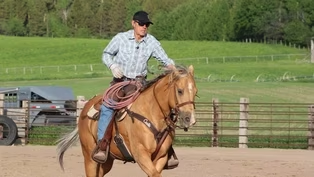
Video has Audio Description
Clip: S17 Ep5 | 6m 29s | John Cook trades Husker red for cowboy grit. (6m 29s)
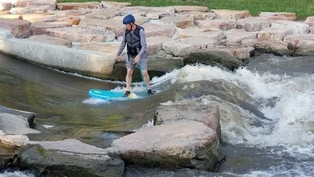
Norfolk’s Wild Whitewater Park
Video has Audio Description
Clip: S17 Ep5 | 5m 34s | Surf the Elkhorn River in downtown Norfolk. (5m 34s)
Providing Support for PBS.org
Learn Moreabout PBS online sponsorship

- News and Public Affairs

Top journalists deliver compelling original analysis of the hour's headlines.













Support for PBS provided by:
Nebraska Stories is a local public television program presented by Nebraska Public Media