Call The Doctor
Obesity in Northeast & Central PA
Season 34 Episode 5 | 25m 50sVideo has Closed Captions
Take a closer look at the metabolic disease and the options available to treat it.
Let’s talk about obesity. Here in Pennsylvania, according to a 2019 study, 33% of adults and 18% of children K-through-12 are affected by obesity. More and more, obesity is now understood by the medical community to be a serious and chronic metabolic disease, and it can be treated in a variety of ways…one of those ways being surgery.
Problems playing video? | Closed Captioning Feedback
Problems playing video? | Closed Captioning Feedback
Call The Doctor is a local public television program presented by WVIA
Call The Doctor
Obesity in Northeast & Central PA
Season 34 Episode 5 | 25m 50sVideo has Closed Captions
Let’s talk about obesity. Here in Pennsylvania, according to a 2019 study, 33% of adults and 18% of children K-through-12 are affected by obesity. More and more, obesity is now understood by the medical community to be a serious and chronic metabolic disease, and it can be treated in a variety of ways…one of those ways being surgery.
Problems playing video? | Closed Captioning Feedback
How to Watch Call The Doctor
Call The Doctor is available to stream on pbs.org and the free PBS App, available on iPhone, Apple TV, Android TV, Android smartphones, Amazon Fire TV, Amazon Fire Tablet, Roku, Samsung Smart TV, and Vizio.
Providing Support for PBS.org
Learn Moreabout PBS online sponsorship(upbeat music) - [Announcer] The region's premier medical information program, "Call the Doctor."
- [Narrator] Obesity, or having an excessive amount of body fat is not just about appearances, it's a disease that's often described as complex, and it can do a lot of damage by increasing the risk of a host of other health problems, such as heart disease, diabetes and high blood pressure, just to name a few.
Losing weight can improve or even prevent some of those health issues, but losing that body fat can also be described as complex.
Surgery is not the only answer, but it is an option.
We look at some of the causes of obesity and what you should consider before you decide whether bariatric surgery is right for you.
Now on "Call the Doctor."
- Hello, and thank you so much for tuning in to this episode of "Call the Doctor."
I'm Julie Sidoni.
I'm the News Director here at WVIA, and I'll be the moderator of "Call the Doctor" this season.
This episode deals with obesity here in Northeastern and Central Pennsylvania.
It is no doubt a concern for many doctors in the area, a few of whom we have invited here to help us wade through what I know is a very giant topic, something we're not gonna be able to get through, I say this all the time, in 25 minutes.
But we'd like to introduce you to a couple of area experts.
I'll just have you say yourself who you are.
Tell us where we can find you.
- I'm Christopher Motto.
I'm a Bariatric and General Surgeon at Evangelical Community Hospital in Louisburg.
- [Julie] And you?
- I'm Gary Neale, Surgeon at Wilkes-barre General Hospital, part of Commonwealth Health.
And I also do general and bariatric surgery.
- All right.
- And I'm Dave Parker.
I'm a surgeon at Geisinger Medical Center.
I'm the Program Director for our Bariatric and Foregut Surgical Fellowship.
- Thank you, thank you all for being here.
We really appreciate your time.
I wanted to start, we'll get to the bariatric surgery part of this next, but I wanted to start with obesity, which obviously is what we're talking about here, including the root causes of, maybe that's not even a fair question because there probably are a lot of root causes, but if you wanna kind of take a guess, get us started in conversation here about some of the things that you see as the causes of obesity, because I would bet it's a little more complex as we mentioned than just that person eats too much, for instance.
- So you're exactly right.
Obesity is an incredibly complex disorder 'cause diet and exercise certainly important, but you also have to look at patient's lifestyles.
There can be some hormonal problems, some problems with the endocrine system, which can also lead to obesity.
So when we see patients, a lot of times, what we do for their initial evaluation is really try to investigate all the different types of causes and see what could lead to their problems being obese.
- Do you see that there's some sort of, I don't wanna say genetic component, but if someone lives with others who are obese, is that something that you also see?
- Certainly, like you said, it's complex, that's really what we consider multifactorial.
So there's typically multiple factors that cause that obesity and some of that's, poor dietary and sedentary lifestyle, but there's also certainly some genetic factors that get involve.
- It seems as though it's very common.
I don't want to speak for you.
How common is it here in this area, Dr. Neale?
- It's probably a third of the population could actually have the operation.
- A third of the population?
- Yeah, it's huge.
So if there's, I think 15 million people in the country who are morbidly obese in the country, and we're only operating on about 200,000 a year.
- We still use the BMI system?
Is that still used to diagnose obesity?
- It is, we kind of broken down into different levels of obesity and we consider morbid obesity or severe obesity above a BMI of 35 or 40.
- Okay.
- So, yes.
- You wanna explain a little bit more about BMI if people don't know?
- So yeah, BMI stands for your body mass index and it's your weight in kilograms divided by your height in meter squared.
And it gives us a more objective number, just little bit better than just weight or height looking at obesity.
- Yeah, and for the average person, we kind of say as a generic kind of estimate of your BMI, if you're about a hundred pounds over weight, then your BMI is probably in that kind of morbid obesity category.
- And patients can look up their body mass index on the internet.
So if go on an app or a website, they can find their BMI simply by putting their height and weight in pounds and inches.
And yeah, generally anybody over a hundred pounds really should be considering this.
- Other than that score, what else do you look for or talk to a patient about when you're first getting to know them?
- So we're collecting all their information, their past medical history, past surgical history, diabetes, hypertension, sleep AP, all these medical diseases that many people have.
And then often, sometimes our patients don't even know that they have sleep apnea, which is where they stop breathing during the night.
And they require a CPAP machine, which is a mask they have to wear to maintain their airway, otherwise their risk of sudden death.
We also go through their past surgical history.
Some of these patients have had multiple prior abdominal operations we'd wanna know about beforehand.
There's a whole education process to this to get them ready for surgery.
- Yeah, and really what we're referring to is we've kind of defined it more in metabolic surgery.
So what we know is obesity isn't just that they're overweight, is that metabolically there's a lot of processes going on there.
So patients are more likely, like you said, to be diabetic, more likely to have high blood pressure, high cholesterol, more likely to have sleep apnea.
And oftentimes these are all underdiagnosed in this population, 'cause they're oftentimes not seeking regular medical care because of their weight or because of other issues.
- Do you always see the comorbidities often?
What's the chance that if someone is obese, there are other issues happening?
- So it's almost universal.
Almost all of our patients have some comorbidities and we mentioned the big ones, hypertension, sleep apnea, diabetes.
So, and the true reason, yes, we love the weight loss, but what we're really looking for is to see an improvement in those medical comorbidities, along with behavioral, depression and anxiety go along with obesity as well.
- Say more about that, how often do you see that?
- Depression and anxiety?
Absolutely common.
I mean, I would say most of, not the majority of my patients have some form of depression or anxiety.
And a lot of it is from their own self body image that they've been afraid to go out, they've been afraid to ride in amusement park with their child.
They're afraid to fly on an airplane with their spouse to go on vacation.
- I imagine you see a lot of the stigma too.
- Absolutely.
- Absolutely.
- And what do you do to combat that?
- Well, I think they go through a pretty rigorous process really at any program these patients are going to in terms of meeting with nutritionist to meeting with medical providers to kind of look at all those medical problems.
And one big portion of that also is to meet with mental health professionals to address some of those underlying depressive depression, underlying mental health issues that may have not been previously addressed.
- So you have a patient maybe who comes in and says, "I would really like your help to lose weight."
Before we even get to the surgery up, if you could detail what you've seen in your own organizations or in your own departments, what's the first thing?
And I know I'm talking to three surgeons here, but what's the first thing someone might try before they get to that option?
- So when patients start with me, I usually sit down and we go over our comprehensive medical history and physical with them.
And then we set 'em up to meet our outpatient dieticians.
And they come in for frequent monthly outpatient dietary visits.
They meet with my clinical nurse coordinator as well as we set 'em up with support groups to attend as well.
So the process prior to surgery is usually a minimum of six months.
So I use it as a huge educational process prior to surgery to kind of not only get the root cause their obesity, but also to kind of teach 'em the things that they're gonna need to be successful after surgery.
- Do you ever try interventions that are not surgical first?
- I think that's quite quite common and our systems may be a little bit different in that our system is a medical program.
So all of the patients who are referred to our hospital go into the GI nutrition and weight management program.
And a lot of those patients come into our program, not even seeking surgery and surgery is really not on their radar, but after going through other attempts at diet and exercise or potentially weight loss medications, they find themselves coming to surgery.
- I find many patients have never seen a dietician before.
They will just simply come my way once they're a hundred, 150 pounds overweight and they've seen success from friends or family, and then they want to have what they had.
It's kind of surprising that perhaps 80% of my patients have never met a dietician before.
And then when we collect their diet history, there's a good number of the patients who are pretty happy to say they've never tried diet whatsoever, that it hasn't occurred to them.
That our list of formal diets that the world all knows they've not tried one single diet before they show up.
- Do they have success once they do try?
- Well, they may, of course, and I'm not necessarily following them medically for that.
All my patients are surgical patients, but we can certainly prefer people to do dieticians and they can certainly try.
But the chance of losing significant weight on a diet is about 5%.
- 5%?
- Yeah.
- Define significant 'cause that was gonna be my next question.
- I think 30 pounds for some patient would be significant, so it's not happening.
- Yeah, so when you look at, there's certain medications that the indication is for weight loss.
When you look at what they consider a successful weight loss medications, you're talking about losing 10% of your weight.
So for many patients that's 20, 25 pounds and that's considered successful.
So I think most of the patients that we're taking care of are kind of beyond that stage where they're gonna be able to reliably lose enough weight and just with diet and exercise.
- I've heard you say that even if you lose five to 10 pounds, you've automatically had helped your joints.
I mean, is even a little amount of weight loss helpful?
- Yeah.
- Absolutely.
All weight loss helps.
But certainly the more weight loss, certainly the bigger the effect it is on those comorbidities.
- Well, these patients are, many patients, not many people, not even patients, just people when they're this size, they get to a point where they can't even have other operations.
Their knees are shot, and recently Pennsylvania State stopped recommending joint operations if their body mass indices are over 40.
So many people can't even get joint replacement operations when they're of a certain size.
- So will that sometimes then draw people to you, they need to say a hip replacement, but they have to lose that weight first.
- Yes, I've even had a patient who neurosurgery went to do a spine operation on, but when they put the person on the table on their belly, they were unable to get the person in the correct position and keep them safely asleep because of the size of the person.
So they wake them up, cancel the surgery and then send them to somebody like myself.
- Wow!
Are we overall just getting bigger?
Are you seeing that?
Or not necessarily.
- I think the rates of morbid obesity really across the country and really across the world are increasing.
And so, this is an event that is isolated to our area, but certainly we're seeing significant trends in terms of increasing obesity.
- Yeah.
- Absolutely.
I think you've seen it across all, as you said, not just the United States, but across the whole developed world, the obesity rates are still climbing.
- Well, for some people who are struggling with weight loss, bariatric surgery obviously is a viable option.
We spoke with Dr. Lisa Medvetz at Wayne Memorial Hospital about the process and some of the changes that she sees in her patients.
- We do see more people accepting the fact that it is a viable option for somebody who is morbidly obese and probably can't lose more than about 10% of their weight by traditional diet and exercise.
- My main goal was I wanted to feel more comfortable in my skin.
I wanted to fit in a chair and not feel awkward.
My son was graduating in a another year or so, so I wanted to be able to feel comfortable with going to graduation.
It was just mainly my own, I wanted the weight off of knees.
I wanted it off of my ankles.
So I didn't want to have to grow old and to be struggling in pain and that was my main goal.
- But the really exciting thing is when you look at their medical list and they're not taking the medications anymore, they are off their insulin.
We had a patient who had a gastric bypass recently and threw out $4,000 worth of insulin to get them off their CPAP machine, their high blood pressure medications.
That's really exciting.
And just to see them blossom, a lot of people are much more confident and happier.
They have so much more energy.
That's what I hear the most from patients, how much more energy that they have.
- Like fitness is definitely oddly like priority minus work, which is something I never did beforehand.
I have a workout buddy that we kind of buddy up which helps.
The best advice I could anybody is take measurements before and during and after and take photos, even if they're your own photos for yourself to compare to, but the measurements on the weeks that you're not losing, it's beneficial.
- So we'll talk now about those different types of surgical intervention.
And I think people, for the most part, are familiar with the terms bariatric surgery or gastric bypass, but I'd love for someone to explain the overall, I know that there are a lot of different types of surgical interventions.
So if someone could jump on that one and explain all of the different options available.
- So there are a lot of different types of surgeries.
Most of them or all of them involve, usually causing some degree of malabsorption or restriction.
Some both mechanisms, some use ones, the most common ones now are the laparoscopic sleeve gastrectomy along with the laparoscopic gastric bypass.
But you're also seeing a variety of others that do duodenal switches and then laparoscopic adjustable bands done in lesser numbers.
But by far, I think most of us agree that the bypass and the sleeve are probably the two most common ones done in the United States.
- So take me through that surgery.
What do you do when you are working on that person?
- So these operations are done with minimal invasive camera, small holes, similar to gallbladders if you've had your gallbladder out in the last 20 years was done with camera and small holes, and we're doing this to those patients as well, and we're using staplers which have been around for decades and put staples in people to separate their stomach, make it smaller such so they have a smaller stomach.
The gastric sleeve basically turns the stomach, which is a bag in their abdomen, turns it into a like tube, just like you have a tube in your chest.
The stomach now becomes a tube so the capacity is much less.
And we actually remove that other piece of the stomach.
So approximately 80% of the stomach is taken out through a 12 millimeter hole and it works fantastic.
People lose about 60% of what they have to lose.
So if they're a hundred pounds of weight, they're looking at losing like 60 pounds.
And the gastric bypass, which has been around for longer, perhaps 40, 50 years, that operation involves systemic being divided into two, one it's like the size of an egg.
And the other, remnant, is just left in there.
And then the intestine is divided as well and rerouted, and there's two junctions created surgically, and this is all done through small holes.
And the sleeve might take an hour, the gastric bypass could take about two hours.
And most people are in the hospital for a night.
And just like any operations, we have our usual risks for infection, bleeding, complications, intestinal leaks, clots in the legs.
But the risks are very low, perhaps two or 3%.
- You said the size of an egg, I'll hear from you, just a second, Dr. Parker, you said the size of an egg, what is a normal stomach size?
I'm curious how much-- - Well, imagine if somebody can drink a two liter bottle soda, they can fit it in there and their stomach will expand.
They shouldn't of course, but they do.
- But you can?
- Yes.
- Yes.
Size of a football is probably a good estimate.
- A football?
- Yeah.
- Interesting.
- So, yeah, and I was just gonna say, so there's multiple different types of surgery and I think all of them have their purpose and all of 'em have of their utility and patients can benefit from all those.
We somewhat kind of tailor what surgery they need based on not only how much weight they need to lose, but metabolically, other diseases they're affected with.
So, such as diabetes maybe responds to some of those surgeries better than others.
And I think that's one important thing we didn't really touch on, the first part is that this is really one of the only treatments that we know that will cure diabetes, which is, I think doesn't actually get said enough.
- It will cure diabetes?
- Can cure, this is one of the only cures for diabetes.
- So are there patients then who would come in and just say, "It doesn't really matter how much I weigh, I need to get this in order."
- Yes, definitely.
- Yes, absolutely.
- And in fact, most insurance companies, or oftentimes insurance companies now will authorize bariatric surgery in patients that historically we wouldn't have been considered candidates.
So in that group, between a BMI of 30 to 35, 10 years ago, we would've said, "You can't have bariatric surgery," but now we say, "Well, if you're a poorly controlled diabetic, you're still gonna benefit."
- I know this is not a quick fix.
I've heard it said a hundred times and you said it again earlier, this isn't a quick fix.
So can you go over how long of a process this really is?
And maybe more importantly, how you figure out whether that patient is right for a surgery.
I imagine not everybody is going to be the right patient for you.
- So I stress it right from the beginning that you can't rely on this surgery for a lifelong success.
All of us are not looking for quick solutions.
We really wanna see you being healthy five, 10, 15 years down the road.
So making those positive behavioral changes, increasing your physical activity, eating a healthy, appropriate diet, those are really the true keys to long term weight loss.
The surgery is a tool, we redesign your insides to give in an effect, to give you some earlier satiety cause you to have some mal-absorption, but it's really those behaviors and those habits that are necessary for lifelong success.
So I tell 'em, this is a lifelong process.
You need to be thinking about diet and exercise for the rest of your life.
You're gonna have a weight problem forever.
- And it's very difficult to tell them this, though.
Many of these people have never gone to the gym in 20 years.
They haven't done sports.
You're try trying to talk to them about Fitbits and apps on phones to track their steps and they don't know.
They don't know how to work an Apple watch that they have, they've never looked at it.
It's very challenging to try and encourage them to do 10,000 steps a day.
And many of these people also are disabled, or I've even had patients missing their leg.
They can't even walk on a treadmill, but there is no alternative for certain people.
So we proceed and do these surgeries and they can have great success.
I've even had patients, like our colleagues who've probably lost their diabetes before they even come into the hospital because they're on a liquid diet before surgery, they lose 10 pounds, they cut back on their insulin and they come in and when they leave the hospital, they're off their insulin.
It's that quick.
- Do people still have to lose X amount of pounds before they will even go on that table?
Is it still sort of, I don't want to call it a test, but do you still use to say, all right, if you can lose this amount of weight on your own, you're gonna be okay after the fact.
- Yeah, I think as you mentioned, behaviors and behavior modifications is a really important part.
And they go through a process and that's part of that process to make sure they can make those behavioral changes and to make sure they're gonna be able follow our recommendations.
So usually we'll set a goal weight for them and here's your goal weight prior to surgery.
And I think along with help from our hospitals, nutritionist and medical providers, they can typically meet those goals.
- And if I came in tomorrow and said, "I would like to have this done," when is the timeline?
Is there a timeline?
Is there a rough estimate or is this case by case?
- It is a case by case, but probably a rough estimate, at least in my program is a six to nine month waiting process.
Most insurance companies have a certain period.
They want to discourage somebody from coming in and just signing up and having surgery the next week, 'cause you really, everyone's overwhelmed with, "Oh, six months until I have surgery," but it goes by quickly.
There's a lot of, lot of things we have to do in those six months from pre-op testing and psychology analysis and meeting with the dietician and getting them to increase their physical activities.
So the six months goes by pretty quickly.
- Is there anyone who really seriously shouldn't consider bariatric surgery for weight loss if they're obese?
- I think that still goes back to those behavioral modifications.
So patients who can't make those modifications.
So if they have problems with alcohol or substance abuse, those patients definitely should not undergo surgery.
- If they're not reliable, if they don't follow up appointments, don't answer their phone, don't return messages, don't do what we need them to do, that would be a red flag.
And that would be somebody I would not want to be doing surgery on.
- And one of you said earlier that this was interesting because you get to follow these patients for a very long time.
And you said just now, five, 10, 15 years, I know, not getting into specific cases, but anecdotally, what are some of the wins you've seen for people who've gone through this?
- Marathons, triathlons.
And it's really what got me hooked into bariatric surgery is not necessarily surgery, certainly it's fun to do, but watching those patient change as they go throughout their life, seeing them more active, seeing them have better relationships with their family members.
It's really what it's about.
- That's probably very rewarding, I would imagine.
- Yeah, I think, that's the key, is rewarding.
I think, it is actually stunning.
Sometimes you'll see someone back at their three month appointment and then you'll see them at a year and it's almost like you don't even recognize them.
It's a pretty stunning transformation, I think, at times.
- I've certainly had patients stop me in the grocery store and started talking to me.
I'm like, "I'm not sure... Oh my gosh!"
- And then they show you a picture and you're like, yeah, okay, I remember.
- I remember you.
I'll give you the same opportunity.
- Yeah, the patients can get to family reunions and they, of course, stun their family members 'cause they don't look the same.
And they're very happy for that.
And getting rid of their medical problems is a huge win.
The diabetes, hypertension, sleep apnea, that many people have all three of these things and they're not getting any better and it's not going away and they take 10 medications and then they're down to three and they're taking some vitamins and they're happy and they've picked up some good habits of exercise.
So that's fantastic.
I'm happy to see them when they come back.
And the biggest gripe they might have is they have to get a new wardrobe 'cause nothing fit anymore.
- And it probably also bleeds into their family life as well.
So now kids see, "Oh dad got healthy and now maybe I should do that too."
And maybe that's also part of it that you're teaching an entire generation, the next generation behind you how to live well.
- Absolutely, I think our most successful patients are patients that have that support system, the family, the spouse that buys-in, the children that are willing to try new foods and make it a whole family affair.
I think that's certainly for those patients that have that, it's a big plus.
- I wish we could touch on that a little more too, because I imagine that's a huge part of it is that support system or who they're living with or what they are also willing to do.
- Yeah, for sure, for sure.
- Well, we have a, the last few minutes here, if there is a message that you would like people to get from this show if they're watching or they're really not sure what they should be doing here, what's the message, the residue message you want people to take?
- That if you're struggling with weight, there's help out there.
There are bariatricians and nutritionist, that bariatric surgery is a viable option.
We've all said, I think we were talking about before, one of what patients say is, "I wish I would've done this 10 years earlier."
So don't be afraid, you're not taking the easy way out by how having surgery.
- Yeah, I think that's a frequent message we hear is, "I wish I would've done this earlier."
And it doesn't have to just be surgery.
I think, as you said, getting plugged in with your physician, getting plugged in with nutritionist, if surgery's right, you'll find your way to us, but I think getting help.
- Yeah, people need to their primary care doctors about their weight.
I wonder if primary care doctors are maybe hesitant to bring up the subject because they probably brought it up before to the previous safety people and it didn't go over well maybe, or they realize it's a difficult conversation and it may not go very far, but patients and members of the public should bring it up with their primary care doctors, try it out, try a diet, try writing it down in a food diary, go on the internet, find a whole bunch of apps and track your steps, try and do 10,000 steps a day, have a goal, make some aspirations and then if you need more help then yeah, ask for a referral to a dietician, they're easy.
- Well, thank you to all three of you.
I appreciate your perspective and your time, and that's gonna do it for this episode of "Call the Doctor."
And if you missed a portion of the show, you can always catch it on replay the WVIA mobile app or wvia.org.
I'm Julie Sidoni.
Thanks for watching.
And from all of us here at WVIA, we'll see you next time.
(upbeat music)
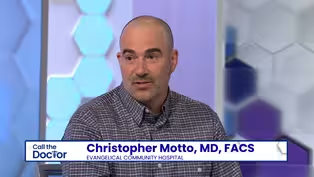
Clip: S34 Ep5 | 22s | Christopher Motto, MD, FACS - Evangelical Community Hospital (22s)

Obesity in Northeast & Central PA - Preview
Preview: S34 Ep5 | 30s | Watch Wednesday, March 30th at 7pm on WVIA TV. (30s)
Providing Support for PBS.org
Learn Moreabout PBS online sponsorship
- Science and Nature

Explore scientific discoveries on television's most acclaimed science documentary series.

- Science and Nature

Capturing the splendor of the natural world, from the African plains to the Antarctic ice.












Support for PBS provided by:
Call The Doctor is a local public television program presented by WVIA