
Omari Booker
Season 17 Episode 5 | 26m 46sVideo has Closed Captions
Omari Booker has built a reputation as an artist who isn't afraid to face uncomfortable truths.
Omari Booker's path to success in the art world has been marked by profound challenges and personal triumphs. He elevates stories and experiences that we, as viewers, often look away from. Whether it's mental health, addiction, homelessness, or the criminal justice system, his work challenges us to take a deeper look at the world around us.
Problems playing video? | Closed Captioning Feedback
Problems playing video? | Closed Captioning Feedback
The A List With Alison Lebovitz is a local public television program presented by WTCI PBS
Omari Booker
Season 17 Episode 5 | 26m 46sVideo has Closed Captions
Omari Booker's path to success in the art world has been marked by profound challenges and personal triumphs. He elevates stories and experiences that we, as viewers, often look away from. Whether it's mental health, addiction, homelessness, or the criminal justice system, his work challenges us to take a deeper look at the world around us.
Problems playing video? | Closed Captioning Feedback
Where to Watch The A List With Alison Lebovitz
The A List With Alison Lebovitz is available to stream on pbs.org and the PBS app.
Providing Support for PBS.org
Learn Moreabout PBS online sponsorshipThis week on The A List, I get to know a Nashville artist whose work has helped him process his darkest moments.
I got a 15 year sentence, which I served three and a half years of that, and then served the rest on parole, But in the i the midst of parole, I did find Artmaking as a consistent, outlet.
And even when I was in art making was a big, big thing that helpe get me through that, that time.
And so, so yeah, I, grateful for that part of it for sure.
Join me as I talk with visual artist Omari Booker, coming up next on The A List.
Omari Booker has built a reputation as an artist who isn't afraid to face uncomfortable truths.
His path to succes in the art world has been marked by profound challenges and personal triumphs.
And through it all, his wor has served as a powerful guide for navigating the dark and the light of his journey.
In the process, he elevates stories and experiences that we, as viewers often look away from.
Whether it's mental health, addiction, homelessness or the criminal justice system, Omari's work challenges us to take a deeper look at the world around us.
Omari, welcome to the A-list.
Thank you for having me.
Well, thank you for having us in your gorgeous former home slash current studio slash treasure trove of your life story.
It looks like.
- That is it.
So all the work and all the stories are pretty much here.
So, yeah, I'm grateful that yall were able to make it.
Well, we're thrilled to be here.
And as I look and am understandably distracte by the beautiful artwork around.
I love that.
It's actually, it feels like prompts for me with you to go back and unpack your story and how it has fueled this creative energy in the artwork that you do.
So tell me a little bit about your childhood.
Yeah, well, I grew up in Nashville, so I'm from Nashville, Tennessee, and my dad's from Franklin, my mom's from Trinidad, and after they met in college they ended up moving back here because that's where my, my family was.
So, yeah, I grew up in Nashville and had a sibling who, who passed away, unfortunately.
But it's really present in all of my life and all of my work and ended up going to high school here, college here, transferred to another school and had some really challenging life ups and downs that I, I get deep into, into my art work.
It's, it's a great way to share my story.
And it's, you know, it's cathartic.
It's my, you know therapeutic outlet where I can deal with challenging problem and also escape them at the same time.
So.
Yeah.
So.
Its been a gift.
So tell me about that.
So you were a basketball star.
I, I, I like to say so.
Now I finally hit the age where nobody knows the difference.
So whatever my story is about it, like there's no footage, Dont let the truth get in the way.
It's good.
Exactly that.
But yes I played at Belmont, University and then played at MBA, for high school here.
And so, yeah, had a good basketball career, you know, won a high school state championship and went out and played Divisio one college and really enjoyed, enjoyed it.
It didn't always feel like a completely natural fit for my personality.
I was pretty laid back.
I wasn't, you know, super competitive.
But I had some good coaches who, who taught me, taught me to get good, pretty good and aggressive.
And I really enjoyed it.
And I think the thing I liked most about sports was the the community.
I was a pretty shy kid, and it just gave me a group of friends automatically.
Whatever.
Wherever I went, the, there was always people to, to play ball with, and that was ended up being the peopl that I kind of got close with.
So, so yeah, that that was big part of the sports for me.
And when did the painting start?
Painting starte my senior year of high school.
I had, high school art professor, Jim Womack, who actually was a teacher at MBA and I had to take an art class as a, just to graduate.
It was either art or theater.
I didn't want to be in a play because I did not trust my, ability to to act even a little bit.
And so I said, I'll just I'll take the art class, you know, because it was required and loved it.
So you'd never even picked up a paintbrush.
You didn't pencil draw.
You weren't, like, doodling an thought maybe I'm good at this.
Not really.
I did a little doodling as a little little kid.
Okay, Bart Simpson and Teenage Mutant Ninja Turtles, I would see if I could draw the cartoons, but no, not really.
My mom was in to arts.
We went to museums and galleries and that kind of thing as a kid.
But as far as me making art, I was a senior in high school before I ever attempted to make any.
And so whenever I work with kids, it's always like, man, you never know how muc of this could be in you, because you know you don't know until you start.
Yeah.
So, so yeah.
So when did you realize you were good at it?
Probably.
You know, I think the pieces that I made as a high school senior for someon who hadn't made anything before were, weren't terrible.
And so I think that's a good litmus test for anyone starting anything.
It's lik if there's some natural ability, that's plenty, because art making has so much more to do with repetition and practice.
than it does, you know, just talent and and so, so yeah, the piece that I made were pretty decent.
And then when I went to college, I started taking art electives.
I was a math major.
That was my best subject in high school.
And that's just what I decide I was going to do for my major.
But I started taking art electives and found that my drawings got better and better, and it also gave me a release, a place to kind of just settle into the moment and, yeah, kind of de-stress.
And so, so yeah, I think I started realizing I was pretty good at it in college, and then I changed majors when I realized, like, hey, I'm enjoying doing it.
And so trying to try to fin a way to, to, to craft a career out of the thing I like doing.
Is that what you thought yo were going to do after college?
Be a full time artist?
No, I had no idea what was going to do after college.
Yeah, when I was in college.
Right.
Good.
That's a good place to be.
Yeah.
I had no idea.
I, started doing restaurant work.
I enjoyed that.
And so when I left school, probably around 20, I just leaned into restauran work and I had a mental health diagnosis that even further pushed, my, yeah, at that point, it was just see if I can get healthy and then maybe get back to school.
But I didn't have any, like, career aspirations.
Yeah, I just just was trying to get healthy and, after having a bipolar diagnosis to get healthy and, after having a bipolar diagnosis and two hospitalization for that, my sister passed away.
And so I was kind of dealing with the mental health struggles.
And then the most important person passed, and that was kind of like, you know, I'm just I'm just going, I just need to see if I can just make it one day at a time.
Yeah.
I wasn't thinking deep into the future.
I was just trying to just just take care today.
And so.
So yeah, I didn't know what I was going to do.
And sadly, lif got a little harder for you too.
It did the it did.
It kept on.
I tell you, it gave m a lot of material to work with.
You know, I didn't have to.
I didn't have to dig too deep as far as looking for for stories.
So.
Yeah.
And, you know, I had I ha three, three hospitalizations.
And after the third time, I finally got on a medication that worked, and also starte looking at some drug and alcohol addiction issues, did some 12 step work.
And, you know, got, yeah I got sober and things got got better for a little bit.
And then I was incarcerated a couple of years later on a drug possession charge when I wasn't using, but was was selling at that time.
And, and didn't think I was going to get a lot of, I didn't think I would have a really extensive sentence or even sentence at all.
I thought maybe it'd be a probation because first time offender.
First time offender.
I thought it might be something that was, not super heavy and it ended up being heavy.
I got a 15 year sentence, which I served three an a half years of that, and then served the rest on parole which I just finished in 2023.
So.
So, yeah.
So I mean, from from those early days of college up until a couple of years ago, that was all sort of happening.
But in the in the midst of parole, I did find Artmaking as a consistent, outlet.
And even when I was in art making was a big, big thing that helpe get me through that, that time.
And so, so yeah, I, grateful for that part of it for sure.
When did you figure out that you were able to, really like, sort of funnel the the frustration, the emotions into your artwork and that, I assume, became therapeutic for you?
Yeah.
I was sitting in my cell, probably.
Probably in my second yea somewhere in that second year.
And this poem about this, this blackbird kind of came to me.
And I was sketching the cell, this bird man in the window every, every, every day for over a year.
And in that poem I kind of was writing about the, my relationship with this bird and, you know, my ability to be free wherever I am while I'm in this creative process and that was kind of it.
I think that was the the moment where I realized that no matter where I am, no matter what I'm doing, I do have this thing to to lean into and, and, and it was it was necessary and necessary in that moment.
And then when I got home I just kept doing it because I, I knew that life was going to, that there would be more challenges like that was I had gotten through that one major thing.
But, yeah, as long as I was alive I was going to keep on running into something that would produce suffering.
And that's had that had been my whole life.
Even though I think I've had a great life.
I've also had some, you know, those thing we've talked about that.
Yeah.
I needed something to to push me through.
Long before he ever left his cell, Omari discovered a profound sense of freedom in the act of creating.
And as he began navigatin his life and career on parole, his art became a powerful tool for reclaiming his narrative.
Okay.
All right.
I don't even know if you need to explain this piece, because there's so much in this that I think anyone could unpack, even if they don't know you.
But.
But tell me about this.
What how how many days?
Weeks, months.
Are you into your sentence when you think this image is taken?
Probably the second year.
Okay.
Yeah.
I, I went up for parole, after about two years, and I was denied parole, and 18, I got sent back for 18 more months.
And somewhere in that last 18 months, really leaned into art making and writing.
And, this bird, als started showing up in my window and and so that's that's when I started, that's when this was happening.
And then I painted it.
Once I got home, I probably and I painted probably ten years after I got out because it wasn't a easy thing to paint, you know, to to recreate that experience.
And so just sitting across from it, as the painting was showing up was, therapeutic in some ways.
But a lot of grief around it, too.
So, yeah, it's a tough one, too.
It was it was a tough one to make.
Has it gotten easier to look at?
Not if I'm looking in my eyes, but, but I think it's probably the most important piece that I've made.
I mean, it is, it feels like the moment when I. When I knew that I could be free anywhere.
And and I think it was really important that viewers could interact with me in that space because people meet me in this, this side of it, in it.
And, there's not the connection or the proximity to, you know, that's the same.
The same same person.
And so a lot of people neve get to go stand in a prison cell and se somebody look up from the cell.
And that's that' kind of what I wanted to create.
And then the bird at the end of that poem, it reads, it brings me hope.
It feeds my dreams.
They're only bars, they're only screens.
It's only tears, it's only screams.
And to be born, we need these things.
So for now, I guess I'm free.
My little blac friend visits me every morning.
Every day.
Yeah.
It's beautiful.
Thanks.
Thanks.
So.
Yeah, I think that this this, this moment really illustrated that, you know, to get to whereve we're supposed to be, you know, like, there's going to be tears and screams.
Nobody comes in and goes out without it.
Like, whether it's a spiritual birth or a literal birth, and this felt like a part of my spiritual birth.
It's like this was when I knew that I'm going to be okay.
And art making was a huge part of that.
Looking around Omaris Studio, it's clear that his art has served as a profound mean of processing his own story, but his creative expression isn't confined to self-exploration.
Through his work, Omari invite audiences to confront discomfort and in doing so, discover radical empathy and a sense of connection in our shared humanity.
well, there' I mean, you've said this before, but a clear, intention with your artwork about and, and sort of this funny irony, maybe funny is not the word, but an irony that you're putting things on the wall that as humans, we tend to organically look away from or not talk about or pretend are not there.
I mean, between you're very open about your mental illness, about the death of someone who's very close to you, about your incarceration.
You have a whole series about B that I want to talk about, right, about homelessness.
Did yo did you find that that's a lane you were comfortable going down, or did that find you?
And then you realized yo just had to embrace these things that were unmentionables for a lot of us, but you were shining a spotlight on.
Yeah, I think that was more, and it's funny too.
It's emotional to think about just because I think about like why like like why does that not impact me in the way that it does a lot of people?
And as we sit at this table that, you know, my my grandmother and my mom and my dad and my sister, it's lik I really have that foundation of your you're a good person, you know, like wherever stuff you did, whatever stuff you went through, like, you're a valuable person who, deserves to, to be here.
And I think, like having, you know, knowing that like kind of deep in my self and then seeing that in people around me.
And it's like I, I know that, you know the people that share once, once one person shares about something challenging, you know, the rest of the room opens up because everybody goes through, you know, everybody goes through something that, that they eithe they may not be super proud of or was kind of hurtfu wherever that vulnerability is.
And I think artwork is a grea place to put that, because it is it is displaying it.
It's kind of taking in something that's that's really deep inside you and putting it out there for, for people to see.
And it's, and for me, it's like, I need to see it.
It's like I need to like, like the first audience is myself.
It's like when I'm paintin a piece about my incarceration, you know, the first person that I'm trying to come to grips with that is it's me.
It's like I need to to know that you know, you're not what people say an inmate is or, you know, like, that's.
And it's not only that I'm not.
It's all those guy that helped me get through that, that were in there.
Theyre not.
It's like I was in prison with hundreds of people that walked me through that sentence, you know, and not people writing letters from the outside, people eating ramen noodles in the bunk above me, and they're like, those are the people that, and so, so yeah.
So I think, you know, B, yo know, very similarly, it's like, you know, once as I got to know him, I kind of know that this, this idea of what someone who lives outside is.
That's not that's not the experience that I'm, that I'm having with this person.
And, and if I can put something on the wall that elevates that person to, to something that we kind of feel like is either special or immortal or whatever, then it shines a light, it's my hope is that that the conversation with that paintin would make someone think about how they relate to someone when they see, drive by and see them living, living outside because, yeah, if there's a, if there's a $5,000 painting of someone and we believe that that's worth $5,000, then how can we drive by the actual person and and they're not worth a quarter.
That doesn't make sense.
You know, I literally was reading about that, that whole, exhibit.
And the next day, this happened to me.
I'm driving by.
This happens in any city, and there's a homeless man and he's got the sign.
And I felt that, you know, internal and external tension of, do I look, don't I look, do I engage, dont I engage.
And it is it's real human experience that we have all the time and for you to humanize it for us and also just say, hey, it's you know, it's not bad, it's not good.
But here it is.
I think it's helpful and i translates beyond the artwork.
But tell me how you met B. Well, my my partner, she, Tara, she went up and introduced herself one day because we'd been driving by.
And I mean, initially there's just images and people that I know that I would want to paint, and now the people that are close to m like my mom, my partner, though, they know now, like, oh, that's a painting.
And so instead of seein a picture or a scene, its like oh thats a painting, sometimes you take a picture of it.
Sometimes they let me know that it's in a certain space.
But she thought that about B. She said, I saw this guy, you're gonna want to paint.
And so then she stopped and met him.
And then I stopped and met him a couple of days later.
And we just kind of built a relationship over the course of the next year or so.
Then I started making pieces inspired by him, and, and I dealt with my own.
Yeah.
It's like I'm, I'm, I'm not immune to that human thing of like do I engage or not engage?
Am I you know, exploiting this, this person's image.
And I'm like, yeah, it's like, I mean, I, I deal with the same back and fort that everybody else does when.
But for me, it felt like my responsibility is to the artwork.
And so it's like if I feel called to make work about something and it feels lik it's coming from a true place, then my responsibility is to do that and to do it in the most compassionate way that I can.
But but I, I definitel the reason I started making work about people experiencing homelessness was because I had that same tension of like, do I roll down the window, do I give this person money?
This person might be, you know, an addict.
It's like I got all the same back and forth that, you know, everyone I think that everyone else has.
And so this was a way for me to to work that out.
And then when I met B, and it became like an actual friendship with this specific person, then, then I think that's sort of when it shifted more into, like, I would like to make a body of work that is, is highlighting this, yeah.
This person who is really special that, that, that it's that I don't know that, That the broader community would get to see.
whether he's exploring childhood memories, processing trauma, or portraying those he loves, it's clea that art is a lifeline for Omari and the openness and vulnerability with which he approaches his work serves as an open invitation to the viewer to examine hard truths, to consider their own biases, and to find their own sense of freedom through art.
So how do you reconcile what may be a tension for you as an artist, as a working artist, as an artist who makes a living off of his artwork with the fact that yo you know this dichotomy, right?
You create things that we, you know, as a human society, turn away from.
But we want to hang these on our walls, right?
Or you're doing things as something that you feel a personal responsibility obligation to.
But then how do you market it?
What's what takes priority?
I think the making always takes priority.
It's like, that's sort of the first step is being true to what you make.
And, and then I think, you know, for me, the marketing is sharing it with people.
And I think when it, when stories really connect, people want to support that story, even it's not even about the individual as much as like they believe in th thing that is that's being made.
And and then I think people tend to support that.
And also just faith, like fait that if I make the things that are authentically that I feel like, authentically need to be made.
If I put that into the world then I'm not going to be left.
Without what I need.
And there's a lot of grace and and living.
I've lived a whole life where I've had everything I needed.
I mean that whether it was prison or school or, you know, being a drug user, being a drug dealer, like, not one of those days did I not have the stuff that I needed.
So why would that change?
You know, because I'm painting.
So, so yeah, I think a lot of it is just faith.
Yeah.
Faith that if I do what I'm here to do, I'm going to be taken care of.
Yeah.
So the question is, how do you want the world to see you?
As someone that cares about people is probably the most, yeah, I think that's probably the most important thing that I can think of.
Yeah.
Someone that, yeah, cares about people treats people like, like like lik I would like to be treated, but, but yeah, I don't, I don't, I don't, I don't kno if I'm, I don't think too much about how I'm seen, I don't think, I mean, that's, now that I say that.
It's like, is that really true because.
Because I would imagine that, you know, I, I do care.
But I think I care more about, like, what my specific interactions are with people where it's like, if if I am having this dialog with you and you leave worse than you came in, I don't like how that feels.
Now, if you saw a post and I said that I care about X, y, z, and you don't like that, so you don't like me, that's got nothing to do with me right?
And that.
Yeah I care very little about that.
But, but yeah, the people that I've interacted with, I want them to know that I care about them.
And I think that is naturally in me.
And it's also a reason why I've, I think I'll always be taken care of.
I mean, like the amount of support that I've had, just right here in Nashville from the people that, that love me and that I love.
And it's not just my family.
I mean, that's the that's the whole community.
It's part of the reason I'm here.
Its part of that community.
And so so yeah, it's a pretty, a pretty deep well of, of, of love that it's kind of helped me in this, in this space.
So yeah.
Im grateful for that.
Well, we're grateful that you've found a way to to take the things that you see through a really beautiful lens and bring them to life into light for all of us to enjoy and to cherish.
Thank you.
Thanks, Omari.
Thanks.
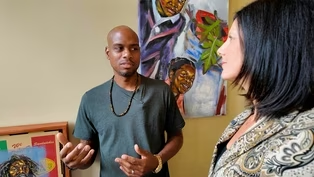
Omari Booker knows he needs to tell the hard stories.
Clip: S17 Ep5 | 1m 51s | Omari finds the making of art part of his calling to tell stories. (1m 51s)
Providing Support for PBS.org
Learn Moreabout PBS online sponsorship New Episode
 New Episode
- News and Public Affairs

Top journalists deliver compelling original analysis of the hour's headlines.

 New Episode
 New Episode
 New Episode


 New Episode
 New Episode

Support for PBS provided by:
The A List With Alison Lebovitz is a local public television program presented by WTCI PBS