Oregon Art Beat
Only What We Love
Season 25 Episode 5 | 28m 9sVideo has Closed Captions
See Craig Winslow’s “ghost sign” light projections and meet ceramics artist John Hasegawa.
Portland artist Craig Winslow uses projected light to temporarily resurrect “ghost signs,” the faded ads painted on the sides of historic buildings. The beautiful illuminations pay homage to a bygone craft. Ceramics artist and educator John Hasegawa’s most important art pieces are two tiles for the Ireichō project, a book that documents the names of all Japanese Americans incarcerated during WWII
Problems playing video? | Closed Captioning Feedback
Problems playing video? | Closed Captioning Feedback
Oregon Art Beat is a local public television program presented by OPB
Oregon Art Beat
Only What We Love
Season 25 Episode 5 | 28m 9sVideo has Closed Captions
Portland artist Craig Winslow uses projected light to temporarily resurrect “ghost signs,” the faded ads painted on the sides of historic buildings. The beautiful illuminations pay homage to a bygone craft. Ceramics artist and educator John Hasegawa’s most important art pieces are two tiles for the Ireichō project, a book that documents the names of all Japanese Americans incarcerated during WWII
Problems playing video? | Closed Captioning Feedback
How to Watch Oregon Art Beat
Oregon Art Beat is available to stream on pbs.org and the free PBS App, available on iPhone, Apple TV, Android TV, Android smartphones, Amazon Fire TV, Amazon Fire Tablet, Roku, Samsung Smart TV, and Vizio.
Providing Support for PBS.org
Learn Moreabout PBS online sponsorshipSupport for Oregon Art Beat is provided by... and OPB members and viewers like you.
Funding for arts and culture coverage is provided by... [ music playing ] My name is Craig Winslow.
I'm a light artist and experiential director.
So I call this project Light Capsules.
They are light installations that bring back to life these old ghost signs and faded ads.
What I love about light in general is that it is additive.
It has this, like, magic quality to it.
Being able to play with that and warp it to a wall that has never lit up before is what excites me to kind of give it a chance to really shine.
Like, I-- how I see these walls, you know?
To date, I have created 39 Light Capsule installations.
I did a series in London, I've done Detroit and L.A., Texas, Cincinnati, trying to put pins as far as I can.
I did an amazing series in Winnipeg.
One of my favorites is right downtown here in Portland, Roy Burnett Motors.
It's this giant wall, it's got a couple layers to it.
What I love is there's-- obviously there's like a primary layer to it, but there's a hint of a layer underneath, and you can actually see there's two sign companies' tags on here.
There's definitely a lot going on in this sign, and finding new layers of the past and bringing them into the future is what is really inspiring to me.
You start to see this wall as no longer just like a moment in time but like a spectrum of time.
So up until now, all of these Light Capsules have been temporary, where it's one night only, show up with a generator and a projector, map it really quickly, have this temporary installation.
So it's kind of this magic time portal that opens up, and at the end of the night, it closes and it goes back to being what it is.
But some of them are just so beautiful, I've been trying to make some sort of permanent installation of them.
[ music playing ] This ghost sign in particular, which is right over here, is the one that inspired the entire Light Capsules project, and now it's becoming one of the first permanent installations of its kind.
What I would hope to see is these ghost signs are acknowledged as historical artifacts, that they get some protection.
Because if you're not aware of how significant and special these really are, a new building owner could come in and just be like, "Cool, we'll just whitewash the building."
It happens all the time.
If they're not historically protected, then they could be painted over and then just completely lost to time.
There's a lot of just logistics we have to deal with when you make something permanent that's not just a one-night thing.
What I'm fortunate to find is these architectural Gobo fixtures are built for 24/7 use, they are weather-rated... Glare shields.
...and to approve, "Yeah, we can mount this, like, giant light fixture on top of your roof," and, "Yes, we're going to wire power separately."
Yeah, there we go.
So rather than a high-tech video projection installation, we're actually going more analogue.
So this is a custom Gobo.
It is essentially a printed colored glass stencil that is placed between the light fixture and the wall, and it casts a very precise shadow that is our mapping.
Even the video mapping that I typically do has to be precise, but this is even more so because it's, like, kind of an experiment at this point.
Nice, there we go.
We won't know until we actually turn it on if this whole thing's going to work or not.
It might be slightly off, but time will tell.
[ chuckles ] [ music playing ] My first step when creating a Light Capsule is taking a lot of high-resolution photos to analyze and see what layers I can see.
The most obvious layer on this wall is Astoria Sign Co., but there are multiple layers behind that.
And you start to see, you know, there's a C and an L and an O.
There's all these little details there, but I had to go to the Historical Society to really fill in the gaps.
Okay, Commercial...
Here's the wall right here.
So this is the 1931 Astoria city directory.
Tailors, okay, so there we go.
I knew the address was 404 Commercial Street, and searching under tailors in the city directory, this name pops up, and that tells me a pretty confident solve that Carl Laine was the one that was there.
The medallion is the trickiest part of this whole thing.
This is as far as I had figured out, which doesn't look that great, but this is all I really have to go with.
There's definitely some bits of a curve here, a curve here.
What I was able to get finally was this historical photo.
This is the epiphany for not only what used to be here on this medallion, the Radio Service Co., but it confirmed everything else I had found.
There's actually eight different businesses that are involved on this sign, and I'm able to bring them all back to life.
[ music playing ] So tonight we are going to have a public launch.
We have invited all of our friends and family and locals and sign painters from Portland and everyone to come out and celebrate the lighting of this wall.
And I'm glad that we've-- essentially being able to give this gift to Astoria, and it'll be up sunset until 10, 11 at night every night, so I'm very proud of this project and just wanted to say thank you.
So, uh, yeah, that's... that's it.
We will hang out.
In about 10 minutes, start to see-- oh, you can start to see some stuff here, right?
Look at that.
It's coming through.
[ people chattering indistinctly ] MAN: Looking great, you guys!
Congratulations.
MAN: I think that the importance of this project is preserving the past and the history of this particular building, but also the businesses that used to be in Astoria.
Between tailors and shoes and, you know, everything else, these were businesses that operated in town at one point here.
CRAIG: There's been a lot of people that have stopped by tonight to thank me personally, to thank the building owner that we haven't destroyed the sign, we haven't painted over it.
They, I think, are just genuinely excited that this is now an added piece to Astoria that they can celebrate.
There were sign painters that came out from Portland, historians that live here that love local history, and to have conversations with all these different people that all contribute their own love for this wall in particular, these personal connections, all of those make me really proud of the work that I've been able to make for this.
When I was a kid, I used to go out in the rain and go play in the mud.
And some people are repulsed or don't feel that, but I did.
I was like, "Ooh, this is fun."
It's very tactile.
You're really touching it in the middle of the clay.
My name is John Hasegawa.
I teach at Mount Hood Community College.
I teach ceramics classes and I'm also a ceramic artist.
Okay, so it's ready.
[ music playing ] I was kind of double majoring in two very unlike things, math and philosophy, and I heard that ceramics was supposed to be a really fun class.
And at that point in my life, I really needed something fun.
And then I realized about the time I was graduating, "I think I'm graduating with the wrong thing."
And then that's when I turned around and went back to get an art degree, mainly in ceramics.
I was getting all these deep questions in philosophy class and math classes.
Art was exactly opposite.
For me, it was just about making these things.
Through the process and as I've matured and grown up, I've now realized that it is a discovery process about myself.
Everything can be an influence: where you live, who you talk to, what you watch on TV, what movies you're going to.
You'll see it in the patterns I'm putting on, so the cups, I'm very much referring back to these mathematical tile books.
So I look back at those patterns and those things, and I try to bring that back onto my surfaces.
[ music playing ] When I was growing up, I was always surrounded by Japanese pottery.
And my mom was always a collector of Japanese pottery.
And so I was very influenced by all that.
And it's very interesting, because when I show my pots to a Japanese person, they're not very Japanese.
But when I show pots to other people, it does look pretty Asian.
So I consider my pots Japanese American pots.
I have always thought I could make tea cups, and that would be really Asian-- they drink tea.
And so I would make tea cups and I would realize, "You know, John, you don't really drink tea."
Coffee?
I got coffee.
I drink coffee all day.
I understand what kind of coffee cup I like.
I understand how big it is, how much weight, how a handle, a coffee-cup handle should be.
I use the Japanese patterns on the outside, taking patterns from a lot of Japanese textiles, for example, and I'm putting that layer on the outside.
So in that sense, I'm designing it with a Japanese aesthetic but it's in a very-- what I consider a very Western thing with coffee.
My best day is often the days I'm working in the studio.
But I also love teaching a lot.
Like my whole life, I've really loved interacting with people and helping them learn new things and helping them grow as a person.
[ banging ] Don't worry, make noise.
Yeah!
Sandwich them.
Hold them together and then flip the whole thing over.
Hello, everyone.
So today we're going to make some slab cups.
I got into YouTube because pandemic happened, no in-person classes, so I was desperate.
I really was missing teaching.
And so I thought, "Well, I guess I can do ceramics online."
[ music playing ] I had my phone on the tripod and I'd just log in the Zoom and I was pointing down, and once I had that figured out, I brought in another camera.
See how it's raised up a little bit, and that...
So all these things could be all tied together where they can have two simultaneous views.
I can move the camera to where the student could see it, wow!
So now we flip this guy over.
Right now it looks like this, right?
You can see-- let's go from here.
You can see that's the profile of it if I cut this in half.
So this is a lot like the way you would trim a bowl or something.
After about a year of doing that over Zoom, I thought, "Well, these videos are good enough to put on YouTube now," and that was the start of my little ceramics YouTube channel.
I would love it if this baby was, like, dead flat.
MAN: John has a very beginner-friendly approach.
He's so high energy and so fond of teaching, it's hard not to just kind of want to be friends with the guy.
-So this one looks better.
-What?
Yeah.
Ooh, this is actually a little wet still.
That's even sticky.
The most important thing for me as an artist was being part of the Ireichō Project.
So the Ireichō Project is a book of names that has all the 125,000 names of all the people that were in the internment camps during World War II, the Japanese.
I went to visit Camp Amache, which is where my mother's family was held during World War II.
That's in southeast Colorado.
And we took my two boys there to go visit with my mom and my uncle.
And we stood on the spot where they were interred at camp.
MAN: We believe there were 75 different camps run by the U.S. Army.
We had John create these ceramic pieces that would highlight the specific soil samples of all of these 75 sites, and he made ceramic tiles and we embedded those into the book.
I think John kind of instinctively knew, like, the power of the soil.
Just not only as a technique and as a ceramicist but in terms of imbuing the pieces with the philosophy of what the overall book and what it was trying to do, I think he got that so well.
JOHN: Going to camp changed how I felt about camp.
It wasn't this abstract place.
I got to stand there, to feel the earth, and got to see and smell it and everything.
So I took the soil and I was putting different amounts of clay and firing them to see how it looked.
And I would take that little tile and polish it so that it looks like it's glazed like the way they polish granite countertops, but then each little fleck of soil is still exposed.
So when you're touching the tile surface, you're actually touching the soil from all 75 sites.
But the soil that was coming from the 75 sites is the most precious stuff I own.
Even just touching it is like an honor.
Just having it here and being included in the project, it was a little bit stressful, right?
Being in charge of this really sacred stuff and that I didn't know if it was going to work, how I would get from a pile of soil to something that had all the meaning and significance that the project deserved.
We now proclaim the Ireichō as a national monument to the wartime incarceration by opening the cover of this sacred book of names to reveal a ceramic artifact made of the soil from 75 camps.
[ people singing softly ] [ music playing ] [ people chattering indistinctly ] JOHN: And then putting on a stamp that you're honoring your ancestors, and that's all about what I kind of believe in.
That's why we went to camp, as a remembrance to honor what my mother went through and then also to take my children there so someday they can be part of the chain that passes on the knowledge of where their ancestors were held in internment camp.
The Ireichō Project has really changed how I think about myself and my art.
I'm a potter.
At my heart, I make things that I want people to enjoy drinking out of, eating out of, so I try to build as much joy and pleasure in every single step.
If there's a better way to make it, I'm not that interested in the better.
I'm more interested in the way of making it that brings me more happiness, right?
So I don't care if it's slower, I just care that it brings you more joy.
[ music playing ] I'm kind of amazed at the Oregon coast.
The tide is constantly changing, the beach itself is constantly changing.
There is an endless parade of things going on in the natural world here.
GILFILLAN: For most of us, this clump of washed-up kelp is kind of a stinky eyesore.
But to Nora Sherwood...
It's habitat right now, you know?
Its life as a plant is over, but there's a whole world in there.
Nora's the kind of artist whose work you're as likely to find in a textbook as a gallery.
We were the ones who enjoyed the dissections-- bones, skulls, guts, you know, whatever it is.
Like, "Oh, wow, that's really cool."
That weird crew.
[ laughs ] So I know these look silly.
I always try to remember to take them off before I... Before I go and answer the door.
[ laughs ] But they're very useful, especially for this kind of work.
Nora's lived in Lincoln City full time since 2014.
I'm from planet Earth.
My father was-- he's a retired foreign service diplomat, so I was born in Columbia.
We were in Finland, Sweden, and then Chile, and then I graduated from high school in Spain, at which point I came back to the U.S. to go to college.
So this is going to be a little bit of a salal study so that you can identify the leaf, and then I'm going to add the very tiny pink bloom.
So I'm going to get the entire area wet, and then you kind of watch it for when the sheen is gone but it's still damp.
Yep, there we are.
Okay, so then I'm going to use this paint, and I'm just going to spread it on lightly everywhere.
It's so cool as to lay in more color while it's still wet and just watch the color disperse.
Yeah, yeah, I like it.
Get those moments sometimes when something just really works.
One of the things about a science illustrator is we're not married to a medium, so I just keep using whatever media is necessary to get it to look like I want it to look.
[ music playing ] I do a lot of work in colored pencil, and it's just amazing for showing shininess in bugs.
And a lot of color theory goes into that.
That's a lot of what makes that realistic is understanding how to use complements and triads to darken a primary color.
I'm going to go over all of these with their complements to get it to roll back down.
I was in high tech and I was enjoying my career, but I just really felt like I was ready for something different.
I just-- you know, life is long and you need a few chapters, and the thing that I kept coming back to was a zoology class and how much I enjoyed that.
But to build a new career, Nora had to study both art and scientific illustration.
That was very difficult because I'm not an artist.
I wasn't an artist.
I guess I'm an artist now, but... [ laughs ] Before, I was not an artist.
But I really believe in the 10,000-hour concept.
It's not talent, it's hard work and a deep desire to learn how to do it.
And at the end of the day, it was all about trying to figure out how to see.
I can literally remember the moment when I was able to get my brain to quiet and actually draw what I saw, and it was a chocolate chip sea star.
So I was looking at that sea star arm, it was a foreshortened view, and I was trying to draw it, trying to draw it, and all of a sudden it's like, "Oh, I have to draw it like that."
So I'm working on a slimy cap mushroom, and so I'm trying to get scratchboard to look wet and slimy.
The scratchboard is coated with ink and reverses the usual relationship between light and dark.
Rather than applying media, you're actually removing media.
So every time you remove media, you're bringing things closer, and my favorite implement is the good old X-Acto knife.
One of the things that I really wanted to do in becoming a science illustrator was to illustrate the natural world to try to get people to think more deeply about what we're doing with our natural world and the fact that we are abusing it and it's going away, you know?
It's going away.
[ blows ] I can definitely just sit here and do this for hours.
Would makes some people just nuts, but I really like it.
[ music playing ] This new project is a commission for a cinnamon teal lifting off from water.
Half of my time is spent just looking for usable reference images.
Okay, so, yay!
Here is a cinnamon teal.
He's a little bit too deep into the process, but that's going to be a helpful image for sure.
So I have a feeling I'm going to have to take a mallard and turn him into a cinnamon teal.
But I think I'll just look for other ducks to help me figure out what to do, and I don't-- Oh, wow, look at that.
Common merganser takeoff.
Oh!
Oh, my gosh, look at-- the feet are just barely going into the first big run that they're going to use to take off.
That is gorgeous.
I always go to the Slater Museum.
They have a bird tails and feathers database.
It-- it just kind of soothes my eyeballs to have this much green around me.
[ music playing ] Yeah, so this is Sitka spruce cones, and we have a lot of Douglas squirrels here that eat the seeds out of these.
So the false lily, it's evergreen.
It's here year-round, and it has this lovely heart-shaped leaf.
Gonna have little tiny white flowers, and they're absolutely gorgeous.
One thing that I really love is we have lots of rough-skinned newts that come through here, and they just tromp right by the house with their bright orange undersides.
This is a fabulous quote from Baba Dioum, who was a Senegalese forester: "In the end, we will conserve only what we love, we will love only what we understand, and we will understand only what we are taught."
And I think a picture is worth a thousand words, so I'm just doing my tiny little bit to get people to think about the natural world.
[ music playing ] To see more stories about Oregon artists, visit our website... And for a look at the stories we're working on right now, follow us on Facebook and Instagram.
Support for Oregon Art Beat is provided by... and OPB members and viewers like you.
Funding for arts and culture coverage is provided by...
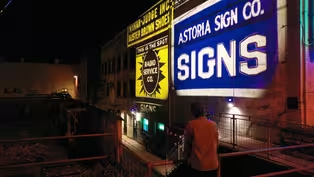
Video has Closed Captions
Clip: S25 Ep5 | 8m 5s | Craig Winslow’s light projections celebrate an age-old craft. (8m 5s)
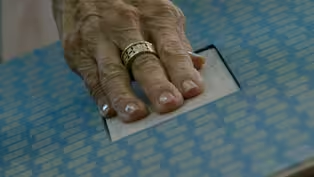
Video has Closed Captions
Clip: S25 Ep5 | 10m 23s | John Hasegawa uses pottery to explore Asian American identity. (10m 23s)
Providing Support for PBS.org
Learn Moreabout PBS online sponsorship















Support for PBS provided by:
Oregon Art Beat is a local public television program presented by OPB