
Open Your Eyes: Lula Washington Dance Theatre
Clip: Season 9 | 15m 21sVideo has Closed Captions
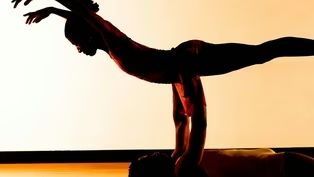
The Lula Washington Dance Theatre is more than just a building or studio.
For Lula and Erwin Washington, the Lula Washington Dance Theatre is more than just a building or studio. It's a beacon of black ownership, a means in which to share a powerful message about race and society, and a necessary part of their community. The University of California, Los Angeles was where they started their revolution, and their partnership has kept their business and message strong.
Problems playing video? | Closed Captioning Feedback
Problems playing video? | Closed Captioning Feedback
Artbound is a local public television program presented by PBS SoCal
Open Your Eyes: Lula Washington Dance Theatre
Clip: Season 9 | 15m 21sVideo has Closed Captions
For Lula and Erwin Washington, the Lula Washington Dance Theatre is more than just a building or studio. It's a beacon of black ownership, a means in which to share a powerful message about race and society, and a necessary part of their community. The University of California, Los Angeles was where they started their revolution, and their partnership has kept their business and message strong.
Problems playing video? | Closed Captioning Feedback
Where to Watch Artbound
Artbound is available to stream on pbs.org and the PBS app.
Providing Support for PBS.org
Learn Moreabout PBS online sponsorshipI think what many want to craft stories for dance is the fact that there was so much happening in society and around the world that was not being addressed in the arts.
Lula is just a goddess.
How she is seen within the field of dance, of American dance, and she's done it all alongside Irwin, who's also had a vision for not only American dance but for black dance specifically.
He was a writer and she's a dancer.
They were able to blend and do stories.
Lula has a voice in her choreography in the way that she feels this is her platform allowing the dancers to be part of that in their own way.
So giving us a phrase and asking us to create that with our body.
This is my year to experiment and to be able to use dance to speak to many different communities.
Irwin and I met in high school.
I was running to class so he held the door open for me I always joke that I've been holding the door for her ever since.
We were in the inner city.
We were in south L.A.
for Lula there was no Saturday ballet classes.
There was R'Wanda Lewis in her garage with drums teaching African dance.
Lula was a young black woman from Watts that if not by chance might not have found the performing arts.
Today in rehearsal, actually, we were only focusing on the sign language portion of a piece that we're doing called Open Your Eyes.
There are many different ways to communicate with dance.
But then I said, "Let me explore incorporating sign language into it.
Lula and I were at UCLA together dancing at the same time I was 19 when I became a writer for The L.A.
Times and I found myself growing at UCLA and I asked her what she wanted to do and she said she wanted to dance.
In Lula's case she started dancing when she was much later in life.
And so when we met dance had become her passion for the very first time I first met Lula and Erwin at UCLA and we in the theater arts program together.
It was it was pretty racist school to be in.
We were the first to break some of the basic boundaries that were happening at the time.
Lula was an instant rabble rouser in her department.
She created a Black Dance Association at UCLA and they challenged the department.
At the same time I created a black theater group.
It was very difficult because every time we tried to audition our choreography, it was always denied.
I don't know when you knew it but you started to feel that you were going up against a modern trend that might not leave as much room for the kind of expression that needed to be coming out of the African-American community.
I'm sorry, and we weren't African-American then.
We were black, and happy to be called black, and ready to be called that.
I actually started my dance company at UCLA.
So what I liked about being at UCLA is that I learned how to do things out of the box.
Everything that we both did was built around helping black students learn more about their own culture and learning to produce ourselves instead of waiting to be produced.
For Lula it was about telling the story that activism in the arts always comes first.
And sometimes they pushed against or for it.
By the time the Rodney King situation came we didn't know what to do with ourselves.
Lula had us coming to rehearsal and the movement she gave us was just ... she had one hand up and you just walk around.
This is the beginning of the dance and you drop.
[sigh] [sigh] That improvisation, that time for us.
She said, "When you're ready Tell us what happened.
Tell us how you feel."
Let's create like an opera dance drama about this.
So I came up with a rap called Engine engine number 9/ going down the L.A.
line/ those white cops got out of a line/ Check it out.
Check it out.
Check it out.
And she was angry and she channeled the anger of our community.
And when we performed it Man ... I mean I just have to tell you people that we thought were our friends that they didn't want to talk to us.
In fact I remember at a reception a gentleman came up to me and said, "We just want to be entertained."
And I was like, "Okay.
I get it.
I get it."
But that to me made me understand we're not just an entertainment dance company.
"We were tired of the lies.
We were tired of being ignored.
We were tired of seeing the truth smeared and distorted And we were tired of double standards for justice.
We were tired.
Lula's always saying, you know, I need thinking dancers.
Whether youe taking ballet, whether youe taking African, I need you to understand the historical context behind it.
Because you want the audience to feel connected to what they're doing, If they don't understand the meaning behind the movement then sometimes it's really hard for them to communicate that movement to the audience.
Every dancer has a responsibility to maintain the choreography Part of learning the sequence has to do with muscle memory.
And theye supposed to have the sternum lifted and the focus to the ceiling.
And I said to them, only want to see this.
I don't want to see this.
This is different from this.
So they have to have rehearsal enough that they will, their bodies will remember what the movement should feel like and how to execute the steps.
I knew Lula mostly as a concert artist and when I didn't know so much about was that she has also had this extraordinary career in the commercial media world as well.
She choreographed Little Mermaid.
I don't think that anyone ever brought up the fact that they had someone who was African-American do some of the choreography for that movie.
My job is to create movement that is exciting and dynamic and that helps further the story along.
That was one reason why James Cameron picked me for Avatar.
Avatar, an enormously huge movie.
I cannot think of someone else who would have been a better choreographer for them.
He said that, our choreography made it so I could do my story of the Navi tribe.
I threw away hundreds of pages because it was in the dance Lula has this ability to blend and mix both the cultural flavor, a purpose behind the dance, at the same time with a contemporary flair Sometimes a move is really, really fast.
But it's not so fast that you cannot complete it.
So it's getting everyone to move with the same timing and speed.
By the time we got to Adams my parents understood the value of owning your own space.
I think black ownership is the most important part of of evolving a black community because if you don't have ownership, then how can you have buy-in to the changes that are in the community.
You know?
You're always going to be this place.
I always wanted to give back and giving back, it means that I provide opportunities for other people.
She wanted to have something in our inner city community.
She didn't want our kids to have to go outside our community to get the quality of teachers we have here, to study in the quality of a studio that we have here.
But they put roots in the community in neighborhoods where other people had no interest in being.
We're probably one of the only dance, very specifically, dance organizations that fully owned their building free and clear.
Only an earthquake pushed them out of that building.
I was devastated.
And then they still rebuilt.
And then they found another property to go into.
And another property.
And along the way, Irwin, this good writer who could have had a theater life of his own, was 100 percent supportive and behind having Lula create work and to administer this company.
When I was working in the news business I was telling, often other people's stories but in dance what I felt was instead of telling a story, I was building a story.
I was able to build a company.
I could make things happen in the world for real.
I don't really talk about my work a lot because when I started really talking about it it may not turn out to be that.
So I like to let it evolve naturally, organically.
One day Lula was driving down the street on Crenshaw and she saw this building we're in now.
Because I always wanted to have a building on Crenshaw anyway because Crenshaw is very important in this, in the African-American community.
What they have done is given a community space for both the students and for the families.
Irwin has also done so much to support the sustainability.
Without that fundraising they wouldn't be able to contribute the way that they do.
It is a place where you can come anytime and feel safe And at the same time you feel artistically inspired by what is going on in here.
L.A.
is better for them being a dance studio here for these last 30 years.
Open your eyes so you can see, see, see the love.
What are we seeing now?
So much hate.
So much nastiness that's going on in today's society that we wanted to project when people go home a different way of thinking about each other.
So it was their hard work.
It was their vision.
It was their commitment to each other.
Really.
Their commitment to each other.
I think that has made it so they could do the impossible.
 Now Playing
Open Your Eyes: Lula Washington Dance Theatre
Video has Closed Captions
Clip: S9 | 15m 21s | The Lula Washington Dance Theatre is more than just a building or studio. (15m 21s)
Video has Closed Captions
Preview: S9 | 1m | "Artbound" is an Emmy® award-winning arts and culture series. (1m)
The Art of Basketweaving (Preview)
Video has Closed Captions
Preview: S9 Ep8 | 35s | Native peoples across the country are revitalizing basketry traditions. (35s)
Video has Closed Captions
Preview: S9 Ep7 | 35s | Mother artists confront the stakes while exploring the realities of art and motherhood. (35s)
Raul Ruiz on the Perils of Being A Chicano Photographer
Video has Closed Captions
Clip: S9 Ep5 | 1m 19s | Raul Ruiz captures crucial events with a Chicano perspective. (1m 19s)
No Trespassing: A Survey of Environmental Art (Preview)
Video has Closed Captions
Preview: S9 Ep6 | 35s | The natural beauty of California has inspired artists from around the world. (35s)
Video has Closed Captions
Preview: S9 Ep5 | 35s | Bilingual newspaper/magazine "La Raza" archives the East Los Angeles Chicano Movement. (35s)
Variedades: Olvera Street (Preview)
Video has Closed Captions
Preview: S9 Ep4 | 34s | Rubén Martínez explores the 200-year struggle for control of Los Angeles’ Olvera Street. (34s)
Why Are There Chickens in This Desert X Mural?
Video has Closed Captions
Clip: S9 Ep2 | 1m 6s | For Desert X, Armando Lerma created his own mural on half of the El Tepeyac store. (1m 6s)
Go Down This Bunker in Homage to JFK
Video has Closed Captions
Clip: S9 Ep2 | 45s | Walk into Will Boone's "Monument," an homage to a revered president in U.S. history. (45s)
Electric Earth: The Art of Doug Aitken (Preview)
Video has Closed Captions
Preview: S9 Ep3 | 35s | This episode profiles prominent artist Doug Aitken. (35s)
Video has Closed Captions
Preview: S9 Ep2 | 35s | Desert X is a site-specific biennial exhibition that first took place in Spring 2017. (35s)
A Walk Through the 'Blade Runner' House
Clip: S9 Ep1 | 1m 16s | The Ennis House is the last of Frank Lloyd Wright's textile block houses in Los Angeles. (1m 16s)
Walk Through One of LA's Earliest Frank Lloyd Wright Homes
Clip: S9 Ep1 | 1m 10s | The Millard House was Wright's earliest known attempt to build using textile blocks. (1m 10s)
That Far Corner: Frank Lloyd Wright in Los Angeles (Preview)
Video has Closed Captions
Preview: S9 Ep1 | 35s | This episode explores the houses legendary architect Frank Lloyd Wright built in L.A. (35s)
A Rare Look at Frank Lloyd Wright's Hollyhock House
Clip: S9 Ep1 | 59s | The Hollyhock House is perhaps one of the most viewed of Frank Lloyd Wright homes. (59s)
The Chicana/o Printmakers of 'Estampas de la Raza'
Clip: S9 Ep5 | 11m 19s | Print making in the Chicano community flourished in the 1970s. (11m 19s)
Providing Support for PBS.org
Learn Moreabout PBS online sponsorship

- Arts and Music
The Best of the Joy of Painting with Bob Ross
A pop icon, Bob Ross offers soothing words of wisdom as he paints captivating landscapes.





 New Episode




Support for PBS provided by:
Artbound is a local public television program presented by PBS SoCal