
Our Mrs. Batten & More
Season 16 Episode 10 | 27m 12sVideo has Closed Captions
This week a public education trailblazer, a Hot Wheels library, lesson in the art of the swing, more
From Husker cheerleader to public education trailblazer, a Hot Wheels library sparks young imaginations, lessons on the art of the swing and, the last homesteader’s tractor…This week's segments are titled Our Mrs. Batten, Speedy Swaps, A Vision for the Game, and The Last Homesteader's Tractor.
Problems playing video? | Closed Captioning Feedback
Problems playing video? | Closed Captioning Feedback
Nebraska Stories is a local public television program presented by Nebraska Public Media
Our Mrs. Batten & More
Season 16 Episode 10 | 27m 12sVideo has Closed Captions
From Husker cheerleader to public education trailblazer, a Hot Wheels library sparks young imaginations, lessons on the art of the swing and, the last homesteader’s tractor…This week's segments are titled Our Mrs. Batten, Speedy Swaps, A Vision for the Game, and The Last Homesteader's Tractor.
Problems playing video? | Closed Captioning Feedback
How to Watch Nebraska Stories
Nebraska Stories is available to stream on pbs.org and the free PBS App, available on iPhone, Apple TV, Android TV, Android smartphones, Amazon Fire TV, Amazon Fire Tablet, Roku, Samsung Smart TV, and Vizio.
Do you have a Nebraska Story?
Do you have a story that you think should be told on Nebraska Stories? Send an email with your story idea, your name, your city and an email address and/or phone number to nebraskastories@nebraskapublicmedia.org. Or, click the link below and submit your information on nebraskastories.org.Providing Support for PBS.org
Learn Moreabout PBS online sponsorship(upbeat music) -[Narrator] Coming up on Nebraska Stories from Husker cheerleader to Public Education Trailblazer, (upbeat music) A Hot Wheels Library sparks young Imaginations, (upbeat music) lessons on the art of the swing, (upbeat music) and the last homesteaders tractor.
(upbeat music) (upbeat music) (upbeat music) (upbeat music) (upbeat music) (gentle music) - And everybody goes quiet at this spot.
- That's really true.
- [Narrator] This lively group of women are not only good friends, they were once colleagues who had long careers at Lincoln Public Schools.
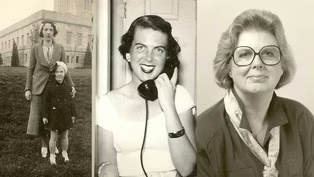
Among them is Jody Batten, a former teacher who devoted her life to shaping young minds.
(piano music) Jody's passion for education may be tied to her family story, perhaps influenced by the inequities her mother faced having been denied the chance to study beyond high school.
(wind blowing) -[Jody] My dad was a farmer.
He was college educated.
(wind rustling) Mother came from a family where you educated the boys, but not the girls.
So the boys got educations (wind rustling) -[Narrator] Before her marriage to Albert Loder.
Minnie Decker worked part-time at a downtown Lincoln department store, but following the custom of the time, she left her job when she became a wife, and later welcomed the Loader's only child, Jody.
When Jody turned five, Minnie's, former employer invited her to return to work -[Jody] When I was five.
Charlie Simon came to her and said, Min, we like the way you dress, Jody, so we'd like for you to start a children's department for us.
A girls' department mother said, I don't have any experience.
I can't do that.
And he said, oh, I'll hold your hand in the market.
You'll be fine.
This was on Thursday and on Saturday she went to New York (jazz music) and became the buyer from Ben Simon and Son's children's department.
(jazz music) -[Narrator] Minnie Loder excelled in her work.
Eventually the family moved to Lincoln where Albert started a small business.
Minnie continued her career as a buyer, traveling to New York City four times a year.
-[Jody] My first trip to New York was my graduation present at 18, and we went back to the market and I got to see what she did.
(jazz music) -[Narrator] Jody's education was important to her parents.
In high school, Jody attended a prestigious girl school in St. Louis.
On her graduation, she had the opportunity to attend college in the East, but Jody missed her old friends and came home to dear old Nebraska U and that's when she stepped into a bit of Husker history.
-[Jody] Somebody came to me and said, we're having cheerleader tryouts.
Why don't you come try out?
And I was into activities from the very beginning and I tried out and made it.
We were not skilled.
We were not pompom girls.
We didn't do the acrobatics.
We cheered and you had to get used to the sound of what was happening on the field because you were down by the player's bench and you heard all of the hitting and you'd see all of the blood that they were shedding on the field, and you had to be sure that the crowd kept involved.
They had the corn cobs for men and the tussles for women, and they were cheer groups.
The only one I really remember was a Nebraska cheer, and it was really easy.
N-E-B-R-A-S-K-A three times, yay.
(Jody laughing) I'm sure there were others that were more complicated than that, but I don't remember them.
(guitar music) -[Narrator] In the early 1950s, Jody graduated from Nebraska with a teaching degree.
Her first job was at Fremont Public Schools.
There she discovered her students would continue her education.
(guitar music) -[Jody] We had a girl who came from the Sandhills and she had learning problems and the gentleness that with which she was treated by her live-in mates, but also by the classmates was a great thing to see the kids just kind of melded together.
Whatever they accomplished, they accomplished as as a team.
(gentle music) They just, I remember it as being a magical year.
(gentle music) -[Narrator] After three happy years in Fremont, Jody was searching for something new (gentle music) and as it so happened, so were a few of her hometown friends, - Two gals from up the street who were both in advertising and they'd been in San Francisco that summer.
I had traveled there that summer with friends and we were playing bridge and talking about that experience and decided that it might be fun to move to San Francisco and get a job.
-[Narrator] Jody soon realized moving to California was the easy part.
- Fools, Rush in.
Where angels fair to tread.
-[Narrator] It was September and school was already in session.
There were no open positions.
At semester break, Jody began teaching at a racially integrated elementary school where parental involvement was heavily encouraged.
Eventually, Jody ended up in Palo Alto where she had her first experience working with gifted students.
-[Jody] The school was in an area where there were a lot of Stanford professors, so I could call on them as resources.
One of the students my first year was Jimmy Hewlett, and his dad was Hewlett Packard.
(guitar music) -[Narrator] Jody fell in love and married while living in California.
She later gave birth to a son, but the marriage didn't last, and so she returned to Lincoln.
(guitar music) -[Jody] I was so busy trying to keep my life together, and that was the first time I had taught kindergarten, so I was just concentrating on that learning to deal with that age student, so there were things that kept me thinking about how to use the skills that I had learned in with gifted kids.
(guitar music) -[Narrator] In the late 1960s, Jody's teaching abilities earned her a spot on a team pioneering the Gifted Student program at Lincoln Public Schools.
-[Jody] There was a group of parents (guitar music) that thought the program should be one way, (guitar music) and then there was a way we were doing it, and that was a very difficult time.
There needs to be insurance that all students, that all districts provide for the development of students that have extraordinary ability and potential.
We lived through that and if it were not for them, we would not have the highly gifted program.
It's a mentor program where we provide an hour a day in the student's area of expertise of instruction.
(whimsical music) -[Narrator] Jody's dedication to learning extended beyond the classroom.
(whimsical music) In the late 1980s, she served on the committee that went on to found, the Lincoln Children's Museum.
-[Jody] We started working on the idea of a children's museum and we did a mock museum.
This was put together probably within two months.
These were all homemade exhibits.
We had a big, huge chair that dwarfed the kids in size.
We had experiments that had been worked up by community members.
It was open for, I think, three days to determine the interest in the city.
Huge attendance.
The initial board then was formed and we opened the Children's Museum one (whimsical music) cold November day.
(whimsical music) -[Narrator] Today, the museum welcomes over 150,000 children and their families each year and has earned a spot among the top 20 children's museums in the country.
According to Parents' Magazine, Jody's commitment to education and her community has been extraordinary, but her lasting legacy lies in the students She mentored, (gentle music) always cheering them on to brighter futures.
-[Jody] I was really close to my students.
(gentle music) They were a part of my family.
So it's their personal experiences, their lives (gentle music) that were important to me.
(gentle music) (gentle music) (upbeat music) -[Carson] He builds cars, Yeah.
(upbeat music) -[Scott] For me, an auto technician, we don't have enough people in our industry the same way with the old car hobby.
Hopefully we influence them to maybe one day be a technician or maybe one day have the drive to restore an old car.
(upbeat music) -[Jessalyn] He kind of refers to himself lovingly as like a big burly bear.
But he's like the softest guy ever.
I mean, he's like the nicest guy I've ever met.
- Sure.
And get me when I cuss too.
I've always been into cars.
So as we grew up, it was me and some friends that run around at the car club meetings and hung out together while our dad's had the meetings or at other places while they were working on cars.
Since day one, I just knew I was gonna work on cars.
(engine idling) Being in the car club, that was just the normal, this is my career, this is my life.
(upbeat music) -[Narrator] Working in a mechanic shop may be a career to some, it's a passion for Scott and he hopes to pass his love of cars down to the younger generation.
-[Scott] We don't really have enough people coming up through the ranks with-the younger people like we did years ago.
And that all starts with the Hot Wheels.
(engine starting) -[Narrator] The conversation between Scott and a friend inspired an idea for children to love and learn about cars.
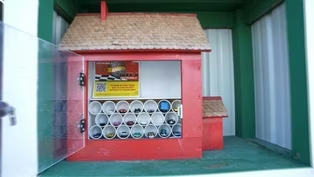
(upbeat music) -[Scott] It's a little book library that's been repurposed to hold Hot Wheels and it's the same idea when you're tired of your book, you would go trade it at the book library.
Well, it's the same thing.
When the kids are tired of their Hot Wheels, they can come trade it in the little Hot Wheels library and get a different car.
(upbeat music) (panting out of breath) (upbeat music) It's, it's cool.
Every kid smiles when they get one.
I mean, you'd buy somebody a cup of coffee or a drink at the bar.
Why wouldn't you get a kid a Hot Wheels and make their day?
You rarely do you ever give out a Hot Wheels and the kid doesn't just smile from ear to ear.
And the parents too.
(upbeat music) -[Jessalyn] Oh gosh, every time we see 'em, it's here.
Boys, you want some hot wheels?
You want some hot wheels.
So now it's like, what is it?
What year is it?
What make is it?
And it's, it's kind of fun.
(upbeat music) -[Interviewer] Where did all these cars come from?
- Mm mm.
-[Interviewer] How'd you... --From Scott and Scott.
-[Interviewer] Who's Scott?
The Hot Wheels guy.
(upbeat music) -[Scott] Primarily when we started, we were just doing just a little library, but we wound up with so many new Hot Wheels setting around that we had to do something with them.
So we just started handing them out to people.
(upbeat music) We give well over 500 away last year, new in the package.
And that's not counting what gets exchanged to the library.
(upbeat music) -[Jessalyn] Scott is notorious for just leaving Hot Wheels and random cracks and crevices all over town.
So it's kind of like an Easter egg hunt all the time with Hot Wheels.
(upbeat music) -He does hide them Everywhere.
-[Scott] When I walk uptown for something, sometimes we'll just kind of hide cars on the window, ledges around or on the edge of the steps on the courthouse.
What what we do is if there's car seats in the back of a car and we throw hot wheels in them car seats and the vehicle leaves.
And when they go to pick up the kids at daycare or grandma and grandpa's or school and all of a sudden they find a Hot Wheels (upbeat music) -[Narrator] A toy as simple as Hot Wheels can spark the imagination and love passed down by generations.
(kids laughing) - So every Father's Day there's a huge rod run just right around the square here in Ord.
And it's always like a huge thing is bring your dad, come look at the cars and it's really fun with the Hot Wheels now my kids are starting to figure out what cars are and what this make and model is.
So they'll be like, we have that hot wheel, the Hot Wheels library, and then the car show.
(kids squealing) -[Scott] At the end of the day, what did you do to make your community better?
That's it.
If it's a Hot Wheels for a kid, then it's a Hot Wheels for a kid.
(upbeat music) (soft acoustic music) - [Narrator] Sometimes along the road of life, you get some advice along the way.
You certainly will, if you're traveling the steep winding road that leads to Mark Wetzel's home.
- [Mark] My dad, his favorite one was "No Hill for a Climber," so I put that one at the top of the hill.
And then I knew, "The smooth, straight path seldom leads anywhere," "Don't quit on the first bump on the road," I, thought, well, I'll just put these on my road.
Because I've got a bumpy road, I've got a hill, I've got a fork in the road, smooth path.
I'll just put these on the road.
- [Narrator] Mark has had his own share of hills to climb and bumpy roads to navigate.
The 72 year old coach works out of an indoor batting facility just steps from his home in Omaha.
He's known nationally for the work he's done over the past four decades, helping young baseball and softball players hit the ball.
- Good, good good good.
One year, a few years back, I had these nine All-Staters, baseball players in Nebraska, six of them were coming out here on a weekly basis.
That was a great year for us.
I'm throwing the bat on the inside of the ball.
(bat hits floor) Last year I had some people come from Oregon twice.
I get people come from Colorado, Oklahoma, a majority of them from right here in this area of Western Iowa, Omaha, Lincoln area.
Now get out of your comfort zone!
- [Narrator] Mark has a knack for helping his hitters see the ball better.
That despite the fact, he doesn't see very much of anything.
- Let the bat lay on the ball as long as it can.
Okay, buddy?
- [Narrator] Mark is legally blind.
He started losing his eyesight at the age of 11, and by age 14 had to quit playing baseball, the game he loved.
- Let's keep our back heel a little closer to the ground.
(somber piano) - So it got to the point where I went from the best, to average, to sitting the bench my last year.
(music continues) - [Narrator] Medically, his blindness is due to a rare juvenile onset of macular degeneration.
Something that doesn't affect most people until they're much older.
Mark has been living with it most of his life.
Couple more and we'll get Mr. Kozol in there for a few more.
- Well, most of my center vision has gone.
It really accelerated the last two or three years here.
Like right now, I can't see your face.
My mother, if she were to walk in here today, my wife, I don't know them by face.
I gotta hear them walk and talk.
Better, much better!
Much better.
- [Narrator] Yet, despite being legally blind, Mark is able to dissect the smallest movement in a player's swing, that can make the difference between a good hitter and a great one.
- You're going to come out of the dugout when you're ready to bat, right, buddy?
- Yeah.
- [Mark] I can't see their face, but I can see their outline, see with peripheral vision.
I can see their outline and their movements.
I can see the weight shift.
I can see if they let the bat lay on the ball naturally long enough.
I can see if their knees started behind their hands, stuff like that.
I think maybe it's a gift that I can see the whole body work as one, you know, my eyes are just, I can see your whole body.
what it's doing in one swing instead of noticing you've got freckles.
- [Narrator] Mark has worked with thousands of hitters through the years.
He even developed a friendship with one of the greatest hitters of all time, hall of famer, Tony Gwen.
That started with Mark telling him what he saw in his swing.
Mark's been featured on ESPN and interviewed by Paul Harvey.
Along the way, he became known in baseball simply as "The Blind Guy".
And I thought, right there, my name is now The Blind Guy, because you know what?
You'll never forget The Blind Guy.
"Oh, I go to some hitting coach out Calhoun, "what's his name?
John Smith or something?
Oh, yeah, oh."
Well, The Blind Guy!
Okay!
Nobody ever forgets the blind guy.
So, it's been a benefit.
Might as well be up front with it.
I don't want to fool you.
(laughs) (onlookers chanting and clapping) (metal bat hits ball) Good!
Do about three apiece.
- [Narrator] Mark says it may take him a while to develop trust with his hitters, but most quickly become believers.
Mark Pearson is one of them.
He took lessons from the coach as a kid, and now he's bringing his two daughters and son to him.
- The front foot's not going to move.
Take your back foot.
- I don't know how he sees things, but he's, he'll be over here, and he'll see something over there.
And I think he even hears things.
He can tell, by the way the ball is hit, on whether, you know, good contact, how they missed it, or where they missed it.
- [Narrator] For the players, they see results, not a blind hitting coach.
- I was, like, surprised when I heard, but I didn't, I didn't even notice.
Like, it felt the same as someone that can see fine.
- I didn't even know when I first got here.
We were driving home, my dad tells me, and I'm like, "I didn't know that."
Like I couldn't even tell.
- I want to make darn sure that her barrels come across her here, because she was under the ball right here.
- [Narrator] And that's just the way Mark likes it.
- [Mark] Alright.
Well, there's people that come in, and they're pretty skeptical.
Wait, wait a minute.
A blind guy teaching hitting?
And then they just watch the difference I can make in a few swings, and I talk to them and tell them what I see.
And, you know, what in the world?
Mentally, you've got to get out of your comfort zone and look a little higher.
Attaboy, head down.
- [Narrator] Mark plans to keep working with his hitters for as long as he can.
Like his signs on the wall, he's got plenty more advice for those who want to listen.
It could make them a better hitter, or just better at the game of life.
- It's pretty simple.
You're going to get knocked down about every other day, just plan on it.
Don't let it surprise you.
But just get back up.
You're going to strike out, just get back up, just keep swinging.
Great job.
You're going to have bad days, we all do, but just keep swinging.
Good job!
Next hitter.
- [Narrator] That, from a legally blind guy, who sees things pretty clearly.
- Good effort!
Beautiful!
Give me a couple more of them.
Beautiful.
(applause) EMCEE: I know everybody's been waiting for this moment.
NARRATOR: Why is a weathered, 70 year old tractor on display here, in a place where the first homesteaders settled decades before tractors existed?
Let's rewind the story of a fascinating journey, covering 4,000 miles and 150 years of history.
(fast skipping music) In 1974 a Vietnam vet from California filed a claim on 80 acres of Alaska wilderness, built a log cabin, and became the last person to take advantage of the Homestead Act of 1862.
In a lot of ways, Ken Deardorff, the last homesteader, was like the first, Daniel Freeman.
30's-ish men moving to far away places, looking for a new start.
Freeman, a Civil War vet, came from Illinois to Nebraska.
He filed his homestead claim on New Year's Day, 1863, and built a small log cabin west of Beatrice.
Freeman had hand tools to work his 160 acres, so did Deardorff.
But he also had a used tractor.
(tractor starting up) A 1945 Allis Chalmers Model C. It gave him fits at times.
MARK ENGLER: When Ken would be on this tractor pulling stumps at times the tractor'd rear up, so that his back may have even been close to being parallel with the ground.
NARRATOR: When Deardorff moved away in 1984, the tractor stayed behind, sinking into the mud for decades.
Until the Homestead National Monument launched a rescue effort funded by retired Beatrice doctor, C.T.
Freriks.
A rather difficult rescue effort.
MAN: Walk forward.
(crunching grass) Hey, hey, hey!
There we go.
Oh, now there we go.
(grunts of effort) (whirring helicopter blades) NARRATOR: Helicopter, to a ship, then a truck, all the way to a shed behind the University of Nebraska Lincoln's Larsen Tractor Museum for a few weeks of work by the University's Tractor Restoration Club.
ALAN LEVITAN: We're gonna clean it up some, we're gonna try and stabilize it, part of conservation work, you try and slow any future deterioration.
(upbeat strumming music) (loud vacuuming) JAYTHAN SCHEIDELER: Right now I'm just kinda vacuuming to get all the debris and the dirt that's been built up on this tractor, and trying to get all the rust that's kinda breaking off onto the exhaust manifold and stuff.
DOUG KOOZER: This had a tree growing through right there.
JAYTHAN: Oh yeah?
DOUG: And we found this an hour before the helicopter got here.
So it was a scramble to get the tree cut and carry it down the bank.
CHUCK KRUEGER: As you can see, he has an assortment of file to punch to sockets.
JAYTHAN: It's crazy that this is pretty much like all he had out in Alaska to do all that he did.
MARYDITH DONNELLY: Okay, this mud has been airlifted.
I've never even been on a helicopter, this mud has had more experience than I have.
WOMAN: Literally!
KOOZER: We're gonna do a little bit of prevention, some rust maintenance on it, and see what we can do with the seat.
If we can get it slowed down a little bit in the deterioration.
KRUEGER: What I'm doing is I'm taking off all the moss that has grown on this wood.
ASHA SCHEIDELER: Right now, I am just trying to clean off the black mold and wiping down the dirt and stuff that's on there.
LEVITAN: We don't want to restore to an as new appearance, we want it to look as closely as it possible could as to when Ken actually used it.
KOOZER: When school started, club met, and they looked at this thing and they go, you went where?
(laughter) NARRATOR: So the students who helped get Ken Deardorff's old tractor ready for this day, got a history lesson.
And the Homestead National Monument got what they're calling America's most famous tractor.
Restored to its middle-aged, Alaskan glory, Ken Deardorff's tractor now has a home in Nebraska.
Forever connecting the first and last homesteaders.
MARK ENGLER: To have this treasure, this tractor, at Homestead National Monument of America kinda represents a bookend.
LEVITAN: The tractor being in kinda the rough condition that it's in tells that story of him being out there by himself.
NARRATOR: Its gone through a lot, this old tractor.
A little battered, but not beaten.
Not unlike Daniel Freeman, Ken Deardorff, and the other homesteaders who often endured a lot in return for free land and the new lives that came with it.
(upbeat music) (upbeat music) - [Narrator] Watch more Nebraska stories on our website, Facebook and YouTube.
Nebraska Stories is funded in part by the Margaret and Martha Thomas Foundation, and the Bill Harris and Mary Sue Hormel Harris Fund for the presentation of cultural programming.
(upbeat music) (upbeat music) (upbeat music) (upbeat music)
Video has Closed Captions
Preview: S16 Ep10 | 4m 21s | She was a teacher’s teacher! (4m 21s)
Video has Closed Captions
Clip: S16 Ep10 | 4m 21s | A Hot Wheels library sparks young imaginations. (4m 21s)
Providing Support for PBS.org
Learn Moreabout PBS online sponsorship

- News and Public Affairs

Top journalists deliver compelling original analysis of the hour's headlines.













Support for PBS provided by:
Nebraska Stories is a local public television program presented by Nebraska Public Media