Outdoor Elements
Barking Up the Right Tree: Norway Maple
Clip | 4m 30sVideo has Closed Captions
No description
🍁🌳 Have you noticed some maple trees hanging on to their leaves longer than the rest? You might just be barking up the <em>right</em> tree! In this episode of <strong>Outdoor Elements</strong>, Evie takes a closer look at the <strong>Norway Maple</strong> — a non-native, and sometimes invasive, tree that leafs out early and holds onto its leaves late into the seas...
Problems playing video? | Closed Captioning Feedback
Problems playing video? | Closed Captioning Feedback
Outdoor Elements is a local public television program presented by PBS Michiana
Outdoor Elements
Barking Up the Right Tree: Norway Maple
Clip | 4m 30sVideo has Closed Captions
🍁🌳 Have you noticed some maple trees hanging on to their leaves longer than the rest? You might just be barking up the <em>right</em> tree! In this episode of <strong>Outdoor Elements</strong>, Evie takes a closer look at the <strong>Norway Maple</strong> — a non-native, and sometimes invasive, tree that leafs out early and holds onto its leaves late into the seas...
Problems playing video? | Closed Captioning Feedback
How to Watch Outdoor Elements
Outdoor Elements is available to stream on pbs.org and the free PBS App, available on iPhone, Apple TV, Android TV, Android smartphones, Amazon Fire TV, Amazon Fire Tablet, Roku, Samsung Smart TV, and Vizio.
Providing Support for PBS.org
Learn Moreabout PBS online sponsorshipWell out on a late fall hike, I came across an area in the woods that looked like it had a lot of maples, but many were still hanging on to their leaves.
So I looked a little more closely and realized that these are Norway maples, so this is another in the series I often do called barking up the right tree.
Norway maples are not native.
They were an introduced species into the landscape trade, and they often do overtake a woods.
So in many areas they're considered invasive.
If we take a look at the leaves, at first glance it might look similar to a sugar maple leaf, but it's really broad, much broader than a sugar maple leaf.
And the buds, if we look closely, are kind of a swollen, dark brown.
Whereas sugar maple buds, which are a maple that we often find growing near Norway, maples in the woods, those buds on a sugar maple look like they remind me of like a little upside down ice cream, sugar cones, much more pointed little lighter brown.
So that's one way to tell the two apart.
But the bark is also really diagnostic.
Norway maples have this ridge to brown bark, whereas sugar maples are grayer, more smooth, and often have kind of darker splotches on them here and there.
So the bark is really, really different.
Norway maples do hang on to their leaves much longer in the fall, and they leaf out earlier in the spring than our native maples.
That allows them to outcompete our other native trees in the woods.
And some botanists actually have done some studies and say that the Norway maples release toxins into the soil.
That also helps curtail competition from our native plants in the understory, or even young trees that are trying to grow.
One other interesting thing about maples they all have opposite branching.
So the branches come out opposite each other on larger branches, and the leaves also come out opposite each other.
And that's true for all of our maples in the Great Lakes region.
But the samaras, or the seeds on a Norway maple are broader, wider spread than a sugar maple, for example, which is almost like an upside down you.
So Norway maple Samara wings come out almost exactly opposite each other, or 180 degrees apart.
Another way to tell the two species apart, if you have a crimson king maple in your yard, perhaps with deep Burgundy leaves, that's a cultivar of Norway maple.
And if you snap a Norway maple leaf in the summertime when it's still growing, it will exude milky sap.
Another great identification feature.
Sometimes your maples might get black spots like this.
That's called tar spot.
It's a type of fungus.
It's not harmful to the tree.
It might look a little funky, but it's really not harmful.
And many kinds of maples often get tar spots.
No need to worry.
In any case, if you notice a maple in the woods in late fall that is still holding on to its sleeve, take a look more closely, because maybe it's a Norway maple.
Remember, you can find your own outdoor elements when you visit area parks and natural areas.
We'll see you soon.
You.
Video has Closed Captions
Clip | 4m 42s | Looking for a tiny sign that winter is on its way out? Evie hit the snow-covered trails in (4m 42s)

Video has Closed Captions
Clip | 6m 54s | 🦆❄️ When winter tightens its grip, the waterways tell a different story. (6m 54s)
Video has Closed Captions
Clip | 3m 2s | Take a winter walk with us at Fernwood Botanical Garden! (3m 2s)
Video has Closed Captions
Clip | 4m 20s | 🦉🌲 WHOO was here? While walking along a wooded path, Evie came across a mysterious p (4m 20s)
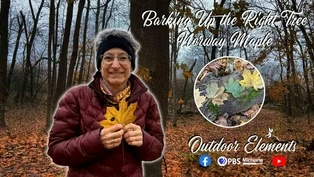 Now Playing
Barking Up the Right Tree: Norway Maple
Video has Closed Captions
Clip | 4m 30s | No description (4m 30s)
Don't Toss Those Holiday Lights! | OE
Video has Closed Captions
Clip | 8m 25s | 🎄✨ Got holiday lights that no longer sparkle? Don’t toss them! ♻️ In this ep (8m 25s)
Video has Closed Captions
Clip | 3m 38s | 🍂✨ Out on a fall walk in the woods, Evie stumbled upon a sweet seasonal surprise — (3m 38s)

Urban Transformation at Milkweed Gardens
Video has Closed Captions
Clip | 17m 11s | No description (17m 11s)
Video has Closed Captions
Clip | 11m 50s | 🌿🖊️ It’s time to slow down and connect with nature! In this episode of Outdoor E (11m 50s)
Video has Closed Captions
Clip | 3m 20s | 🐔👀 There’s a possum in the hen house! 🐾 On this episode of Outdoor Elements, E (3m 20s)
Video has Closed Captions
Clip | 2m 57s | 🍁 It’s that time of year when nature puts on its most colorful show! 🌳 In this epi (2m 57s)
Video has Closed Captions
Clip | 3m 36s | 🌿🪲One of our awesome viewers spotted a beetle making its way across the driveway and (3m 36s)


Video has Closed Captions
Clip | 3m 24s | A viewer shared a fascinating video of a Paintedhand Mudbug, and Evie dives into the detai (3m 24s)
Pretty in Pink for Pollinators
Video has Closed Captions
Clip | 5m 3s | At Lydick Bog Nature Preserve, Evie spots a burst of pink in a wetland. She explores these (5m 3s)
Another Milkweed Specialist: Milkweed Tussock Moth
Video has Closed Captions
Clip | 4m 36s | No description (4m 36s)
Video has Closed Captions
Clip | 3m 43s | Evie spotted Pointed-leaf Tick-Trefoil and shares how to identify this plant. (3m 43s)
The Unique Flowers of Buttonbush
Video has Closed Captions
Clip | 3m 58s | Evie finds Buttonbush at Spicer Lake Nature Preserve (3m 58s)
Saving Ash Trees, One Tree at a Time
Video has Closed Captions
Clip | 11m 16s | No description (11m 16s)
Bringing Bees Back to the Nature Center
Video has Closed Captions
Clip | 6m 10s | No description (6m 10s)
Gathering for Science: An Environmental Research Symposium
Clip | 10m 27s | Evie stops by the St. Joseph County Public Library during their Earth Day celebration to c (10m 27s)
Surprising Color in the Woods: Blue Stain Fungi
Video has Closed Captions
Clip | 3m 48s | No description (3m 48s)
Maple Sweet Treat for Ants | Outdoor Elements
Video has Closed Captions
Clip | 1m 34s | A sweet surprise in the woods! (1m 34s)
Evil Greens of Spring with Garry Harrington
Video has Closed Captions
Clip | 12m 56s | Things are greening up in the spring woods, but it’s not necessarily a welcome sight. (12m 56s)
Volunteers Help Build a Healthier Trail
Clip | 6m 9s | At Lydick Bog Nature Preserve, volunteers make a big difference in protecting and maintain (6m 9s)
Art, Sun and Science: Botanical Cyanotypes
Clip | 6m 49s | Experimenting with cyanotype fabric brings nature to life in beautiful, sun-printed design (6m 49s)
Clip | 3m 57s | Evie shares a fun and simple craft idea using autumn leaves that the whole family can enjo (3m 57s)
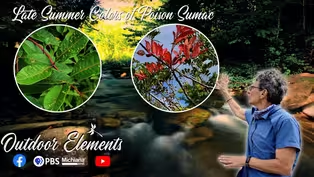
Late Summer Colors of Poison Sumac
Clip | 1m 59s | Watch out for this colorful danger at Lydick Bog Nature Preserve! (1m 59s)
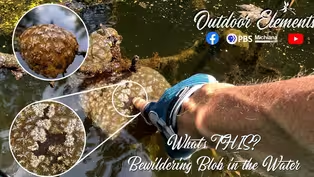
What's THIS? Bewildering Blob in the Water
Clip | 5m 8s | What’s that mysterious blob in the water (5m 8s)
Clip | 7m 14s | Find out how thousands of volunteers help the US Geological Survey teams and other resourc (7m 14s)
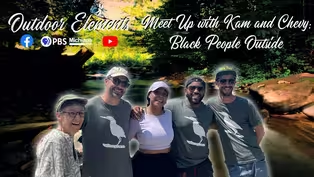
Meet Up with Kam and Chevy: Black People Outside
Clip | 5m 18s | Meet the inspiring creators behind Black People Outside. (5m 18s)
Providing Support for PBS.org
Learn Moreabout PBS online sponsorship















Support for PBS provided by:
Outdoor Elements is a local public television program presented by PBS Michiana