Outdoor Elements
Exploring a Native Tree Trail
Clip | 8m 45sVideo has Closed Captions
A stroll along the Native Tree Trail at Pinhook Park in South Bend provides an introductio
Pinhook Park, South Bend https://sbvpa.org/treetrail/ List of Native Trees in Indiana: https://sites.pfw.edu/native-trees/NativeTreeListByCommonName-Page1-Test.htm Purdue Ft Wayne has a Native Trees of Indiana RiverWalk with 100 native trees: https://www.pfw.edu/microsites/native-trees/the-native-trees/index-of-trees A stroll along the Native Tree Trail at Pinhook Park in So...
Problems playing video? | Closed Captioning Feedback
Problems playing video? | Closed Captioning Feedback
Outdoor Elements is a local public television program presented by PBS Michiana
Outdoor Elements
Exploring a Native Tree Trail
Clip | 8m 45sVideo has Closed Captions
Pinhook Park, South Bend https://sbvpa.org/treetrail/ List of Native Trees in Indiana: https://sites.pfw.edu/native-trees/NativeTreeListByCommonName-Page1-Test.htm Purdue Ft Wayne has a Native Trees of Indiana RiverWalk with 100 native trees: https://www.pfw.edu/microsites/native-trees/the-native-trees/index-of-trees A stroll along the Native Tree Trail at Pinhook Park in So...
Problems playing video? | Closed Captioning Feedback
How to Watch Outdoor Elements
Outdoor Elements is available to stream on pbs.org and the free PBS App, available on iPhone, Apple TV, Android TV, Android smartphones, Amazon Fire TV, Amazon Fire Tablet, Roku, Samsung Smart TV, and Vizio.
Providing Support for PBS.org
Learn Moreabout PBS online sponsorshipWe're going to take a stroll on the native tree trail at Pine Hook Park in South Bend, Indiana.
And we're going to do that with Steve Sapp, who was the lead on this project and helping to get it going here in the park.
It's a great project.
People can stroll here right off of Riverside Trail.
Tell me a little bit about the trail and how many different kinds of species are here.
Sure.
So the trail itself, as you mentioned, is right off of Riverside Trail here at Penn Hook Park.
So it makes a nice natural extension.
The trail itself is about three quarters of a mile long, and it's paved.
It's a multi purpose trail.
So it's designed for walking and for bicycling.
We have a lot of cyclists that may come in off of Riverside Trail.
And this is an opportunity for people to come in to Penn Hook Park and see a new feature, which is the native tree trail and the Native Tree Trail currently consists of somewhere just under 40 different trees.
And each tree has a sign on it, and the sign provides information about that specific species of tree.
OK. How about if we stroll a little bit?
We're happened to be under a beautiful sugar maple, which is a native tree.
And how about if we stroll a little bit?
Because some of the trees that are on the trail were here.
Yes.
And some were planted, right?
Right.
For example, the sugar maple is obviously been here for a long time.
Right.
And it is a native tree.
And so when we start out to create this trail, we look to try to incorporate as many trees that were existing on the property as we could.
And so there are just over two dozen or so existing trees or trees that existed prior to the development of the tree trail.
And we added a dozen or so thus far oak trees.
So how about if we walk along?
Because up ahead, I see some newly planted trees.
So let's take a look.
Oh, look at those.
OK, I love that these all have identification signs, right?
Right.
And what's on here?
So a little bit of information about the tree, right?
Yes, a little bit.
We have the name of the tree, the common name in this case, Princeton alum.
Below that we have the taxonomic name, which in this case is on this American, a Princeton.
And then below that, we have a short description about the tree enough that folks could maybe read in about 30 seconds or so.
But below that, there is a QR code.
And if you have your mobile phone with you and you scan the QR code, it will take you to the South Bend.
Then use Parks and Arts website and there's a specific page for each tree on the trail here, which has lots more information about the tree, including the description of it, the wildlife value pictures.
I think there's picture pictures as well as landscape uses.
Many of these trees can be adapted to the home landscape, of course.
And this particular tree, let's walk back and look at it because, you know, a lot of times we think of elms being disease ridden.
Right.
Right.
We got to tiptoe over these newly planted native plants, which is great.
Yeah.
So tell me about the Princeton Elm.
OK. Sure.
This is an American elm tree.
Almost Americana.
And the American Elm Tree of trees, of course, were one of the predominant street trees in eastern North America in the early part of the 20th century.
And what happened was in the 1950s or so, a pathogen, a fungus that attacks American elm trees made its way into our country from Europe, and it spread by a beetle.
And what happened then was we lost all of our mature elm trees.
Now, this particular one is a cultivar called Princeton, and it was developed in New Jersey in 1922.
It was originally cultivated based on its esthetic value.
But what they found later on was that it has a resistance to Dutch Elm disease.
And so this is an American elm tree that we can plant in our landscapes that will be moderately successful and long lived and not fall victim to Dutch Elm Disease.
Now there's kind of an ethical argument that goes on with this as well.
When we deal with cultivar trees like this wood for instance, they're propagated vegetative early rather than sexually through seed.
And so they're, they're, they're propagated through cuttings, in other words.
And so what happens is that we have every Princeton Elm tree is an identical clone of this tree.
And so when we plant them across our cities and our landscapes, we're putting the genetically identical tree everywhere.
So that's kind of the downside of the cultivars as a single pathogen that this tree is susceptible to could potentially come along and wipe away all of the Princeton out.
But it's an honest to goodness American elm tree.
And the nice thing about this one is that it is a native tree versus the Siberian elm was widely planted as an American Elm replacement in the 1960s onwards, which proved to be highly invasive.
And now we're trying to get rid of we're trying to take all those Siberian owls.
Exactly.
OK, Let's walk down because I think there's a yellow wood down here, which is a tree that we don't see very often, but is also a native tree to Indiana.
Yeah.
Let's take a look and take a look Steve, I love the bark of yellow wood, this kind of smooth, mottled bark.
And I know the hardwood is actually yellow.
That's how it gets its name.
Right?
Right.
Now, this one is it leafed out.
Yeah.
Not all trees leaf out at the same time.
And of course, in a project like this, some trees take, some trees don't.
There's an ongoing plan to put more tree species here, right?
Yes, there is.
Currently, we are somewhere in the neighborhood of 36 to 40 different trees there are over 100 trees that are native to Indiana.
So the goal is to have all of them represented here, right here, including the ash trees, which is going to be a little bit of a challenge because they're going to require some systemic treatments to keep them alive.
Right.
Emerald ash for yellow.
It has an interesting story, though.
It's a tree that of the southern United States.
So its native range includes Alabama, Kentucky, in fact its taxonomic name as Clyde cleared.
The rest is Kentucky and Tennessee.
In Indiana, it's found natively in only one location, which is Brown County, but it is planted here in there as an ornamental tree.
And it's a member of the P family.
So it makes a fairly large white, irregularly shaped flowers.
And then later on in the year, the seeds will be in pods much like a pea would be.
Given that there are over 100 native trees, why is it important to consider native trees for landscaping?
Or on this trail in particular, why?
Why native?
Because native plants and in particular even native trees are really the basis for our entire food chain, our entire ecosystem.
Is reliant upon our native trees, particularly insects and everything which eat insects, which includes almost all of our birds.
And many mammals and bats and in different things.
And Fabian's even our native insects need native plants and native trees to survive and so if we put a plant for our tree from China or from southwestern Asia in our landscape, chances are there's going to be very few things that are able to make use of the foliage of that plant for food.
And so although it is providing beauty and it is sequestering carbon and it's producing oxygen, it's not contributing to the food web.
And if we are to continue on as a species on the planet, it's important that we maintain our ecosystems and maintaining our ecosystems starts with the plants getting the right native plants into our landscapes.
Hopefully if folks stroll this lovely tree trail, they'll learn about native trees and be encouraged to consider some of them for their own landscaping and their own yards.
Right.
This is a great place for folks to come out and see these trees in an urban landscape setting and see if maybe this is something that you want to plant in your your own yard.
And the signs give information as far as the soil conditions and the height that they'll grow to some trees we don't want to put under electrical lines.
Right.
That's a different quality.
It's a great learning tool here in Pinellas.
Park.
So thanks for your work to help get the trail established and thanks for sharing information about the tree trail here at Pinellas Park.
My pleasure.
It's been a great project.
Video has Closed Captions
Clip | 4m 42s | Looking for a tiny sign that winter is on its way out? Evie hit the snow-covered trails in (4m 42s)

Video has Closed Captions
Clip | 6m 54s | 🦆❄️ When winter tightens its grip, the waterways tell a different story. (6m 54s)
Video has Closed Captions
Clip | 3m 2s | Take a winter walk with us at Fernwood Botanical Garden! (3m 2s)
Video has Closed Captions
Clip | 4m 20s | 🦉🌲 WHOO was here? While walking along a wooded path, Evie came across a mysterious p (4m 20s)
Barking Up the Right Tree: Norway Maple
Video has Closed Captions
Clip | 4m 30s | No description (4m 30s)
Don't Toss Those Holiday Lights! | OE
Video has Closed Captions
Clip | 8m 25s | 🎄✨ Got holiday lights that no longer sparkle? Don’t toss them! ♻️ In this ep (8m 25s)
Video has Closed Captions
Clip | 3m 38s | 🍂✨ Out on a fall walk in the woods, Evie stumbled upon a sweet seasonal surprise — (3m 38s)

Urban Transformation at Milkweed Gardens
Video has Closed Captions
Clip | 17m 11s | No description (17m 11s)
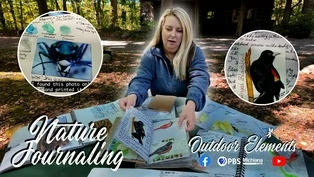
Video has Closed Captions
Clip | 11m 50s | 🌿🖊️ It’s time to slow down and connect with nature! In this episode of Outdoor E (11m 50s)
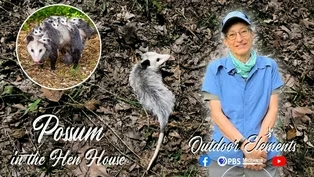
Video has Closed Captions
Clip | 3m 20s | 🐔👀 There’s a possum in the hen house! 🐾 On this episode of Outdoor Elements, E (3m 20s)
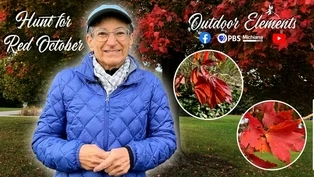
Video has Closed Captions
Clip | 2m 57s | 🍁 It’s that time of year when nature puts on its most colorful show! 🌳 In this epi (2m 57s)
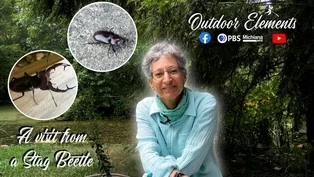
Video has Closed Captions
Clip | 3m 36s | 🌿🪲One of our awesome viewers spotted a beetle making its way across the driveway and (3m 36s)


Video has Closed Captions
Clip | 3m 24s | A viewer shared a fascinating video of a Paintedhand Mudbug, and Evie dives into the detai (3m 24s)
Pretty in Pink for Pollinators
Video has Closed Captions
Clip | 5m 3s | At Lydick Bog Nature Preserve, Evie spots a burst of pink in a wetland. She explores these (5m 3s)
Another Milkweed Specialist: Milkweed Tussock Moth
Video has Closed Captions
Clip | 4m 36s | No description (4m 36s)
Video has Closed Captions
Clip | 3m 43s | Evie spotted Pointed-leaf Tick-Trefoil and shares how to identify this plant. (3m 43s)
The Unique Flowers of Buttonbush
Video has Closed Captions
Clip | 3m 58s | Evie finds Buttonbush at Spicer Lake Nature Preserve (3m 58s)
Saving Ash Trees, One Tree at a Time
Video has Closed Captions
Clip | 11m 16s | No description (11m 16s)
Bringing Bees Back to the Nature Center
Video has Closed Captions
Clip | 6m 10s | No description (6m 10s)
Gathering for Science: An Environmental Research Symposium
Clip | 10m 27s | Evie stops by the St. Joseph County Public Library during their Earth Day celebration to c (10m 27s)
Surprising Color in the Woods: Blue Stain Fungi
Video has Closed Captions
Clip | 3m 48s | No description (3m 48s)
Maple Sweet Treat for Ants | Outdoor Elements
Video has Closed Captions
Clip | 1m 34s | A sweet surprise in the woods! (1m 34s)
Evil Greens of Spring with Garry Harrington
Video has Closed Captions
Clip | 12m 56s | Things are greening up in the spring woods, but it’s not necessarily a welcome sight. (12m 56s)
Volunteers Help Build a Healthier Trail
Clip | 6m 9s | At Lydick Bog Nature Preserve, volunteers make a big difference in protecting and maintain (6m 9s)
Art, Sun and Science: Botanical Cyanotypes
Clip | 6m 49s | Experimenting with cyanotype fabric brings nature to life in beautiful, sun-printed design (6m 49s)
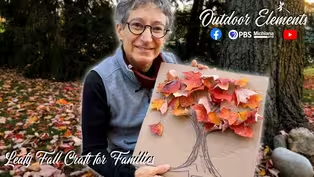
Clip | 3m 57s | Evie shares a fun and simple craft idea using autumn leaves that the whole family can enjo (3m 57s)
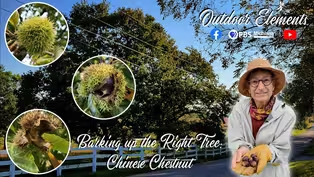
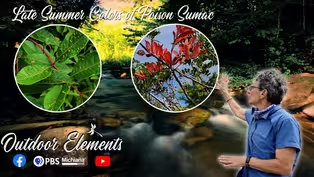
Late Summer Colors of Poison Sumac
Clip | 1m 59s | Watch out for this colorful danger at Lydick Bog Nature Preserve! (1m 59s)
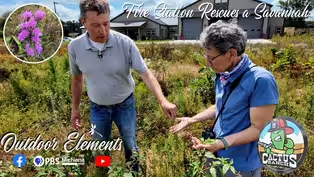
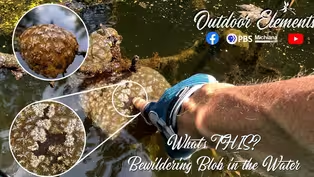
What's THIS? Bewildering Blob in the Water
Clip | 5m 8s | What’s that mysterious blob in the water (5m 8s)
Clip | 7m 14s | Find out how thousands of volunteers help the US Geological Survey teams and other resourc (7m 14s)
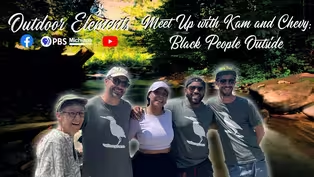
Meet Up with Kam and Chevy: Black People Outside
Clip | 5m 18s | Meet the inspiring creators behind Black People Outside. (5m 18s)
Providing Support for PBS.org
Learn Moreabout PBS online sponsorship















Support for PBS provided by:
Outdoor Elements is a local public television program presented by PBS Michiana