Reducing Invasives and Protecting Habitats
Clip | 8m 57sVideo has Closed Captions
Evie and Steve Sass take a look at some examples of invasive landscaping plants.
When common landscaping plants escape into natural areas they dramatically alter the habitat. Evie and Steve Sass take a look at some examples of how some invasive landscaping plants are causing a problem for native plants at Obrien Park in South Bend. The state of Indiana has added some rules to eliminate the use of certain invasives being used. South Bend has created th...
Problems playing video? | Closed Captioning Feedback
Problems playing video? | Closed Captioning Feedback
Reducing Invasives and Protecting Habitats
Clip | 8m 57sVideo has Closed Captions
When common landscaping plants escape into natural areas they dramatically alter the habitat. Evie and Steve Sass take a look at some examples of how some invasive landscaping plants are causing a problem for native plants at Obrien Park in South Bend. The state of Indiana has added some rules to eliminate the use of certain invasives being used. South Bend has created th...
Problems playing video? | Closed Captioning Feedback
How to Watch
is available to stream on pbs.org and the free PBS App, available on iPhone, Apple TV, Android TV, Android smartphones, Amazon Fire TV, Amazon Fire Tablet, Roku, Samsung Smart TV, and Vizio.
Providing Support for PBS.org
Learn Moreabout PBS online sponsorshipWhen you consider plants to put in your landscaping at home do you think about whether they're native or what their origin is, and why does that even matter?
We're going to learn more with Steve Sass.
And you were instrumental in getting the city of South Bend to establish an ordinance that is restricting the use of invasive plants.
Right?
Right.
Tell us a little bit about that.
Sure.
So invasive plant species are devastating in a number of ways.
They're financially devastating.
Because they cost a lot of money to control.
And they're also ecologically devastating.
We're here in the woods at O'Brien Park, and it's a beautiful beach maple woods.
And we're going to take a look at some different, different examples of what invasive species do.
But essentially the state of Indiana back in 2019 addressed the issue of invasive plant species species with a new DNR invasive terrestrial plant rule which prohibited the planting, sale, transport etc.
of 44 different species of plants, many of which were common landscape plants.
However, left off of that list were some of the most common and most widely sold landscape plants, which are both highly considered, highly and medium invasive.
And so what we did in South Bend was we closed the gap on the Indiana invasive terrestrial plant rule by refining our own municipal ordinance to ban all of the species that are defined as invasive by the Indiana Invasive Species Council, which is an officially created state agency full of experts who assess which plants are invasive to an ecosystem.
And we should clarify that invasive is a term that's used for plants that are not indigenous to Indiana.
So they come from other continents, other countries, and they primarily were brought here in part for the landscape trade.
Yeah, they say over 80% of our invasive plants are escaped from the landscape of the horticulture trade.
The USDA defines an invasive plant as one that's exotic to a given ecosystem.
And whose introduction is likely to cause harm.
Okay.
And here is a perfect example.
So we're, as you said, we're at O'Brien Park, we're in a beach maple forest, which the trees here, for the most part, are native.
Well, boy, when you look at the understory, this side and this side look totally different.
Yes.
So what are we got over here?
What's this green carpet?
Over here, we have a very common ground cover called zinc, a minor.
The common is the taxonomic name.
The common name for this there.
Several of periwinkle would be one.
Myrtle is another one.
And they're sold at just about any place that sells landscape plants has this plant.
And it's it's very popular because it does grow in shade.
It's easy to establish.
And a carpet's a and an area of wooded area where folks maybe aren't able to grow grass.
So it works well from a landscape perspective.
However, once it escapes into the wild like this, it just spreads through underground rhizomes and it completely carpets and blankets an area like this.
And that excludes the native plants.
So as I kind of look out through there.
There's some, you know, two inch trees, but there's I don't see a lot of native wildflowers or even really small trees.
Yeah.
They're unable to compete with this dense of a land of a groundcover.
And if we just kind of stand up and go back over here we can see there's much more diversity over here and no big, thick green carpet.
Right, right, right.
On the other side of the path, I mean, we can even see leaf litter here, which is hardly heavy over there.
But there's there's evidence of some some native wildflowers.
This is one of the dissenters either Dutchman's breaches or squirrel corn.
And we have another spring Ephemeral plan, Cutleaf toothwort.
These are the native wildflowers that were that have existed in woods like this since the end of the last glaciation.
There are some other plants people use in landscaping that have escaped here in the woods as well.
So maybe we can take a look at another one real quick.
Sure.
Okay.
On our way to look at some of the other invasives, we found this beautiful little patch of prairie Trillium, which is a native wildflower growing in this oasis away from that encroaching myrtle.
Right.
You can see the myrtles come in this way.
A couple other Cutleaf toothwort here.
I think behind you, there is some May Apple and.
Yep So scattering around.
They're trying to hold their own against that advancing wave of myrtle.
Yeah.
And this is the, these are the plants that we're trying to protect by eliminating the planting of the invasive plants.
Right.
Once once the invasives comes, in to this area.
These plants aren't able to compete against them, and we just lose them.
Part of our heritage.
It is.
Absolutely is.
Let's go check out another one.
Okay.
Steve, this one is one I think is even worse than Myrtle because it's really hard to pull it.
You know, again, it also spreads by these underground and surface rhizomes.
What is this one?
This is called Winter Creeper or Euonymus fortunei.
It's another one of those plants that was brought over from Eurasia as a groundcover.
And as you can see, similar to vinka does tend to carpet an entire area.
This one will also scale trees.
And in many cases, kill trees.
And I've seen vines growing up trees that are almost the diameter of a baseball probably becomes quite woody.
We focused on two... kind of understory species.
But there are some other things that homeowners could consider maybe removing from their landscape.
Sure.
What would those be for There's a lot of things the honeysuckle shrubs are ones that were planted very commonly in the 1960s, in the 1970s, those have escaped population.
If you have those in your landscape, please get rid of those.
Burning Bush is another very popular landscape shrub.
It turns that bright pink color in the autumn and it's very pretty but it also escapes and it's here also at O'Brien woods, in certain parts, invading the native understory here.
Callery pear is another tree that beautiful.
It is.
And we've planted those all throughout eastern North America as street trees because they are they do make good urban trees is they're salt tolerant and they're pyramidal in form.
But we're we're seeing all kinds of problems with Callery pear escaping cultivation and invading old fields.
And just fills in spring.
You just look out and it's solid white.
You don't realize how much of it there is until it's in flower and you see just how much white there is.
So what can a homeowner do?
Well, a homeowner is native plants are always the best choice for for any ecosystem.
Those are the plants that have existed here for hundreds or thousands of years.
They've reached an ecological balance in the ecosystem, and they're not going to become invasive.
So if you have these plants, please consider pulling them out.
A lot of folks think that plants, invasive plants aren't invasive because they don't see evidence of them leaving their own yard.
But many of them are spread by the birds who eat their fruit and fly away and spread it that way.
In the case of these vines, who knows they can escape from a yard into a neighbor's yard and rip through entire neighborhoods sometimes or even be transported in a small container of soil, maybe with another plant.
And the next thing you know, you have acres of this.
And in the case of O'Brien Woods here we have a beautiful native woods that's worthy of saving.
But it's going to take years, if not decades, and lots of money and lots of of human resources to be able to remove this, to get it back to its native form.
Again.
All right.
So bottom line, if you have the opportunity to get some native plants for your yard, that's always the best choice.
If you have some invasives in your yard, see if you can rip some of them out.
Every little bit helps.
Steve, thanks so much for sharing the story about the new ordinance and about the detriments to ecosystems that these invasive plants provide.
Wonderful.
Thank you.
And I encourage everybody to use native plants whenever possible.
Video has Closed Captions
Clip | 3m 2s | Take a winter walk with us at Fernwood Botanical Garden! (3m 2s)
Video has Closed Captions
Clip | 4m 20s | 🦉🌲 WHOO was here? While walking along a wooded path, Evie came across a mysterious p (4m 20s)
Barking Up the Right Tree: Norway Maple
Video has Closed Captions
Clip | 4m 30s | No description (4m 30s)
Don't Toss Those Holiday Lights! | OE
Video has Closed Captions
Clip | 8m 25s | 🎄✨ Got holiday lights that no longer sparkle? Don’t toss them! ♻️ In this ep (8m 25s)
Video has Closed Captions
Clip | 3m 38s | 🍂✨ Out on a fall walk in the woods, Evie stumbled upon a sweet seasonal surprise — (3m 38s)

Urban Transformation at Milkweed Gardens
Video has Closed Captions
Clip | 17m 11s | No description (17m 11s)
Video has Closed Captions
Clip | 11m 50s | 🌿🖊️ It’s time to slow down and connect with nature! In this episode of Outdoor E (11m 50s)
Video has Closed Captions
Clip | 3m 20s | 🐔👀 There’s a possum in the hen house! 🐾 On this episode of Outdoor Elements, E (3m 20s)
Video has Closed Captions
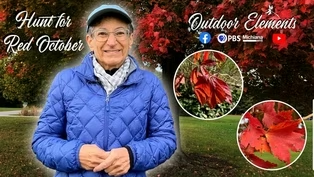
Clip | 2m 57s | 🍁 It’s that time of year when nature puts on its most colorful show! 🌳 In this epi (2m 57s)
Video has Closed Captions
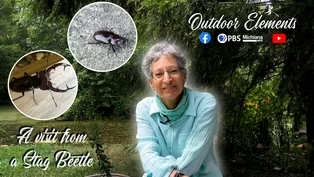
Clip | 3m 36s | 🌿🪲One of our awesome viewers spotted a beetle making its way across the driveway and (3m 36s)


Video has Closed Captions
Clip | 3m 24s | A viewer shared a fascinating video of a Paintedhand Mudbug, and Evie dives into the detai (3m 24s)
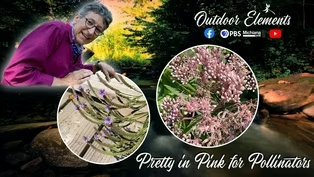
Pretty in Pink for Pollinators
Video has Closed Captions
Clip | 5m 3s | At Lydick Bog Nature Preserve, Evie spots a burst of pink in a wetland. She explores these (5m 3s)
Another Milkweed Specialist: Milkweed Tussock Moth
Video has Closed Captions
Clip | 4m 36s | No description (4m 36s)
Video has Closed Captions
Clip | 3m 43s | Evie spotted Pointed-leaf Tick-Trefoil and shares how to identify this plant. (3m 43s)
The Unique Flowers of Buttonbush
Video has Closed Captions
Clip | 3m 58s | Evie finds Buttonbush at Spicer Lake Nature Preserve (3m 58s)
Saving Ash Trees, One Tree at a Time
Video has Closed Captions
Clip | 11m 16s | No description (11m 16s)
Bringing Bees Back to the Nature Center
Video has Closed Captions
Clip | 6m 10s | No description (6m 10s)
Gathering for Science: An Environmental Research Symposium
Clip | 10m 27s | Evie stops by the St. Joseph County Public Library during their Earth Day celebration to c (10m 27s)
Surprising Color in the Woods: Blue Stain Fungi
Video has Closed Captions
Clip | 3m 48s | No description (3m 48s)
Maple Sweet Treat for Ants | Outdoor Elements
Video has Closed Captions
Clip | 1m 34s | A sweet surprise in the woods! (1m 34s)
Evil Greens of Spring with Garry Harrington
Video has Closed Captions
Clip | 12m 56s | Things are greening up in the spring woods, but it’s not necessarily a welcome sight. (12m 56s)
Volunteers Help Build a Healthier Trail
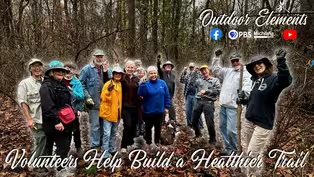
Clip | 6m 9s | At Lydick Bog Nature Preserve, volunteers make a big difference in protecting and maintain (6m 9s)
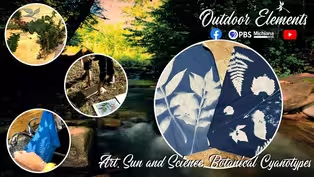
Art, Sun and Science: Botanical Cyanotypes
Clip | 6m 49s | Experimenting with cyanotype fabric brings nature to life in beautiful, sun-printed design (6m 49s)
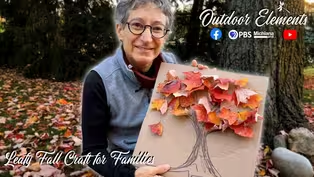
Clip | 3m 57s | Evie shares a fun and simple craft idea using autumn leaves that the whole family can enjo (3m 57s)
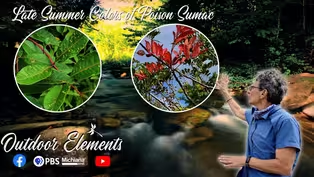
Late Summer Colors of Poison Sumac
Clip | 1m 59s | Watch out for this colorful danger at Lydick Bog Nature Preserve! (1m 59s)
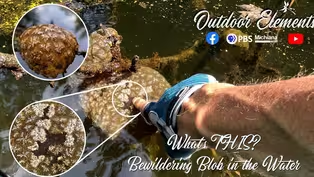
What's THIS? Bewildering Blob in the Water
Clip | 5m 8s | What’s that mysterious blob in the water (5m 8s)
Clip | 7m 14s | Find out how thousands of volunteers help the US Geological Survey teams and other resourc (7m 14s)
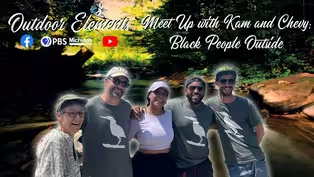
Meet Up with Kam and Chevy: Black People Outside
Clip | 5m 18s | Meet the inspiring creators behind Black People Outside. (5m 18s)
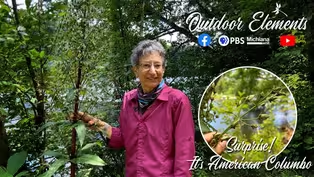
Surprise! It's American Columbo
Clip | 5m 14s | Explore the unique features of the American Columbo. Discover its habitat, appearance, and (5m 14s)
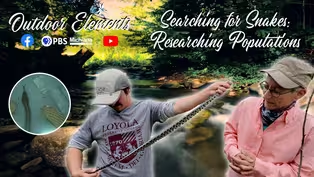
Searching for Snakes: Researching Populations
Clip | 13m | Delve into the world of snake population research in northern Indiana and discover the met (13m)
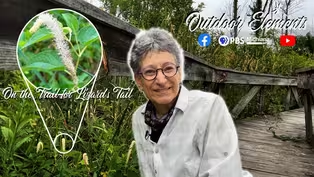
On the Trail for Lizard's Tail
Clip | 3m 10s | We are at @SpicerLakeNaturePreserve to learn about the fascinating plant known as Lizard's (3m 10s)
Providing Support for PBS.org
Learn Moreabout PBS online sponsorship















Support for PBS provided by: