Outdoor Elements
Turtle Research Along Lake Erie
Clip | 7m 6sVideo has Closed Captions
No description
We caught up with a research team from The Ohio State University that is surveying turtle populations along marshes of Lake Erie to learn more about their habits and habitats, with a special emphasis on Blanding's Turtles, a species of special concern.
Problems playing video? | Closed Captioning Feedback
Problems playing video? | Closed Captioning Feedback
Outdoor Elements is a local public television program presented by PBS Michiana
Outdoor Elements
Turtle Research Along Lake Erie
Clip | 7m 6sVideo has Closed Captions
We caught up with a research team from The Ohio State University that is surveying turtle populations along marshes of Lake Erie to learn more about their habits and habitats, with a special emphasis on Blanding's Turtles, a species of special concern.
Problems playing video? | Closed Captioning Feedback
How to Watch Outdoor Elements
Outdoor Elements is available to stream on pbs.org and the free PBS App, available on iPhone, Apple TV, Android TV, Android smartphones, Amazon Fire TV, Amazon Fire Tablet, Roku, Samsung Smart TV, and Vizio.
Providing Support for PBS.org
Learn Moreabout PBS online sponsorshipThis is an outdoor elements field.
Note I recently met up with some turtle researchers in a marsh in Ohio along Lake Erie.
We're going to find out about the really interesting research and data that they're collecting about turtles that live in the Great Lakes region.
Hi.
So my name is Jake, and this is Gene and Julia.
And we're out here in northwest Ohio, along Lake Erie coastal marshes, doing some turtle research with the Ohio State University.
The Ohio State University is is collaborated with the Toledo Zoo and some other partners, such as the Division of Wildlife, to conduct this research in northern Ohio on the turtle populations.
The research is primarily focused towards blending turtles.
But as you can see here, we have a snapping turtle and we catch a lot of painted turtles as well.
So our research is focused on measuring lengths and the weights of the turtles.
We then individually mark them for recapture at a later date, or at least that's the hope.
And from that data, we can monitor them long term.
For many years to come as turtles are a very long lived species.
What Julia is doing to the turtle, she's getting ready to put some notches in the scoots along the side.
So what these notches do is they give the turtle an individual code by letter.
So we know if we catch this turtle in the future, the tube here is to hold over the turtles head.
So obviously nobody gets bit because it does not feel good to get bit by one of these things, I can tell you that much.
So so this is a little dremel to how I keep on fingernails it.
Yup, yup.
And it doesn't hurt the turtle at all.
It is perfectly fine for the turtle, and we will not.
We'll put four little notches in it and that will give it a a individual notch code.
And basically, that's how you would identify it if you recaptured it, right?
Yes, absolutely.
So the hope is that in 20 years somebody will come back in and catch a turtle and be able to see what not code it has, and then that not toad will correspond to our data that we put down in the data sheet.
And you'll be able to determine how much that turtle has grown over that time span.
And basically the other data that you collect will be things like the size, the weight, the length of the shell, the the carpets and plaster onto the top and bottom of the shell and the weight of the turtle on Blandings turtles, we take blood samples and do a little bit more with them because that's what the project is focused on.
But yeah, in general, we're looking for growth data on the product.
So here I'm going to show you how to sex the turtle.
So if you take the turtle on its back and you stretch out its tail, you look at the cloaca opening, which is here.
If that comes past the carapace or the edge of the shell, then that turtle is a male So as you can see, this one is well past that curve, this line, meaning if this is a male snapping turtle, the female would be much closer up in here her cloaca opening would be here and her tail would be much thinner.
So that's how we can tell this is a male snapping turtle Well, this stop to we also found a Blandings turtle, and this is what our research is primarily focused on.
And when we found these, it's really exciting because there aren't in high numbers around in this area, and that's what we're looking to try to uncover.
If you look a little closer here, we try to determine the age of this turtle similar to a tree.
They have rings on the bottom of their cluster on.
These are formed during their winter dormancy.
So they're slow in their fast growth periods.
And each year you can tell by counting their rings in here, this turtle has about ten annually on it.
So it's probably an educated guess would be somewhere around this turtle around ten or 15 years old.
And one of the ways that we can identify a blandings turtle is those beautiful spots on the shell, right?
Yep.
And the blending turtle.
It's Shell.
This one is a little young but the older they get, they have a very domed shaped care piece, unlike the painted turtles that are primarily a little bit more thin and the snapping turtles that are a little bit more rugged.
And this one isn't showing it right now, but they have a beautiful yellow neck, right?
Yep.
Now we're going to be putting a pit tag into the Blandings Turtle.
And this is a great way for us to know if we've caught this turtle in the past when like in the future.
And this is a little bit like a microchip, right?
It's exactly like what you would put in your dog or cat.
And so to make sure you don't lose it and it's just a little poke, really quick little insertion of this tag.
And then it'll be in there for hopefully a long time to come.
And then we have our little reader and it will tell us the exact number.
And then we can in the future, hopefully get some more information on it.
Now, Blandings Turtles, the reason you're studying them is they are state endangered in Ohio, State threatened, state threatened in Ohio.
And just like that, it's done easy.
One second and it's pretty painless for them, especially that one in the foot, right in the it went right in their like body cavity.
So if you take out their leg, they have a little.
Oh, yeah.
Section there.
Yeah, very easy.
Okay, let me just There it is.
I've got the number.
So everything's working.
And because of the because of the tag, we've been able to find trails that we haven't worked on our ourselves but other people have worked on as far back as 20, 30 years ago.
And because of the pit tag, we were able to identify them.
It's very cool.
Awesome.
So your great research will actually continue long after you three are done, right?
Yes.
That's very cool to be a part of.
Awesome.
And so the last thing we do with the bleeding circles is we take blood.
And this is for genetic analysis.
So we can determine like the status of relationships between different animals.
And interestingly, the data for the blood sampling is actually gathered or analyzed someplace else.
Right.
You send it away.
We send it away.
OK. And I think you told me earlier, actually, Purdue University is doing that data right?
Yes.
Very cool.
Thanks to the protection of wetlands like these and this great research, we'll learn more about our native turtles for years to come.
Remember, you can find your own outdoor elements when you visit area parks and natural areas.
We'll see you soon.
Video has Closed Captions
Clip | 4m 42s | Looking for a tiny sign that winter is on its way out? Evie hit the snow-covered trails in (4m 42s)

Video has Closed Captions
Clip | 6m 54s | 🦆❄️ When winter tightens its grip, the waterways tell a different story. (6m 54s)
Video has Closed Captions
Clip | 3m 2s | Take a winter walk with us at Fernwood Botanical Garden! (3m 2s)
Video has Closed Captions
Clip | 4m 20s | 🦉🌲 WHOO was here? While walking along a wooded path, Evie came across a mysterious p (4m 20s)
Barking Up the Right Tree: Norway Maple
Video has Closed Captions
Clip | 4m 30s | No description (4m 30s)
Don't Toss Those Holiday Lights! | OE
Video has Closed Captions
Clip | 8m 25s | 🎄✨ Got holiday lights that no longer sparkle? Don’t toss them! ♻️ In this ep (8m 25s)
Video has Closed Captions
Clip | 3m 38s | 🍂✨ Out on a fall walk in the woods, Evie stumbled upon a sweet seasonal surprise — (3m 38s)

Urban Transformation at Milkweed Gardens
Video has Closed Captions
Clip | 17m 11s | No description (17m 11s)
Video has Closed Captions
Clip | 11m 50s | 🌿🖊️ It’s time to slow down and connect with nature! In this episode of Outdoor E (11m 50s)
Video has Closed Captions
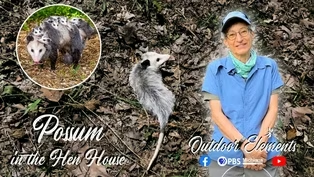
Clip | 3m 20s | 🐔👀 There’s a possum in the hen house! 🐾 On this episode of Outdoor Elements, E (3m 20s)
Video has Closed Captions
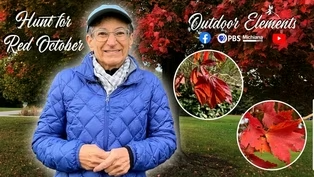
Clip | 2m 57s | 🍁 It’s that time of year when nature puts on its most colorful show! 🌳 In this epi (2m 57s)
Video has Closed Captions
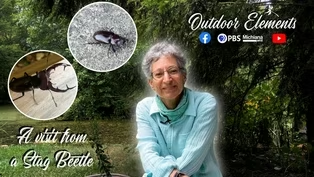
Clip | 3m 36s | 🌿🪲One of our awesome viewers spotted a beetle making its way across the driveway and (3m 36s)


Video has Closed Captions
Clip | 3m 24s | A viewer shared a fascinating video of a Paintedhand Mudbug, and Evie dives into the detai (3m 24s)
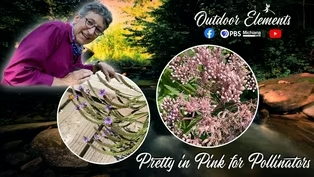
Pretty in Pink for Pollinators
Video has Closed Captions
Clip | 5m 3s | At Lydick Bog Nature Preserve, Evie spots a burst of pink in a wetland. She explores these (5m 3s)
Another Milkweed Specialist: Milkweed Tussock Moth
Video has Closed Captions
Clip | 4m 36s | No description (4m 36s)
Video has Closed Captions
Clip | 3m 43s | Evie spotted Pointed-leaf Tick-Trefoil and shares how to identify this plant. (3m 43s)
The Unique Flowers of Buttonbush
Video has Closed Captions
Clip | 3m 58s | Evie finds Buttonbush at Spicer Lake Nature Preserve (3m 58s)
Saving Ash Trees, One Tree at a Time
Video has Closed Captions
Clip | 11m 16s | No description (11m 16s)
Bringing Bees Back to the Nature Center
Video has Closed Captions
Clip | 6m 10s | No description (6m 10s)
Gathering for Science: An Environmental Research Symposium
Clip | 10m 27s | Evie stops by the St. Joseph County Public Library during their Earth Day celebration to c (10m 27s)
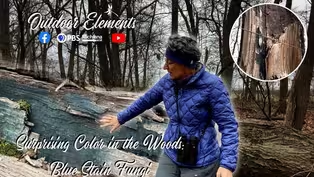
Surprising Color in the Woods: Blue Stain Fungi
Video has Closed Captions
Clip | 3m 48s | No description (3m 48s)
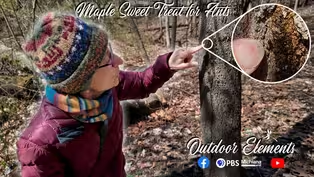
Maple Sweet Treat for Ants | Outdoor Elements
Video has Closed Captions
Clip | 1m 34s | A sweet surprise in the woods! (1m 34s)
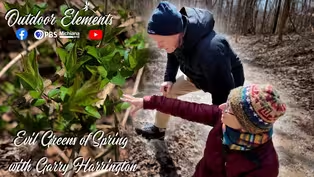
Evil Greens of Spring with Garry Harrington
Video has Closed Captions
Clip | 12m 56s | Things are greening up in the spring woods, but it’s not necessarily a welcome sight. (12m 56s)
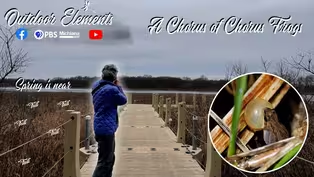
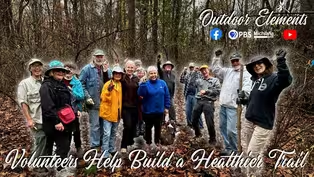
Volunteers Help Build a Healthier Trail
Clip | 6m 9s | At Lydick Bog Nature Preserve, volunteers make a big difference in protecting and maintain (6m 9s)
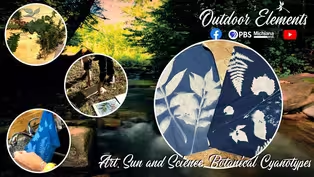
Art, Sun and Science: Botanical Cyanotypes
Clip | 6m 49s | Experimenting with cyanotype fabric brings nature to life in beautiful, sun-printed design (6m 49s)
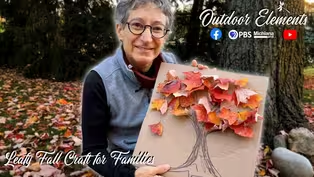
Clip | 3m 57s | Evie shares a fun and simple craft idea using autumn leaves that the whole family can enjo (3m 57s)
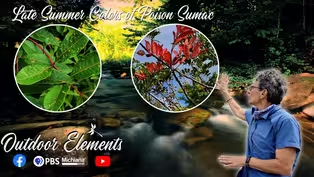
Late Summer Colors of Poison Sumac
Clip | 1m 59s | Watch out for this colorful danger at Lydick Bog Nature Preserve! (1m 59s)
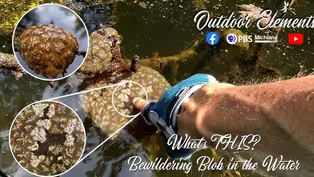
What's THIS? Bewildering Blob in the Water
Clip | 5m 8s | What’s that mysterious blob in the water (5m 8s)
Clip | 7m 14s | Find out how thousands of volunteers help the US Geological Survey teams and other resourc (7m 14s)
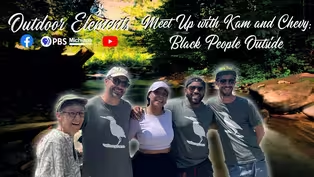
Meet Up with Kam and Chevy: Black People Outside
Clip | 5m 18s | Meet the inspiring creators behind Black People Outside. (5m 18s)
Surprise! It's American Columbo
Clip | 5m 14s | Explore the unique features of the American Columbo. Discover its habitat, appearance, and (5m 14s)
Providing Support for PBS.org
Learn Moreabout PBS online sponsorship















Support for PBS provided by:
Outdoor Elements is a local public television program presented by PBS Michiana