Outdoor Elements
Why Do Leaves Fall?
Clip | 13m 11sVideo has Closed Captions
Why Do Leaves Fall?
Why Do Leaves Fall?
Problems playing video? | Closed Captioning Feedback
Problems playing video? | Closed Captioning Feedback
Outdoor Elements is a local public television program presented by PBS Michiana
Outdoor Elements
Why Do Leaves Fall?
Clip | 13m 11sVideo has Closed Captions
Why Do Leaves Fall?
Problems playing video? | Closed Captioning Feedback
How to Watch Outdoor Elements
Outdoor Elements is available to stream on pbs.org and the free PBS App, available on iPhone, Apple TV, Android TV, Android smartphones, Amazon Fire TV, Amazon Fire Tablet, Roku, Samsung Smart TV, and Vizio.
Providing Support for PBS.org
Learn Moreabout PBS online sponsorshipIt's fall and the leaves are falling off the trees.
We often don't think about how and why that happens.
But we'll find out.
We're going to chat with Rod Romesha, who is the department chair of physical and life sciences here at Holy Cross College at Notre Dame Indiana.
So I'm going to go meet up with him right now.
Most of us are aware that trees turn beautiful colors in the fall if you're in a temperate region, especially here in the Great Lakes area.
But the leaves actually fall off the trees, so we're going to learn a little bit about how and why they do it .
And I'm with Rod Robuchon.
You are here at Holy Cross College as department head, and I would like to start with like the leaves and their shapes.
You actually have a lot of experience in forestry.
Yes, I do.
I actually had the pleasure of taking a number of andrology courses, which is the study of trees and Kentucky, Georgia and in New York.
So I've been immersed in a lot of trees and tree stumps.
So absolutely.
So I think you've got you've got a perfect specimen.
So we'll start with this.
What is this huge leaf?
This is a an amazing American sycamore leaf.
You know, the leaves are made basically have two main structures.
They have the petit old, which is the stem of the leaf.
Yeah.
And then they have the blade, and the blade is composed of the mid rib, which goes right down the center.
And as you can see here, we have lots and lots of really intricate veins, which allows for sap and water to be transported to all the cells within leave It's kind of like the plumbing right coming out of the leaf.
And so this is the mid rib and these are like side, I guess, I don't know, side ribs, side ribs or side veins.
OK, and then like the outside, what's that?
There's a name for that.
Sure, it's called the margin.
And for a Tree ID, looking at the margins of leaves is actually a key feature that we try to look at, right?
And this one is pretty smooth.
This one?
What is this some kind that is definitely an oak and it's got like little bristles and little bristles and undulations as we Oh yeah, OK. And then again, here's another oak.
Yeah, this is a white oak variety that we have here.
And as you can see, it's not as pointy, but it still has some characteristic undulations that will help us identify it.
OK, so this American Sycamore is a good example.
You know, it's fall, so this one is turning colors, and that's due to like a like chemical changes inside with the pigments in the leaves and sugars and things, right?
Yeah.
Specifically, with the chlorophyl of chlorophyl is the molecule that helps a plant photosynthesize to convert sunlight into chemical energy.
And I mean, Adam, that's a component of it is nitrogen and leaves don't actually change color.
They lose color.
They lose their green color because that nitrogen is actually harvested back by the tree and kept in the buds for the next spring because it's a very limited resource, so trees don't want to just push it away.
Oh, OK, so when basically then the green disappears and then these colors kind of show through, right?
Absolutely.
These are secondary pigments.
OK. OK, in this case, kind of yellow.
We greens and browns, but there's reds and oranges.
It depends on the tree species and the growing conditions as well.
That is correct.
OK. You for the brightest and best colors, we want to see cold temperatures with kind of a wet fall throughout.
But if it's a dry one, sometimes the color just isn't as sharp as it was during wetter years.
OK, and interestingly, we're doing this in 2021 and even 2021.
Our colors are I feel like they're pretty late.
They are.
They are.
It's the end of October already, and most of our trees are still green, so we're not used to that.
But aside from the leaves turning these really great colors that we get to enjoy in fall, the leaves fall off.
And, you know, we might not think twice about that.
But there's like like, how does it happen?
Like, it just doesn't just get ripped off by the wind or does it?
Well, it happens sometimes because obviously during strong storms in the summertime, you'll see leaves falling off trees.
But in the fall, there's two triggering mechanisms.
It's the day length and temperature.
As the days get shorter and shorter, there's less photosynthesis photosynthesizing going on.
So the leaves starts to produce a chemical signal that way back here at the base of the patio.
Causes cells to start to produce a decision plate.
And over time, what happens is those cells will continue to grow and actually push the leaf off the tree.
Shove it off, actually shove it off.
Yeah.
Wow.
Now why is that a benefit to the tree?
Like, why don't they just stay in the tree?
Well, you would think that something is.
Her name is this would be something you want to keep on to, but they do invest in a lot of energy in making absolutely.
But truth be told for this particular structure, it really isn't that big of a deal for a tree.
And there's a lot there's not a whole lot of engineering that has gone into this to make it to survive the winter.
So when the temperatures are below freezing, ice crystals form and it causes cells to be damaged, and so therefore the leaf would just die anyway anyway.
OK, I suppose, too.
We've even seen this on like late spring snowfalls like the snow load would be an issue to write if the trees hang on to their leaves, they would just hold a lot more selling.
Absolutely.
When we get a heavy wet snow or an ice storm, if there's lots of leaves on it, that just adds to the overall weight that's going to be on that tree, which could cause damage.
Right, OK, so it makes sense for the tree to kind of like, get rid of it, right?
Absolutely.
So now the types of trees that lose their leaves are known as what?
Well, broad leaf or angiosperms.
OK. OK. And another term deciduous deciduous tree is another tree that we're familiar with.
But I also have here, which you found on campus.
So what is this?
This is not from a deciduous tree.
It's not.
This is an eastern white pine tree, and this is a conifer.
Tree and conifers actually evolved at a different time than most broadleaf trees and sold their leaves.
Their needles are actually engineered to be able to take on desiccation tree.
What does that mean?
That's a technical term.
It is.
Desiccation means lack of water.
OK, like dry, dry berries because they evolved in a very dry habitat.
OK, so therefore conifer trees put a lot of energy into the construction of these leaves, and therefore they are able to survive the winters, at least depending on the species, for a few years before they will drop because they do drop.
But they just don't all drop all at once like a deciduous tree gets bare.
But conifers like this white pine will hang on to most of their needles, but some fall every use.
It depends on the species actually can see here we have some yellow ones here.
Right?
These are two year old needles.
And then for Easter white pine, when they become two years old, that's when they drop.
OK. And my recollection from the andrology is that one of the things that adaptation for these needles is they're almost like waxy, right?
So that help them hold moisture.
Yes.
Again, to help prevent the loss of a moisture or water has a very waxy cuticle on the outside, on the outside, so it keeps it from drying out.
It's absolutely OK. Well, you know, we were able here just to collect some leaves from down on the ground because it's fall and the leaves are falling.
Absolutely.
But I know sometimes the research requires, you know, maybe in summer you're trying to get leaves from higher in the tree.
And you've got a little really cool tool that will help you do that.
Absolutely.
We'll be seeing that here in a second.
It's called the big shot.
And basically what it is, it's a huge slingshot.
And what it does is launch a weighted line up into the canopy and the weight will come down.
And it allows me to pull on the tree to get a leaf sample.
And those leaf samples are used to extract DNA to do some type of genetic study.
It could be.
We could be looking at the diversity of the forest.
We could be doing a paternity analysis to try to follow.
Find out if there's who is firing all the young seedlings later.
OK, that's cool.
OK, well, I bet your students love using the big shot.
Yeah, everybody wanted to have a shot at the big shot.
OK, well, we would love to see the big shot in action.
So how about if we step over here because I see you've got land right here, OK, take the big steps early and will let you get in place here.
Get these down on the ground.
Well, it does look just like a giant slingshot, and then this looks like a bucket of line, right?
Yes.
The line is splayed in there as I was taught and basically we throw the line in there.
And what that allows us to do is when we launch the line up into the canop it allows for should the line to go up really easy and to come down really OK.
In other words, you don't want it to be all knotted and tangled.
It needs to be right.
If anybody who has ever gone fishing and had a big, you know, whole nest of lying, that is definitely not what you want.
OK, looks like yellow spaghetti, by the way.
It's kind of kind of cool.
OK, great.
Let me get let me get position out here over the out of the way.
Yeah, I will.
And I'm going to be shooting for a that branch, which is about maybe 3040 feet up in the air.
Oh, OK.
Cool.
OK. See?
Oh, wow.
Oh, wow, look at that.
That's amazing.
And it happens like that all the time on the first try.
Oh, wow.
Huh.
So what I'm going to do now is tighten up the line and hopefully we'll get one or two of those Leafs that are up to them now.
OK. Oh yeah, we're going to chase them on a breezy day Yeah, yeah.
Oh yeah.
There we go.
Oh, how about that?
And I would go over now and grab those leaves and put them in a bag and sample.
I'm going to go get it.
I'll be right back.
I hope I find the right one.
I see it.
By the way, what kind of tree?
This is another oak.
This is another red oak.
It looks like a piano, you know?
Yeah, but really deep recesses are sinuses.
Sinuses is the proper term.
OK, all right.
Now I noticed.
Let me get this sycamore in here.
I wanted to talk about this too.
Sure.
Because this is at the base of the patio.
This patio doesn't look exactly like this patio.
Why does this one have such a deep cup?
Well, it's one of the unique features of the American Sycamore.
It turns out that the base of the patio actually covers up the new bud for next year as leaf wear for the elderly.
It doesn't do so.
As you can see here, the buds are at the terminal end of the little branch slats that we see there.
Right?
So where the leaves are actually coming out at the base of the buds?
OK. For the American Sycamore, it actually covers it kind of like a little protection, a little cap over that.
But yeah, that's amazing.
And I know that some oaks hang on to some of their leaves in winter Right?
There's a term for that.
Marchesa Murchison.
I will take you.
That's a new term for me.
I've not heard of that before.
I'm always learning.
That's great, right?
But again, that's another interesting thing about leaves.
So there's always kind of some exception to everything in nature.
Absolutely.
Yeah.
Yeah.
OK, so big shot.
Was that developed for leaf sample?
No, actually.
It was actually developed for professional tree climbers to launch a line up so that they can go up and trim or cut down a particular tree.
Researchers like myself are always looking for new toys or tools to be able to do our jobs more efficiently, and so that's how we were able to acquire this.
Awesome.
OK, well, great.
This has been fun to see the big shot, and it's been fun to learn about the parts of leaves and why and how they fall off the trees.
So thanks so much.
It's my pleasure.
Remember, you can find your own outdoor elements if you visit there, your parks and natural areas.
We'll see you soon.
Video has Closed Captions
Clip | 3m 2s | Take a winter walk with us at Fernwood Botanical Garden! (3m 2s)
Video has Closed Captions
Clip | 4m 20s | 🦉🌲 WHOO was here? While walking along a wooded path, Evie came across a mysterious p (4m 20s)
Barking Up the Right Tree: Norway Maple
Video has Closed Captions
Clip | 4m 30s | No description (4m 30s)
Don't Toss Those Holiday Lights! | OE
Video has Closed Captions
Clip | 8m 25s | 🎄✨ Got holiday lights that no longer sparkle? Don’t toss them! ♻️ In this ep (8m 25s)
Video has Closed Captions
Clip | 3m 38s | 🍂✨ Out on a fall walk in the woods, Evie stumbled upon a sweet seasonal surprise — (3m 38s)

Urban Transformation at Milkweed Gardens
Video has Closed Captions
Clip | 17m 11s | No description (17m 11s)
Video has Closed Captions
Clip | 11m 50s | 🌿🖊️ It’s time to slow down and connect with nature! In this episode of Outdoor E (11m 50s)
Video has Closed Captions
Clip | 3m 20s | 🐔👀 There’s a possum in the hen house! 🐾 On this episode of Outdoor Elements, E (3m 20s)
Video has Closed Captions
Clip | 2m 57s | 🍁 It’s that time of year when nature puts on its most colorful show! 🌳 In this epi (2m 57s)
Video has Closed Captions
Clip | 3m 36s | 🌿🪲One of our awesome viewers spotted a beetle making its way across the driveway and (3m 36s)


Video has Closed Captions
Clip | 3m 24s | A viewer shared a fascinating video of a Paintedhand Mudbug, and Evie dives into the detai (3m 24s)
Pretty in Pink for Pollinators
Video has Closed Captions
Clip | 5m 3s | At Lydick Bog Nature Preserve, Evie spots a burst of pink in a wetland. She explores these (5m 3s)
Another Milkweed Specialist: Milkweed Tussock Moth
Video has Closed Captions
Clip | 4m 36s | No description (4m 36s)
Video has Closed Captions
Clip | 3m 43s | Evie spotted Pointed-leaf Tick-Trefoil and shares how to identify this plant. (3m 43s)
The Unique Flowers of Buttonbush
Video has Closed Captions
Clip | 3m 58s | Evie finds Buttonbush at Spicer Lake Nature Preserve (3m 58s)
Saving Ash Trees, One Tree at a Time
Video has Closed Captions
Clip | 11m 16s | No description (11m 16s)
Bringing Bees Back to the Nature Center
Video has Closed Captions
Clip | 6m 10s | No description (6m 10s)
Gathering for Science: An Environmental Research Symposium
Clip | 10m 27s | Evie stops by the St. Joseph County Public Library during their Earth Day celebration to c (10m 27s)
Surprising Color in the Woods: Blue Stain Fungi
Video has Closed Captions
Clip | 3m 48s | No description (3m 48s)
Maple Sweet Treat for Ants | Outdoor Elements
Video has Closed Captions
Clip | 1m 34s | A sweet surprise in the woods! (1m 34s)
Evil Greens of Spring with Garry Harrington
Video has Closed Captions
Clip | 12m 56s | Things are greening up in the spring woods, but it’s not necessarily a welcome sight. (12m 56s)
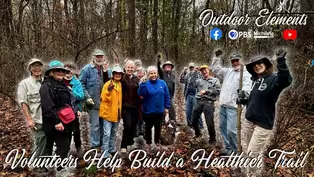
Volunteers Help Build a Healthier Trail
Clip | 6m 9s | At Lydick Bog Nature Preserve, volunteers make a big difference in protecting and maintain (6m 9s)
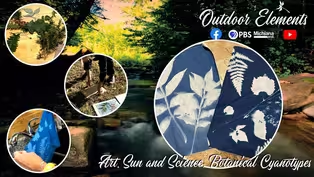
Art, Sun and Science: Botanical Cyanotypes
Clip | 6m 49s | Experimenting with cyanotype fabric brings nature to life in beautiful, sun-printed design (6m 49s)
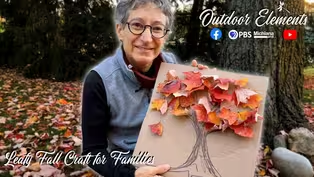
Clip | 3m 57s | Evie shares a fun and simple craft idea using autumn leaves that the whole family can enjo (3m 57s)
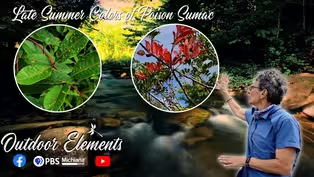
Late Summer Colors of Poison Sumac
Clip | 1m 59s | Watch out for this colorful danger at Lydick Bog Nature Preserve! (1m 59s)
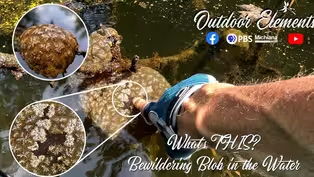
What's THIS? Bewildering Blob in the Water
Clip | 5m 8s | What’s that mysterious blob in the water (5m 8s)
Clip | 7m 14s | Find out how thousands of volunteers help the US Geological Survey teams and other resourc (7m 14s)
Meet Up with Kam and Chevy: Black People Outside
Clip | 5m 18s | Meet the inspiring creators behind Black People Outside. (5m 18s)
Surprise! It's American Columbo
Clip | 5m 14s | Explore the unique features of the American Columbo. Discover its habitat, appearance, and (5m 14s)
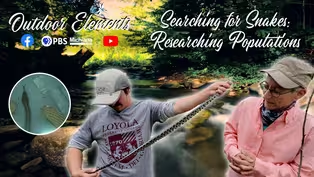
Searching for Snakes: Researching Populations
Clip | 13m | Delve into the world of snake population research in northern Indiana and discover the met (13m)
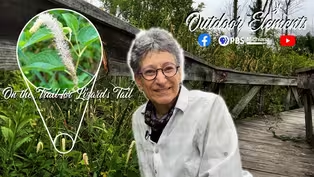
On the Trail for Lizard's Tail
Clip | 3m 10s | We are at @SpicerLakeNaturePreserve to learn about the fascinating plant known as Lizard's (3m 10s)
Providing Support for PBS.org
Learn Moreabout PBS online sponsorship

- News and Public Affairs

Top journalists deliver compelling original analysis of the hour's headlines.













Support for PBS provided by:
Outdoor Elements is a local public television program presented by PBS Michiana