Outdoor Elements
Winter Waterfowl on the River
Clip | 6m 54sVideo has Closed Captions
🦆❄️ When winter tightens its grip, the waterways tell a different story.
<div>🦆❄️ When winter tightens its grip, the waterways tell a different story.</div><div>In this episode of <strong>Outdoor Elements</strong>, Evie heads to the <strong>St. Joseph River</strong><strong> </strong>to see the unique collection of waterfowl that winter brings to our area. With the extreme cold this season, ducks and geese from even farther north are making...
Problems playing video? | Closed Captioning Feedback
Problems playing video? | Closed Captioning Feedback
Outdoor Elements is a local public television program presented by PBS Michiana
Outdoor Elements
Winter Waterfowl on the River
Clip | 6m 54sVideo has Closed Captions
<div>🦆❄️ When winter tightens its grip, the waterways tell a different story.</div><div>In this episode of <strong>Outdoor Elements</strong>, Evie heads to the <strong>St. Joseph River</strong><strong> </strong>to see the unique collection of waterfowl that winter brings to our area. With the extreme cold this season, ducks and geese from even farther north are making...
Problems playing video? | Closed Captioning Feedback
How to Watch Outdoor Elements
Outdoor Elements is available to stream on pbs.org and the free PBS App, available on iPhone, Apple TV, Android TV, Android smartphones, Amazon Fire TV, Amazon Fire Tablet, Roku, Samsung Smart TV, and Vizio.
Providing Support for PBS.org
Learn Moreabout PBS online sponsorshipRivers can be important corridors for wildlife.
In summer, we often see muskrats or turtles or fish traveling along river ways, but in winter they can be important lifelines for overwintering waterfowl.
Here in South Bend and Mishawaka, Indiana, the Saint Joseph River is partially frozen over.
We've had an unusually cold late January, and because of that, parts of the river are partially frozen over.
Waterfowl is congregating in the open water for waterfowl, searching for invertebrates or small fish, or even plant life.
Open water is critical in winter.
Sometimes we get species here that actually we only see in winter.
They migrate down from farther north, and in some winters, when it's unusually cold, we get species that we don't see every winter because some of those ducks have shifted down just a little farther south to find more open water.
Let's take a look.
It's pretty common for us to see groups of mallards swimming along the Saint Joseph River even in winter.
And of course, Canada geese as well.
But I was surprised recently to see a couple of American coots.
They breed in our area and I don't often see them in winter because they migrate a little bit farther south for the winter.
They have a distinctive white bill that contrasts with their black body, and the males and the females look alike.
A marker for winter weather for me is common goldeneye on the river.
They get their name from their golden eye and their surface divers, and the male has a white cheek patch, and the male and the female look different, have different plumage from each other.
Likewise, hooded mark answers also look different from each other.
The males have a white and black crest.
They're kind of, for me, the punk rocker of the waterfowl world in their coloration, and the male can raise and lower its crest in various display, features.
And then they are divers for fish and invertebrates.
So they do rely on this open water that they can find.
And the females, with their brown funky doo, can also raise and lower their crest Gadwalls are the sophisticated, understated, elegant swimmers in the waterfowl world.
They're actually my favorite duck.
And they have the males have a black, but that you can kind of see even from a pretty good distance, and a little white handkerchief.
Beautiful plumage.
And the female is even more subtle sometimes can be easily confused with a mallard.
Greater Scaup have a blue and black bill, and I often find them on Lake Michigan in groups in winter, less often in inland lakes and rivers, and the females have kind of a white circle around their bill and their divers searching for aquatic plants.
Redheads form huge large rafts in Lake Michigan, but much smaller groups here inland and again, not very common in inland areas.
Even in the winter, of course, they get their name from the males striking cinnamon colored head.
Two really uncommon geese showed up in South Bend recently a small, diminutive, all white goose with black wingtips and a kind of stubby little pink bill.
Pink feet and the snow goose is similar but larger, and it has kind of a green patch or a brown kind of gape on the side of its bill.
But the one that was here, unlike the name that you might think Snow Goose must be white, but this was a blue color morph, a little bit less common than the all white coloration of a typical snow goose.
Individuals showed up along Riverside Drive on the St Joe River.
The real showstopper, though this winter, has been the long tailed duck, and a few individuals showed up.
It's a sea duck and a fantastic diver.
They can dive as deep as 200ft as they search for food in open water, and they are, sometimes found along the Lake Michigan shoreline.
Not very often inland.
Long tailed ducks get their name from the very long, slender tail that the male uses for display, and the female is much more subtle colored, even in winter plumage with grays and soft browns and and whites.
So really beautiful birds that lots of nature enthusiasts and birders got to see this winter along the Saint Joe River.
Special thanks to Jim Spier and Tom Kosel for sharing their fantastic photos with us.
Of birds that they got to see here in and along the Saint Joseph River.
This winter, if you're lucky enough to have a river near you that you can hike along in winter.
Be sure to bring some binoculars, or just keep an eye out for some unique and beautiful overwintering waterfowl.
Remember, you can find your own outdoor elements when you visit area parks and natural areas.
We'll see you soon.
 New
NewTaking a Shine to Shining Firmoss
Video has Closed Captions
Clip | 4m 11s | No description (4m 11s)
Video has Closed Captions
Clip | 4m 42s | Looking for a tiny sign that winter is on its way out? Evie hit the snow-covered trails in (4m 42s)
 Now Playing
Video has Closed Captions
Clip | 6m 54s | 🦆❄️ When winter tightens its grip, the waterways tell a different story. (6m 54s)
Video has Closed Captions
Clip | 3m 2s | Take a winter walk with us at Fernwood Botanical Garden! (3m 2s)
Video has Closed Captions
Clip | 4m 20s | 🦉🌲 WHOO was here? While walking along a wooded path, Evie came across a mysterious p (4m 20s)
Barking Up the Right Tree: Norway Maple
Video has Closed Captions
Clip | 4m 30s | No description (4m 30s)
Don't Toss Those Holiday Lights! | OE
Video has Closed Captions
Clip | 8m 25s | 🎄✨ Got holiday lights that no longer sparkle? Don’t toss them! ♻️ In this ep (8m 25s)
Video has Closed Captions
Clip | 3m 38s | 🍂✨ Out on a fall walk in the woods, Evie stumbled upon a sweet seasonal surprise — (3m 38s)

Urban Transformation at Milkweed Gardens
Video has Closed Captions
Clip | 17m 11s | No description (17m 11s)
Video has Closed Captions
Clip | 11m 50s | 🌿🖊️ It’s time to slow down and connect with nature! In this episode of Outdoor E (11m 50s)
Video has Closed Captions
Clip | 3m 20s | 🐔👀 There’s a possum in the hen house! 🐾 On this episode of Outdoor Elements, E (3m 20s)
Video has Closed Captions
Clip | 2m 57s | 🍁 It’s that time of year when nature puts on its most colorful show! 🌳 In this epi (2m 57s)
Video has Closed Captions
Clip | 3m 36s | 🌿🪲One of our awesome viewers spotted a beetle making its way across the driveway and (3m 36s)


Video has Closed Captions
Clip | 3m 24s | A viewer shared a fascinating video of a Paintedhand Mudbug, and Evie dives into the detai (3m 24s)
Pretty in Pink for Pollinators
Video has Closed Captions
Clip | 5m 3s | At Lydick Bog Nature Preserve, Evie spots a burst of pink in a wetland. She explores these (5m 3s)
Another Milkweed Specialist: Milkweed Tussock Moth
Video has Closed Captions
Clip | 4m 36s | No description (4m 36s)
Video has Closed Captions
Clip | 3m 43s | Evie spotted Pointed-leaf Tick-Trefoil and shares how to identify this plant. (3m 43s)
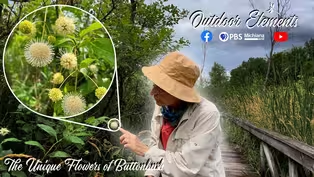
The Unique Flowers of Buttonbush
Video has Closed Captions
Clip | 3m 58s | Evie finds Buttonbush at Spicer Lake Nature Preserve (3m 58s)
Saving Ash Trees, One Tree at a Time
Video has Closed Captions
Clip | 11m 16s | No description (11m 16s)
Bringing Bees Back to the Nature Center
Video has Closed Captions
Clip | 6m 10s | No description (6m 10s)
Gathering for Science: An Environmental Research Symposium
Clip | 10m 27s | Evie stops by the St. Joseph County Public Library during their Earth Day celebration to c (10m 27s)
Surprising Color in the Woods: Blue Stain Fungi
Video has Closed Captions
Clip | 3m 48s | No description (3m 48s)
Maple Sweet Treat for Ants | Outdoor Elements
Video has Closed Captions
Clip | 1m 34s | A sweet surprise in the woods! (1m 34s)
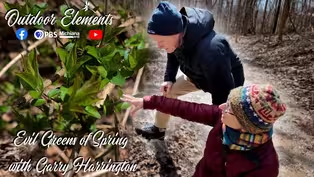
Evil Greens of Spring with Garry Harrington
Video has Closed Captions
Clip | 12m 56s | Things are greening up in the spring woods, but it’s not necessarily a welcome sight. (12m 56s)
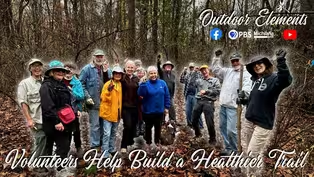
Volunteers Help Build a Healthier Trail
Clip | 6m 9s | At Lydick Bog Nature Preserve, volunteers make a big difference in protecting and maintain (6m 9s)
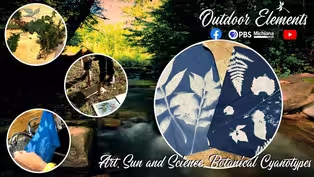
Art, Sun and Science: Botanical Cyanotypes
Clip | 6m 49s | Experimenting with cyanotype fabric brings nature to life in beautiful, sun-printed design (6m 49s)
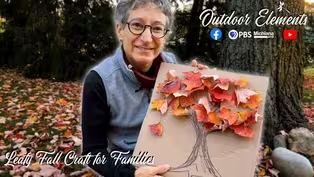
Clip | 3m 57s | Evie shares a fun and simple craft idea using autumn leaves that the whole family can enjo (3m 57s)
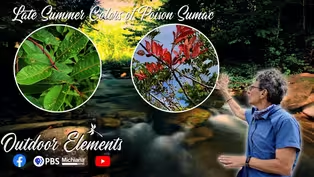
Late Summer Colors of Poison Sumac
Clip | 1m 59s | Watch out for this colorful danger at Lydick Bog Nature Preserve! (1m 59s)
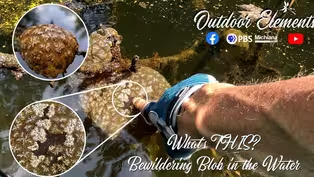
What's THIS? Bewildering Blob in the Water
Clip | 5m 8s | What’s that mysterious blob in the water (5m 8s)
Clip | 7m 14s | Find out how thousands of volunteers help the US Geological Survey teams and other resourc (7m 14s)
Providing Support for PBS.org
Learn Moreabout PBS online sponsorship














Support for PBS provided by:
Outdoor Elements is a local public television program presented by PBS Michiana