Articulate
Pain and Patience
Season 7 Episode 7 | 26m 46sVideo has Closed Captions
Pain is inevitable for humans. And: Is Gil Shaham the last musician to own a great violin?
An inevitable part of the human experience, pain is impossible to objectively measure, but felt universally. And: Gil Shaham might be the last musician to own a great violin.
Problems playing video? | Closed Captioning Feedback
Problems playing video? | Closed Captioning Feedback
Articulate is a local public television program presented by PBS39
Articulate
Pain and Patience
Season 7 Episode 7 | 26m 46sVideo has Closed Captions
An inevitable part of the human experience, pain is impossible to objectively measure, but felt universally. And: Gil Shaham might be the last musician to own a great violin.
Problems playing video? | Closed Captioning Feedback
How to Watch Articulate
Articulate is available to stream on pbs.org and the free PBS App, available on iPhone, Apple TV, Android TV, Android smartphones, Amazon Fire TV, Amazon Fire Tablet, Roku, Samsung Smart TV, and Vizio.
Providing Support for PBS.org
Learn Moreabout PBS online sponsorship- [Narrator] "Articulate with Jim Cutter" is made possible with generous funding from the Neubauer Family Foundation.
(crisp ambient music) - Welcome to "Articulate," the show that explores how really creative people understand the world.
(playful orchestral music) I'm Jim Cotter, and on this episode, Pain and Patience, an inevitable part of the human experience, pain is impossible to objectively measure, but felt universally.
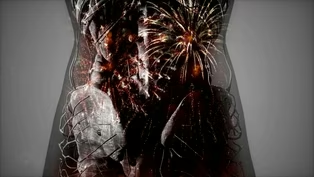
While artists have forever represented pain, it is something most must endure alone.
- Seeing, hearing, tasting, smelling, you know, these are perceptions that brain constructs and pain is one of those perceptions.
And so it's something that's yours, it's private.
It's how your brain constructs it in the context in which you're experiencing it and your particular mood and your cognitive state.
And so it will always be this subjective private thing.
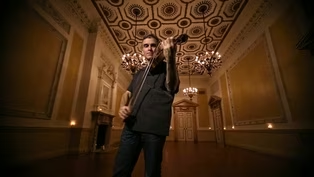
- [Jim] Violinist Gil Shaham may well be the last musician to personally own a great instrument.
His Stradivarius is precious and cherished.
- I was very lucky that there were several people along the way who helped me get this violin, and 25 years later, I'm happy to say that I own it.
- [Jim] That's all ahead on "Articulate."
(music continues) (energetic violin music) (heart beats) (person breathing) (machine beeping) (peaceful ambient music) Pain is both a universal and a deeply isolating experience.
It is perplexingly difficult to convey a precise description of it to another person.
Yes, we call it hurt, ache, or even agony, but for something so ubiquitous, our vocabulary for discussing it is remarkably basic.
Over the years, doctors have developed strategies for helping patients express their pain.
They might ask us to point out the face of our pain on a chart or rank it on a scale of one to 10, but these measurements are ultimately just as personal as the pain itself.
- If I'm at a seven or if I'm at a five, that would be someone else's like, oh my God, take me now.
I can't live any longer, you know?
- I'm a total wimp.
I took all the drugs, you know, as much as I could for my three childbirths.
Absolutely.
I was on that side of things.
- I mean, pain is such a personal experience, you know?
So in our pursuit to try and have other people understand what we're experiencing, there is a compulsion to want to compare it to something else, but the effectiveness of that is kind of debatable as well, you know?
No one knows what it feels like when you broke your arm, you know, however many years ago.
- [Jim] Since time immemorial, art has been the ally of subjectivity.
Capable of expressing the ephemeral: love, beauty, and yes, even pain.
In 1611, Peter Paul Rubens illustrated the pain of Prometheus, eternally bound to a rock and condemned by Zeus, the king of the gods to have his ever regenerating liver picked upon daily by an eagle as a punishment for giving humanity the gift of fire.
In 1873, Gustave Courbet depicted a trout hooked and bleeding from its gills as a representation of the agony he was suffering with alcohol induced liver failure.
And in the early 20th century, Frida Kahlo expressed her experiences of chronic pain after a road accident left her with a fractured spine and pelvis.
And so as photographer Justin Wee also discovered through suffering chronic back pain, when words fail, images can prevail.
- I visualize pain.
If you would ask me to describe an ulcer, I would immediately think of something that was like very craterous and very treacherous, like the surface of the moon and like a golf ball, it's the entryway into those crevices that feel so treacherous, you know, when you have an ulcer on your tongue and like you get a zip of lemon or something.
That lemon enters the crevice of your ulcer and just kills you, you know!
(lively saxophone music) - Seeing, hearing, tasting, smelling, you know, these are perceptions that our brain constructs and pain is one of those perceptions.
And so it's something that's yours.
It's private.
It's how your brain constructs it in the context in which you're experiencing it and your particular mood and your cognitive state.
So it will always be this subjective private thing.
(inquisitive piano music) - [Jim] Irene Tracey is the Director of Oxford University's Nuffield Department of Clinical Neurosciences.
She spent the better part of the past two decades earning her nickname, "The Queen of Pain" by examining the myriad factors that impact what pain means to each of us.
- I think what people sort of fail to remember is that when you're developing to adulthood, your central nervous system, you know, your spinal cord and your brain, that's putting together all these experiences that we perceive and feel, you know, that's been wired up, that's been developed, your brain is developing, it's folding, it's forming new connections, so, you know, as an adult, you end up with a brain that's you know, really a product of that nurture as well as the nature.
And I think we're only scratching at the surface now with our brain imaging tools and this is more broadly in neuroscience, not just pain, just how important that life's journey is on the type of brain you end up with.
In neuroscience and particularly in pain, you know, I think we're recognizing just how important now that is.
(lively violin music) - [Jim] And because pain is so formative to a person's character, yet so internalized, it took Justin Wee a long time to understand that he was surrounded by people in pain.
- I was just having a lot of conversations with my friends about, you know, the various types of pain that we were going through and it was very jarring to me because, you know, we all look to our friends as, you know, superheroes in our lives and I was baffled by the amount of pain that my friends were in.
- [Jim] And so in the hope of finding a better understanding, he asked these friends, all of whom are gifted visual storytellers, to interrogate their own interactions with the sensations and effects of pain.
- So I put out a call out on my Instagram.
One of the things that I asked them was if there was a color that you would attach your pain to, what would it be?
if there was any sort of visual depiction of what your pain looks like, what would it be?
What do you do when you experience the pain?
And what do you do right after you experienced the pain?
Because pain is not just about the moment and the incident of it, it is about how you build your life around it as well and I really wanted the still lifes to not just be like a general representation of pain, but I wanted them to be a very specific representation of someone's pain, you know, because pain is so personal.
When I started the project, I was like, okay, cool, I'm going to do my own image on my own back pain and that's going to be mine.
And then my friend DMed me and she was like, oh, I also live with chronic back pain.
And so I asked her to fill out the survey and the way that she described her back pain was so visceral and so, I mean, the language used was so stunning that I ended up using her words to create the image.
And what I loved most about her particular experience was that I could never have articulated my back pain in the way that she articulated hers, but it was so deeply resonant.
(tinkling electronic music) - [Jim] Author Ruthie Lindsey has survived a great deal of suffering in the past 25 years.
At age 17, she was involved in a car accident that left her with a broken neck, punctured lungs, and a ruptured spleen.
After a spinal cord fusion, she was miraculously able to walk out of the hospital less than a month later.
But a few years later, Lindsay found herself riddled with mysterious chronic pain and reliant on painkillers.
She documents her experiences in a memoir called, "There I Am: The Journey From Hopelessness to Healing" published by Simon and Schuster in 2020.
- I was a shadow of myself.
I could not experience goodness.
Everything was dimmed.
Like I didn't notice flowers.
I didn't notice sunset.
I didn't notice my partner, my friends, my family.
I mean, my nieces and nephews were born in that seven years.
I didn't see them.
- I know you had a spiritual upbringing.
Did you have to unlearn the idea that pain is necessary for redemption or did that ever enter your head?
- There's a lot of things that I've had to unlearn.
I was a part of a church that said I was a broken depraved wretch, I believed it with every part of me.
I thought I was, something was fundamentally wrong with me.
I was taught original sin, which there's no, those words are never in the Bible, and you know, because of that, I thought I was broken.
Something outside of me needs to come and fix me.
- [Jim] And there are many more recent examples of artists and musicians exploring suffering through their work.
Kurt Cobain, the leader of the hugely popular 1990s grunge rock band, Nirvana, suffered chronic undiagnosable stomach pain.
When conventional medicine failed, he sought relief in illicit drugs.
A heroin addiction would eventually lead him to take his own life at age 27.
♪ Things have never been so swell ♪ ♪ I have never failed to fail ♪ Pain ♪ Pain And so for a lot of artists, their work has alleviated at least some of their suffering.
This wouldn't surprise Irene Tracy as she has continued to discover through her research much of our physical experience of pain is determined in part by what's going on in our brains.
- You know, if pain is physically generated through a physical injury, we, again, society was slightly more comfortable with that and there is a bias towards that, well, that's real pain, and then this other one that's more generated by brain networks without an input is sort of second class and isn't really serious and I'm written very emphatically on this that that is not correct.
You know, pain is pain.
It is a brain based experience.
It is produced by networks of brain regions coming together and I don't care whether your pain has been generated by brain networks or been induced from inputs.
It doesn't matter.
It's important to know, because then you know where to target to switch it off, but pain is pain, and therefore it should be the both.
They're not first or second class.
They're both first-class pains.
We've got to deal with them as equal.
- [Jim] But if pain is pain, then is that which is caused by emotional distress rather than physical injury the same thing?
Irene Tracy says that science is not yet ready to answer this question.
- So some of the experiments that have been done by other great colleagues and teams, notably in the US, has been to look at say, let's look at the say, emotional pain side and the non-physically induced pains, where they will look at how does the brain activate when it's in an emotionally pain state, because you've induced a sense of being socially excluded, or you've looked at the brain pattern as I'm saying, looking at somebody, being stabbed with a thing, and I'm like having an empathic reaction towards that.
And what you find is that whilst there really are a very important differences in certain brain regions that are not active that you would expect to see active to if I just stabbed you with a knife, there's an awful lot of overlap too, and the overlap tends to be in those areas of the brain, the more emotional parts of where the brain reacts to the emotional side of pain.
So there's this interesting overlap, but difference too and those experiments are still continuing and refining our understanding of the extent of that overlap and that separation.
- [Jim] Recognizing the neurological link between the physical and emotional aspects of pain might also help us to understand the role that creative expression has to play in shaping our subjective experiences of pain.
- We're entitled to feel our hurt and our frustration, our sadness at the ways that our bodies are changing, our sadness at the things that, you know, have happened to us that have caused us this pain, and, you know, we should make space to feel those things, you know?
- If you experience the beauty, you have to allow yourself to feel and experience the pain and trauma and it is, it's brutal.
It's brutal.
But it's also, that is a full, whole-hearted life.
- [Jim] And so, as our understanding of pain expands, art may be a useful ally helping us to process our hurt but also offering the possibility that we might connect with one another in the open, engaging our pain fully, rather than hiding it away.
(bright, chiming orchestral music) (lively violin playing) Music is Gil Shaham's most dependable companion and it always has been.
- It's like a friend, you know, it's like a person.
You have a relationship with this piece of music.
You know, even if it's a song you used to hear as a kid, somewhere in the back of your mind, you know, you have 40 years of a relationship with that song and that's a very special thing.
- [Jim] Growing up in Israel, Shaham showed a remarkable affinity for the violin from a young age.
He first fell in love with the instrument at the age of four, after hearing recordings of the great American Israeli violinist Itzhak Perlman.
By the time Shaham was 10, he'd been dubbed a prodigy and was performing as a soloist with the Jerusalem Symphony and the Israel Philharmonic.
Shaham's parents were music-loving scientists, and they fostered that love in their three children.
- There is something about the musical bug that once you get it, it seems to be contagious.
- I don't think it's a bug.
You see, here's the thing.
Musicians always ask people when they meet, do you play?
And it's almost code for, are you one of us?
Are you able to mind the ether?
- We're so rude.
It's so clubby.
- It's not rude, no, it's not club, because I think that people who meet other musicians, there's an unspoken understanding.
- Yeah, there is something about that, of trying to do, there's some, you know, there's some bonding about trying to, you know, wrestle with your violin and make a sound or wrestle with some, you know, even trying to sing, you know, trying to achieve something like that.
Yeah, I think it's true.
You know, when you say, oh, I love the Bartok second violin concerto, then yeah, we do share that, you know, I think it's like sports fans talking about, you know, that game and that Superbowl, you know, it is something you can bond to.
It is something you can connect to.
- Born in Illinois, the Shaham family moved to Israel when Gil was just a baby.
They returned to the US when he won a scholarship to the Julliard School.
There he studied with some of the finest violin teachers including Dorothy DeLay and Hyo Kang.
In his teens, he turned down places at Harvard, Princeton, and Yale to stick with the violin.
It paid off almost immediately.
In 1989, Gil Shaham was called to stand in for one of the world's greatest violinists, and one of his personal heroes.
Itzhak Perlman was unwell and unable to give a series of concerts in London.
Within 48 hours, the 18 year old Gil was on concord to England to perform with the London Symphony Orchestra with Michael Tilson Thomas on the podium.
Even at that young age, Shaham's vision for what a performance could be was already beginning to take shape.
- I think of it as a sculpture, you know, and you can look at it from an infinite number of angles and from every angle, you know, with these great masterpieces, you can learn from every angle and you can become enriched from every, you know, every avenue you decide to study it.
- [Jim] 1989 also brought Gil Shaham's first encounter with a very rare and valuable violin.
The Stradivarius Society of Chicago had lent him the Comtesse de Polignac, an exceptional instrument made in 1699 by the Italian mastercraftsman Antonio Stradivari.
It sound was unmatched.
The music seemed to vibrate throughout his entire body.
Shaham wanted to play the Comtesse forever, but owning it seemed impossible.
Investors in rare instruments were driving prices sky high.
The finest examples, and this must be considered one, now sell for upwards of $15 million.
The Messiah Stradivarius, currently in the collection of the Ashmolean Museum in Oxford, England is said to be insured for 200 million.
But the young Gil Shaham was undaunted, and ultimately figured out a way to become the Comtesse's sole owner.
- There were some occasions when I was left out of the office, you know, the whole college degree musician and, you know, and you want how much, you know, but it's equivalent to buying a house, you know, to buying a nice house.
And somewhere in the back of my mind, I remembered there was a gentleman in Zurich.
I had played with the Tonhalle Orchestra in Zurich a couple of years earlier, and I met one of the supporters of the orchestra there, Hans Baer, who ran the bank Julius Baer in Switzerland, and Hans Baer was very kind to me and he was very friendly.
And after the evening we spent together listening to a symphony in the Tonhalle in Zurich, he gave me his business card and he said, if you ever need help, please feel free to call.
And so here I was maybe two years later, two and a half years later, and I'm thinking, well, you know, I'm getting a little stuck here and I called him up and I said, I don't know if you remember me.
And he said, I do.
I remember you.
And he ended up agreeing to give me a loan and to take the violin as collateral and I was very lucky that there were several people along the way who helped me get this violin.
And 25 years later, I'm happy to say that I own it.
- And it's now a third limb.
And it's a, yeah, it's a bit of a third limb, you know-- - It's part of you, yeah.
- I mean, musicians are neurotic about their instruments, as you know, we sort of, when we cross the street, we hold the violin case in the other hand so like a baby, you know, like if a car hits, it'll hit me first, you know.
(intense violin music) - [Jim] Shaham and his Stradivarius have traveled the world together, offering fresh takes on new and old music alike.
Take, for instance, their 2015 recording of the Back sonatas and partidas, played at a tempo that would have raised eyebrows a generation before.
- I just started thinking, you know, how would it sound if I played the minuets in the violin partidas?
(lively violin music) And, you know, I used to play it.
(slower violin music) I feel like, you know, maybe it swings better.
Maybe that, for me, that's the bottom line.
- I've heard you used that phrase before.
You rarely hear classical musicians say something swings.
- Well, I think it's all about swinging eventually, you know?
- So you play anything else besides classical music?
- Very badly.
- [Jim] Really?
I mean, I've, you know, I've tried, but I think for us, our problem, my problem in my education, and in the way I approach music is that it's maybe specialized to the point of a little bit having blinders on, you know?
That I think when Bach composed, and I always thought that the perfection of the music was amazing, of course it is, mind boggling, right, to think, how can you write music so perfectly?
Nowadays, I think his genius was much greater than that, because I think he just improvised all this stuff.
I think he would, I mean, we know that he composed away from the piano or from the keyboard or from the violin, but I think he was able to just sit down and improvise, you know, all those tremendous fugues.
I think he could do it, you know, in real time.
The way the jazz musicians today are able to improvise, the way a storyteller, when he comes out in front of an audience, makes up the story on the spot, you know?
And so, yeah, I feel, although our field is performance, and we're supposed to interpret the works of composers and bring that to life for our audience, the process shouldn't be so different from the composer himself speaking to the audience or improvising for the audience.
- [Jim] And Gil Shaham speaks often softly, always with passion, in words, but mostly through other ancient voices.
And when he speaks, he conveys a sense of joy, of wonder, and of consummate serenity.
In 2020, he was offered a further fresh voice when he was entrusted with a second great violin, the long-term loan of a 1719 Stradivarius from an anonymous benefactor through the Rare Violins in Consortium, an organization that pairs investors in great instruments with highly accomplished musicians.
In the spring of 2021, Gil Shaham took this new instrument on the road playing a series of concerts with orchestras in Britain and Germany with the Boston Symphony and with the Philadelphia Orchestra.
(light, festive orchestral music) Now in the extraordinary position of having access to two Stradivari, the musical choices now afforded to Gil Shaham look to be limitless.
Yet as always, he will approach each new performance with extraordinary virtuosity, with humility, and with gratitude.
- I know that I'm going onstage with the best material possible.
I do my best to learn from it and to enjoy it and I just feel very lucky with my job.
(soulful, dramatic orchestral music) - [Jim] For more "Articulate," find us on social media or on our website articulateshow.org.
On the next "Articulate," young adult author, Veronica Roth taps into a youthful zeitgeist.
Her best-selling novel transport readers to dystopian futures where love still survives.
On piano, Stamey Ang plays and absorbs music in an unusual way: touch, listening, and her own visualizations give her a unique perspective on the sound she's producing.
I'm Jim Cotter.
Join us for the next "Articulate."
(happy orchestral music) - [Narrator] "Articulate with Jim Cotter" is made possible with generous funding from the Neubauer Family Foundation.
(lively music)
Video has Closed Captions
Clip: S7 Ep7 | 12m 28s | Violinist Gil Shaham may well be the last musician to own a great instrument. (12m 28s)
Pain Is Inevitable, Suffering Optional
Video has Closed Captions
Clip: S7 Ep7 | 13m 7s | Artists have forever represented pain, but it is something most must endure alone. (13m 7s)
Providing Support for PBS.org
Learn Moreabout PBS online sponsorship














Support for PBS provided by:
Articulate is a local public television program presented by PBS39