Prairie Yard & Garden
Pat’s Place: She Shed and more!
Season 34 Episode 1 | 28m 45sVideo has Closed Captions
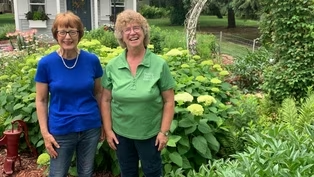
Pat Hein of Morris has designed her very own she-shed!
Pat Hein of Morris has designed her very own she-shed to keep her yard tools, over-winter her plants, create lovely planters and relax with a good book too!
Problems playing video? | Closed Captioning Feedback
Problems playing video? | Closed Captioning Feedback
Prairie Yard & Garden is a local public television program presented by Pioneer PBS
Production sponsorship is provided by Shalom Hill Farm, Heartland Motor Company, North Dakota State University, Friends of Prairie Yard & Garden, and viewers like you.
Support provided by:


Prairie Yard & Garden
Pat’s Place: She Shed and more!
Season 34 Episode 1 | 28m 45sVideo has Closed Captions
Pat Hein of Morris has designed her very own she-shed to keep her yard tools, over-winter her plants, create lovely planters and relax with a good book too!
Problems playing video? | Closed Captioning Feedback
How to Watch Prairie Yard & Garden
Prairie Yard & Garden is available to stream on pbs.org and the free PBS App, available on iPhone, Apple TV, Android TV, Android smartphones, Amazon Fire TV, Amazon Fire Tablet, Roku, Samsung Smart TV, and Vizio.

Visit the Prairie Yard & Garden Website
Do you love gardening? Consider becoming a friend of Prairie Yard & Garden to support this show and receive gifts with your contribution. Visit the link below to do so or visit pioneer.org/donate.Providing Support for PBS.org
Learn Moreabout PBS online sponsorship(light chiming music) - I get a big kick out of the commercial on TV about a lady and her she shed.
We hear about a man cave quite often, but a she shed is not that common to me.
So imagine how my ears perked up when I found out there is a master gardener who has her own she shed, a lovely yard, and beautiful planters too.
I'm Mary Holm, host of "Prairie Yard & Garden."
And let's go see these special things as we visit Pat's place.
- [Announcer] Funding for "Prairie Yard & Garden" is provided by Heartland Motor Company, providing service to Minnesota and the Dakotas for over 30 years, in the heart of truck country.
Heartland Motor Company, we have your best interest at heart.
Farmer's Mutual Telephone Company and Federated Telephone Cooperative proud to be powering a Acira, pioneers in bringing state-of-the-art technology to our rural communities.
Mark and Margaret Yackel-Juleen, in honor of Shalom Hill Farm a nonprofit rural education retreat center in a beautiful prairie setting near Windom, Minnesota.
And by friends of "Prairie Yard & Garden," a community of supporters like you who engage in the long-term growth of the series.
To become a friend of "Prairie Yard & Garden," visit pioneer.org/PYG.
(pleasant acoustic guitar music) - When we got married many years ago, Tom sold his motorcycle so we could afford to buy furniture for our house.
Our goal was always to be able to afford to have another motorcycle for Tom.
Well, that happened a few years back, and he loves his bike.
The only trouble is, his beautiful bike sits right in front of my garden tool rack.
I am so scared that one of these days I'll drop my hoe and scratch his bike.
I need to find out more about Pat Hein's she shed and how she uses it for her gardening.
Welcome, Pat.
- Thank you.
- Pat, how did you get interested in gardening, and how long have you been doing it?
- We moved into this house in 1984.
But previously, in the other house, I was also gardening.
I've been loving gardening for years and years, and it just keeps expanding and expanding.
So it seems like it's gone all the way around the house even.
- [Mary] Well, how did you get started here on your yard?
- [Pat] When we moved in, there was a quarter of a garden.
And I thought, "Oh, I don't really like those, "what they put in there."
So I took everything out and then started again.
Gradually worked it out so every two weeks in my garden, something is growing and blooming.
So it took me a long time to get that far, but it works perfectly.
- [Mary] You live kind of towards the edge of town, and so did you plant anything special for windbreaks too?
- [Pat] Yes, I did.
These evergreen trees, my son and I planted many years ago.
And then I also have planted magnolia bushes and arborvitae, which I learned is not a good thing to plant by a highway because of the salt issue.
And the salt kills the plant.
- Now, do you use mostly annuals or perennials or some of both?
- Around my house, in the pots are all annuals.
And then I winter them in my she shed.
During the winter, I'm snow blowing all the way across there, trying to keep that open.
So that only like three or four times during the winter do I go in there and water something.
- [Mary] So again, since you live towards the edge of town, do you have trouble with critters?
- [Pat] Oh yes, I do.
Raccoons and skunks and rabbits and mice.
Those are probably the four biggest.
It was so bad last year that I had to put this fence up this year.
And this is the first year my garden has done so beautifully.
And it's because there are no rabbits that can get into here.
- So tell me, what are probably your three or four most favorite plants that you have in this beautiful area?
- My lilies are the big thing.
I have every kind of lily that you can possibly imagine, even including Asiatic lilies.
They are very, very special lilies.
I've got yellow, orange, burgundy, every color you can think of.
And they're all from friends.
I don't think I bought any of them.
They have happy memories, because every time I get them from a friend, it was, "I got this from Patty.
"I got this from, these are hydrangeas "and I got this through my brother-in-law."
This was one of the very, very first plants.
And it was a little tiny plant, and now look at it.
It's just really gone to town.
I've tried all kinds.
The purple ones do not seem to grow as well.
The pink ones, I have no problem growing.
And I use some acid in there to make 'em stay pink.
I planted them in the front, but I saw they were getting too big.
So then I planted them in the back.
And I'm going to try that.
And they seem to be thriving.
The daisies, I love little kids walking through them.
So I always tell the kids in the neighborhood, they know how to open up the gate, and they can run through this, because we have little steps that go all the way around that they can play on.
So they're always welcome to.
And then I have little fairy gardens for them to play in too.
So that they can turn 'em around, they can play with them, and Grandma will finally put them back.
(Mary chuckles) It's just, the more kids over here, the happier I am.
- [Mary] Do you do your own mowing too?
- [Pat] I do.
I do everything.
My husband and I used to argue over who was gonna mow.
(Mary laughs) We really did.
And it was.
He ended up losing most of the time.
(laughing) - [Mary] Well, you must use a lot of equipment for the mowing- - I do.
- [Mary] And for your work in the yard.
Where do you store all that?
- Okay.
That is in my she shed.
And in my garage.
I try not to have too much in my garage because my garage is completely finished off and I've got two refrigerators in there.
So I entertain in there.
I clean everything out and try to put as much as I can in my she shed.
Because it was a play house.
My grandchildren were four years old and two months old when my husband died.
So that was in 2006 that he died.
In 2007, I had to go do something.
It was a playhouse, but now it is my she shed.
And I take and read in here, and my little dog and I just sit for hours, and we just listen to Pandora.
And I've got my book, and it's just wonderful.
Open up the windows, and away I go.
- [Mary] Who designed your shed?
- Marlin Baas, my next door neighbor, I designed it, but he built it.
So I'm an interior designer.
So I needed to keep something, keep me busy after my husband died.
I went over to Marlin's and asked him if he would build me a playhouse because my grandkids were four.
I have two four-year-olds, and it was two months old.
And I thought, "I have to have something "to keep my mind occupied."
So we started out with a small house.
And I said, "No, no, no.
"I want this the full size of a garage."
And then he started in, and I told him, "This is what I want, and this is what I want."
And I ordered everything online, from the planters to the filigree up there.
It's just everything I had uniquely done.
Between the two of us, we did, I think, a pretty good job.
(laughs) - [Mary] What is it like inside?
- Well, I decided to have two levels.
So as you go in, that is where I sit.
And then they go up the little stairs, and there is a place where they play.
And they look down through the little bars, and they see Grandma there sitting.
So everything is good there.
And then I decided, in honor of my husband, to have a storage shed in back.
So I put my lawnmower in there and all my garden supplies.
So when I come to winter, everything, it all goes into my she shed, which I really enjoy.
Not everything lasts, but pretty much I don't have very much overhead.
My geraniums are my best thing to overwinter because they go dormant.
But the rest of them, I have had no problem.
Even my pansies.
I can't believe it.
They come right back.
And I don't have to water 'em very much.
All of my succulents go in there.
And they last.
I only water probably three or four times a year during the winter.
And I keep it at 45 degrees.
And it is heated.
Everything is heated.
The storage shed is heated, and the playhouse, or my she shed, is heated.
And I like to think of it as my she shed because my kids, my grandkids, are all grown up.
But now, I have so many neighborhood kids coming over that it's such a joy to watch them play.
And again, I'm sitting in my chair and watching them play.
So it's really neat.
- So you use it in the summer and in the winter.
- Right, right.
I can still remember running out without any coats on, my grandchildren, and we're running into the playhouse so that we can play.
And running back.
We didn't have to have any coats on because it's so close to my house.
- Well, do you have another door on here?
Because I can't imagine you getting your equipment in and out here.
- Right.
I've got a regular garage door in the back.
And I opened that up, and then I take everything out that I need to take.
Especially my lawnmower.
That has a swan on it.
And my husband put a swan on it from his truck.
So it's a special lawnmower.
And every time I've had to have a new lawnmower, I put that swan back on.
- [Mary] Okay.
(laughing) So is there a division in between the two?
- There is.
There is a division.
I don't want the kids messing in the storage shed.
So I immediately tell them, "You can't go in the storage shed."
I just don't want any, I don't have chemicals in there, but I don't want them in the dirt and everything.
The potting, all of my potting stuff.
- Well, I was thinking that that would help keep things cleaner from the front and from the back, if there's a division in there.
- Right.
Right.
And if they don't put the toys back, Grandma's okay with that.
It's just fine.
'Cause Sophie and I just sit in there and put the stuff back.
And it's just, I smile because I see the kids playing still.
It's every day they use it, and it makes my whole day when they can come over.
- When, about what time of year then do you gather some of your planters and get them ready to put into your she shed?
- I do that before it's going to freeze.
I'm very careful about watching the temperature.
And then I start, and I've got tables in there.
And then I bring the tables that I have out here.
And then I also use both of the front windows here and then the back window.
And then that's where all of my plants go.
And they thrive.
They do beautifully in there.
I'm very surprised that they do so well.
I think it's because I have them up on different sections when I put 'em up there.
- Do you, when you bring 'em in, do you put them into the shed part or into the she shed part?
- Both.
Both.
- Do you put anything on the floor to help keep it clean?
- Nope.
Mm-mm.
I can just vacuum that up.
I've got carpet in there.
It's just very thin carpeting.
And no, I just vacuum it up, and it's just fine.
- Then how do you acclimate the plants to get 'em ready to put out in the spring again?
- Okay, what I do is I have French doors on my garage that leads out to my patio.
And that is where I put them.
And I don't open that up at all.
And that is round February that I do that.
And I cover them up, and then I put them in there.
My garage is heated too.
So I have them in there.
- [Mary] Do you cut them back then?
- Yes.
Immediately.
They are cut back to almost nothing by the time, especially the geraniums.
And they're left in their dirt.
So I don't take 'em out of their dirt.
I don't take them out of their pots.
Nothing.
I clip them off to just a little bit that's left.
- Do you clip them off in the fall or in the spring or both?
- In the fall.
In the fall.
And spring, if they're getting kind of straggly, then I do that.
But I have more luck doing it in the fall.
I am a proponent for doing everything in the fall so spring isn't as hard to do.
- [Mary] Well, you have beautiful planters here.
And those are real plants that are in there.
- [Pat] They are.
- [Mary] Do you take those planters inside then for the winter, or do you save those plants?
- [Pat] I save the coleus.
They are beautiful.
They work great.
And I just put them in a pot.
I have found that with coleus, a lot of people take and put 'em in water, and they do all of the, try to keep 'em together.
I stick them right in the dirt.
If one breaks, I stick it in the dirt, and it grows beautifully.
And it's surprising that that's all you have to do to coleus is just stick it in the dirt and will grow.
- [Mary] I noticed that you even have a barn quilt on your she shed.
- [Pat] I do.
- [Mary] Did you do that?
- [Pat] No, I did not.
I had that hired done.
I have one on the front side of the house, and I have one on the she shed.
I quilt.
So the one in the front is my grandson Abram's quilt that I actually quilted him a quilt, a cloth quilt.
And then this one I have on my she shed, I gave to a friend.
I have tried to give all of my quilts to friends so that they will always remember me.
- [Mary] And I see that you have a beautiful swag on your door.
Do you change that out according to the seasons?
- [Pat] Absolutely.
I have a whole, it's unbelievable how many I have.
Plus I do my daughter's.
And she doesn't even know it until she comes home and I've changed exactly.
And she just says, "Thank you."
(chuckling) 'Cause she knows my interior design is just, I'm gonna go for it.
(laughs) - [Mary] Well, it's a great thing that you have this place to keep your plants.
I noticed that you have the most wonderful planters around the yard.
Could we take a look at some of those too?
- [Pat] That would be great.
(soft acoustic guitar music) Mary, I would like to tell you a little bit about all of my planters and where I got them from.
I'm really proud of them in that I just find them, and they just speak to me, and I have to get them.
And when I get them, I have to drill holes in them always.
Because you have to have drainage in anything that you buy, be it wooden, metal, or anything.
It has to have drainage.
So my first one I got at Yesterday's many years ago.
And it is a real buggy.
And then it's got galvanized.
And when I saw that, it just called to me, and I had to have that.
And then I put in Supertunias in there.
And you can put anything in there, and it will grow.
- [Mary] Well, there's a piece, or there's two pieces here, that sure look familiar to me growing up on a farm.
- [Pat] Right, right.
They are milk containers.
And my stepfather gave me, that was one of the very first things he gave me.
I found these things at, it was Benson Drug then, and painted them.
And I put SunPatiens in them.
Two years ago, I found out when I went to a class as a master gardener about SunPatiens.
And they are just absolutely the best flower because they love sun.
And they're so delicate.
They're so pretty.
That they're just one of my favorite flowers.
- [Mary] And bloom all summer too, I'll bet.
- [Pat] They do.
And they get bigger and bigger and bigger.
They're just absolutely gorgeous.
- [Mary] And it looks like you really enjoy fairy gardens too.
- [Pat] I do.
These were bird baths.
And I was so sick and tired of cleaning up bird poop in there that I had holes put in 'em.
And I put them in for the children, the children around here.
And they play with them.
And there's one in the garden and another one here.
And they constantly are moving the things around and playing with them.
And that just gives me such joy.
- [Mary] Do you have like a color scheme and a different color scheme each year?
Or do you just find plants you like and put 'em in?
- [Pat] I find plants that I like and put them in.
And I try to be one of the first ones so that I can pick anything I want.
And then, like I said, I go in March, and then I'll go in April, and then I'll go in May.
And then I just get it as I go along.
And then I think, "Well, I need something for this, "and I need something for that."
- [Mary] I know this isn't a container, but it is a beautiful hosta.
- [Pat] This is a very unique hosta in that it's, if you feel the leaves, they are very thick with wax.
And grubs do not like them.
And they just keep growing, growing.
There's nothing you have to do except water them.
It's just keep the mulch away from them.
That's really important.
I do have a little mulch on there, but I try to keep it away from them.
- [Mary] Well, the slugs absolutely love hostas.
- [Pat] Mm-hmm, they do.
- [Mary] So it is so nice when you can get these varieties that are resistant to their damage.
- [Pat] Right.
When I learned about that, I was just, "I've got to find those."
And then I took and gave away all of my old ones.
And then I also put them underneath my evergreens and did not know that the deer and the rabbits would love them so much.
So now they are kind of little, tiny little things.
- Well, now here's something that I haven't fit into in years, is a school-house desk.
- [Pat] What's really unique to me is I had a planter here that was double.
And it broke off last fall.
And I decided, "How am I going to keep that?"
I didn't wanna throw it, because it's galvanized.
I don't throw anything.
I took this sphere and put it on top.
And then I thought, "I'm going to put flowers around that."
And it turned out just beautifully.
I'm really happy with that.
- Well, that is really a unique idea.
And I see, that's another thing that just really fascinates me.
- Right.
I just loved that one.
It has such special memories.
My children tried to redo the sewing machine, and they wrecked it, actually.
(chuckles) But it wasn't through their fault.
It was just, they were trying so hard to get it redone.
So I took the top off, and I always have it covered with plastic so that it stays, but you can't see it.
And then it has a lace tablecloth over it.
The lace tablecloth is my little thing that I do every year because it just reminds me of my grandma.
So I always put my lace tablecloth on there.
Now that's three planters, three copper planters.
And I've had them for a number of years.
And every time I get them, so many people want those copper planters because they're so unique.
But they're not hard to find.
I found those on the internet.
It's fun to create.
I love creating.
That's one of my favorite things.
Just like the alliums, as you see.
I never finish with alliums.
When they're done, I spray paint them.
It's just such a great thing.
And the kids get to see them, and they just have to feel the tops of them and everything.
Well, it's all kid friendly.
That's the thing.
They can run through my stuff, and I don't mind.
They can't hurt anything.
So it's just fun to create.
- [Mary] This is very, very welcoming to your front door.
- [Pat] Oh, thank you.
- [Mary] But do you have another area too?
- I do.
I have a patio that I'd like to show you.
- [Mary] Great.
(light piano music) - I have a question.
I've seen a living fence made out of willows.
How do you make one?
- Well, they're quite easy.
They look difficult, but they're really not.
When we started making this fence, we started in March.
And when are our whips, we call 'em whips, arrived, they were bare root with no leaves.
And so what we did is we used bamboo as the frame to hold on to the sticks.
And we tied all the sticks on there, and we crisscrossed them.
And in each hole we put two plants and then crisscrossed them.
And then they grew up.
And now we're planting them horizontal.
And then in a couple of years, we'll take the bamboo out.
And then the fence will be on its own.
And it's a Red Salix Flame Willow.
And in the winter time, all that top will shed its leaves, and there'll be red twigs.
And it'll be just gorgeous in the winter time with the snow on it.
And so, this is just not even a whole season.
We had a lot of suckers.
We picked all the suckers off.
And underneath it, we have a mesh that's made of coconut skin, that hairy part of the coconut.
And then there's a mesh in there to keep all the suckers from coming out.
- [Announcer] Ask the Arboretum Experts has been brought to you by the Minnesota Landscape Arboretum in Chaska, dedicated to enriching lives through the appreciation and knowledge of plants.
- Mary, let me show you how close my she shed is to my house.
It's within walking distance.
And it's just so much fun having a she shed.
I heartily recommend it for everyone.
Now, my favorite type of all of them is this Salesmen old-time washing machine, which is a wringer washer.
And I fill it up with plants and just leave it.
And it's just beautiful.
I love it.
- [Mary] So you really use a lot of antiques.
- I do.
Whatever I can find that calls to me is what I use.
- Well, this is a beautiful area here.
- Oh, thank you.
- This is, what?
On the west side of your home?
- [Pat] It is.
Yes, it is.
And I have grasses growing all over.
This is pampas grass, and it gets beautiful.
This I leave and cut down in the spring.
All grasses you cut down in the spring.
You do not cut down them down in the fall because they are so pretty in the winter to watch.
And you watch them sway.
It's very pretty.
And then I have my SunPatiens, which is, again, my favorite plant.
And I've got two huge plants like this, and they are doing so well.
I love the variegated leaves on them.
I guess that's my favorite part of that.
(chuckles) I also have a lot of fairy gardens that I like in here.
And this actually was in my office that I had because I like fairy gardens.
And then this was a trough that I had.
And I put a fairy garden into it.
It was actually, it truly was a feed trough.
- [Mary] Well, you actually have a lot of fairy gardens scattered around.
- [Pat] I do.
I do.
I have a lot.
It's fun to see what I have in each of them, because they're all different.
Some of them have fairies in them, but some of them have dragons and gnomes and just anything that takes my fancy.
And then I take all of my succulents, including my German Ivy and my begonias and everything.
And they go in the playhouse, or my she shed.
And I probably go in there three or four times during the winter and check on them.
- [Mary] Do you fertilize at all during the winter?
- [Pat] No.
No, no.
I'm trying to make them go dormant.
That's my one thing.
The geraniums, like I said, are one of my better plants to go dormant.
- Well, thank you so much.
- Oh, you're welcome.
- [Mary] For letting us come and see your beautiful planters and your yard and especially your she shed too.
Thank you.
- [Pat] You're very welcome.
(light acoustic guitar music) - [Announcer] Funding for "Prairie Yard & Garden" is provided by Heartland Motor Company, providing service to Minnesota and the Dakotas for over 30 years in the heart of truck country.
Heartland Motor Company.
We have your best interest at heart.
Farmer's Mutual Telephone Company and Federated Telephone Cooperative, proud to be powering Acira, pioneers in bringing state-of-the-art technology to our rural communities.
Mark and Margaret Yackel-Juleen in honor of Shalom Hill Farm, a nonprofit rural education retreat center in a beautiful prairie setting near Windom, Minnesota.
And by friends of "Prairie Yard & Garden," a community of supporters like you who engage in the long-term growth of the series.
To become a friend of "Prairie Yard & Garden," visit pioneer.org forward/PYG.
(pleasant acoustic guitar music)
Pat’s Place: She Shed and More!
Preview: S34 Ep1 | 30s | The 34th season of Prairie Yard & Garden premieres on Jan. 21 at 7:30 p.m. on Pioneer PBS. (30s)
Providing Support for PBS.org
Learn Moreabout PBS online sponsorship

- Home and How To

Hit the road in a classic car for a tour through Great Britain with two antiques experts.













Support for PBS provided by:
Prairie Yard & Garden is a local public television program presented by Pioneer PBS
Production sponsorship is provided by Shalom Hill Farm, Heartland Motor Company, North Dakota State University, Friends of Prairie Yard & Garden, and viewers like you.