
People and Nature
11/27/2025 | 26m 46sVideo has Closed Captions
NC’s coastal black bears, whales and microplastics, hornworms vs. wasps and algae in window panes.
How scientists study NC’s coastal black bear population using the hair they leave behind, why whales and dolphins confuse plastic bags for food and the science of insect flight. Also, meet the wasp that might be saving your tomato plants from hornworm caterpillars, and learn how microalgae in windows could save energy.
Problems playing video? | Closed Captioning Feedback
Problems playing video? | Closed Captioning Feedback
SCI NC is a local public television program presented by PBS NC
Sci NC is supported by a generous bequest gift from Dan Carrigan and the Gaia Earth-Balance Endowment through the Gaston Community Foundation.
People and Nature
11/27/2025 | 26m 46sVideo has Closed Captions
How scientists study NC’s coastal black bear population using the hair they leave behind, why whales and dolphins confuse plastic bags for food and the science of insect flight. Also, meet the wasp that might be saving your tomato plants from hornworm caterpillars, and learn how microalgae in windows could save energy.
Problems playing video? | Closed Captioning Feedback
How to Watch SCI NC
SCI NC is available to stream on pbs.org and the free PBS App, available on iPhone, Apple TV, Android TV, Android smartphones, Amazon Fire TV, Amazon Fire Tablet, Roku, Samsung Smart TV, and Vizio.
Providing Support for PBS.org
Learn Moreabout PBS online sponsorship- Hi there, I'm Frank Graff.
Tracking black bears from the coast to the mountains.
Why whales and dolphins keep eating plastic and the art and science of insect flight.
We're talking people and nature, next on Sci NC.
- Quality public television is made possible through the financial contributions of viewers like you, who invite you to join them in supporting PBSNC.
- Sci NC is supported by a generous bequest gift from Dan Carrigan and the Gaia Earth Balance Endowment through the Gaston Community Foundation.
(upbeat music) ♪ - Hi again and welcome to Sci NC.
You know, people usually think of black bears in North Carolina's mountains, but there is a large black bear population on the coast and scientists want to learn more about them.
Producer Michelle Lotker shows us how a device called a hair snare provides a wealth of information.
- 4:30 in the morning and I'm on the coast in North Carolina and we're gonna go look for some bears.
- This is one of the field crews that's been heading out every day to collect samples from over 1300 sites spread out across the East Coast of North Carolina.
And this is Kaitlin, research coordinator for the project.
- Kaitlin said people are often surprised to hear that there are black bears in coastal North Carolina.
- I like calling them swamp bears, but sometimes we call them beach bears.
Most people think of North Carolina bears, they're out in Asheville, they're out in the mountains, but we actually have some of the highest densities and some of the biggest bears in the state and the country here in Eastern North Carolina.
- Actually, we have more bears in Eastern North Carolina than up in the mountains.
We estimate around 11 to 13,000 bears in the coast and that actually makes North Carolina very unique in the Eastern United States.
North Carolina stands alone at, you're heading to the beach, you're likely to see a bear along the way.
That's pretty darn cool 'cause it's very exciting to see a bear.
I've been doing bear research for 26 years now.
I still get excited when I see a bear, it never gets old.
And the reason we have so many bears in Eastern North Carolina, it's just there's lots of habitat, fewer people and lots of food available, both natural and unnatural, such as agricultural crops.
- To learn more about how bears are dispersed across the diverse landscape of Eastern North Carolina, teams have been collecting data over the course of two summers.
And while it would be awesome to see a bear today, what we really wanna find are their hairs.
- So this is called a hair snare or hair sampling site.
Sometimes when we say snare, people think we're trapping bears, but we're not trying to trap bears.
We never have with this setup.
That's not the intent here.
The idea is that we set up this kind of barbed wire corral with usually three trees.
And we stretch this wire really tight between those trees so that if bears are in the area and they come to check out the bait that we hang here in the middle, they have to somehow climb over, under, or through the barbed wire and hopefully leave behind a hair sample.
That's what we're looking for right now is those little tufts of fur, those little hair follicles that they leave behind.
- Oh, there's a nice one right there.
Oh, look at this one.
Look at that.
- Oh!
(laughs) - Gloves and heat are used to prevent contamination between samples.
- We got a big clump of hair here.
We're gonna try and get as much of that hair as we can here in one pull.
- Each cluster of hair is carefully placed in its own envelope because what researchers like Fabian are really after from these hairs is the bear DNA attached to them.
A genetic study of this scale hasn't been done in the coastal black bear population.
- So we don't really know how genetically similar or how genetically different they are.
This study will unravel a lot of that unknown information and actually allow us to investigate that in detail.
That lighter part of the hair, sort of white, grayish, that's the actual follicle and that's what contains the DNA.
- Back in the lab, a set of bear-specific primers will be used to amplify and sequence specific parts of the DNA.
These sequences could be used to identify individual bears.
- I like to think of it like a code.
Organisms of the same species will share about 99% of the same code and that 1% is what makes us different.
- Besides hairs, the team is always keeping a lookout for other bear sign, like scratches on a tree.
- He's actually probably pretty fresh.
- Or other more scatological evidence.
- Some bear scat there.
Wanna go look at some poop?
- Sure.
- Oh yeah.
- Definitely some bear scat.
- Have you, can you tell what it's been eating?
- A lot of plant fiber.
- Yeah, not many seeds, so.
- So we do work on a lot of farms, so a lot of times you'll see, you know, anthropogenic food sources in the bear's diet.
Anthropogenic being like, humans planted this and the bears happen to be eating pieces, parts of it.
- A lot of the times these farms and these agricultural fields will border up against these like dense wooded areas.
So bears live in the wooded areas and then they'll come out for lunch, go back into the woods.
- Yeah, so here you can see that most likely a bear was having this for lunch.
They sort of eat it like we do.
- Bears are opportunistic in a similar way that we are.
I tend to eat what's convenient and what tastes the best and maybe has the highest, maybe not nutritional value, but caloric value.
I mean, they're super adaptable as a species.
They live in tons of areas across the country.
And so wherever they can find the resources to survive, they can potentially adapt to live.
- Although bear sign is abundant on the coast these days, that wasn't always the case.
- Black bears first are a wildlife success story, but we're fortunate about that because at one point in time, we hardly had any bears on the landscape.
- Black bears in North Carolina, historically were really found all over the place.
- All across the state.
- Following the arrival of an expanding human population, unregulated hunting and conversion of forest land to agricultural fields and urban development really pushed those bears out to the mountains and out to the swamps and pocosins in the coast.
- Pretty much by the 1970s, we had an estimated less than a thousand bears across North Carolina.
- Colleen says bear management efforts starting in the seventies, help restore and stabilize black bear populations in North Carolina.
- So we're at a place now that we've restored bears on the landscape.
Bears have adapted to living in a highly disturbed environment, living with people.
The future of bears really now relies on our people willing to adapt to living with bears.
This coastal bear research project is gonna be very impactful as we update our current bear management plan.
What is the state of bears in North Carolina?
Where are we now?
- We wanna get a better idea of what the coastal bear population looks like.
- And the more detailed population density data that the study is gathering will shine a new light on where bears are in the coastal landscape.
Current data describing North Carolina's coastal black bear population comes from a partnership with licensed hunters who send a very important pre-molar to North Carolina's Wildlife Resources Commission.
- There's a small tooth that's located behind the canine of a black bear.
And that is how we actually can age a bear.
The main way we've been monitoring trends in the bear population has been through pulling that tooth and getting that age at harvest, getting the sex at harvest.
We've been doing that since the eighties.
We continue to do it now.
And while we've been getting great information, a reliable population growth trends, the one thing that we've questioned is when it estimates how many bears are on the landscape.
- The bears that are removed from the population in a hunting season may not be necessarily representative of what bears in the overall population look like.
And so we wanna make sure that we're accounting for all of the bears that are out there and not just the ones that are getting harvested.
- So we recognize that we needed an unbiased way to estimate the bear population as well as the density of bears across that landscape.
And that's why we're doing this, what we call the hair snare study.
- This is a improved way that we can actually sample a non-hunted population.
It'll provide a lot more information than just relying on harvested individuals.
- A big part of bear management is actually people management.
But we are seeing more and more people who aren't used to seeing a bear and they're wondering what the heck do I do?
Well, one, if you see a bear, really that's exciting, really enjoy it, appreciate that moment.
You know, you're seeing something that represents a great wildlife success story, a success story all North Carolinians should be proud of.
The number one way we can assure bears remain a success story in North Carolina is people.
People being tolerant of them, people learning to live with them.
Because again, no matter now where you are in North Carolina there's a chance you're gonna see a bear.
And so if we can get people to continue to accept bears on the landscape, living with bears, we can better assure that the success story we have now continues for generations to come.
- Whales and dolphins use echolocation to find food.
Sound waves are sent out, the reflection back indicates the prey's location.
Now to us, that reflected image might not look like a fish.
But as producer Evan Howell explains, a whale using echolocation doesn't sense it that way.
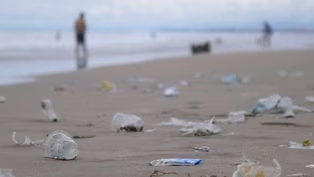
- When you're heading out for dinner, imagine mistaking a shoe for an octopus or a plastic cup for a mackerel.
(whale calling) That's essentially what's happening beneath the waves.
So some marine life are getting tricked.
Researchers are asking why plastic confuses some of the ocean's most intelligent creatures.
Toothed whales like dolphins and other creatures that use echolocation to find food.
Welcome to the RV Shearwater.
It's a 77 foot research vessel dedicated to collecting troves of data on trips that last as long as a week.
They gather data using special equipment that includes some that they've even stuck on the bottom of the boat.
- This is an echo sounder.
And what it does is it uses different frequencies of sound to identify objects.
So like down here on the bottom, we've got the sea floor and these objects passing by underneath the boat are either fish or plastic debris, for example.
And what we used it for was to see the intensity of the signals.
(water bubbling) So the question becomes, how is it that they are, why are they eating plastic instead of food?
Are they misperceiving their acoustic senses?
- Let's look at how echolocation works.
A toothed whale like a dolphin will send out a series of clicks to find out where the prey is.
The acoustic signals that bounce back tell them what's available to eat.
Since they swim shallow, dolphins use eyesight as well.
For other whales that go deeper to look for food, echolocation becomes more important since it's darker and they don't have any visual cues.
The density of the object correlates to what they call the intensity or target strength of the object, or how strong an object sends back that signal.
They found that fish and plastic can sound the same to a whale.
- On the top of their skull, they'll have a melon, which is an organ that produces sound.
And they use it just like sonar.
They're sending out sound signals and hoping it hits prey and bounces back to them.
And they interpret that sound through the lower jaw.
So there's fat on the lower jaw and that sound is received through the lower jaw and then goes up to the inner ear where it's interpreted by the brain.
- So they are eating plastic, but the plastic they're finding in whales isn't just coming from a case of mistaken identity.
It looks like a lot of it has already been in the food chain for a while.
So far, he's found microscopic elements of things like polyester and plastic bottles.
- Microplastics are ubiquitous.
They're everywhere.
The primary way that they're ingesting them is through what we call trophic transfer, meaning they are ingesting food that has already ingested plastic.
The fish have eaten the plastic, the squid have eaten the plastic, and then it ends up in the whales.
- Scientists are learning more about the plastic problem by performing necropsy of dead whales.
They've also devised a unique way to collect tissue samples from these animals and it helps them get a wider and more complete picture of what's going on.
- So this is a crossbow and we use it to biopsy the animals, the whales.
So we take this modified bolt and it's got this tip on the end of it, which will take a pea-sized sample of skin and blubber tissue from the whale when it hits it.
And then we'll take that tissue sample back to the lab.
- What is for dinner?
(laughing) What do we have here?
- So this is our freezer where we keep a lot of our marine mammal samples.
- Could you hold that up a little bit?
What is this?
- So this is the dorsal fin of a pilot whale.
I know it's hard to see in the plastic, but it gives you a sense of the scale of how big a pilot whale is, about 18 feet.
- Wow.
- Blubber tissue is one of the really important ones we take.
So the outside layer is important for thermoregulation.
It's what keeps the animal warm.
And then the inside layer of fat gets mobilized and reforms.
This is the metabolic layer, the layer that's actually used for energy.
Take that sample out.
- They need to dissolve the blubber using a special chemical agent and place it through a filter with holes about the size of the height of a CD disc.
This whole process takes about a week.
- And you're looking kind of for like a needle in a haystack.
In this case, in the blubber tissue, we've found maybe one particle in about a two inch chunk of tissue.
So we don't have a good estimate yet of what that means for the whole animal, but we know that it is there.
- No doubt.
In fact, they haven't arrived on an exact amount of microplastic these echolocating whales consume annually.
But a 2022 study estimated that other whales like filter feeding blue whales might consume as much as 95 pounds of plastic per day.
Is there an answer to the problem of plastics and microplastics?
- I mean, in my opinion, it's a policy solution.
We need to just stop using and producing as much plastic as we do.
There are real legitimate uses of plastic, like in the medical sector, keeping things sterile, but things like single use plastic, we just create so much unnecessarily.
- With each discovery, researchers are getting closer to understanding how whales navigate a noisier, plastic-filled world.
And that knowledge could help teach us all how to reduce our use of plastics so others can thrive.
- Energy conservation not only saves money, it also helps save the planet because less power is needed to heat or cool buildings.
As you can imagine, good windows are important, which is why the windows being tested at UNC Charlotte are so unique.
- Buildings consume 40% of the United States energy and 70% of the electricity.
They also are emitting around 40% of the carbon emissions from the operation of the buildings.
The reason I was interested in looking into microalgae as a building material is their ability to replenish by themselves, while also giving the benefits to the built environment.
Microalgae cells act like human sunglasses.
Where the sun is very intense, they can grow faster, increase the density of the cell growth, such that they can block the unwanted sunlight during the summer.
And during the wintertime, when the sunlight is weak, they will grow slowly, and they can maximize the winter sunlight such that we can reduce the use of the heating equipment.
- Before coming into the architecture program, I studied biology for about eight years.
So I know a lot about algae in the environment.
It's using algae in a more positive way, and it's taking advantage of some of the useful properties of algae, such as carbon sequestration.
(upbeat music) - Sustainability is one of my passions.
And honestly, this class is showing me the different depths that you can take algae biomass, whether it's construction or architecture, the different ways that you can use it and to push innovation in a different light, in a different way.
It's pretty amazing.
(upbeat music) - Innovation Barn demonstrate a lot of circular economy, technology and innovation.
Putting the technology out there in the center of the city, we will attract more public and demonstrate the benefits this technology could offer.
- I'd really like to see the public interact with the windows and see the potential for the use of microalgae in building systems.
- Getting to see how people interact with it, their perception, do they accept algae-based technologies?
Is it something that they wanna see?
Is it something that they appreciate?
Do they know more about it?
Do they wanna get to know more about it?
- Architecture always has the stigma of like sustainability, just being, you know, putting sensors on lights or making windows that open so that you can get cross breeze.
But it's really important to further those concepts and incorporating an entirely new system like this into sustainable design will really help us push the limit of what we can do for sustainable architecture in the future.
- Through the integration of this kind of nature-based technology, I like to find ways to make the buildings less environmentally impactful.
- Dr.
Kim is very passionate about her work.
You know, we tell that from day one, she walked in and immediately started teaching us about algae, you know, without skipping a beat.
It was fantastic.
- Being able to think outside of the box, being able to collaborate with others, it's been a great learning experience.
(upbeat music) - When it comes to people and nature, insects are the creatures we most interact with.
There are so many insects.
Even if insects make you cringe though, there is no denying they are amazing creatures and there is beauty in their flight.
Here's entomologist Adrian Smith at the North Carolina Museum of Natural Sciences.
- These are two species of crambit snout moths.
Filming ordinary insects like these in flight has led me to some surprising places.
For instance, this recent six page spread in National Geographic, featuring insects, mostly from my backyard, that I filmed right here in the lab.
That project was an art collaboration where the raw materials look a lot like this.
Portrait footage in slow motion of insects taking flight.
Now, when I film an insect like these basswood leaf-riller moths, I'm not trying to make art.
What excites me about this footage and why I do it is because of all the detail you get to see and what that can tell you.
For instance, the behavior and the backward arching flight of the moth you just saw is nearly identical to what this one does, a grape leaf-roller.
I didn't know when I filmed this, but these moths are closely related to each other, belonging to the same moth subfamily.
So it's likely these similar behaviors reflect how close these moths are on the tree of life, which I think is a pretty neat thing to capture.
So a few years ago, an artist in Spain saw some of my insect footage, like what you just saw, and reached out to start a collaboration.
His name is Xavi Bou, and you might have seen his work on birds before.
Xavi's ornithographies project captures birds in flight.
These images show patterns, shapes, and movements across time.
They reveal nature in a new way, slightly beyond how we can normally see it.
The still images he creates start as a video, and then they're split into frames and stitched together, revealing traces in the sky.
It's different from long exposure in that these aren't blurs of motion.
These are composites of singular moments in time presented together to show you what these animals are doing.
Xavi's goal of seeing nature in a new way through art is the same as my goal in doing science.
When I work on things, including these videos, I'm trying to see and present nature in a new way.
So working together on this project was an easy fit.
I'd film insects here in the lab and send Xavi the footage.
He splits it into frames, just like with the ornithographies project, and merges them together for an altogether different kind of portrait of an insect in motion.
We did all sorts of species, from spittlebugs to beetles, stoneflies, and of course, butterflies.
My favorite part about publishing this in National Geographic is we ended up showcasing ordinary bugs.
Literally, these two are from my backyard, and this moth is from my mother-in-law's yard.
Usually, I think of National Geographic as filled with images from far off, remote places, but these are all types of insects you probably have around your yard too.
Some of my favorite images from our project are species you've seen on this channel before.
This is a two-lined spittlebug.
These plant-feeding insects use their spring-loaded hind legs to blast off into the air.
Then they quickly transition to a flapping, wing-powered flight.
This image is a series from an Ailanthus webworm moth.
These brightly colored moths are common, and in this still image of flight, the stacked up sweeps of each wingbeat kinda look like an underwater kelp forest or some feathery glass sculpture.
Of course, some of the most striking images were broad-winged, brightly colored butterflies.
For these, I worked in our museum's walk-in tropical forest exhibit, The Living Conservatory, which has several tropical species free-flying in the exhibit.
While most of the other footage was gathered at 4,000 or 6,000 frames per second, butterflies have relatively slow wingbeats, so the starting footage for making those images looks a lot like this, which was filmed at 1,500 frames per second.
Overall, we have dozens of images in this project, and I think they do what we hoped they would.
I think they present us a different view of these organisms.
They show us the color, chaos, and complexity in just a tiny sliver of their lives.
Because these are singular moments merged together, they make me think about how much mystery there is in just the small fractions of a second that are captured.
In each one of these insects, I think there's a deep well of things to find, appreciate, and learn about.
Okay, let's end this video how it started, with a new piece of flight footage that matches with the first two.
This is a bicolored pyrosta, another crambed moth, but from a different subfamily than the ones at the beginning.
Just like with those other moths, this one starts with a small jump, then reaches and almost climbs up into the air with its legs outstretched.
The initial flight paths are a little chaotic, but they manage to direct themselves, artfully I think, up and away.
Thanks for watching.
- Nature in a new way, that is so cool.
And that is it for Sci NC for this week.
If you want more Sci NC, be sure to follow us online.
I'm Frank Graff, thanks for watching.
(upbeat music) ♪ - Sci NC is supported by a generous bequest gift from Dan Carrigan and the Gaia Earth Balance Endowment through the Gaston Community Foundation.
- Quality public television is made possible through the financial contributions of viewers like you, who invite you to join them in supporting PBSNC.
Video has Closed Captions
NC’s coastal black bears, whales and microplastics, hornworms vs. wasps and algae in window panes. (20s)
Providing Support for PBS.org
Learn Moreabout PBS online sponsorship
- Science and Nature

Explore scientific discoveries on television's most acclaimed science documentary series.

- Science and Nature

Capturing the splendor of the natural world, from the African plains to the Antarctic ice.











Support for PBS provided by:
SCI NC is a local public television program presented by PBS NC
Sci NC is supported by a generous bequest gift from Dan Carrigan and the Gaia Earth-Balance Endowment through the Gaston Community Foundation.