Careers that Work
Pharmacist
Season 3 Episode 4 | 4m 8sVideo has Closed Captions
Explore the life of a clinical pharmacist and their impact on patient care in this career spotlight!
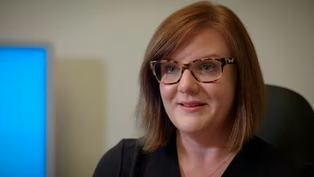
Discover the role of a clinical pharmacist in this episode of Careers That Work! Follow Katie Moore, a Clinical Staff Pharmacist at Lehigh Valley Hospital–Hazleton, as she shares her career journey, education path, and daily responsibilities. Learn how pharmacists ensure medication safety, support patient care, and maintain work-life balance in this high-demand healthcare field!
Problems playing video? | Closed Captioning Feedback
Problems playing video? | Closed Captioning Feedback
Careers that Work is a local public television program presented by WVIA
Careers that Work
Pharmacist
Season 3 Episode 4 | 4m 8sVideo has Closed Captions
Discover the role of a clinical pharmacist in this episode of Careers That Work! Follow Katie Moore, a Clinical Staff Pharmacist at Lehigh Valley Hospital–Hazleton, as she shares her career journey, education path, and daily responsibilities. Learn how pharmacists ensure medication safety, support patient care, and maintain work-life balance in this high-demand healthcare field!
Problems playing video? | Closed Captioning Feedback
How to Watch Careers that Work
Careers that Work is available to stream on pbs.org and the free PBS App, available on iPhone, Apple TV, Android TV, Android smartphones, Amazon Fire TV, Amazon Fire Tablet, Roku, Samsung Smart TV, and Vizio.
Providing Support for PBS.org
Learn Moreabout PBS online sponsorship(upbeat music) - One of my coworkers said to me that we're jack of all trades, master of none.
And no truer words could be spoken because it seems like every day is different in some capacity.
I am Katie Moore.
I am a clinical staff pharmacist at Lehigh Valley Hospital in Hazleton.
This is the IV lab.
This is like a sterile area.
I always was exposed to taking care of people in some capacity.
My family ran a funeral home, which my home growing up was attached to, so I always had a respect for people that way.
And my dad was a very good nurse who worked for Hazleton General Hospital for years and years.
And so, I was a junior volunteer for the hospital, and then I became an intern.
Okay.
Good job.
(lively music) (bright music) Ooh.
Hey, Liz.
My educational path to becoming a pharmacist was graduating from high school.
I attended Hazleton Area High School and graduated in 1998.
From there, I began my college career at Wilkes University.
I earned a Bachelor of Science degree in 2002, and my Doctor of Pharmacy degree in 2004.
(bright music) Some of the tasks that I do on a daily basis is checking in with the patient inventory, if you will, in our hospital.
Did you see that the OR used the Activase upstairs?
Who are the most critically ill patients?
Where are they located and what do they need first?
Who's going in the OR?
Who's having surgery today?
What do they need?
And so we make sure that the medications are prepared for them, tailored to them, for their specific need, and we make sure that they're correct and safely delivered on time.
For me, the most rewarding thing is when a patient says thank you to me.
Although I don't see patients one-on-one every day, we do offer discharge counseling on the way out.
(door knocking) Knock, knock.
Hi, can I come in?
- [Patient] Oh, please.
- Hello.
My name is Katie, I'm from the pharmacy.
I'm a pharmacist.
Is it okay if I join you before you hit the road?
- [Patient] Oh, absolutely.
- And when somebody says thank you or just acknowledges or has a nice conversation with me, that means the world.
How did medications go?
I saw you were on something new.
- Yes, yes.
- Yeah, what's going on?
To succeed as a pharmacist, you kind of have to roll with the punches because you never know what's going to happen, what kind of patients you're going to get, what kind of challenges you're going to encounter.
But you also have to be very analytical because you have to take into account a whole plethora of information when you're making sure a patient is getting the correct medication.
(bright music) What keeps me motivated to keep going as a pharmacist and keep working in this field are my children.
And my husband and I are visible at most of their activities.
We just, we love going to their events, their sport things, their recitals, their theater productions, everything that we can.
And as a family, we enjoy fostering kittens.
I have a good life-work balance.
I'm able to do the things that I want.
I'm able to afford the lifestyle that we have, and it's close to home for me.
(bright music) I love working as a pharmacist because there's always going to be a need, people are always going to need prescriptions, whether it be a patient directly or helping out a nurse that's having a problem with a patient on the floor with medication.
They're always going to have questions, they're always going to have issues that arrive, and they're always going to need to talk to a pharmacist.
(bright music ending)
Video has Closed Captions
Clip: S3 Ep4 | 4m 24s | ¡Explore la vida de un farmacéutico clínico y su impacto en la atención al paciente en este foco pro (4m 24s)
Providing Support for PBS.org
Learn Moreabout PBS online sponsorship

- Home and How To

Hit the road in a classic car for a tour through Great Britain with two antiques experts.












Support for PBS provided by:
Careers that Work is a local public television program presented by WVIA