
Philadelphia High Schools
Special | 28m 51sVideo has Closed Captions
This episode features Simon Gratz High School and West Philadelphia High School.
Part one of this episode focuses on Simon Gratz High School, where a group of educators created a culture of care to intervene in the impacts of gun violence on the student body. Part two explores the history of West Philadelphia High School, which today cultivates a very active community of esteemed alumni.
Problems playing video? | Closed Captioning Feedback
Problems playing video? | Closed Captioning Feedback
WHYY Presents is a local public television program presented by WHYY
Philadelphia High Schools
Special | 28m 51sVideo has Closed Captions
Part one of this episode focuses on Simon Gratz High School, where a group of educators created a culture of care to intervene in the impacts of gun violence on the student body. Part two explores the history of West Philadelphia High School, which today cultivates a very active community of esteemed alumni.
Problems playing video? | Closed Captioning Feedback
How to Watch WHYY Presents
WHYY Presents is available to stream on pbs.org and the free PBS App, available on iPhone, Apple TV, Android TV, Android smartphones, Amazon Fire TV, Amazon Fire Tablet, Roku, Samsung Smart TV, and Vizio.
More from This Collection
A community history project from Scribe Video Center taught video production to Philadelphians embedded in the local neighborhoods to show you what makes them so special.
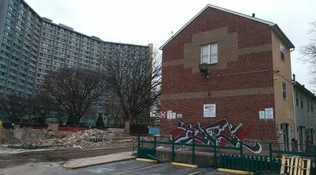
Housing Issues in Philadelphia
Video has Closed Captions
This episode features the UC Townhomes in West Philadelphia, and Elder Abuse in Housing (25m 39s)
Providing Support for PBS.org
Learn Moreabout PBS online sponsorshipMajor funding for this program was provided by-- [INTERPOSING VOICES] --the community of West Philadelphia.
[INTERPOSING VOICES] People are saying, I'm here.
I'm alive.
I exist.
[MUSIC PLAYING] I live up there.
I live up there.
I live up the street.
I live up there.
I live up there.
I live up the street.
I live up there.
[MUSIC PLAYING] Like, Gratz was popping.
They had every and anything, any type of activity, any type of event they had.
I saw a community.
- Gratz was a part of me and a part of my DNA even before I got here, although I was never a student.
- My mother was a 16 year old student pregnant with me attending Simon Gratz and here I am as an adult working here.
- All of my mother's siblings went to Gratz.
My brother-in-law went to Gratz.
- When I was in high school, Gratz was the athletic powerhouse.
They were known for track.
They had Rasheed Wallace, Aaron McKee.
So this was the sports school.
I also remember being a native Philadelphian when grads had 3,500 students.
The challenges were great within the city and mastery was coming in and we had a promise that we wanted to see students excel academically.
We went out and we talked to them.
We knocked on their doors.
We walked into their homes.
As a dean, I was recruiting on the street.
Sometimes we were walking into the projects.
Sometimes I walked through doors that had bullet holes in them.
- Coming to Grass was really challenging for them 'cause they were like, it was really super structured.
- My main goal was to be better than what I was raised around.
- We don't know the hell that they're going through at home and we saw that and we saw that before they were our students.
- At home wasn't the best.
So being at school was just like another thing to deal with before I had to go back home.
An educator within the urban context has to know that what happens in the outside of the classroom walls and building, they absolutely impact inside the building.
Neighborhood schools are microcosms of the neighborhoods that they're in and so they already bring community with them.
The teachers that were here, the teachers who wanted to, who were in ninth grade academy, wanted to be a part of ninth grade academy.
And the ninth graders are isolated and we can work on them, not only academic wise to grow them, but also to immerse them into like the ways of, of grass and mastery in the vision of that they want to see from this school.
Some folks coming in was like, no, you're going to respect me because fill in the blank.
I'm your teacher.
I'm an adult.
And honestly speaking, there's no respect to person.
It's respect to what and how are you caring for me?
Because we were in just this one little portion of the building.
It was set up for this nurturing, right?
Like we were just all there and all on top of each other.
And so they were with us and it fostered this closeness.
It became more like a family than just like a school.
James, Bay, Parker, we had a deep relationship and brotherhood among us.
We saw something within one another.
First of all was the dedication to the mission.
Parker and I used to actually meet before school for prayer.
Certain staff that see value in our students and didn't just look at them as a number or a statistic.
The village has to be a collective and a collective humility to say like, "Hey, I can't do this by myself."
Those who took the posture of learner I think were the most effective educators.
They're just looking for a connection.
That's all they want.
So if the connection is negative, they're going to go all in and lean into that.
It's very easy to identify the data points, the stats around whether it be gun violence or poverty or food desert, but it's a very different experience when you're in it.
I enrolled myself here at Gratz .
I just remember us writing on the board, "Choices."
I'm having these conversations with these young men every week, but I'm a woman.
Their teachers are women.
A lot of them live in single-parent households, and grandmoms, aunties, where are the men.
And I was just like, let me lean into the brothers I got access to.
Number one, that the kids trust, like, and respect, and they know.
The male empowerment program, the very first meeting, was actually in my classroom.
It was just a meeting for young men.
And it was a lot of young men who were going through things.
It wasn't a script.
It was just a natural occurrence.
I just saw the problem of our boys rotating to placement in jail every weekend.
And I just-- I wasn't having it.
It was for a lot of young men who behaviorally were high flyers.
You had kids that were stick-up kids.
It was stick-- you-- and wouldn't care.
Your mom, your grandmom, and then, you know-- and then buy you something with the money that they stole from you.
I don't care about any type of stats or any type of measures that other people would deem as this is what is success.
And I care about you.
And sometimes they needed discipline.
But a lot of times, they needed that discipleship piece where they were being taught or retaught something.
They didn't only hear from us, but they heard from some of their peers who had just went through some real life experiences.
I taught Safik in ninth grade in African-American history.
Some would describe him as my school son.
He was he was a young man that literally lit up the room.
He may not have had any leadership titles that I know of, but he was the leader of this of that class and arguably the school.
Safiqa got in trouble in Mr.
Pripty's class.
He was with us for the majority of the day because he was acting a whole plum fool.
[MUSIC] Mr.
Parker was the one who called me.
I'm not gonna forget it was on a Friday night.
I'm in my apartment, watching TV.
He calls me about what happened to Syphie and how he died.
And I literally laid in the floor for about an hour or two just crying like I lost my own son.
I could be as vulnerable as I want, I could express how I feel, I could let all my emotions come to the table.
So like, that's a way to relieve myself.
They started to connect as brothers in school, even though they might have been from different blocks and neighborhoods that would not associate with each other.
So then when you left Maryland Power, there was an expectation that you take that information and do something with it.
These two boys came back the games and said, we were at an ATM.
We're about to rob a old head.
But we thought about the word that you said during the session.
And that's what let me know that we had something.
>> Entering school after the loss of life and to have students crumbling your arms in the hallway.
It changes you.
>> But seeing how the rest, the atmosphere of the school switched after that.
>> Coming out of grads, I didn't get to see a lot of my friends graduate.
I got friends that either fell victim to the incarceration system or fell victim to the game of the streets.
I believe it was at the end of the 10th grade, right before summer 2014, one of the people from my friend group got killed.
That's when I started looking at my own mortality.
We lost a lot of people.
It just seemed like it was happening constantly.
So far as Jameer, he got killed by a straight bullet.
It wasn't even like no beef type times.
We all were in the honors cohort, right?
So naturally we were the kids that thought we were the smartest and the brightest.
To see his life taken from him early was definitely a wake up call.
Can you come from a particular place?
Things can be cut short.
>> But with Reggie though, I feel like that really, really like affected me a lot.
>> And then that's when I started realizing, this is happening more than I thought.
>> Reggie was like a smart student.
I'm thinking you want to graduate college and all that.
Like, this is how you end up in that.
I was like, okay, I can stay out of problems, but that don't mean problems won't find me in one way or another.
So being a kid and understanding that you're losing friends to gun violence early is never going to be an easy thing, especially when you feel as though you could have all been doing something really substantial with your lives, right?
I used to have post-traumatic stress, brother.
Like, I was afraid to answer the phone on Friday and Saturday nights.
There wasn't a weekend we didn't watch the news or text each other just to check and say, "Okay, did you see this?
What street or what block, what hood are they from?"
Because we knew that our kids were from certain hoods, and so we would know the likelihood of maybe if our kids weren't involved, they still may have been impacted by an incident of community violence.
And we wanted to make sure that when they got to school on Monday, that we had buffers.
Everybody was in their positions.
We knew what role we were going to play, and to make sure we supported the kids and also supported each other.
Things that may have been uncomfortable to you at one point, they become comfortable.
To say I love you, or to say I want to see you in school on Monday.
Sometimes you have to hunt for your happiness.
During community meetings, students would be so excited.
Students would just go crazy for these competitions and supporting one another and having pride not only for their grade but for the community as a whole.
So anytime you would hear that, "Tell me who's in the house tonight, Bulldogs!"
Everybody gets hyped and they're ready, like it's about to blow the roof off like a concert or something.
There also was another way for us to connect to each other.
That's how we dealt with the stress, the trouble.
We did not even realize it was so organic.
People don't go into education to lose students.
So the fact that that's become a normal part of educating students means that something is drastically wrong.
- In our cases, oftentimes it brought people together, which was beautiful to watch.
- And one student asked me, he said, "Why you come back and teach this?
"Like, people keep dying.
"Like, why you do it?"
If I can have a conversation with one and change their mind about their decision, it's worth it.
The fact that we planted that seed back then, and they still have connection to my brothers, they're gonna always have a place to land.
This wasn't like work funds, this was life.
Like, what you're seeing is the same person you're seeing— I can't speak for everybody, but I know it like, at least us— the same person you're seeing here, the same person you're gonna see if you see me in these streets.
Right.
>> You won't get the same person, right?
>> You won't see me in these streets.
>> [LAUGH] >> Some people are like, you suspended.
Get out of here.
I'm like, no, you gonna talk to them like that?
Cuz I may see them at the corner store.
And I know you going over to Jersey, but I live here.
>> [LAUGH] >> The precious place is where you get the right people with an abundance of love in their heart.
And you place them in this place.
That is the thing that makes Simon Gratz a special, precious place.
[ Music ] >> On social media, we were starting to see some of our students after graduating, which were becoming like numbers in the streets.
Like the murder rate had like skyrocketed because of COVID.
It was just to a point where I was like, we gotta say something.
Like the murder rate going up, we're starting to lose students now, former students.
I'm like, we gotta do something in terms of like trying to help the youth or help our community to heal and to get better.
And I think that would triggered us to get the podcast going.
And then we just talked about the name and that's kind of what came about being the cure.
And the cure, it's not the cure in terms of like we say medicine, but we are the cure in our society.
If something's gonna change in our society, we have to be the ones to be the cure for it.
>> The one piece I would add is, this is a friendship, right?
So it went from the things that we talk about on a daily basis, the things that we, you know, we jonesing on each other, or what happens in the barbershop.
It was a conversation, and that's what the cure is often as well.
It's transmitting information, communicating information.
It's a lot of what, you know, even from our tradition of sitting under our elders and listening to the wisdom that they had and being able to apply it to our lives.
We're practitioners, so it's not just the fact that we have something to say.
We have receipts for the things that we're talking about.
We know people who are connected.
These aren't numbers.
These are, you know, the newspaper can write down stats, but we know the individuals.
Some years back, we worked with Scribe, my religious organization worked with Scribe on a Muslim Voices project.
I had a restaurant and I was driving one day and I saw Dr.
Richardson walking.
Dr.
Richardson was one of our facilitators on that particular project.
I shared this idea with her a couple years ago.
And it came around after we all got back together, and it came around and that's when we actually reached out to Scribe Video Center.
And lo and behold, she wound up on our project for this particular assignment.
So I think it was just destiny for it to happen that way.
I had a club where I could take kids out of the city.
We were taking kids places, but it was somebody that was behind the scenes that was giving me the money to do that, to say, "Hey, you can do these things."
And it came down to the point of like, "Man, who we gonna interview?
How long can we do this?
And how many people can we get in?"
Because there were so many people that played a role.
We have to, as men, understand that love is not just like, "Oh my God, don't say that, bro.
We men, we don't..." Nah, love is a real thing.
How you care about a person is a real thing.
And that's what you saw through the video, is our care and love for the people that we were given the privilege to serve, and especially our students.
[music] One, two, three, hey!
We are West Philly!
Three, four, five, hey!
West will survive!
West Philly, West!
West Philadelphia High School, built in 1912, was designed to be a symbol of community pride and a landmark for the rich history of West Philadelphia.
As the first secondary school in Philadelphia, located west of the Schuylkill River, West Philadelphia High School was designed in a simplified collegiate Gothic style.
It features impressive details, including a grand marble staircase at the main entrance, brass railings, chandeliers, and 96 classrooms.
The school spans an entire city block and was separating students by sex until the late 1930s when it was unified.
West Philadelphia High originally served a predominantly white working class community.
In the 1940s, demographics would begin to change.
West would begin to see a presence of African American families due to the Great Migration.
Okay, I love this because you're bringing back history.
Coming up in the era of segregation, where there were very few schools that were segregated, most of my elementary school was totally all black.
My first school of integrated was Shaw Junior High School and from then when I went to West Philadelphia High School there were only two black people in my class.
And I used to walk 17 blocks to school.
I lived in South Philly on Gray's Ferry Avenue and between Grace Ferry and West Philadelphia High School the neighborhoods changed.
If we didn't go in a group we get our butt kicked.
After Brown vs.
the Board of Education in 1954, the integration of black families into the school accelerated.
Initially, the population of the school was equally mixed and integrated.
Over time, however, white families had practically all but disappeared.
West Philadelphia High School became a tight-knit, high-achieving, predominantly black school entrenched in the era of civil rights.
The late 1960s saw some of the most powerful and impactful student protests in Philadelphia, demanding that public education, educators, and curriculum be inclusive of black history.
One of the things that we always have to remember, there are always people in the background guiding and leading and doing the labor.
Coming out of the civil rights era in the 60s, students felt empowered and committed to make changes in their communities.
This is the truth.
Coming into West Philadelphia High School, I said I was going to be president one year, and that actually happened.
That's what made it the most historical time.
They were raising us up as leaders.
I remember when Frank Rizzo was in office.
He wanted to run a third time.
Honey, folks came out.
They remembered all the horrific things he did.
They did not want to see him be back in office again.
-In 1985, under the authorization of Mayor W. Wilson Goode, the West Florida community was shaken when state and local officials dropped a bomb on MOVE, a black liberation movement headquartered at the 6200 block of Osage Avenue.
The bomb ignited a fire they allowed the burn out of control, destroying over 60 homes and killing 11 people, including five kids.
The incident sparked a national and international outrage and remains an example of differential treatment in policing of minority communities.
- And you're smelling smoke.
And you're like, "Oh my God, what is going on?"
You will never forget that, what happened to a generation of people.
You'll never forget the transformation of the neighborhood itself.
As we moved into the 2000s, West Philadelphia High School encountered new struggles.
The community experienced a rise in gun violence, which negatively impacted the school's reputation and safety.
Enrollment also suffered due to shifting boundaries caused by the expansion of nearby universities and the rise of charter schools.
Today, the West Philadelphia community continues to struggle with challenges such as gentrification and underfunding.
It happened so much.
You know, you you kind of become almost numb to it.
It was also a desert, if you will, of dilapidated housing, lots, gun violence.
And so that left our vineyard open for developers to come and seize opportunities to buy land and raise rents and build buildings and have people displaced.
When your neighborhood has a history of activism and organization, it can further strengthen and support the work as you go along.
By 2005, the School District of Philadelphia had decided to shutter the old West Philadelphia High School due to a shrinking student population and costly and critical renovations.
The School District decided to build an entirely new West Philadelphia High School.
One block up and one block over, this building was designed by Kelly Maiello Architects, led by Emanuel Kelly, class of 1961.
Mr.
Kelly designed this school.
Look around at the colors, the orange and blue, and the hallways, the intricate structure.
There's a culture here.
And that's a good feeling, it says, "We care about this building.
It's yours."
That means a lot.
So we've had a culture shift in our school with our new principal, and it is much more student-driven and student-focused.
I think the vision of our principal with 21st century learning and moving the needle for West Philadelphia High School is really focused around student engagement and empowerment.
Students are comfortable being who they are here.
I feel like West Philadelphia High is really on a path of innovation, which is going to produce great thinkers, great leaders.
Anytime I go back and I get to speak to some of the students who go there and really see that they've learned some great things, that's precious to me.
West is phenomenal.
This is just the epicenter of West Philadelphia.
Our children are fantastic.
Our staff is smart, altruistic.
They love our kids.
And it's just a dynamic place to be.
The passion of West Philadelphia High School Alumni Association has kept the tradition of the Old West alive.
We're going to work with the principal of the school.
We're going to work with all of our alums to try to make sure we have a better opportunity for the West Philadelphia High School students.
And if we can develop scholarship money to help them go to college and pursue their dream, that's what we're all about.
West Philly High is a precious place to me because of family.
My father went here, my mom went here, my godfather went here, grandparents went through here.
The family I have has caused friends now that I've had since West Philly High that are still friends now.
So that's why everything is precious to me here.
And growing up in a black family around predominantly black people in my neighborhood, churches, schools, all of those institutions, West Philadelphia High School allowed me to just feel comfortable to achieve.
It kind of becomes a part of your legacy.
And so West Philadelphia High means a lot to me that I graduated from there.
Well, I think what I am today is because of having gone to West Philadelphia High School.
We should be proud of who we are, proud of our history, proud of our ancestors, proud of what we represent.
I just appreciate just everything.
And like I said, all of these experiences made me who I am today.
From the class of 1969, I am Victoria Huggins Purefoy and I approve this message.
Go West Philly!
Go West Philly!
Hey!
Hey!
Hey!
Hey!
Hey!
[Music] I am a graduate of West Philadelphia High School and I'm also an alumni member of West Philadelphia High School Alumni Association.
And by being a part of that, that's what got me connected to doing the project.
Some people were discouraged about things that were going on when they had moved us out of the old building.
And some of the alumni people were talking about that and how they had destroyed very important documents, artifacts, pictures, trophies, all these things from years before.
And when they went in there to make the building different, they destroyed all these things.
So we were all talking about that, trying to figure out ways we could preserve our school legacy.
We really got started when West turned 100.
And we had a big centennial gathering where a lot of people, where we did a whole lot of interviews and stuff like that at that time.
The principal at the time said, "I want to see how many people can get on the steps of West Philadelphia High School and take a picture."
Now mind you, this was for the 100th year anniversary.
They thought it was going to be about 20 people.
It ended up being about 4,000 people.
And we had to break the chains of West Philadelphia Field for all of us to take a picture.
We all had As a member of the West Philadelphia High School Project at the Joy Lab, I felt very fortunate that working on this documentary and doing historical research for it and planning for it kind of just became my everyday.
We met every Thursday night, so I spent a lot of time here at Scribe working on the documentary on Adobe Premiere, and every Thursday we would watch the documentary together, sometimes twice a week, but definitely every Thursday.
And we would just start and stop and start and stop and collect a bunch of edits, and then I would come back to Scribe and help to realize the vision for the documentary.
I mean if you went to West Philly High back in the day when we was on 48th Street, you got a story, you got history, I do.
Because like my class, we was down there protesting, trying to get the teachers out that wasn't teaching us black history and stuff like that.
Here we go to Temple, they got the newspaper article.
I didn't know we was on no newspaper.
We was marching and yeah.
This is my cap from the year I graduated with my actual tassel from the year of '71.
And this is my yearbook, which is the same thing that's on the shirt.
Major funding for this program was provided by.
[Music]
















Support for PBS provided by:
WHYY Presents is a local public television program presented by WHYY