
Pipes and Ports
Season 1 Episode 31 | 26m 46sVideo has Closed Captions
Greener shipping in Indiana, the Benton Harbor lead crisis and water safety in Ontario.
Indiana’s Burns Harbor is “greening” and hoping to change the shipping industry’s image and impact. A Lake Michigan city has high lead levels in drinking water. And a visit to Ontario’s Walkerton Clean Water Centre with its customized water treatment plans and training program for technicians, all to better protect drinking water in Canadian communities.
Problems playing video? | Closed Captioning Feedback
Problems playing video? | Closed Captioning Feedback
Great Lakes Now is a local public television program presented by Detroit PBS
Pipes and Ports
Season 1 Episode 31 | 26m 46sVideo has Closed Captions
Indiana’s Burns Harbor is “greening” and hoping to change the shipping industry’s image and impact. A Lake Michigan city has high lead levels in drinking water. And a visit to Ontario’s Walkerton Clean Water Centre with its customized water treatment plans and training program for technicians, all to better protect drinking water in Canadian communities.
Problems playing video? | Closed Captioning Feedback
How to Watch Great Lakes Now
Great Lakes Now is available to stream on pbs.org and the free PBS App, available on iPhone, Apple TV, Android TV, Android smartphones, Amazon Fire TV, Amazon Fire Tablet, Roku, Samsung Smart TV, and Vizio.
Providing Support for PBS.org
Learn Moreabout PBS online sponsorship- [Announcer #1] On this edition of Great Lakes Now: the push to make ports greener.
- We want to make sure that we have a positive impact and not a negative impact - [Announcer #1] And another municipal drinking water crisis.
- We gotta use bottled water.
We can't drink the water, we can't cook with the water, can't wash your hands with water.
- [Announcer #1] Can these hardships be avoided?
- [Carl] If the infrastructure issues are left unresolved, then it is bound to happen.
- [Announcer #2] This program is brought to you by the Fred A. and Barbara M. Erb Family Foundation, the Charles Stewart Mott Foundation, Laurie and Tim Wadhams.
- [Announcer #3] The Consumer's Energy Foundation is committed to serving Michigan.
From preserving our state's natural resources and sustaining our future to continuing business growth, academic achievement, and community involvement.
Learn more at ConsumersEnergy.com/foundation.
- [Announcer #2] The Richard C. Devereaux Foundation for Energy and Environmental Programs at DPTV.
The Polk Family Fund, Eve and Jerry Jung, the Americana Foundation, the Brookby Foundation, Founders Brewing Company, and viewers like you.
Thank you.
- Hi, I'm Ward Detwiler.
Welcome back to Great Lakes Now.
Two recent industrial spills on Indiana's Lake Michigan shore have made headlines, but in Burns Harbor, the port has been working to change the image of lakefront industry by adopting new green measures.
This work was supported in part by the Solutions Journalism Network and Great Lakes Now contributor Kari Lydersen brings us the story.
- [Kari] These trucks are waiting to load or unload steel at the ports of Indiana Burns Harbor.
And as they sit their engines idle.
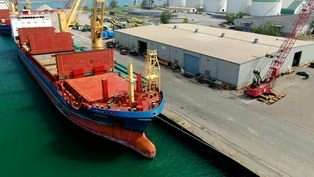
Located at the southern end of Lake Michigan, Burns Harbor is one of the busiest ports on the Great Lakes.
And that means lots of traffic, around 350,000 trucks a year.
Ryan McCoy is the port's director.
- [Ryan] So every morning we have a morning rush where trucks are coming in early.
You know, a lot of these guys want to try to get first in line to get loaded.
So this is where NLMK receives their raw material.
- [Kari] N L M K is a Russian-owned steel manufacturer.
It's one of about 30 tenants at the port and the largest employer on site.
- [Ryan] So we have incoming loads of scrap that are going on to their sorting operation.
And we're also seeing inbound trucks that are going to be taking out their finished product, so coils and slaps.
- So they can't turn their engines off, so they're emitting that whole time that they're moving around.
- They're constantly have to move up in line, move up in line.
- The 600 acre port sits on Indiana's 45 mile Lake Michigan shoreline.
And it's surrounded by beachfront communities and Indiana Dunes National Park, a natural wonder and an important part of the region's tourism.
But the port is also home to heavy industry.
Most tenants are connected to steel production.
- Steel is a vital part to our nation.
I mean, it is the backbone of our nation.
Unfortunately, historically northwest Indiana's industry has had some incidents that have led to, you know, negative connotations on industry.
- [Kari] A series of spills that garnered major news coverage have left many suspicious about area industrial operators.
- And now let's take a look.
This is what closed Indiana Dunes National Park beaches look like today - In September of 2021, a plume of orange, iron-tainted wastewater from a U.S. steel plant, adjacent to the port spilled into Lake Michigan.
Only 12 days later, another spill from the same U.S. steel facility.
This time an oily discharge.
Both spills prompted Indiana Dunes National Park and the nearby community of Ogden Dunes to shut down access to Lake Michigan.
- So, unfortunately that was just the tip of the iceberg.
- Victoria Wittig is the senior program specialist with Save the Dunes, a nonprofit that works to preserve the Indiana dunes.
- 2017, there was a hexavalent chromium spill at the U.S. steel facility, right on the shores of Lake Michigan.
Hexavalent chromium was made famous in the movie, Erin Brockovich.
It's a carcinogen.
We really need these facilities to step up to the plate and start to protect the waters that they need for their operations, but that we need for our drinking water and for our ecosystems to be sustained and be healthy.
- [Kari] As port director, Ryan McCoy is well aware of how industrial pollution reflects on the port, but the port is taking steps in an effort to improve.
- [Ryan] Being a part of the industrial corridor of Indiana here, we want to make sure that we have a positive impact and not a negative impact on the community.
That's something that we're very focused on with programs like Green Marine is changing that reputation.
And showing that these different industries that reside here in the ports and that our neighbors also can have a positive impact and improve our national lake shore.
- [Kari] In 2014, the port joined Green Marine, a multinational organization started in 2007.
- Green Marine is a voluntary environmental certification program for the shipping industry.
- David Bolduc is Green Marines' executive director.
- Any port or ship corner or terminal operator who decides to be certified commits to improve its environmental performance beyond regulatory compliance.
- [Kari] Green Marines scores its members in a variety of categories on a five point scale.
A one indicates compliance with government's regulations.
Higher scores are earned with additional investments or actions.
In 2020, the port scored a four in spill prevention, a four in community impacts, a three in environmental leadership, a two in greenhouse gas and air pollutants, and a two in waste management.
Independent verifier Randy Helen has tracked the port's progress since they joined Green Marine in 2014.
- I would love to see them just continuing to improve.
If they continue to improve and go up a ladder.
One day, maybe making a maximum score of fives in each category.
And if someone does that, they're knocking it out of the park, Being a verifier within Green Marine, one of the privileges I have is to not only come alongside ports and terminals and shipping companies and verify where they're at within the standards of Green Marine, but to talk about where they want to go and what they want to accomplish over time and to help them develop a plan to get there.
- [Kari] One issue Burns Harbor plans to address is greenhouse gas emissions from all those idling trucks.
Behind the port's administration building, Ryan McCoy shows us where one of the ports planned Green Marine projects will go.
- So this is going to be our truck marshaling yard.
It's six acres from end to end.
So right now we have our trucks that come in over the bridge behind us here.
They all will do the Cloverleaf.
All 350,000 a year will be able to come around the Cloverleaf and potentially come in and park and shut their vehicles down, shut their trucks down in the truck marshaling yard.
- [Kari] So then they don't have to be lining up inside the port, running their engines.
- [Ryan] Correct.
- [Kari] All that diesel exhaust.
- Like we saw on the tour earlier, we won't have to have them lining up on the roads, leaving their trucks running, just inching forward one truck length at a time.
- [Kari] When the marshaling yard is ready in 2023, it's expected to reduce annual carbon emissions by the equivalent of a single truck idling continuously for over 13 years.
So it's more efficient for the customer and you're getting rid of that pollution while the trucks are running.
- Yes, much more efficient for the customers, cuts down the amount of carbon dioxide going into the air, the amount of diesel emissions.
- [Kari] Across from the truck marshaling yard, another green project is underway.
- Much of our stormwater goes directly into Lake Michigan.
So we have to have those processes and procedures in place to protect the lake.
- Nick Harper is the port's operations manager.
- So these are some of the Jack Pines that we planted as part of the USDA GLRI, a grant we've received with them.
The Jack Pines are native to the state of Indiana, and these are going to be great at catching some of the fugitive dust that blows around in the area.
These also suck up a ton of storm water.
So it helps us lessen the storm water runoff we have onto the roads and other impervious areas.
- When you look at the whole port, 600 acres, a lot of hard surfaces, a lot of heavy industry going on, does it feel sometimes overwhelming or like this is just a drop in the bucket compared to the environmental impact that you are having.
- It is an overwhelming task.
It's not something that we can do on our own.
We are one of many industries in the area that have done these GLRI plantings to get some green back in the area.
We want to get that national lake shore landscape back and do whatever we can to get the green canopy back around us.
- Two Burns Harbor tenants have also joined Green Marine.
The shipping company Fednav and Metro Ports.
- Metro ports is our break bulk stevedore.
They are the ones that handle all the bulk cargo that come in here.
- Bulk cargo, like this furnace cope, can be pretty dusty, but Metro ports has taken steps to address that issue.
- [Nick] So next to us over here is a water cannon.
They had customized, especially for their operations.
Every time the loaders put their buckets into the pile of cargo, there's generally some dust produced.
As well as when they dump into the hoppers as we're seeing right now.
But because the water cannon is on, it's catching the dust in the air before it gets into the lake and causes dustier conditions around the port.
- So right now, any dust from that furnace poke that's being moved, this will help keep the dust down?
- Correct, yep.
- Community engagement is a category where the port scored high, four out of five points.
- We have six annual commission meetings where we discuss new products going on from the port.
They are public.
So it's a way for the public to come in and sort of interact with us on what their opinions are on any of our new projects going on.
- [Kari] But environmental leaders in the community that we spoke to were not aware of the public forums.
Would you like to hear more specifically about what they're doing to reduce emissions or increase sustainability?
Do you want them to reach out to the community more directly?
- Yes.
We are open to all of those communications, those conversations, those partnerships that are built.
So they understand more of what it is we're looking to see from them.
And they can share with us what it is they're trying to achieve.
- Today, two international vessels known as salties dock and unload steel coils, originating from Turkey.
- Bringing cargoes and freight in by water is much cleaner than bringing cargo in by truck.
Average vessel can take 10 to 15,000 tons of cargo.
Whereas if it was trucked in or railed in, you're looking at 20 to a hundred tons per move.
So definitely cleaner, more sustainable cargo movement by vessel with our proximity to the lake and the river system, it's definitely has benefit to us.
- I think the sustainability is not optional anymore.
I think the consumer has a demand that they're only going to do business and purchase from companies that have sustainability programs.
And I think our goals have to get bolder.
I think we have to have loftier goals and I think the zero emissions are possible.
I think there is a lot of technology out there that supports zero emissions and full sustainability.
- For more on the environmental impact of great lakes, ports, and shipping, visit GreatLakesNow.org In October of 2021, another municipal water crisis in Michigan began to make national headlines.
We went to Benton Harbor with MLive environmental reporter, Garrett Ellison.
Who's been tracking the story.
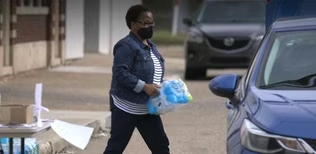
- We're at the Southwest Michigan community action agency where people in Benton Harbor are driving through, picking up cases of bottled water, tossing them in their backseat or the trunk of their car and taking them home because the city is under an advisory for high levels of lead in their water.
Well, right now, nobody in Benton Harbor is supposed to be drinking anything out of the tap, using tap water for cooking or mixing infant baby formula.
Any consumptive uses essentially, people are being told, use bottled water for that.
- [Ward] Benton Harbor's water problems aren't new this year.
The city's water first tested high for lead in 2018.
- And so since then, it's been continual, action level exceedences through every consecutive round of testing here in Benton Harbor.
- The federal action level for lead in drinking water is 15 parts per billion.
In the wake of the Flint water crisis, the state of Michigan has adopted an even lower standard of 12 parts per billion, but some homes in Benton Harper had far exceeded those maximums.
- Some individual homes have lead levels that are in the hundreds, a hundred to 400 to 600 to 889 parts per billion.
There was a home here in Benton Harbor this year that had that level of lead in its drinking waters.
- It makes you wonder all these people that died.
Heart attacks, you know, because when I read up on what lead do, high blood pressure and stuff like that, I'm like, damn.
- [Nathan] Third world nation, Benton Harbor, Michigan, third world nation.
We got to use bottled water.
We can't drink to water, can't bathe with the water, can't cook with the water, can't wash your hands with the water.
- [Ward] Since 2018, the state has provided water filters to residents, but when the state announced on October 6th, the residents should use bottled water, many here were still surprised.
- Since October sixth, it's been a pretty high profile response.
It's been a lot of news crews in Benton Harbor.
It's been a lot of questions being asked and you know, that's a status that's gonna probably continue for quite a while.
- [Ward] Benton Harbor has always drawn its drinking water from Lake Michigan.
But the problem isn't the source water, it's the aging lead service lines connecting water mains to homes.
Corrosion control additives can keep lead from getting into the drinking water, but in Benton Harbor, they've only been used for the last couple of years.
- The city of Benton Harbor only started using corrosion control in 2019 after that first exceedance for lead in 2018.
And so since then the state of Michigan's been trying, has started adding corrosion control, tweaking the formula and the blend.
And the point of adding corrosion control is to put a chemical in the water that coats the inside of those lead pipes and prevents the toxic metal there from flaking off and leaching into the tap water.
- [Ward] Despite these measures, the city's lead levels haven't declined.
- [Garrett] So right now the state of Michigan is pledging to get all of Benton Harbor's lead service lines dug up out of the ground and replaced by April, 2023.
That's essentially 18 months from now.
That's a tall order.
And you know, it remains to be seen if that can actually be done.
They're saying it's gonna cost about $30 million to do.
And so far they have secured about 18.6 million of that effort.
And so there's a lot of discussion right now in Lansing as to where the rest of the money is going to come from, how much is needed and amidst that discussion, there is definitely talk of who is to blame for this.
- For more about drinking water and lead pipes in our region, visit GreatLakesNow.org.
Unfortunately, water crises are not a new phenomenon.
Before Benton Harbor and before Flint, our region saw a deadly water crisis in Walkerton, Ontario.
Today, Walkerton helps safeguard water supplies throughout the province.
Bridge, Michigan environmental reporter Kelly House spoke with experts there about Benton Harbor and what it will take to avoid more crises in the future.
- [Kelly] In the year 2000, lax regulations and human error led to bacterial contamination in Walkerton, Ontario's drinking water.
At least seven people died and thousands were sickened.
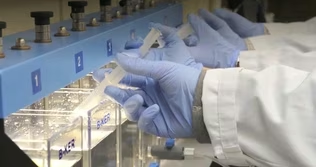
To shed some light on the Benton Harbor water crisis, I spoke with Carl Kuhnke and Souleymane Ndiongue, the CEO and manager of research at the Walkerton Clean Water Center, which was established as a response to the Walkerton crisis.
- It created havoc for the government of the time and they made the right decision to not only strengthen hugely the drinking water regulations in Ontario and how things work, but also set up this center here so that we could train every drinking water professional in this entire province.
We ensure that every drinking water operator in this province has rigorous training and is certified by the province of Ontario to act as an operator.
- [Kelly] On average, the center trains or recertifies around 10,000 water treatment professionals each year, either at the facility in Walkerton or at treatment facilities around Ontario.
The problems they cover range from common source water issues like arsenic and iron to emerging challenges like blue-green algae and organic compounds, but in Flint, Benton Harbor, and many other Great Lakes city's, drinking water operators have to contend with another problem, their own infrastructure, which can include thousands of lit service lines, connecting water mains to homes.
Given that those pipes are there, how do you address those issues from a water treatment and maintenance perspective?
- As you said, if the led the pipes are there, removing them is the most effective and permanent solution.
We all know that, but if you cannot do that there are other options.
One of them is to change the water chemistry at the treatment plant to prevent lead corrosion, where it flows through the lead service line.
So we can do that by adding additives to the water, or we can adjust the pH or the alkalinity of the water.
But again, those system need to be tested to ensure that it works.
It does not have the same performance in all settings.
The other things is a regular and reliable testing and communicating that led the risk to the water consumer and educate them what to do to minimize exposure to lead.
- [Kelly] Adding corrosion control inhibitors isn't as straightforward as it sounds.
Every water source is chemically different.
So to keep the water from taking on lead, as it moves through the pipes, each water system needs its own unique mix of additives and treatments.
How crucial is it to have the right mix and how hard is it to find the right mix?
- So the science is there, but when you go from science, from the lab and you come to the field, the chemistry is completely different.
You have other factor, you have biofilm in the pipe, you have the water standing in the pipe, you have different water chemistry, it really need to be tested.
We cannot anticipate that any adjustment treatment will work for any plant, always need to be tested.
And it takes some time to be tested.
- [Carl] If you put in too much anti leaching, then you're going to have other problems in your water.
If you put in too little, the lead's going to leach out of the pipes.
And so it's back and forth and back and forth until you get the exact right mixture that will give you the best results with the least secondary problems.
- And I know that in Benton Harbor, they basically immediately started with a treatment while sort of conducting those tests to see what the optimal treatment would be.
Is that standard practice?
And is that an okay thing to be doing?
Or should you be holding off on doing anything until you know what the right mix is going to be?
- Ideally, it's better to find the right mix first, but it's also possible to stop something and to monitor at the same time.
And in the meantime, finding other source of water.
Not using water for drinking, not use it for cooking, and find another source of water like bottled water or house treatment devices to reduce the lead level.
- [Kelly] Many cities are now moving to replace the lead service lines in their water systems.
But that process is extremely expensive.
And lots of communities simply don't have the money, which raises serious questions about fairness and equity.
Many of the most extreme ongoing water issues in Canada are happening in First Nations communities.
And you know, it is not lost on people here in Michigan that two of the most prominent water crises in our state have happened in majority black, high poverty communities.
Why is that?
Do these water problems often break down along racial and socioeconomic lines and why?
- Well, I think it comes down to money and unfortunately that's always at the top of the list.
The water infrastructure is funded by the tax base.
So if the tax base is not there to fund the infrastructure, it leads to a catch 22.
Over time, your older infrastructure gets older.
You don't even get the chance to do the repairs to that infrastructure.
And so you're in a vicious catch 22 cycle where things only spiral downhill.
- [Kelly] A lot of cities could find themselves caught in that downward spiral as infrastructure ages and water quality standards rise.
In Michigan alone, as of November 3rd, 2021, nine water systems had lead levels that exceeded federal standards and 25 water systems currently exceed more stringent state standards that will take effect in 2025.
In both the U.S. and Canada safeguarding the water supply will take both resources and know-how.
- If there were more centers like the Walkerton Clean Water Center in Canada and in the United States, I think that would be a start to improvement across both of our countries.
- As an agency of the government of Ontario, the Walkerton Clean Water Center can't provide training or assistance to operators outside the province, but they can provide information.
- We have a 24-7 drinking water resource library with over 4,000 documents on it, documenting problems, common problems, and solutions to them, so that if you don't have a lot of money and you're a drinking water planter and operator, you can go to that site and get free help and advice.
And that's the least we can do.
But my suggestion would be, there needs to be more centers of excellence like this established.
Certainly in Canada and also in the United States.
- Should we expect more water crises, like the Walkerton crisis, like the Flint crisis to be happening in the future.
- I think we can expect more water challenges.
I think the crises that we have had and are having both in Canada, the United States are less than they used to be.
But if the infrastructure issues are left unresolved, then it is bound to happen.
And when you combine that with climate change, which is changing the source water of all drinking water treatment plants worldwide, not just Canada and the United States, then that combination at some point will probably result in a calamity somewhere sometime.
- Thanks for watching.
For more on these stories and the Great Lakes in general, visit GreatLakesNow.org.
When you get there, you can follow us on social media or subscribe to our newsletter to get updates about our work.
See you out on the lakes.
- This program is brought to you by the Fred A. and Barbara M. Erb family foundation, the Charles Stewart Mott foundation, Laurie and Tim Wadhams.
- The Consumer's Energy Foundation is committed to serving Michigan, from preserving our state's natural resources and sustaining our future to continuing business growth, academic achievement, and community involvement.
Learn more at ConsumersEnergy.com/foundation.
- The Richard C Devereaux Foundation for Energy and Environmental Programs at DPTV, the Polk Family Fund, Eve and Jerry Jung, the Americana Foundation, the Brookby Foundation, Founders Brewing Company, and viewers like you.
Thank you.
Video has Closed Captions
Clip: S1 Ep31 | 4m 11s | Another Michigan city has too much lead in its drinking water. (4m 11s)
Preventing Future Water Crisis
Video has Closed Captions
Clip: S1 Ep31 | 8m 59s | The Walkerton Clean Water Centre was created to prevent more water crises in Ontario. (8m 59s)
Video has Closed Captions
Clip: S1 Ep31 | 11m 36s | Indiana’s Burns Harbor is trying to “green” the image of Great Lakes ports and industry. (11m 36s)
Providing Support for PBS.org
Learn Moreabout PBS online sponsorship
- Science and Nature

Explore scientific discoveries on television's most acclaimed science documentary series.

- Science and Nature

Capturing the splendor of the natural world, from the African plains to the Antarctic ice.












Support for PBS provided by:
Great Lakes Now is a local public television program presented by Detroit PBS