
Poetry From the Saddle and More
Season 17 Episode 8 | 28m 12sVideo has Audio Description
A poet whose words rise from a life in the saddle, & planting trees with messages revealed by time.
A poet whose words rise from a life in the saddle, planting trees with messages revealed by time, America’s longest-serving Vietnam War correspondent and, a track star’s extraordinary strides. Learn about a cowboy turned poet, trees that tell stories, a female war correspondent from Hebron, and a Bellevue middle schooler who has dreams of running in the Olympics.
See all videos with Audio DescriptionADProblems playing video? | Closed Captioning Feedback
Problems playing video? | Closed Captioning Feedback
Nebraska Stories is a local public television program presented by Nebraska Public Media
Poetry From the Saddle and More
Season 17 Episode 8 | 28m 12sVideo has Audio Description
A poet whose words rise from a life in the saddle, planting trees with messages revealed by time, America’s longest-serving Vietnam War correspondent and, a track star’s extraordinary strides. Learn about a cowboy turned poet, trees that tell stories, a female war correspondent from Hebron, and a Bellevue middle schooler who has dreams of running in the Olympics.
See all videos with Audio DescriptionADProblems playing video? | Closed Captioning Feedback
How to Watch Nebraska Stories
Nebraska Stories is available to stream on pbs.org and the free PBS App, available on iPhone, Apple TV, Android TV, Android smartphones, Amazon Fire TV, Amazon Fire Tablet, Roku, Samsung Smart TV, and Vizio.
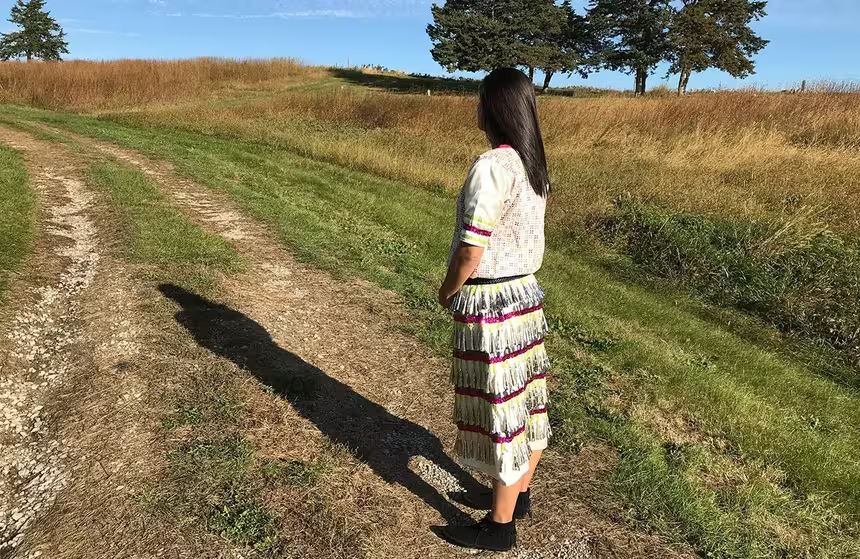
Do you have a Nebraska Story?
Do you have a story that you think should be told on Nebraska Stories? Send an email with your story idea, your name, your city and an email address and/or phone number to nebraskastories@nebraskapublicmedia.org. Or, click the link below and submit your information on nebraskastories.org.Providing Support for PBS.org
Learn Moreabout PBS online sponsorship(upbeat music) - [Narrator] Coming up on Nebraska stories, A poet whose words rise from a life in the saddle.
(upbeat music) Planting trees with messages revealed by time.
(upbeat music) America's longest serving Vietnam War correspondent (upbeat music) and a track star's extraordinary strides.
(upbeat music) (upbeat music) (soft music) (birds chirping) -[R.P.]
"For 500 years, the American cattleman has revolved around seasons and cycles.
His life has revolved to boil it down to one statement that still holds true.
Take care of your cows and your grass.
They'll do their best to take care of you."
(soft music) (insects chirping) -[R.P.]
I was third out of four boys, our names all started with R. And Ronnie Paul was just too long and it got shortened to R.P.
and by the time we'd gone very far, I wasn't even deserving of the extra syllable and it was just down to Arp.
So.
(soft insects chirping) (guitar music) My great-grandfather and great-grandmother would come, and that was actually on the ground down on the South Loup.
That gets back into the 1800s.
And that was my mom's side of the family.
-[Narrator] R.P.
Smith's roots in Custer County reach back to the sod house era, when Solomon Butcher roamed the countryside, capturing his iconic photographs.
-[R.P.]
My dad enjoyed farming a lot more than I did, although he enjoyed the livestock too.
The percentage of farming genes seems to have gotten diluted out and we have become more livestock people.
(soft music) -[Narrator] Life as a rancher is just one side of who he is.
He's also a poet.
-[R.P.]
"He wears a wide brimmed hat, His legs are bowed.
There's no counting the calves he's wrestled or the miles he's rode.
Some say is breed is dying.
There ain't as many as before."
(engine rumbling) -[Narrator] Cowboy poetry is a niche tradition dating back to the days of the cattle trails.
It centers on the work and lifestyle of cowboys (door clank shut) who turn their daily experiences into verse.
(soft music) -[R.P.]
If you're not observant, you're just going to write the same poem over and over.
(soft music) It all comes back to here, maybe more than it should.
That connection with the livestock and the land is what gets me out of bed, and the rest of it's just icing on the cake.
(birds chirping) -[Johnny Carson] Tonight representing are Waddie Mitchell and Baxter Black, gentlemen.
(applause) - They found that plants feel pain.
Pain.
-[Carson] No, I don't know.
- Yeah!
And.
(laughing) (laughing) So that inspired this little piece titled "The Vegetarian's Nightmare."
-[Carson] Okay.
-[Narrator] The spark for R.P.
's poetry came one night while he was watching cowboy poets on a late night talk show.
-[Baxter] Tomatoes were wincing in fear!
(laughing) -[Narrator] But it was a call from a higher star that turned his life in a new direction.
(guitar music) -[R.P.]
I'd accepted Jesus as my Lord and Savior.
And I think he just decided I (guitar music) needed to do something other than just follow cows around, which I was very content doing.
(guitar music) "500 years of droughts, blizzards, brand and fire smoke that wheel just keep turning.
(guitar music) We are part of the spoke."
(guitar music) -[Narrator] He wrote his first verse at 27.
It was about a bad day at a sale barn.
(guitar music) -[R.P.]
I had sold a that cow that day that I thought I had gotten a pretty short end of the stick kind of a deal.
I wrote a derogatory poem about cattle buyers and presented it to my best friend as a wedding gift.
That was how that started.
-[Narrator] Eventually, R.P.
began performing his poems locally.
He's performed in nearly every county in the state.
(guitar music) -[R.P.]
My dad, once I got going, he was the biggest promoter that I could have had.
He was pretty proud that I did the poetry.
-[R.P.]
"Three boys remounted.
Now he's taking a nap.
The cow goes right, she's making a break."
-[Narrator] Today He's a frequent performer at national gatherings, including the iconic Cowboy Poetry Festival in Elko, Nevada.
-[R.P.]
"My mom is to my right doing pony side passes.
My daughter to the left does not have her glasses."
(ground crunching) -[R.P.]
I'd say the poetry made me a better rancher, but probably hasn't made me a better parent.
I give my wife most of the credit.
I like Nebraska, where I could go do a show and get back in time for chores in the morning and kind of maintain a little more normalcy.
Our grandkids come every day after school.
(guitar music) We get them for a couple of hours every day and that's really cool.
There's an awful lot I don't have figured out, and I'm not doing a whole lot better with the grandkids, but it's not for lack of trying.
(guitar music) "He's had a good life on the northern Great Plains, and his hands feel best when they hold the reins."
(feet clomping) -[Narrator] While he writes about his appreciation for land, life and family and all the places they've taken him.
(guitar music) One question remains would R.P.
ever give up ranching for poetry?
-[R.P.]
Well, I'm pretty fortunate.
I mean, if I never do another show here, I'd still got something to do every day.
As long as I can do it.
I don't do the poetry so I can leave the ranch.
I do the poetry so I can stay.
(guitar music) "Such a buckaroo, mob you seldom will see.
A grandma, four kids, and a foreman.
That's me.
Trying to wrangle this motley crew.
So the cows are corralled when the evenings through.
As we enter the pasture, I lay out the plot and hope that everything works like it ought.
The cows are described by colors and numbers.
As my list gets longer, my help starts to slumber.
We need 301, She's a black brockle-face, her ear tag is green.
Check the blues just in case.
When you've got them paired up, use the gate by the tank.
Let's hustle, the clouds They're forming a bank.
My mom is to my right doing pony side passes.
My daughter to the left does not have her glasses.
And the boys are loping right through the main herd, singing without a discouraging word.
And I'm questioning if this job makes any sense.
When Tink nips a calf and it runs through the fence, then one of the boys comes back in a flash, Chasin' 031 on the 100 yard dash.
I thought you said red.
Is that that number right?
And the foreman, that's me, gets a little uptight.
Before we go further, I need to explain with grandmas and kids, you don't talk like John Wayne.
You very soon find if you give your tongue slack, that the help takes it in and then plays it all back.
And I said, I'm the foreman not the same as the boss.
She stays at headquarters, on my ears she might toss if she hears from the crew while they're hitting the hay.
An expanded vocabulary.
They heard daddy say.
Then I hear about it in a tone none too sweet.
When it comes to kids' minds, there's no hitting delete.
We need 301 her ear tag is green.
I yell it out louder and I sound kind of mean, but I hardly get noticed.
I sure wish I could whistle, the boys are playing tag, mom's pulling the thistle.
My daughter's horse is grazin' the grass.
If this is a test, well, I probably won't pass My mount It's a lope as I beller and blow, we never will finish if you keep moving slow.
Sis go Left.
Don't let him turn back.
Take back off and give him some slack.
Three boys on the ground, did they stumble and fall?
No, they dismounted when they heard nature call.
Take Sis.
Sis go!.
Mom, fill up the gap.
One boy has remounted.
Now he's taking a nap.
The cow goes right.
She's making a break.
I'm riding a Colt.
This could be a mistake.
Get in front of the cow.
I shout out in vain.
Dad!
My saddle slipping.
It's starting to rain.
Sis, help your brother.
Turn round, you old bat!
No, not you, mom!
Just stay where you're at, keep the calf with the cow.
Don't let them split up.
Go the other way now!
Oh, you crazy pup!
Tink, Sis.
Sis, go!.
Mom, turn toward the gate.
We'll take 'em on through.
You're doing just great.
Come over here, boys.
Don't be moving slow.
We've got one pair sorted.
(birds chirping) There's just a dozen to go."
(insects and birds chirping) ♪ ♪ (gentle music) -[Narrator] Across the grasslands and the hills of Nebraska.
Some names don't vanish.
They grow.
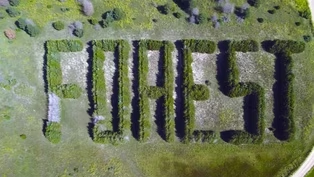
In the 1990s, near Calamus Reservoir State Recreation Area in Rock County, a forest of sorts was planted across the rolling grasslands, but not the dense kind one might imagine.
(gentle music) Dale Sostad cultivated over 80,000 trees between 1992 and 2010.
Nearly all planted by machine and irrigated with six pivots to help them thrive.
(gentle music) Sostad Forest is a signature of trees, a living tribute set within a broader area of conservation plantings.
Nature took its own course and many are now gone.
Yet every summer, as the leaves grow and the canopy fills, you can read Dale's last name from the air.
(gentle music) Just 24 miles west.
Another family name lives on in Cedar.
On ground handed down through generations.
Dale and Audrey Caskey raise three daughters.
A careful steward of the land, Dale planted trees not just for function, but for legacy.
And as a father of girls.
Dale found a creative way to ensure his family name would carry on.
(gentle music) Shaped by time and manicured by nature, the Caskey name lives on.
(gentle music) Tucked into a quiet stand of trees near Rockville, two letters rise from the ground.
L and B in the mid 70s, Lawrence Burman, a teacher and photographer, set out to plan to living tribute to his parents and to himself.
With five friends and a couple of post hole diggers.
They put more than 800 trees in the ground in a single evening.
(gentle music) Over the next 14 years, Lawrence planted more than 10,000 trees and shrubs, all provided by Nebraska's Natural Resource District.
(gentle music) His goal was simple give back to the land, creating shelter, windbreaks, erosion control and habitat for wildlife.
(gentle music) In 1967, Nebraska marked the 100th anniversary of its statehood, a milestone honored in communities across the state In Fullerton, Members of the Future Farmers of America planted a grove of evergreens to honor the centennial.
(gentle music) And in Hickman Hickman at Wagon Train Lake State Recreation Area.
Local youth groups planted their own tribute.
The numbers have since faded into the forest, but the spirit of that centennial planting remains.
(gentle music) In a state once called "The Tree Planter's State" and the birthplace of Arbor Day.
Our roots continue to grow in unexpected ways.
(gentle music) In a peaceful forest, planted one tree at a time, or as a signature visible only from the sky and lasting for as long as nature allows.
(gentle music) ♪ ♪ (helicopter whirring) (equipment rattling) [Narrator] On April 29th, 1975, South Vietnam's government and military collapsed as North Vietnamese troops attacked Saigon.
(helicopter whirring) US forces rescued 7,000 Americans and South Vietnamese allies in our country's sobering end to the Vietnam War that left more than one and a half million people dead.
(helicopter whirring) 88-year-old Nebraskan Beverly Deepe Keever reported on that war and the risks that came with it.
[Keever] This American advisor said very casually, "Don't worry, you never get the first bullet that gets you."
[Narrator] Back then her newspaper byline was Beverly Deepe.
She was America's longest serving Vietnam war correspondent.
(gentle music) Born in 1935 in Hebron, Nebraska.
Beverly Deepe's parents' tireless work kept the family farm afloat in the Great Depression.
(gentle music) It also inspired in Beverly a curiosity to explore faraway places.
I went into journalism because I wanted to understand people and culture in other countries.
(gentle music) [Narrator] With journalism degrees from the University of Nebraska and New York's Columbia Journalism School, Keever worked as a public opinion pollster and a freelance reporter after college.
(gentle music) She bought a ticket to East Asia and paid for her travels teaching English and selling freelance newspaper stories.
[Brooke] So this is someone who's got a halo, you know, she's anointed.
There's something really marvelous about her in her sense of herself.
Even coming from a small Nebraska town.
(gentle music) [Narrator] In 1962, Keever arrived in Saigon, drawn by the news of South Vietnamese troops fighting Viet Cong guerrillas backed by Communist North Vietnam.
(gentle music) [Mitch] It's a tinderbox.
Hasn't quite exploded when she's there in the early 1960s and there's still a lot of questions about where America's gonna go, where America's role is.
[Narrator] US military advisors were involved too.
Sent by President John F. Kennedy to stop the spread of communism.
[Larry] The words were repeated again about how in in Vietnam, literally, the free world stood in the balance.
[Narrator] As more US troops poured in, Keever wrote to a friend in Nebraska.
[Wartime Keever] I am undergoing a shock treatment here.
All those professional and personal ideals which had never been shattered until I reached here seemed to be under constant bombardment.
(gentle music) [Narrator] Keever was the only woman among a handful of male correspondents covering South Vietnam at the time.
The men earned full-time pay with health benefits.
Keever did not.
Because she didn't have healthcare, Keever almost died from an infection on one war reporting trip.
[Keever] An American secretary with the construction company found me and got me to the hospital.
That took me a long time and it still has left my liver damaged from infectious food and water and so on.
[Narrator] Keever persevered and kept reporting.
[Brooke] For a woman to make a career, if you're willing to be a stringer, you can find a war and it's easy to get hired because everyone is happy to hire you for cheap.
[Keever] When I was finally hired for "Newsweek" they said, "Well, I don't know what New York will say about hiring a woman."
They were stuck though.
They had to find somebody.
[Narrator] She wrote about US military and South Vietnamese pacification programs, which provided rural villagers with medical care and new schools.
She covered America's steady military buildup in South Vietnam too.
[Keever] It turned out to be more than I bargained for.
I got a war with it.
(weapon booms) (explosion booms) [Narrator] In 1964, as American involvement in Vietnam escalated, Keever became a full-time special correspondent with the "New York Herald Tribune."
A tip from a South Vietnamese general helped Keever break one of her biggest stories.
[Keever] Interviewed the first North Vietnamese prisoner who said he came in from North Vietnam in units.
[Narrator] President Johnson though, was up for election at the time.
[Keever] Johnson did not want to be, you know, doing anything to retaliate against the North, and so they denied it.
[Narrator] Keever says it was a tip off that partisan politics was leading US decision making on the Vietnam War.
One month later, the US Congress approved the Tonkin Gulf Resolution.
Vietnam now became America's war, with General William Westmoreland in command.
(upbeat 1960s music) (upbeat 1960s music) Westmoreland preached search and destroy military tactics and he requested more US troops to find and kill the enemy.
Keever believes that was a misguided philosophy.
[Keever] That's all they knew.
They had to fight with what they had, but they didn't have the right machinery.
[Narrator] The Viet Cong were no match for America's fire power.
But Keever reported they were winning support and recruiting new fighters from South Vietnam's poor villages.
[Keever] I wanted to get the Vietnamese viewpoint, and I did write it, and they were very, very blunt.
(gun shots) [Narrator] By 1967, more than a half million US soldiers were fighting in Southeast Asia and 200 of them were dying in combat each week.
The war was not getting better for America.
(explosions booming) 4,000 US Marines in South Vietnam's remote Khe Sanh Combat Base were attacked by 30,000 North Vietnamese soldiers.
The unprecedented barrage didn't stop for 77 days.
American supply planes had minutes to land and take off before North Vietnamese mortars found their targets.
Keever risked flying in to report the story.
[Keever] We knew it was dangerous, but The president, Westmoreland, the general, everybody they were focusing on that.
That's what the story was, so you just did it.
(gentle music) [Narrator] Keever wrote this description of Khe Sanh's grueling conditions.
(gentle music) [Wartime Keever] Khe Sanh is six dirty hands grabbing into a C-ration box.
A Communist mortar round thumps into the center of the box between the outstretched fingers.
Six Marines lay dead, like tattered rag dolls.
(gentle music) [Narrator] Keever's Khe Sanh reporting was nominated for a Pulitzer Prize.
(gunfire popping) Almost simultaneously, 80,000 Viet Cong and North Vietnamese troops launched the largest attack of the war.
The Tet Offensive, spraying surprise assaults on military and civilian targets in hundreds of South Vietnamese towns and cities.
[Keever] Cause an uproar in the east, attack from the west, and that's all they did.
[Narrator] US and South Vietnamese troops counterattacked, inflicting heavy casualties on the Communists.
North Vietnam's Tet Offensive was a military failure, but a propaganda success for the enemy.
[Keever] It raised the possibility of an American defeat in Vietnam, which the American officials had said never could have happened.
[Narrator] The fighting convinced a growing number of Americans that the Vietnam War could not be won.
More than 58,000 American military service members made the ultimate sacrifice, fighting and dying for our nation.
(gentle music) 395 of them were Nebraskans.
(gentle music) Almost 50 years later, Keever says the real battle in Vietnam wasn't about stopping Communist insurgents.
It was a power struggle for economic and social justice between South Vietnam's wealthy minority and its poor majority.
(gentle music) [Keever] The military thinking has to realize that the American approach to power is different than what you're going to need probably in the future.
(helicopter whirring) [Narrator] In 1969, America took a new path and began withdrawing troops from Vietnam.
After seven years covering the war, Beverly Deepe Keever took a new path too.
Well, did you want me to mention about Chuck?
(upbeat music) [Narrator] Beverly fell in love with Chuck Keever, the Marine Corps officer who escorted Beverly to interview medical teams who were treating rural Vietnamese villagers.
[Keever] He was really an incredible guy.
I'm so fortunate that I met him.
[Narrator] The two left Vietnam in 1969 and married a year later.
It was eight years to the day after Beverly Keever first arrived in Vietnam.
Chuck Keever died in 2021.
(gentle music) Through it all, Keever says she's been lucky.
[Keever] I was lucky I got to Vietnam as early as I did, when it was a Vietnamese show.
How I met Chuck and how I got out of there when I did.
I was stunned the way it ended.
(gentle music) (gentle music) ♪ ♪ (intense music) (intense music) (intense music) - [Jaiya] I can make it to the Olympics one day and that's a really big goal that I have now.
(intense music) - [Coach] You hit that 10 yard.
(intense music) - [Jaiya] You can't give up, you gotta keep working.
And it's something that, it almost is like a sibling to me 'cause like you don't always like it, but you love it in the end.
(intense music) -[Sheree] We did not know that it would come to this, but we're grateful and we don't take it for granted.
- And at the rate, she's accomplishing what she's accomplishing, there is no limit.
(intense music) (intense music) - [Jaiya] My dad saw me running when I was like in my walker when I was a baby.
He said I wasn't just running, I was actually striding, which showed him that I had like the technique for a track runner.
-[Sheree] She started running at seven as far as officially in a track circuit.
She started to really perform at a higher level than expected.
It just caught us by surprise.
-[Jaiya] I made it to nationals my first year.
So that's kind of when I realized that this is something that I'm actually good at.
It's something that I can have a career in.
- Seeing her talent, my whole thing was, I know I can help her, (intense music) but it's gonna take a village to raise Jaiya.
(intense music) So I'm trying to bring the right people in to make sure that her gift goes as far as she wants.
(intense music) -[Jaiya] A lot of people think running is just going out on the track and running, but there's a lot of small things that you have to work on and it takes a while to master them.
And even professionals have to work on this.
(intense music) -[Coach] The little nuances of exercise, the nuances of her sprint mechanics, those are gonna be things that the best of the best do very, very well.
And so getting her to that level is kind of what we're all striving for 'cause the physical maturity will still come.
(intense music) (intense music) She's very naturally talented.
But I think what separates her from other people her age is her just desire to do the things she loves.
Ready.
(intense music) - [Jaiya] I love track a lot and I have a lot of fun doing it, but track is one of those things that it's also not always gonna be fun.
You can't give up.
- She is carrying on a torch that, you know, we didn't see coming.
(crowd chattering) (crowd chattering) - [Jaiya] I know I've trained like all season for this, so now's the time where my hard work will pay off.
(intense music) (intense music) -[Kevin] I knew she was gonna do well, but I did not know she was gonna do this well.
- [Announcer] On your marks.
Get set.
(starting gun pops) - [Kevin] She went out there and she dominated that race from start to finish.
-[Sheree] In that moment, I'm very excited that she's won.
But the way she responds to it and handles that is what matters even more than the fact that you have this title.
(intense music) Anything that she does, people are gonna pay attention to.
Not just the fact that you're a winner, but how you win, you know, and what you represent overall.
(crowd cheering) (intense music) -[Jaiya] My biggest goal overall is to break a world record in the 400.
But right now I just wanna keep focusing on getting better, getting my times down.
I can make it, hopefully make it to the Olympics one day and that's a really big goal that I have now.
- Yeah, I don't see her getting off track.
She's very focused on what she wants to accomplish and what she wants to do.
And I think that we can expect to see more great things from Jaiya.
(intense music) (upbeat music) (upbeat music) - [Narrator] Watch more Nebraska stories on our website, Facebook and YouTube.
Nebraska Stories is funded in part by the Margaret and Martha Thomas Foundation, and the Bill Harris and Mary Sue Hormel Harris Fund for the presentation of cultural programming.
(upbeat music) (upbeat music) (upbeat music) (upbeat music)
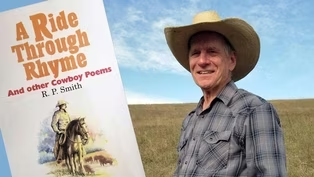
R.P. Smith, Poetry From the Saddle
Video has Audio Description
Clip: S17 Ep8 | 9m 8s | A poet whose words rise from a life in the saddle. (9m 8s)
Video has Audio Description
Clip: S17 Ep8 | 3m 38s | Planting trees with messages revealed by time. (3m 38s)
Providing Support for PBS.org
Learn Moreabout PBS online sponsorship














Support for PBS provided by:
Nebraska Stories is a local public television program presented by Nebraska Public Media