
Policing/Driving While Black
Season 48 Episode 39 | 26m 46sVideo has Closed Captions
Policing/Driving While Black | Episode 4839
The relationship between police and the community in our special series, “Do Black Lives Matter in America?” We’ll hear from Detroit law enforcement about building trust in the neighborhoods … and we’ll hear how the Black community feels about policing and safety. Episode 4839
Problems playing video? | Closed Captioning Feedback
Problems playing video? | Closed Captioning Feedback
American Black Journal is a local public television program presented by Detroit PBS
Policing/Driving While Black
Season 48 Episode 39 | 26m 46sVideo has Closed Captions
The relationship between police and the community in our special series, “Do Black Lives Matter in America?” We’ll hear from Detroit law enforcement about building trust in the neighborhoods … and we’ll hear how the Black community feels about policing and safety. Episode 4839
Problems playing video? | Closed Captioning Feedback
Where to Watch American Black Journal
American Black Journal is available to stream on pbs.org and the PBS app.
Providing Support for PBS.org
Learn Moreabout PBS online sponsorshipComing up on "American Black Journal", the relationship between police and the community in our special series, Do Black Lives Matter in America?
We're gonna hear from Detroit law enforcement about building trust in neighborhoods, and we'll hear how the black community feels about policing and safety.
Don't go away, "American Black Journal" starts right now.
Announcer 1: From Delta faucets to Behr paint, Masco Corporation is proud to deliver products that enhance the way consumers all over the world experience and enjoy their living spaces.
Masco, serving Michigan communities since 1929.
Announcer 2: Support also provided by the Cynthia & Edsel Ford Fund for Journalism at Detroit public TV.
Announcer 1: The DTE foundation proudly supports 50 years of American Black Journal in covering African-American history, culture and politics.
The DTE foundation and American Black Journal partners in presenting African-American perspectives about our communities and in our world.
Announcer 2: Also brought to you by Nissan Foundation, Ally and viewers like you.
Thank you.
♪♪ Welcome to "American Black Journal".
I'm Stephen Henderson.
And I'm Orlando Bailey, from Bridge, Detroit.
Today, we are concluding our special series of reports on Black Lives Matter with the look at the relationship between police and residents.
And we'll talk about community safety and police crime fighting techniques, including the controversial facial recognition software.
But we'll get started today with my interview with Detroit Police Department assistant chief, Todd Bettison.
So I want to start with talking about police community relations.
And I think an interesting place to start is with something I saw this week on the news, a story about a man in Southwest Detroit being punched and kicked while on the ground by Detroit police officers in a video.
These kinds of things, when they happen, they remind us of the things that still need to be done, I think, to improve police community relations.
But they also remind me of how far things have come over time.
I mean this is a very different city than it used to be.
I want to give you a chance to put that in context, that kind of incident, what does that tell us about police community relations here in Detroit?
Well, I'm glad you started with that question, Stephen.
I had a chance to see the video and also had a chance to look at the body worn cameras of the officers and read the various reports.
So without going too far into it, because the young man is facing criminal charges, what I can tell you is this, that the snippet that you saw was taken, but it didn't show the totality.
And if you notice, the camera never faced the crowd.
It was a crowd of 25 to 30 folks out there.
The officers were driving, patrolling the area.
They saw this street party, saw individual in the street, the person in question.
And he had a Patron bottle or some type of liquor bottle in his hand in the street.
And a pistol was in his shorts with an extended clip.
So as a result, they stopped to investigate.
He didn't want to comply with their orders.
They ordered him to raise his hands.
He didn't want to raise his hands because he had on shorts.
When he did raise his hands, the pistol fell from his waist to the ground, with extended clip.
As they moved in to try to investigate further, he wouldn't comply.
Other folks in the crowd attempted to stop the investigation, and that's what led to the use of force.
That's what led to other individuals being arrested as well as they tried to interfere.
And like I say, force never looks pretty, but he was actively resisting and drugs were also found in the backpack, book bag, whatever.
And the subject also has a criminal record.
So I'm pretty sure that, you know, he definitely did not want to engage or go to jail, go back to jail, dealing with law enforcement.
Individuals, like I said at the scene actively, actively tried to stop that arrest.
So, I think one of the things that's hard for citizens like me or other people who are not police is to see that kind of conduct by police and never be able to come up with a reason for happening.
I mean, having somebody on the ground and punching and kicking that person, why is that part of the police repertoire, I think is one of the questions that comes up.
I mean, the idea of deescalating tense situations is what I think we think of when we think of what we have the police for.
That seems like the kind of thing that makes it worse.
So what I will say is this, that if you saw the entire video and with the body cam, which I'm so glad that we have.
And as a major department, we weren't the only departments where all of our officers are equipped with body worn camera.
What that'll show is the totality of everything that occurred in which you would see then is officers did deescalate.
They did give verbal orders, which is a form of deescalation.
They had a presence there, but as the crowd and the individuals refused to comply at that point, that's what ups the ante right there.
Also punches is a part of training as well, it's called hand ends.
And when a person is actively resisting to get control, you do get a chance or option to utilize that.
Also a taser was used.
It was an active scene where he was actively resisting.
So as soon as officers got him under control, he was quickly handcuffed.
And that's when the use of force stopped.
So, as I said, a little earlier, this is a different city than it was when I was a kid in the 70s and 80s.
The relationship between police and the citizens here is very different for a lot of reasons.
One of them is the federal consent decree that we had for several years in place.
I wonder what you make of where we are with police community relations in this moment though, where we see this continual protest against police brutality and systemic racism, and increasing conflict clashes between police and citizens who are protesting.
Is this making that whole effort to improve relations more challenging?
It's twofold.
You know, you have the national narrative, and of course what happens nationally, when you see incidents of excessive uses of force, everybody can see it on their cell phone.
So it definitely has an impact.
It makes you feel a certain way when you view it.
And folks will have a general tendency to generalize.
But the good thing is when you have a relationship with your community or where something does like that happen, as a result, you have advocates.
And as a result with our activist community, the advocates, the folks that we have built these trusting relationships with, they will actually come to the defense of the Detroit Police Department.
And during this whole thing that has occurred since the George Floyd incident, we've had local activists that have stood with us and have told other individuals that listen, we don't have those problems here.
And why don't you go to Warren?
Why don't you go to Harper Woods?
Why don't you go to Shelby Township?
Why don't you protest there?
Because that's where African-Americans in the city of Detroit is having an issue with, just to be bluntly.
And I've heard that from the activists that I have relationships with.
So it's not by accident that we didn't have looting, that we didn't have burning buildings or any other burnt structures.
Our community in the city of Detroit, still with the Detroit Police Department, and it's based off that relationship that we have with them to ensure that our city didn't burn.
So the return on investments for DPD, our relationship under Chief Craig of building those relationships pay dividends for the city of Detroit.
Last question, this has been a really violent summer here, and lots of people have been affected by that violence.
Lots of people have losses because of that, that violence.
Does that put an additional strain on police community relations?
And does it put more pressure on the department than we had before?
Does it change, I guess, the narrative around building that trust that was so important in police community interactions?
These are unprecedented times.
We're still in the midst of the COVID pandemic, which affected our department as well.
And at the same time, we have the protests that are going on nationally.
And as a result, major cities across the country has seen a sharp increase; Chicago, New York and Seattle, Portland, Oregon, they have seen violence surge.
And there's other cities that I haven't even named.
So Detroit is no exception.
But when you think about the pandemic, in February, March, you know, in March, April, we had 700 police officers that were quarantined at one time.
So you gotta think that's gonna have an impact on violent crime.
And other cities had issues like that as well.
Thank God, we were able to put things in plan and quickly get to a point where we were able to get our force back, back to low numbers of COVID.
But then right on the heels of the pandemic, with that, we went right into the, to the George Floyd incident and daily protest, where we're gonna have to deploy sometimes upwards of 200 police officers to deal with the large crowds.
Because at one point we were seeing crowds of a thousand downtown.
So that requires some maneuvering.
And as a result, you know, it really requires us to run a lot of overtime to ensure that we backbill and have officers in the neighborhood as well.
But these are unprecedented times and our community is under a lot of stress.
You know, they even call it like COVID brain.
So it's a lot of violence that we're seeing, just a lot of folks that are suffering from mental illness out there and it exacerbates their particular situation.
Yep, we're under a lot of pressure.
And I'm not just saying as a police department, we all are as a community, but I do believe that we'll get through it together.
The Black Lives Matter Movement focuses not only on police brutality, it looks at the entirety of what it means to value black life in America.
Organizers want to redefine the concept of neighborhood safety by placing control within the community.
I spoke with social justice activist, Tawana Petty, and BridgeDetroit reporter, Bryce Huffman about the current state of crime fighting in the city.
The Detroit news broke that Detroit is leading the nation in violent crime.
Bryce, what is your reaction to that while we are having this discussion around surveillance and public safety?
Well, my question in the wake of that would be have any of these programs like Project Greenlight or having facial recognition technology and live surveillance, has any of that made the city less dangerous?
Like has any of that stopped crime or helped reduce crime?
Has any of that made the city feel safer to people who actually live and work here?
And I would say, not really.
Sure, you can point to some types of crimes that have gone down since Project Greenlight came into the fold, but the idea that we're doing this and investing all this money into something that has all of these civil rights implications, has all of these potentials to lead to wrong, more wrongful arrests than the ones we've already seen, the idea that sure, we have a lot of crime, so let's keep investing in these things, that falls apart once you look at, all right, well, how effective are these things at stopping crime?
Have these things actually made a difference in the neighborhoods that are stricken by crime?
Or like Project Greenlight tends to show us and like the city tries to tout every time they mention Project Greenlight, has it made business owners feel safer?
And I think that while, yes, we want business owners to feel safer and feel like their businesses won't be robbed or have any issues with crime, you know, the whole idea of Project Greenlight is to make Detroiters feel safer.
And you know, we're not really seeing anything concrete that points to that.
So Tawana, Detroit leading the nation in violent crime, and you're in a fight against surveillance and facial recognition.
How do you react to that?
I mean, I react similarly to Bryce.
We've spent nearly $30 million on both of these systems since 2016 and they have not made any drastic reductions in crime.
Also, we always know what reduces, crime resource neighborhoods reduce crime.
General lighting in neighborhoods reduces crime.
I mean, you don't need a vivid imagination, just drive 10 minutes outside the city and see the neighborhoods that have lower crime.
They have groceries stores, they have recreation centers, they have adequate public housing infrastructure and public schools.
And so, you know, surveillance has never been a solution to crime.
And I don't understand why in a predominantly black city, when 13 cities across the country so far and counting have banned facial recognition, which happened to be predominantly white cities, I might add are saying that this is a racially biased technology, that they will not subject their residents who are black and brown to this technology, they're banning it, they're standing up against it.
And then the blackest city in America is doubling down and spending more money on it, instead of resources into the communities, which could actually reduce crime.
Quality of life issues, create quality of life crimes.
Bryce, facial recognition, you've been following this a lot in your reporting.
What have you uncovered and what stories are being told in the stratosphere around this facial recognition technology?
Is it working?
Is it not working?
So I found two really, I think important things when it comes to facial recognition.
And the first is that a lot of Detroiters don't have a full understanding of how the system works, and how facial recognition technology leads to arrest.
And the second thing is when you do understand it, you're wholly against the technology being used here.
Outside of the people who work for the police department and people who are city officials, people who understand how it goes from an image on a security camera, or insecurity camera footage to the arrest warrant, to the arrest, people who understand that process, see that well, using something that according to the chief himself only works 4% of the time, you know, to arrest people, that just doesn't make sense.
That seems like a system that is built to harm more and more innocent black people than it's going to help.
So when we look at that, those are like the things that really jump out to me.
The other thing that jumps out to me is that despite the data showing that it only works 4% of the time, the chief is, you know, defending it at every turn.
You know, the department invited me to the Real Time Crime Center to kind of see how it operates.
And while that visit did ease some of my worries about the technology and its use, it didn't stop the fact that they're using a system that is racist, and when I say racist, I mean it's known to misidentify black and brown faces in a city that's 80% black.
But they keep defending its use despite those numbers, despite the wrongful arrest that we've seen with Robert Williams and Michael Oliver.
Despite the fact that you know, nationally and globally, we're kind of having a reckoning with how we police black communities.
Despite all of those things, the chief and the people in the department are just backing it 100%.
Tawana, where is the data coming from in these systems?
Where is the police getting the photos?
Is my photo in this database somehow?
Where's all of these pictures and things coming from?
Yeah, so any person in the state of Michigan who has taken an ID at the Secretary of State since 1999 is in that database.
So we're literally all in a virtual lineup, not just in Detroit, but in the entire state of Michigan.
And so that's why you saw Robert Williams get arrested for something in Detroit when he hadn't even traveled to Detroit, he lives in Farmington Hills.
And so his image is in that database.
And any time they're looking for someone, they're flipping through every person in the state of Michigan to look for that person.
So imagine being in a perpetual lineup, hoping that this faulty algorithm somehow exonerates you of a crime, and you're sitting at home watching television, not even knowing that you're part of an investigation.
They also use images from social media and any other images that they can take.
I've seen officers in various cities, including Detroit, take photography, take photo images at protests and things so they can use those images.
Now, when they first entered into the facial recognition contract, they had real time crime surveillance, which means that they could have taken a cell phone and mark somebody real time on the spot and connected them to the system and identified them in that point.
But because of protest and activism over the last two years, they had to issue a more stringent policy and get rid of real time crime surveillance.
We saw in Baltimore at the Freddie gray protest, that officers scan the audience of protests and pick people up for tickets and other warrants in the middle of protest.
So, you know, right now, we're going by, you know, the DPD's promise not to misuse this technology, but if the trend that we're seeing in any other law enforcement agency across the globe is any indication, it will be misused.
Staying safe while driving has been a special concern for African-Americans.
Although the automobile provided mobility and independence during the 20th century, African-Americans were further exposed to systemic racism while driving around.
An upcoming PBS documentary titled, "Driving While Black" examines how the travel guide known as The Green Book helped keep black motorists safe.
Here's a preview.
Victor Green was the businessman who started the Negro Motorists Green Book, which was an African-American travel guide that started in 1936.
And it was published until 1966.
And it took African-Americans throughout the country safely.
This is a time period when everything was segregated, North and South.
And Green came up with this idea that what a fantastic thing it would be if there was a travel guide that could help African-Americans to travel through the country.
Victor Green created the Negro Motorist Green Book, which was essentially a travel guide for African-Americans taking road trips.
It included listings for hotels, restaurants, boarding houses, public accommodations, amusement parks, campgrounds that would be accommodating of the black tourist.
And for Green, it was in many respects a stroke of genius, which is to recognize that African-Americans have mobility.
But when you go to a place where you don't have personal connections, where you're not familiar with the geography and the terrain, and you wanna be ensured that you can find a place that's gonna be welcoming, you pull out your copy of the green guide, you get the address, you look at your map and off you go.
It allows you to travel across country with a greater degree of security and comfort.
Geographically, the country was divided into black spaces and white spaces.
So black people didn't venture into white spaces.
White people generally didn't venture into black spaces.
But the automobile changes that, right?
Highways intersect all of these spaces.
And now people are out on the road moving between spaces and it changes interactions, it changes etiquette, it changes the way we think about one another and the way we interact with one another.
And it really starts to open up the country in ways that it had never been opened up before.
If you're an African-American and you can afford a car, as mass car ownership is spreading, even if it's a used car, it provides a powerful alternative to the daily indignities of riding the rails, of riding a street car, of riding a bus.
You have control over where you sit.
You're not being supervised by bus conductors or train conductors.
You don't have to defer to whites in ways that are really dehumanizing when you're traveling by car.
And so there's a way in which being behind the wheel gives African-Americans a degree of freedom, a degree of immunity from the slings and arrows of Jim Crow on a daily basis.
To be sure, African-Americans faced all sorts of dangers when they got behind the wheel of their own cars.
On one hand, African-Americans who have access to a car can leave where they are.
They can travel to visit relatives, they can experience the various degrees of freedom in different parts of the region or the country more easily.
But they also face all sorts of risks along the way.
There are a few places anywhere in the United States where African-American travelers can stop safely and securely.
Many black travelers carry portable toilets in the trunk of their cars because they can't be guaranteed that there'll be a restroom available to them at a service station alongside the road.
Many long distance black travelers would travel at night because of the police regularly target African-American drivers, leading some to decide to drive at night so they're not as easily seen.
During the day, African-Americans could be spotted much more easily by cops, and were disproportionately targeted for what would later come to be known as driving while black.
You can see the documentary, "Driving While Black" right here on Detroit Public Television on October 13th at 9:00 PM.
That is gonna do it for us.
We're gonna have extended interviews with our guests at americanblackjournal.org.
Plus you can find additional resources and reports at bridgedetroit.com and connect with us on Facebook and Twitter.
And thanks to Orlando for joining me on the past few shows.
We're gonna look forward to more collaboration with him and others at BridgeDetroit in the future.
Stay well, and we'll see you next time.
Announcer 1: From Delta faucets to Behr paint, Masco corporation is proud to deliver products that enhance the way consumers all over the world experience and enjoy their living spaces.
Masco, serving Michigan communities since 1929.
Announcer 2: Support also provided by the Cynthia & Edsel Ford Fund for Journalism at Detroit Public TV.
Announcer 1: The DTE Foundation proudly supports 50 years of American Black Journal in covering African-American history, culture and politics.
The DTE Foundation and American Black Journal, partners in presenting African-American perspectives about our communities and in our world.
Announcer 2: Also brought to you by Nissan foundation, Ally and viewers like you.
Thank you.
Video has Closed Captions
Clip: S48 Ep39 | 8m 16s | Community | Episode 4839/Segment 2 (8m 16s)
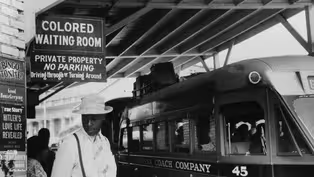
Video has Closed Captions
Clip: S48 Ep39 | 4m 30s | Driving While Black | Episode 4839/Segment 3 (4m 30s)
Video has Closed Captions
Clip: S48 Ep39 | 9m 50s | Policing | Episode 4839/Segment 1 (9m 50s)
Providing Support for PBS.org
Learn Moreabout PBS online sponsorship New Episode
- News and Public Affairs

Top journalists deliver compelling original analysis of the hour's headlines.
 New Episode
- News and Public Affairs

Today's top journalists discuss Washington's current political events and public affairs.
 New Episode
 New Episode
 New Episode
 New Episode
 New Episode


 New Episode
 New Episode

Support for PBS provided by:
American Black Journal is a local public television program presented by Detroit PBS